

Coffee Bag Valve: What It Does and What It Doesn't

The small round button on a bag of coffee is a one-way valve. It lets carbon dioxide (CO₂) escape from the bag and keeps outside air from getting back in. It exists because freshly roasted beans give off gas for days and weeks. What it can’t do is keep coffee fresh on its own, and that matters more to your cup than the valve does. Roast date, the bag’s barrier film and how you close the bag after each use decide how the beans taste. We roast every Adira order only after it is placed, so you open a bag close to the day it was roasted.
TL;DR
- The valve is a one-way vent: gas flows out, outside air can’t flow back in, so the bag doesn’t balloon as the beans release CO₂.
- Whole beans release gas slowly over weeks, which is why whole-bean bags are the ones you see with valves.
- A valve is not a freshness guarantee. The film of the bag, the roast date and your storage habits do the rest.
- After opening, press the air out, fold the bag tight and use the beans within roughly 10 to 12 days for the best flavor.
- Buy by roast date, not by the presence of a valve.
In this guide
- What the valve on a coffee bag is for
- How a one-way degassing valve works
- Why coffee degasses, and how fast
- Do all coffee bags need a valve?
- What a valve can and can’t tell you about freshness
- Does the valve keep coffee fresh after you open the bag?
- How to store opened coffee beans
- Valve or no valve: what matters to the cup
- Shipping matters too
- Fresh coffee that arrives close to roast day
- Our view on valves and freshness
- FAQ
- Sources
What the valve on a coffee bag is for
Roasting leaves coffee holding a lot of CO₂. University of Guelph researcher Jessey Cowell’s 2018 thesis on degassing valves explains that roasted beans retain gas after roasting, some of it escapes when the beans are ground, and the rest is released gradually during storage.
Now picture that coffee sealed in a bag. Without an exit, the gas builds up and the bag swells. Seal a bag with no valve too soon after roasting and you get a puffed pillow that can split a seam or push the zipper open. You could also solve it the other way: leave the coffee open to air out before bagging. But then oxygen and moisture start working on the beans before they ever reach you.
The valve solves both problems at once. Gas leaves, air stays out.
How a one-way degassing valve works
The valve is a tiny piece of plastic, usually a small disc with a flexible membrane and a thin film of sealing liquid or a soft diaphragm. You don’t need the engineering, only the principle. According to the Guelph thesis, a valve opens at a designed pressure difference between the inside of the bag and the outside air, vents the headspace gas (the pocket of air and gas above the beans), then reseals as the pressure falls.
A few practical consequences follow:
- It opens only when the inside pressure is higher. Pushing air in from the outside only presses the valve shut.
- It reseals on its own. There is nothing for you to do or adjust.
- It works between two pressure thresholds. Gas leaves between the opening and closing pressures, so a bag can hold a small amount of pressure and still be sealed.
- It is slow. A valve is built to let gas out gently, not to let you push air in and out of the bag.
That is why squeezing a fresh bag makes a puff of coffee-smelling air come out of the valve. You are pushing gas through a vent designed to let it escape.
Why coffee degasses, and how fast
Degassing is simply the release of the CO₂ trapped in roasted beans. It is fastest at the start. One packaging-industry analysis puts it at around 40% of all absorbed CO₂ in the first 24 hours, with the pace slowing after that. Whole beans degas slowly because their surface area is small relative to their volume. Ground coffee loses gas much faster, since grinding exposes far more surface.
Roast level plays a part too. The packaging engineers behind one valve guide note that darker, more porous roasts tend to release CO₂ faster and more heavily soon after roasting, while lighter, denser roasts degas more slowly over a longer window. The Guelph thesis likewise finds that roast time and temperature affect porosity and degassing.
For you at home, that has two practical meanings:
- Very fresh coffee can taste a little uneven or sharp, and in espresso it can produce a lot of foam-like crema that disappears quickly, because gas is still leaving the beans. That is why many people wait a few days before brewing. Our guide to resting coffee beans explains how long to wait for each brew method.
- Gas is not a sign of a problem. A bag that is still puffing is a bag of fresh coffee.
Do all coffee bags need a valve?
No. A valve matters when coffee goes into the bag while it still has a lot of gas to release. Packaging suppliers generally describe it this way:
| Situation | Valve usually needed? |
|---|---|
| Whole beans sealed within 24 to 72 hours of roasting | Yes, for most small and moderate bags |
| Standard 8 to 12 oz retail bags | Likely to benefit |
| Bulk and wholesale bags | Yes, often with higher-flow valves |
| Coffee rested around 7 to 14 days before bagging | Often not necessary |
| Single-serve sachets and nitrogen-flushed cans | Often not necessary |
So a bag with no valve is not automatically stale, and a bag with a valve is not automatically fresh. It tells you how the roaster chose to package the coffee, not when or how well it was roasted.
What a valve can and can’t tell you about freshness
A valve is the packaging’s way of managing gas. It says nothing about the roast date, the quality of the beans or how long the bag sat on a shelf.
Packaging specialists make the same point: a valve handles CO₂, but it cannot replace the barrier film that keeps moisture and oxygen from seeping through the bag walls, and it is not a freshness guarantee. A bag with a perfect valve and thin, leaky film can still let coffee go flat. A bag with strong, opaque film and a valve does far better.
A better freshness test, in order of usefulness:
- The roast date. A printed roast date beats any other signal. Our piece on why roast date matters for peak coffee flavor goes through how to read it, and how to identify fresh coffee at home covers the rest.
- A “best by” date months away. That date tells you when the roaster stopped caring, not when the coffee peaked. Beans don’t spoil on a date; they peak and then fade.
- The bag itself. Opaque, sturdy and sealed, with a valve if it holds whole beans.
The oils on the beans are a related question people ask. Oil moves to the surface as beans age and in darker roasts, so a shiny bean tells you about roast level and time, not about the valve. It does matter for your gear: America’s Test Kitchen notes that separate storage canisters need regular cleaning to remove accumulated coffee oils, especially for dark-roast drinkers.
Does the valve keep coffee fresh after you open the bag?
Partly, and only if you close the bag. America’s Test Kitchen reports that once a bag is opened and resealed, the valve helps limit how much outside oxygen creeps in, but it is not a substitute for closing the package. Leave the top open and the valve is irrelevant, because air enters through the opening.
How long do opened beans last? In its storage guide, America’s Test Kitchen says its tasters generally noticed a substantial loss of freshness in opened beans after 10 to 12 days, and recommends airtight storage and using the beans within that period. Plan your purchases around that window, not around the bag’s best-by date.
How to store opened coffee beans
America’s Test Kitchen’s advice is simple: keep whole beans in a cool, dry place, fold the original bag tightly after each use, and grind just before brewing. Here is how to turn that into a routine.
- Scoop and close right away. Take out what you need for the brew, push out extra air gently, roll or fold the top down tightly and clip it. If the bag has a zipper, use it.
- Pick a cool, dark spot. A cupboard away from the stove, kettle and a sunny window. Heat and light are the enemies.
- Use the original bag or a zipper-lock bag if you will finish the coffee within 10 to 12 days. If you move beans to a canister, wash and dry it fully between bags so old oils don’t touch fresh coffee.
- Buy whole beans and grind at the last minute. Ground coffee gives up gas and aroma far faster. Our case for buying whole bean coffee lays out the flavor difference.
- Buy the amount you will drink. For one or two people, a 12 oz bag lasts about as long as the freshness window. A household going through more can take a 1 lb or 2 lb bag and split it, keeping the part you aren’t using sealed.
- Freeze only if you must. If you have a big bag and a slow week, portion it and freeze the beans in airtight containers.
For more habits worth building, see our coffee storage tips and the walkthrough on storing coffee beans for maximum freshness.
Valve or no valve: what matters to the cup
Here is what you can do with all that, whether you brew on a Breville, a Moccamaster, a V60 or a French press.
- Look for a roast date first. If a bag has a valve and no date, you know only that the coffee gives off gas.
- Match your brew method to the beans’ age. Espresso, with its pressure and fine grind, is the most sensitive to very fresh, gassy beans. Drip and pour-over are more forgiving. Fresh beans in a French press or AeroPress are usually fine within a few days.
- Don’t squeeze the bag to “smell test” daily. You’re pushing the gas out, which is fine, but you’re also opening the bag more often. Open it only to take beans out.
- Keep the bag shut and upright. Valve down on a counter can let a bit of debris near the vent, and a clip at the top does the real work.
Shipping matters too
A well-built valve bag has to survive the trip to your door. Crushed bags, torn film and flattened pouches let air in long before you open them, so how a roaster ships is part of freshness. If you’re curious how shippers cut damage in transit, this look at protective packaging and shipping damage covers the logistics side.
Fresh coffee that arrives close to roast day
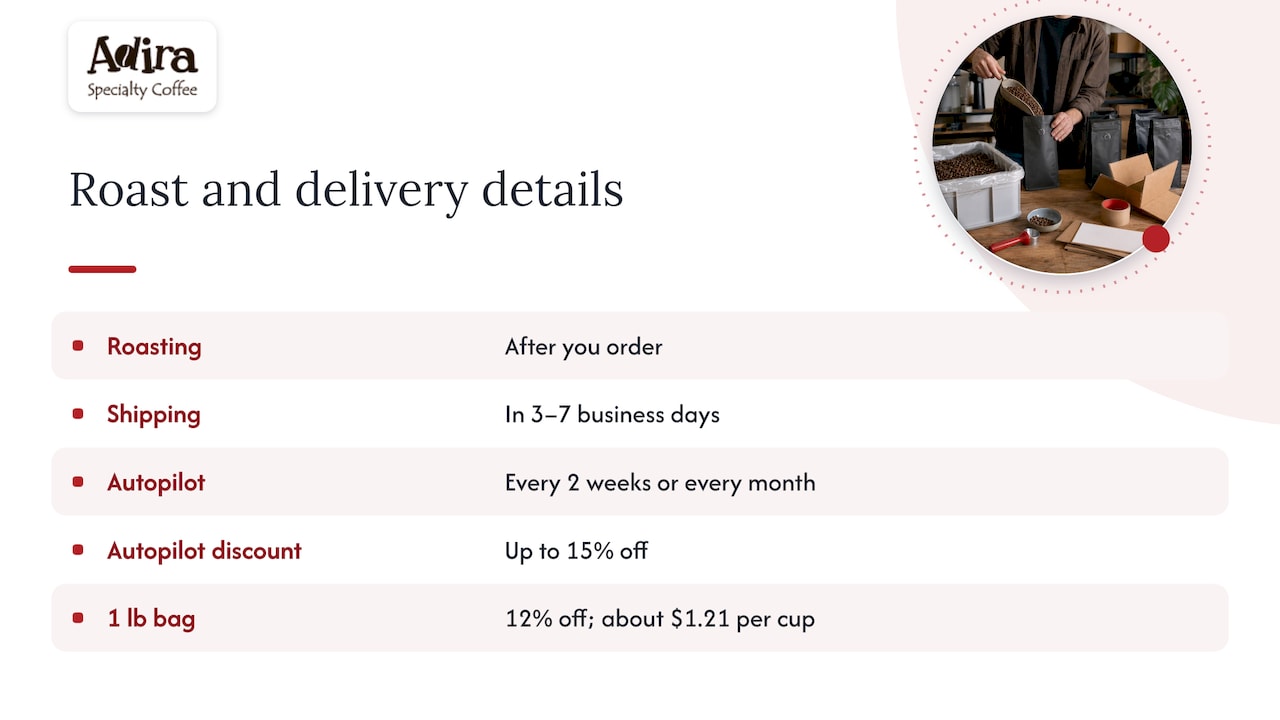
With us, the valve question is simpler, because freshness starts earlier. Adira coffee is roasted after you order and ships in 3 to 7 business days, so you open a bag in its first weeks, when the beans are at their best. Every coffee comes whole bean or ground for your brewer, with a starting recipe for the machine you already own, whether that’s an espresso machine, a drip brewer, a V60 or a moka pot.
If you want the beans to just show up, Autopilot delivers every 2 weeks or every month with up to 15% off, and the 1 lb bag is 12% off (about $1.21 a cup). Every Autopilot delivery ships free, and you can skip, pause or cancel anytime. Your first bag ships free with the code FIRSTBAG, and orders over $35 always ship free. Browse the coffee blends or the single origins from Colombia, Ethiopia, Costa Rica, Mexico and Sumatra.
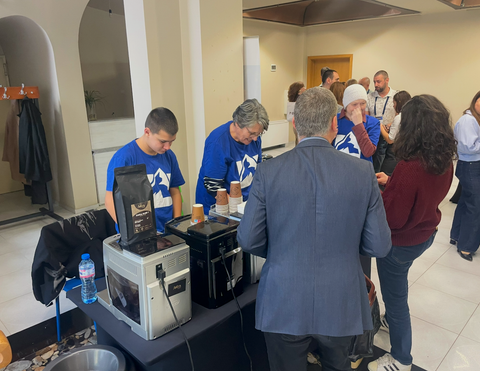
Every bag also sends $1 to young leaders in Bulgaria: free coffee at their gatherings, practical teaching about business and money, and time spent alongside the next generation.
Our view on valves and freshness
We are asked about the valve more than almost anything else on a coffee bag, and the honest answer is that it’s a small part of a bigger idea.
The valve exists because fresh coffee breathes out gas. The way we think about it, the best thing you can do for your cup is to shorten the time between the roaster and the grinder. That’s why we roast only after an order is placed and ship within days.
Then the work is yours, and it’s easy: keep the bag closed, keep it cool and dark, grind when you brew, and use the bag in a couple of weeks. We would rather you finish a bag while it tastes great than stretch it for months.
That is also why we send a starting recipe for the machine you own. Fresh beans deserve a good brew, and a recipe tuned to your Breville, Moccamaster or V60 lets you taste what the roast was meant to be.
Stefan
FAQ
Are coffee bag valves really one-way?
Yes. Gas from inside the bag pushes the valve open and leaves, then the valve reseals as pressure drops, so outside air can’t flow back in. Pushing on the outside only presses it closed.
Is coffee in a bag without a valve bad?
Not necessarily. Coffee that has been rested for a week or two before bagging, single-serve sachets and nitrogen-flushed cans often don’t need a valve. Check the roast date instead.
Should I squeeze the air out of a coffee bag?
A gentle press to push out extra air before you fold the top down is fine. The valve will let gas out, and a tight fold or zipper does the sealing. Don’t squeeze a fresh bag hard or repeatedly.
How long do beans stay fresh after I open the bag?
America’s Test Kitchen’s tasters noticed substantial freshness loss after 10 to 12 days in opened beans. Store them airtight, away from heat and light, and grind just before brewing.
Why are my beans oily?
Oil rises to the surface of beans over time and is more visible on darker roasts. It’s normal, but oils build up on canisters and grinders, so clean them regularly.
Sources
- What Is That Valve on My Coffee Bean Bag? (America’s Test Kitchen)
- Tips for Buying and Storing Coffee (America’s Test Kitchen)
- One-way Degassing Valve Behavior and Function (University of Guelph thesis, 2018)
- How Long Does It Take Coffee To Degas?
- Why Do Coffee Bags Have Vents? All About Degassing Valves
- Pick a Coffee Bag Valve for 24 to 72 Hour Degassing
- Roaster’s Packaging Guide: Coffee Degassing Valves
- Why Do Coffee Bags Have Vents, and Do You Need One?
- 30 to 90 Day Packaging Damage Fix for E-commerce Operations
Recommended
Brew it with the right coffee
The bag this guide was written around. Roasted after you order, shipped from California.
More to try
All coffee Dark roastLightDark
Adira Blend
Dark chocolate, Caramel, Roasted nuts
Invests in young leaders in Bulgaria
$24.99
 Medium-light roastLightDark
Love Blend
Milk chocolate, Caramel, Floral lift
Invests in young leaders in Bulgaria
$24.99
 Medium-dark roastLightDark
Ocean Blend
Cocoa, Soft caramel, Clean vanilla finish
Invests in young leaders in Bulgaria
$24.99
Never run out.
Never pay shipping.
Any Adira coffee with Monthly Sender: up to 15% off every delivery, free shipping every time, skip, pause or cancel whenever you like.
Set up Monthly Sender