
TL;DR:
- Proper coffee storage involves controlling air, moisture, heat, and light to maintain freshness. Using airtight, opaque containers like displacement or vacuum canisters extends coffee’s flavor, especially within the first two weeks. Buying only as much coffee as can be consumed within 10 to 14 days maximizes quality and prevents flavor loss.
Proper coffee storage is defined as controlling four environmental factors: air, moisture, heat, and light. Get all four right and your beans stay at peak flavor for weeks. Get even one wrong and you’ll taste the difference in your first sip. Whether you buy whole bean coffee or pre-ground, the same core principle applies: minimize exposure, maximize freshness. These coffee storage tips cover everything from choosing the right container to the one freezer mistake that ruins an entire bag.
1. What are the best container types for storing coffee?
The best container for coffee storage is opaque, airtight, and as small as possible relative to your coffee volume. Less empty space inside the container means less oxygen sitting against your beans. Reducing oxygen inside a coffee container from 21% to 0.5% can increase shelf life up to 20 times. That single fact explains why container choice matters more than almost any other storage decision.
Three container types dominate the market for home coffee storage. Displacement canisters like the Airscape push air out through a plunger lid before sealing. Vacuum canisters like the Fellow Atmos use a twist mechanism to actively pump oxygen out. Standard glass jars with rubber gaskets reduce air exchange but do not actively remove oxygen. Displacement and vacuum options outperform glass jars by a wide margin.
Opaque containers with CO2 one-way valves extend freshness further by allowing freshly roasted beans to off-gas carbon dioxide without letting oxygen back in. This matters most in the first week after roasting, when beans release the most CO2. Clear glass jars on a sunny countertop are the worst option. Light and oxygen work together to break down aromatic compounds fast.
| Container type | Oxygen control | Best use case |
|---|---|---|
| Airscape canister | High (displacement) | Daily use, 1–2 week supply |
| Fellow Atmos | Very high (vacuum pump) | Longer storage, 2–4 weeks |
| One-way valve bag | Moderate | Short-term, original packaging |
| Glass jar with gasket | Low | Not recommended for daily use |
| Clear glass jar | None | Avoid entirely |
Pro Tip: If you freeze coffee in its original roaster bag, tape over the one-way valve before placing it in the freezer. The valve can fail at low temperatures and let air seep in, which defeats the purpose of freezing entirely.
2. How to store whole bean coffee for maximum freshness
Whole beans last significantly longer than ground coffee when stored correctly. Freshly roasted beans maintain optimal quality for about 90 days unopened, but that window drops to just 10–14 days after you open the bag. That short post-opening window is the most important number in any coffee storage guide.
The best practices for whole bean storage come down to five habits:
- Keep beans in their original vacuum-sealed bag if the bag is unopened and has a one-way valve.
- Transfer beans to an airtight opaque canister immediately after opening.
- Store the canister in a cool, dark pantry or cupboard, away from the stove, oven, and dishwasher.
- Maintain an ambient temperature between 50–70°F (10–21°C) for best results.
- Keep the container away from windows and any direct light source.
The kitchen is full of heat traps. Ovens radiate heat even when off. Dishwashers vent steam that raises ambient temperature and humidity. A cabinet above the refrigerator seems convenient but is one of the warmest spots in most kitchens. A lower cabinet or pantry shelf away from appliances is the right location.
Whole beans also benefit from being bought in quantities you can finish quickly. Buying a 12-ounce bag you will finish in two weeks beats buying a 2-pound bag that sits open for two months. Freshness is not just about storage. It starts with buying the right amount at the right time.
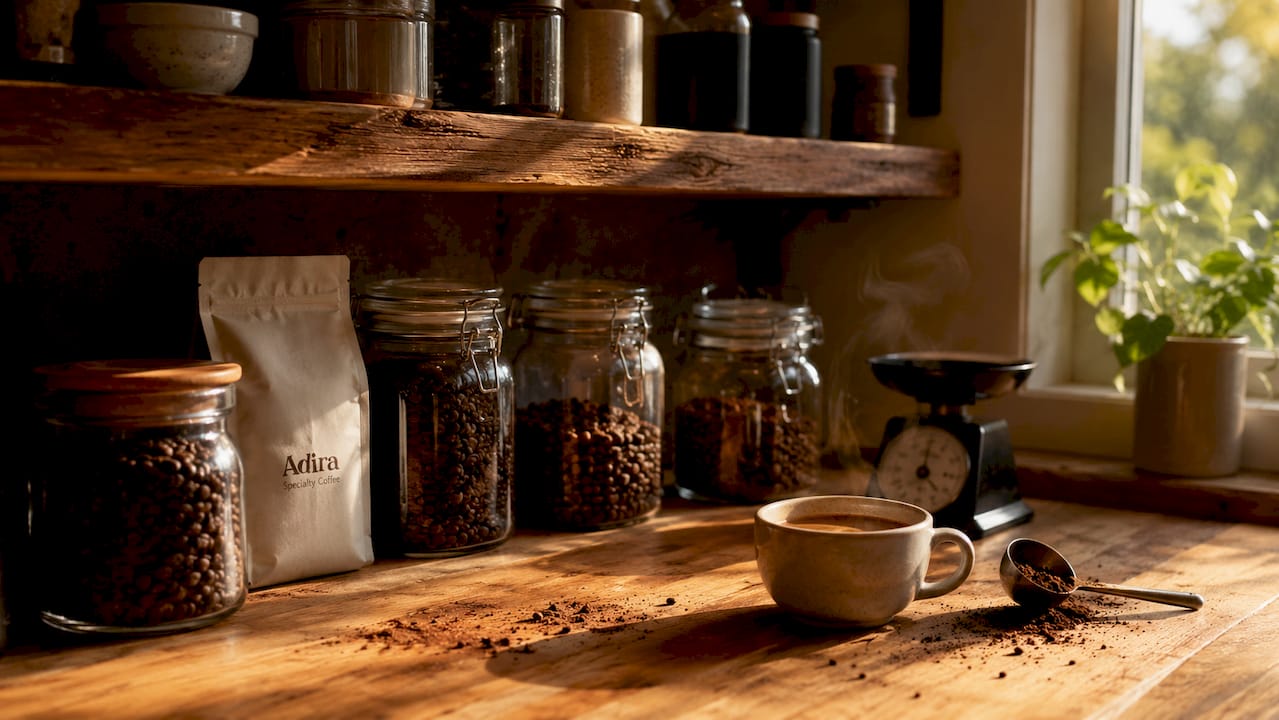
Pro Tip: Buy beans in amounts you can consume within 2–3 weeks after opening. No container, no matter how good, can fully compensate for beans that have been sitting open for a month.
3. Best practices for storing ground coffee
Ground coffee is far more vulnerable than whole beans. Volatile aromatic compounds escape within 15–30 minutes of grinding. That means pre-ground coffee is already losing flavor before you even get it home from the store.
The best approach is to grind just before brewing. A burr grinder like the Baratza Encore or the Timemore C2 produces consistent grounds and takes under a minute. The flavor difference between freshly ground and pre-ground coffee stored for three days is noticeable to most drinkers.
If you use pre-ground coffee, follow these rules:
- Store it in a small, airtight, opaque container. Smaller containers leave less air space.
- Keep the container in a cool, dark, dry location, just like whole beans.
- Use pre-ground coffee within 5–7 days for the best flavor.
- Never leave the bag open between uses. Reseal it tightly every single time.
- Avoid scooping from a large bag repeatedly. Each opening lets in fresh oxygen.
Portioning is the most underused tactic for ground coffee storage. Divide a fresh bag into several small airtight containers right after opening. Each container stays sealed until you need it. You expose only one portion to air at a time, and the rest stays protected. This single habit extends usable freshness noticeably.
4. Is freezing coffee a good storage method?
Freezing coffee works well for long-term storage when done correctly. Done wrong, it ruins the coffee faster than leaving it on the counter. The difference comes down to two things: how you package the coffee before freezing, and how you thaw it before use.
Follow these steps for safe coffee freezing:
- Divide your coffee into single-dose portions before freezing. Use small, airtight, vacuum-sealed bags or containers for each portion.
- Tape over any one-way valves on roaster bags before placing them in the freezer. Valves can fail at freezer temperatures and allow air to enter.
- Label each portion with the date so you use older stock first.
- Place portions in the back of the freezer where temperature is most stable.
- When you are ready to use a portion, move it to the counter and allow it to thaw fully to room temperature before opening the bag.
- Never open a bag while the coffee is still cold or frozen. Condensation forms immediately on cold beans when they hit warm air. That moisture damages the coffee fast.
Repeated freezing and thawing causes condensation cycles that accelerate staling. Each freeze-thaw cycle pulls moisture into the bean structure. Freeze once, use once. That is the rule.
Freezing is the right call for rare or expensive single-origin coffees you want to preserve, or for large quantities you cannot consume within a month. For daily drinkers finishing a bag in two to three weeks, a good airtight canister at room temperature is all you need.
5. Common coffee storage mistakes that ruin flavor
Most coffee goes stale not because of bad beans but because of avoidable storage errors. The mistakes below are the most common ones, and each one has a straightforward fix.
- Storing coffee in the refrigerator. Refrigeration causes moisture buildup and off-flavor absorption from other foods. Coffee absorbs odors readily. A bag stored next to leftovers will taste like them.
- Using clear glass jars on the counter. Light degrades aromatic compounds quickly. A clear jar on a sunny windowsill is one of the fastest ways to flatten a good coffee’s flavor.
- Leaving the bag open between uses. Every minute the bag sits open, oxygen is doing damage. Reseal immediately after every scoop.
- Grinding coffee hours or days in advance. Pre-grinding destroys the freshness advantage of whole beans entirely. Grind right before brewing.
- Storing coffee near heat sources. Countertop spots near the stove, oven, or toaster expose beans to repeated temperature spikes. Even indirect heat accelerates staling.
- Buying too much at once. A 5-pound bag sounds economical. But if it takes two months to finish, the last third will taste flat regardless of how well you store it.
One mistake that surprises most coffee drinkers: the freezer door. Temperature fluctuates every time the door opens. Beans stored in the door compartment experience more temperature cycling than beans stored in the back. Always store frozen coffee in the back of the freezer.
Key takeaways
Proper coffee storage requires airtight, opaque containers stored in a cool, dark place, with whole beans consumed within 10–14 days of opening for peak flavor.
| Point | Details |
|---|---|
| Container choice matters most | Use opaque, airtight canisters like Airscape or Fellow Atmos to minimize oxygen exposure. |
| Whole beans have a short window | Peak freshness lasts just 10–14 days after opening, so buy only what you can use quickly. |
| Ground coffee degrades fast | Aromatic compounds escape within 15–30 minutes of grinding; grind just before brewing. |
| Freeze correctly or not at all | Portion into single-dose bags, tape valves, and thaw fully before opening to avoid condensation. |
| Refrigeration is a mistake | Coffee absorbs moisture and food odors from the fridge; use a pantry or cupboard instead. |
What I’ve learned from storing coffee the wrong way first
I spent the first two years of my coffee life storing beans in a clear glass jar on the kitchen counter, right next to the stove. The coffee always tasted a little flat by day five, and I blamed the roast. It was not the roast. It was me.
The shift that changed everything was switching to a proper displacement canister and moving my beans into a lower cabinet. The same coffee I had been drinking tasted noticeably brighter and more complex. That experience taught me that storage is not a minor detail. It is the last mile of the roaster’s work, and you either protect it or waste it.
The one thing most articles skip is the psychology of convenience. People leave bags open because resealing takes five seconds they do not want to spend. They store coffee on the counter because it looks nice. They buy large bags because it feels economical. Every one of those habits costs flavor. The fix is not discipline. It is setting up your storage so the right choice is the easy choice. A good canister on a pantry shelf is just as convenient as a jar on the counter, and it does a far better job.
My honest advice: invest once in a quality airtight canister, buy beans in two-week quantities, and grind fresh every morning. Those three habits will do more for your daily cup than any brewing technique upgrade.
— Stefan
Fresh coffee starts before you brew it
Every storage habit you build protects the work that went into sourcing and roasting your beans. At Adiracoffee, every bag is roasted to order in small batches in California and shipped within days of roasting, so the beans arrive at peak freshness.

From the Love Blend to single-origin coffees from Ethiopia, Colombia, and Costa Rica, each coffee is built to reward good storage habits. Beans this fresh deserve an airtight canister and a cool, dark shelf. Pair that with a subscription for 10% savings and free US shipping over $35, and you get great coffee arriving on your schedule, always fresh, never sitting in a warehouse. Browse the full single-origin collection and find the coffee worth storing right.
FAQ
How long do coffee beans stay fresh after opening?
Freshly roasted beans stay at peak quality for 10–14 days after opening. Store them in an airtight, opaque canister to get the most out of that window.
Can you store coffee in the refrigerator?
No. Refrigeration introduces moisture and causes coffee to absorb odors from other foods. Use a cool, dark pantry instead.
What is the best container for storing coffee beans?
Opaque, airtight canisters with displacement or vacuum mechanisms, like the Airscape or Fellow Atmos, are the best options. They actively reduce oxygen exposure, which is the primary driver of staling.
Is it safe to freeze coffee beans?
Freezing works well for long-term storage when beans are portioned into single-dose airtight bags and thawed fully to room temperature before opening. Never open a frozen bag while the beans are still cold.
How quickly should you use ground coffee?
Use ground coffee within 5–7 days for the best flavor. For the freshest cup, grind whole beans immediately before brewing rather than storing ground coffee at all.