
TL;DR:
- Proper storage and timing are crucial to maintaining coffee freshness and flavor.
- Use airtight, opaque containers and avoid light, heat, and moisture for optimal preservation.
- Buy and grind beans fresh, within the peak flavor window of 5 to 14 days after roasting.
Most home brewers spend real money on specialty coffee and then quietly destroy its flavor within days, not because they brew badly, but because they store beans wrong. A bag of beautifully roasted single-origin coffee from Colombia or Ethiopia holds incredible potential, but oxygen, heat, light, and moisture work against it from the moment the bag is opened. The good news is that preserving peak flavor doesn’t require expensive gadgets or complicated rituals. A handful of consistent habits, applied every time you reach for the bag, will protect every cup you brew.
Table of Contents
- Understand why coffee stales and what causes it
- Best storage methods: Air, light, and temperature control
- Timing is everything: Roast date, peak window, and grinding fresh
- When and how to freeze coffee for longevity
- The truth about coffee freshness: It’s all about simple discipline
- Ready for the freshest cup? Explore our specialty selections
- Frequently asked questions
Key Takeaways
| Point | Details |
|---|---|
| Air, light, and heat degrade flavor | Most coffee stales because air, heat, light, and moisture break down its natural flavors. |
| Short window for best taste | After opening, use whole beans within about 10–12 days for peak results. |
| Airtight, dark storage is key | Store beans in opaque, airtight containers at room temperature for the best preservation. |
| Freeze only for long-term | Freezing works if you portion beans and avoid repeated thawing, but is unnecessary for quick use. |
| Grind only before brewing | Freshly ground beans yield the richest flavor, so wait to grind until just before you brew. |
Understand why coffee stales and what causes it
Before you can protect your beans, you need to know exactly what you’re protecting them from. Coffee stales through a set of very predictable chemical reactions, and all of them are avoidable once you understand why freshness matters so much to specialty coffee flavor.
The four main enemies of fresh coffee are:
- Oxygen: The biggest offender by far. Once roasted beans are exposed to air, oxidation begins immediately and strips away the aromatic compounds that make your cup bright, sweet, and complex.
- Heat: Warmth speeds up every chemical reaction that degrades flavor. Storing coffee near a stove, oven, or even a sunny window dramatically shortens its peak window.
- Light: UV rays break down the delicate oils in roasted beans. Clear glass jars look beautiful on a counter, but they actively harm your coffee.
- Moisture: Water vapor triggers the breakdown of bean structure and promotes mold growth. Even slightly humid environments can ruin a bag within days.
Specialty coffee freshness is mainly about slowing staling driven by air and oxygen exposure, with heat, light, and moisture also playing significant roles. For specialty beans specifically, this matters more than it does for commodity coffee. When you pay a premium for a natural-processed Ethiopian Yirgacheffe or a washed Guatemala Antigua, you’re paying for distinct flavor notes: stone fruit, jasmine, dark chocolate, citrus. Those are exactly the flavors that disappear first when storage is neglected.
“The enemies of coffee freshness are oxygen, light, heat, and moisture. The goal of good storage is to minimize contact with all four.” — The Kitchn
Here’s the part that surprises most people: the container matters far less than the method. An expensive ceramic canister used carelessly, left open too long, filled to the brim with two-week-old beans, will produce worse results than a simple resealable bag used correctly. The real work of freshness preservation is behavioral. It’s about how often you open the container, how much air you let in, and how quickly you move through your beans.
Specialty coffee is also far more sensitive to staling than pre-ground supermarket blends. Those blends are often roasted weeks or months before purchase, so the flavor has already settled into a flat, consistent baseline. Specialty coffee, by contrast, is vibrant and dynamic right after roasting. That’s exactly why it can drop so noticeably when exposed to poor storage conditions for even a short period.
Best storage methods: Air, light, and temperature control
Knowing what hurts coffee’s freshness, here’s how you can put protective measures in place every day.
Follow these steps to set up a reliable storage system at home:
- Choose an opaque, airtight container. Dark-colored ceramic, stainless steel, or matte plastic containers block light and seal out air. If you can see your beans through the container, light is getting in. Make the swap.
- Minimize headspace. The more air inside the container above your beans, the faster oxidation occurs. As you use beans throughout the week, consider transferring them to a smaller container so the headspace shrinks with the quantity.
- Stick with the original bag if it has a one-way valve. Quality specialty coffee bags, including the ones we use at Adira Coffee, are designed with a one-way degassing valve. This valve lets CO2 out after roasting without letting oxygen in. If your bag has one, press the air out, fold the top tightly, and clip it closed. It works well for a week or two.
- Find the right spot in your kitchen. A pantry shelf, a cabinet away from the stove, or a dark corner of your counter works well. Avoid spots above the refrigerator (warm), near the oven (very warm), or on a windowsill (light exposure).
- Never store coffee in the fridge. This is the mistake we see most often. Keep beans airtight, cool, dark, and dry at room temperature. The fridge creates condensation every time the bag warms back up, and that moisture destroys flavor fast.
Good guidance on storing coffee beans consistently points to the same priorities: seal it tight, keep it dark, and hold it at a stable room temperature. What’s less discussed is the importance of a repeatable freshness workflow that you actually stick to each morning. Consistency is what separates good storage intentions from real results in the cup.
Pro Tip: Every time you reseal the original packaging, press the bag firmly from the bottom up to push air out before you fold and clip. It takes three extra seconds and meaningfully extends your beans’ flavor life by reducing oxidation between uses.
Clear glass canisters deserve a specific callout here. They’re enormously popular as kitchen decor, and they look great. But from a coffee preservation standpoint, they’re among the worst options available. Every morning when light hits those beans, it degrades the aromatic oils that define your specialty coffee’s character. If you love the aesthetic, place the canister inside a cabinet when not in use.
Timing is everything: Roast date, peak window, and grinding fresh
Great storage helps, but timing is the often-missed ingredient for true coffee freshness.
The single biggest purchasing mistake home baristas make is ignoring the roast date. Most coffee bags display a “best by” or expiration date, which tells you almost nothing useful. A bag roasted eight months ago with a “best by” date two months out is already stale. What you want is the roast date itself, printed clearly on the bag, ideally within the last two to four weeks.
For peak flavor timing, always use the roast date rather than expiration dates. This is a discipline that specialty roasters like us take seriously. Every bag from Adira Coffee is stamped with the roast date so you know exactly where you stand. If a brand doesn’t print the roast date, that’s worth noting.
Here’s a quick reference for when your coffee is at its best:
| Stage | Timing from roast date | Flavor profile |
|---|---|---|
| Just roasted | Days 1 to 4 | CO2 still off-gassing; can taste flat or sour |
| Peak window | Days 5 to 14 | Bright, full, complex, and vibrant |
| Acceptable | Days 15 to 30 | Still good; some brightness starts to fade |
| Declining | Days 31 to 60 | Noticeably flat; fine for everyday use |
| Past prime | Beyond 60 days | Stale; much of the nuance is gone |
Once you open the bag, the clock accelerates. After opening, aim to use whole beans within about 10 to 12 days for peak flavor. Grind immediately before brewing, not the night before. This is where the whole bean coffee benefits become undeniable: whole beans have far less surface area exposed to air, so they stale much more slowly than pre-ground.
Key timing habits that make a real difference:
- Buy smaller quantities more often rather than one large bag every month. A 250g bag used within two weeks beats a 1kg bag used over two months every single time.
- Grind on demand, every single brew. Even 30 minutes between grinding and brewing allows some off-gassing and oxidation that slightly dulls flavor.
- Track your roast date. Take a photo of the bag when you open it. You’ll know exactly how old your beans are without guessing.
The ability to identify fresh coffee by roast date alone is one of the most practical skills a home barista can build. Pair that habit with solid coffee roasting tips knowledge and you’ll quickly outpace most home setups simply by buying smarter.
When and how to freeze coffee for longevity
Short-term storage usually suffices, but what if you want to stock up? Here’s how to freeze beans without sacrificing quality.
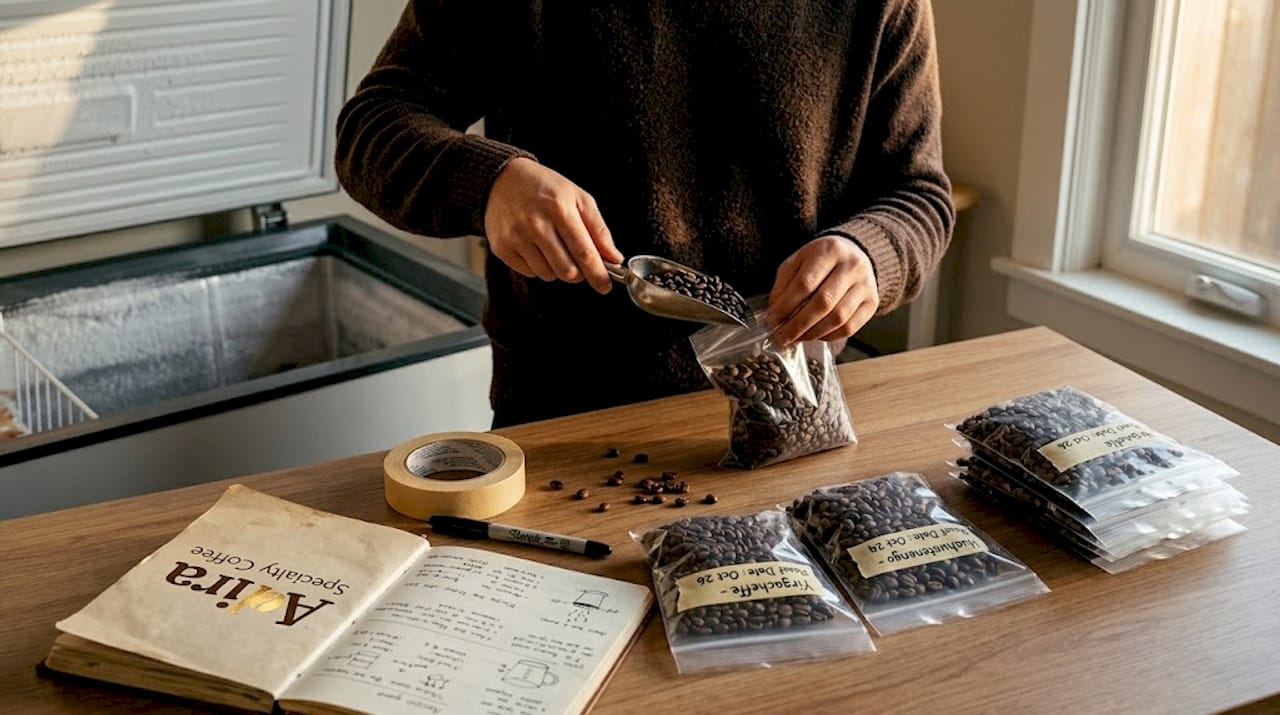
Freezing coffee is genuinely effective when done correctly, and genuinely damaging when done carelessly. The distinction matters, so let’s be specific about when it makes sense and how to execute it properly.
When to freeze:
Freezing is appropriate when you’ve purchased more coffee than you can realistically drink within 10 to 14 days. Maybe you found a great deal on a rare micro-lot. Maybe you ordered multiple bags to save on shipping. In those cases, freezing can be appropriate for longer storage, but only when done carefully with airtight, portioned packaging and no repeated thawing and refreezing.
When not to freeze:
If you’re buying a single 250g bag that you’ll use within two weeks, the freezer adds no benefit and introduces unnecessary risk. Room temperature storage in an airtight container is always the right call for short-term use.
| Scenario | Best storage method |
|---|---|
| Using beans within 2 weeks | Room temp, airtight, dark container |
| Stock of 2 to 4 bags | Freeze portions you won’t use this week |
| Single large bulk purchase | Freeze in individual serving portions |
| Daily drinker buying often | Room temp only; skip the freezer |
Here’s how to freeze coffee properly, step by step:
- Divide immediately. As soon as you receive your beans, portion them into single-week servings before freezing. Once you freeze a portion, don’t refreeze it.
- Use airtight, moisture-proof containers. Zip-lock freezer bags with the air pressed out work well. Vacuum-sealed bags work even better.
- Label each portion. Write the roast date and the freeze date on each bag. This keeps you honest about how long beans have been stored.
- Thaw at room temperature before opening. Divide into portions, use airtight moisture-proof packaging, thaw to room temperature before opening, and do not repeatedly thaw and refreeze. This step is critical. If you open a frozen bag while it’s still cold, warm air rushes in and condenses on the beans, introducing moisture that immediately begins degrading quality.
- Use within a week of thawing. Once thawed, treat your beans exactly as you would a freshly opened bag.
Pro Tip: Mark each frozen portion with a strip of masking tape noting the roast date and the week you intend to use it. Pull portions in rotation so nothing sits in the freezer past the six-month mark. Beyond that, even well-frozen beans start to lose their distinctiveness.
Exploring fresh coffee delivery options can also reduce how often you need to freeze at all. When freshly roasted beans arrive at your door on a regular schedule, you’re always working with coffee at its best without the need to stockpile.
The truth about coffee freshness: It’s all about simple discipline
Here’s something we’ve observed after working with dozens of farms and thousands of home baristas: the people who consistently brew outstanding coffee at home aren’t using the most expensive equipment or the fanciest storage systems. They’re the ones who’ve built repeatable habits around a few core behaviors.
The specialty coffee market is full of products promising to preserve freshness better than anything else. Nitrogen-flushed containers, argon gas canisters, vacuum pumps. Some of these tools do help at the margins. But the marketing noise around them distracts from a simple truth: airtightness, darkness, stable temperature, and fresh grinding account for the overwhelming majority of freshness outcomes. Nail those four things and you’re already doing better than most.
We’ve also seen incredibly mediocre beans taste surprisingly good when every step of storage and brewing was handled with care. And we’ve watched rare, exquisite micro-lots get ruined by a humid cabinet and a habit of grinding beans the night before. Brewing tips for better flavor always come back to the same foundation: start with fresh beans, keep them protected, and grind right before you brew.
The mindset shift that matters most is moving from treating coffee as a pantry staple to treating it as a perishable ingredient with a real, specific window of greatness. When you think of it that way, the habits follow naturally.
Ready for the freshest cup? Explore our specialty selections
Once you’ve dialed in your storage and timing habits, the next level is starting with beans that give you something worth protecting.
At Adira Coffee, every bag ships within days of roasting so you get maximum time inside that peak flavor window. Whether you’re drawn to the bright acidity of our Colombia coffee beans or the smooth, nuanced profile of our Costa Rica specialty beans, you’ll know exactly when the beans were roasted because we print it right on the bag. Browse the full Adira Coffee selection and find your next favorite single origin. Great storage habits deserve great beans to work with.
Frequently asked questions
How long will coffee beans stay fresh after opening?
Whole beans keep their best flavor for about 10 to 12 days in airtight, cool, dark conditions once opened. After that window, flavor begins a gradual but noticeable decline.
Can I store coffee beans in the fridge?
No. The fridge introduces condensation and accelerates flavor loss every time the bag warms back up. A cool, dark, dry pantry shelf is always the better option.
Does the original coffee bag work for storage?
Resealable bags with a one-way valve are effective for a week or two, as long as you press the air out and seal tightly after each use.
Is it safe to freeze coffee beans?
Yes, freezing works well when you divide into portions and use airtight, moisture-proof packaging. The key rule is to thaw at room temperature before opening and never refreeze a thawed portion.
Should I grind coffee in advance?
Grind only immediately before brewing. Tasters consistently preferred brewed coffee from freshly ground beans over beans ground just 24 hours earlier. The difference is real and worth the extra minute.