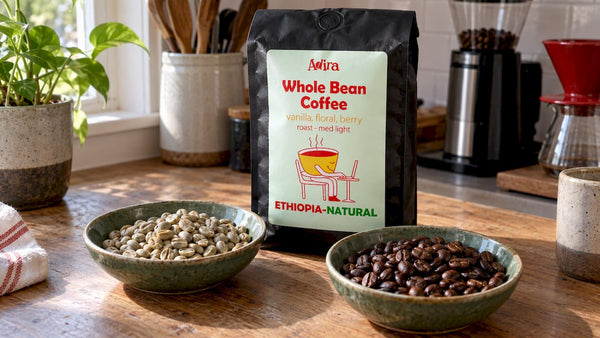


Resting Coffee Beans: How Long to Wait Before You Brew

Freshly roasted coffee is not at its best the moment it leaves the roaster. Most beans taste better after a short rest, usually somewhere between 2 and 7 days for drip and pour-over, and a little longer for espresso, so the carbon dioxide trapped inside can escape. The National Coffee Association puts the sweet spot at 2 to 7 days after roasting. We roast every Adira bag after you order it, so you never have to guess how old your coffee is or sit on a bag for weeks waiting for it to wake up.
TL;DR
- Resting (also called degassing) means letting roasted beans release the CO2 built up during roasting before you brew.
- For most home brewers, 2 to 7 days after roasting is the target for drip and pour-over. Espresso usually likes a few more days.
- Brew too early and you can get sour, flat or uneven cups and thin crema. Wait too long and you lose aroma.
- Rest beans in a sealed, opaque container at room temperature, away from light and heat, with the whole bean intact until you grind.
- Buy coffee that was roasted recently and shipped soon after, so the resting happens on your counter, not on a shelf for months.
In this guide
- What resting coffee actually means
- Why brewing too early goes wrong
- How long to rest coffee beans
- A simple resting plan for the week
- What happens after the rest: the 15-15-15 rule
- How to store coffee beans while they rest
- Is coffee roasted four months ago still good?
- Signs your coffee needs more rest, or is past its best
- Resting, grinding and your equipment
- Our perspective
- Fresh coffee that arrives ready to rest
- Frequently asked questions
- Sources
What resting coffee actually means
Roasting is a chemical process. As beans heat up, they form gases, mostly carbon dioxide, and the beans swell. According to a technical guide from the packaging company MTPak, roasting can increase bean volume by up to 80%, and most of that gas stays locked in the bean. It leaks out slowly while the coffee sits, and quickly when you grind and brew.
That is why a fresh bag often has a one-way valve: the gas pushes out, and air can’t get in. It is also why fresh coffee bubbles and puffs up so dramatically when hot water hits it.

Resting is simply the waiting period while most of that gas leaves. Nothing needs doing. You don’t open the bag, shake it or treat the beans. You store them well and give them time.
Why brewing too early goes wrong
CO2 and water don’t mix well. When you pour hot water over very fresh grounds, the gas pushing out gets in the way of the water. Three things can happen:
- Uneven extraction. Water can’t reach every particle evenly, so some parts of the coffee are under-extracted (sour, thin) while others are over-extracted (bitter, astringent).
- Unstable espresso. In an espresso machine, escaping gas can cause channeling, where water punches a path through the puck. Crema can look big at first and then collapse.
- Erratic filter flow. In a pour-over or drip brew, bubbling grounds can disrupt how evenly the water drains.
This is the reason pour-over recipes start with a bloom: you wet the grounds, wait 30 to 45 seconds and let a first burst of gas out before the main pour. Blooming helps, but it can’t fully make up for beans that are only a day or two off the roaster.
Some roasters describe very fresh coffee as “too fresh,” and Epicurious reports the same: coffee that hasn’t degassed yet can taste overly bitter. If a bag you just opened tastes harsh or oddly hollow, the beans’ age may be the reason, not your recipe.
How long to rest coffee beans
No single number is right for every coffee. Here are the ranges from published sources, translated into what they mean at home.
| Brew style | Typical window after roast date | Source |
|---|---|---|
| General guidance, any brew | Ready after about 2 to 3 days, best at 2 to 7 days | National Coffee Association |
| Filter (drip, pour-over) | Roughly 2 days to 4 weeks | Epicurious, quoting a roaster |
| Espresso | Roughly 1 week to 6 weeks | Epicurious, quoting a roaster |
| Cautious all-rounder | At least 7 days, used within 15 days | Tasting Table, quoting a coffee sommelier |
A pro brewer interviewed by Westchester Magazine recommends a full seven days after roasting, because excess CO2 gets in the way of water saturation.
The ranges overlap, and that is fine. If you want one rule to follow: brew drip and pour-over from about day 3 to day 7 onward, and give espresso about a week. After that, you are in the window where most home brewers will taste a balanced, sweet cup.
Roast level changes the wait
As a general pattern, lighter roasts are denser and hold their gas longer, so they usually need more time. Darker roasts are more porous, release gas faster and can be ready sooner. If you are not sure, a medium roast is forgiving at the one-week mark. Single origins, especially bright, fruit-forward ones, often reward an extra day or two.

Espresso needs more patience than filter
Espresso is the least forgiving method. It forces water through a compact puck of fine grounds at high pressure, so any gas that is still escaping shows up as uneven flow and unpredictable shots. That is why espresso windows run later than filter windows in the table above.
If you own a Breville Barista Express, Bambino or a De’Longhi Dedica, you may have noticed that a bag that pulled beautifully on day 9 behaves differently on day 3. That isn’t your grind setting going wrong. The coffee is changing under you. When you dial in a new bag, wait until at least the one-week mark before you start chasing grind and dose adjustments, or you will be adjusting for gas, not for flavor.
Super-automatics and pods
If you brew with a super-automatic such as a Magnifica or a Jura, the same rule applies: the machine grinds and extracts quickly, so very fresh beans can make a thin, foamy shot. Give those beans a week as well.
A simple resting plan for the week
Here is how this plays out for a bag you order and receive.
- Check the roast date, not the “best by.” The roast date tells you how old the beans really are. A coffee sommelier quoted by Tasting Table advises skipping bags that don’t show one.
- Count from roasting, not from arrival. Days in transit are part of the rest. With coffee that is roasted to order and shipped in 3 to 7 business days, some of the waiting happens before the box reaches you.
- Store the bag sealed. Keep it closed, out of sunlight and away from the stove.
- Brew filter from about day 3 onward, espresso from about day 7. If the first cup tastes sharp or hollow, wait another day or two and try again.
- Grind only what you need, right before brewing. Whole beans protect aroma; ground coffee loses it fast.
- Plan to finish the bag within a few weeks. Rest is the start of the window, not the entire window.
What happens after the rest: the 15-15-15 rule
You may have seen the 15-15-15 rule: green coffee should be roasted within 15 months of harvest, roasted coffee used within about 15 days, and ground coffee brewed within 15 minutes. It is a handy mnemonic, not an official standard, and it pairs well with resting. Rest for roughly the first week, then drink through the next one to two weeks.
The minutes-after-grinding part is the one that matters most. Oxygen reacts with the oils and aromatic compounds in coffee, and the more surface area is exposed, the faster that happens. Food Republic explains that this is why ground coffee is judged in minutes while whole beans last days. The coffee sommelier quoted by Tasting Table calls grinding just before brewing the most valuable piece of the rule.
You don’t need to panic on day 16, though. Coffee doesn’t fall off a cliff. Many specialty coffees, especially espresso blends and denser light roasts, hold up well past two weeks when stored properly. We would rather you think of it as a peak window of roughly 2 to 4 weeks from roasting, then a slow fade.
How to store coffee beans while they rest
During the rest, your goals are simple: limit air, light, heat and moisture. Michael Phillips of Blue Bottle Coffee, quoted in Epicurious, calls oxygen and light the two main enemies of freshness and recommends reducing air movement, avoiding temperature swings and keeping coffee out of sunlight.
In practice:
- Keep the bag it came in, or move beans to an opaque, airtight container. If the bag has a one-way valve and a zip, squeeze out extra air and reseal it.
- Store at room temperature in a cupboard. Not over the coffee maker, next to the oven or on a sunny counter.
- Skip the fridge. Food Republic notes that heat speeds the reactions that dull flavor, and beans pick up moisture and odors, which is why refrigeration is discouraged.
- Keep beans whole. You can read more about the reasons in our guide to why whole bean coffee tastes fresher and richer.
- Buy what you can finish. Smaller bags more often beat one giant bag that sits for two months.
For a deeper look at containers and counter habits, see our coffee storage tips and our piece on how to store coffee beans for maximum freshness. If you buy in bulk and want to stretch a bag, we also wrote about how to freeze coffee beans properly.
Is coffee roasted four months ago still good?
It is usually safe to drink, but it won’t taste like fresh coffee. Packaging matters a lot here. A conference paper from ZHAW in Switzerland found that whole beans in non-airtight packaging had a shelf life of under two months, while airtight-packed coffee showed no significant change in aroma ratios for almost a year. So a sealed bag can hold up far longer than an open one, but a bag from four months ago that has been opened and left on a shelf will likely taste flat and papery. Our own take on this is in why roast date matters for peak coffee flavor and how coffee beans peak rather than expire.
Signs your coffee needs more rest, or is past its best
Taste is the real test. Here is how to read your cup:
| What you notice | Likely cause | What to do |
|---|---|---|
| Sharp, sour, hollow cup from a new bag | Beans too fresh, still degassing | Wait 2 to 3 more days, then retry |
| Espresso gushes, spurts or channels | Gas disrupting the puck | Rest to about a week before changing grind |
| Huge bubbling bloom and slow drain | Very fresh beans | Extend the bloom a little, or wait a day or two |
| Dull, flat, papery cup | Beans past their peak, or exposed to air | Use up the bag and buy a smaller, fresher one |
| Little to no bloom at all | Coffee is old | Replace with recently roasted beans |
Change one thing at a time. If you change the grind, the dose and the beans all in one morning, you will not know which fixed it.
Resting, grinding and your equipment
Resting affects how you set up your gear. As beans degas, they extract differently, so the settings that worked on day 4 may need a small tweak by day 14. Expect to move your grinder slightly finer as a bag ages, because older coffee extracts a bit more easily or flows faster. If you want help with this, our guides on grinding coffee beans for better flavor and grinder tips for home baristas cover the basics.
The same logic applies to every brewer, from a Moccamaster or a Breville Precision Brewer to a V60, Chemex, AeroPress, French press or moka pot. Immersion methods like the French press tolerate fresher beans better because the coffee sits in water and the gas can leave on its own. Fast, pressure-based or pour-over methods show the unevenness more.
Our perspective
When Ekaterina and I started Adira, we couldn’t find a supermarket coffee worth a second cup. Much of the problem was age: bags that had sat for months before they got to us, with no way to tell.
That is why we roast after you order and ship within days. Every coffee should arrive in the window where it is ready to enjoy, and you shouldn’t need a spreadsheet to find it.
Our advice is simple. Pick a bag, give it a few days, brew it from whole beans and pay attention to the cup. Our single origins from Colombia, Ethiopia, Costa Rica, Mexico and Sumatra, and our blends like Adira Blend, each come with a starting recipe for the machine you already own, so you spend your week enjoying coffee, not troubleshooting it.
And since every bag sends $1 to young leaders in Bulgaria, the coffee you rest on your counter does a little good while it waits.
Stefan
Fresh coffee that arrives ready to rest
Resting only works if you start with beans that are actually fresh. At Adira, coffee is roasted after you order and ships in 3 to 7 business days. You can choose signature blends or single origins, whole bean or ground for your brewer, in 12 oz, 1 lb or 2 lb bags. Every coffee comes with a starting recipe for your machine.
If you drink coffee every morning, Autopilot delivery sends a bag every 2 weeks or every month, with up to 15% off, free shipping on every delivery, and the option to skip, pause or cancel anytime. The first bag ships free with the code FIRSTBAG, and orders over $35 always ship free.

Choosing a delivery rhythm that matches how fast you drink is the easiest way to keep each bag in its best window. A household that goes through a pound in a month may prefer monthly delivery, while heavier drinkers may prefer every 2 weeks.
Frequently asked questions
How long should you rest coffee beans?
For drip and pour-over, plan on about 3 to 7 days after roasting. For espresso, aim for about a week or a little more. The National Coffee Association gives 2 to 7 days as the ideal period to brew after roasting. Lighter, denser roasts usually benefit from the longer end of the range.
What does resting coffee mean?
It means letting freshly roasted beans sit so the carbon dioxide formed during roasting can escape. This is also called degassing. The gas can get in the way of even extraction if you brew too soon, so a short rest gives a smoother, sweeter cup.
What is the 15-15-15 rule for coffee?
It is a freshness guideline: roast green coffee within 15 months of harvest, use roasted beans within about 15 days, and brew ground coffee within 15 minutes of grinding. It is a rule of thumb, not an official standard, and plenty of well-stored specialty coffees taste great beyond 15 days. Use it alongside a resting period, not instead of one.
Is coffee roasted four months ago still good?
It is generally fine to drink, but flavor will be much duller than fresh coffee. Research from ZHAW found airtight packaging kept aroma stable for almost a year, while non-airtight whole beans lasted under two months. How the bag was stored matters as much as its age.
Sources
- Roasts, National Coffee Association About Coffee
- A guide to measuring the CO2 levels of roasted coffee, MTPak
- Storing Coffee Beans for the Freshest Tasting Brews, Epicurious
- How to Brew Perfect Coffee, Westchester Magazine
- The Rule of Fifteens, Tasting Table
- How To Make The Freshest Coffee With The 15-15-15 Rule, Food Republic
- Can we measure the freshness of roasted coffee? ZHAW
Recommended
Brew it with the right coffee
The bag this guide was written around. Roasted after you order, shipped from California.
More to try
All coffee Dark roastLightDark
Adira Blend
Dark chocolate, Caramel, Roasted nuts
Invests in young leaders in Bulgaria
$24.99
 Medium-light roastLightDark
Love Blend
Milk chocolate, Caramel, Floral lift
Invests in young leaders in Bulgaria
$24.99
 Medium-dark roastLightDark
Ocean Blend
Cocoa, Soft caramel, Clean vanilla finish
Invests in young leaders in Bulgaria
$24.99
Never run out.
Never pay shipping.
Any Adira coffee with Monthly Sender: up to 15% off every delivery, free shipping every time, skip, pause or cancel whenever you like.
Set up Monthly Sender