
Yes, you can and often should freeze coffee beans — with one non-negotiable condition: they must be portioned into single-use packages and sealed airtight before they ever touch the freezer. Toss a half-open bag in there and you’ll pull out stale, freezer-scented coffee a month later. Do it right, and beans roasted today can taste nearly as good three months from now.
The single most important step is portioning before freezing. Divide beans into weekly or per-session amounts, seal out every bit of air, and never refreeze a portion once it’s been thawed. Label each package with the roast origin and roast date so you’re never guessing what’s inside.
Quick reasons this works:
- Freezing dramatically slows the oxidation and degassing that strip aroma from roasted beans.
- Properly frozen beans hold flavor for months rather than the 1–3 weeks you get at room temperature, per the National Coffee Association (NCA).
- The biggest risk isn’t the freezer itself — it’s moisture and repeated temperature swings from opening the same bag repeatedly.
Pro Tip: Label every portion with the coffee’s name and roast date before it goes in the freezer. You’ll thank yourself when you’re pulling a bag out two months later.
Key Takeaways
Freezing coffee beans works when you portion first, seal airtight, and commit to single-use packages — done right, properly frozen beans can hold quality for up to 3–4 months versus 1–3 weeks at room temperature.
| Point | Details |
|---|---|
| Portion before freezing | Divide into single-use amounts before sealing; never refreeze a thawed portion. |
| Seal out all air | Vacuum-seal bags give the longest window; freezer-grade zipper bags work for 4–6 weeks. |
| Freeze at the right time | Wait 7–14 days post-roast for initial degassing to slow before sealing and freezing. |
| Storage window | Properly frozen beans retain freshness for roughly 3–4 months per NCA guidance. |
| Adiracoffee alternative | Fresh small-batch beans shipped within days of roasting; subscription delivery removes the need to freeze. |
Table of Contents
- When does freezing coffee beans actually help?
- How to freeze coffee beans: step-by-step
- Which containers work best for freezing?
- How long do frozen beans stay good, and how should you store them?
- Should you grind from frozen or thaw first?
- How roast level changes what freezing does for your coffee
- Common mistakes that undo the benefits of freezing
- What the research actually says about freezing beans
- A roaster’s perspective on freezing specialty beans
- Fresh beans delivered to your door, no freezer required
- Sources
When does freezing coffee beans actually help?
Freezing is not a universal upgrade. For beans you’ll finish within two to three weeks, an airtight container at room temperature is the better call — simpler, no condensation risk, and the coffee is at its peak anyway. Freezing earns its place when you’re dealing with medium-to-long-term storage: a bag you won’t open for a month, a limited-lot single origin you want to stretch, or a bulk purchase you can’t realistically drink fast.
Timing relative to the roast date matters more than most guides admit. Freshly roasted beans off-gas CO₂ aggressively for the first several days. Sealing them in a package during that window traps pressure and can compromise the seal. Most roasters and specialty coffee sources suggest waiting roughly 7–14 days after the roast date before freezing, letting the initial degassing slow before you lock the beans in. Check your roast date before you freeze — if the bag arrived yesterday, give it a week on the counter first.
Practical rules of thumb:
- Freeze now: Beans more than 10 days past roast that you won’t finish within 2–3 weeks; unopened bags of a limited or seasonal lot; bulk purchases beyond your monthly consumption.
- Leave at room temperature: Beans you’ll use within the next 2 weeks; anything still in heavy degassing (under 7 days post-roast); everyday blends you restock regularly.
The four enemies of coffee freshness are oxygen, heat, light, and moisture. The freezer neutralizes the first three — but only if you control the fourth.
How to freeze coffee beans: step-by-step
The procedure is straightforward. Where people go wrong is skipping the portioning step or using the wrong packaging.
Preparation
- Check the roast date. Wait until at least 7 days post-roast before freezing.
- Work with clean, dry hands and a dry surface. Moisture introduced at this stage causes frost inside the package.
- If you’re using the original roastery bag and it has a one-way degassing valve, tape over the valve with a piece of masking or packing tape. The valve that lets CO₂ out also lets air in once the bag is in the freezer. Food & Wine and specialty roasters consistently flag this step.
Portioning
- Weigh out single-use or weekly-use portions. For espresso drinkers, 15–20g per package is practical. For filter drinkers, a week’s worth (roughly 60–100g depending on your habit) works well.
- Use multiple small packages rather than one large bag. Every time you open a frozen package, you expose the rest to air and moisture.
Packaging and sealing
- Vacuum-seal bags are the gold standard. If you have a vacuum sealer, use it. If not, press out as much air as possible from a quality zipper freezer bag — not a standard sandwich bag.
- Nest the sealed packages inside a rigid airtight container (a glass jar or hard-sided food container). This adds an odor barrier and protects the bags from punctures. Perfect Daily Grind reports that professionals use vacuum sealing and single-dose portioning as standard practice for preserving quality over months.
Freezing
- Place packages at the back of the freezer, away from the door. Temperature near the door fluctuates every time it opens.
- Write the roast origin, roast date, and freeze date on each package.
Thawing and using
- Pull only the portion you need. Leave it sealed and let it reach room temperature before opening — typically 20–30 minutes on the counter. Opening a cold sealed bag immediately causes condensation to settle on the beans, which accelerates staling.
Which containers work best for freezing?
Not all packaging is equal, and the difference between a good container and a bad one shows up in the cup.
Vacuum-seal bags are the strongest option for long-term freezing. They remove nearly all oxygen, create a tight barrier against freezer odors, and keep beans stable for the full 3–4 month window. The trade-off is cost (a vacuum sealer runs $30–$100+) and single-use plastic waste unless you buy reusable bags designed for vacuum sealers.
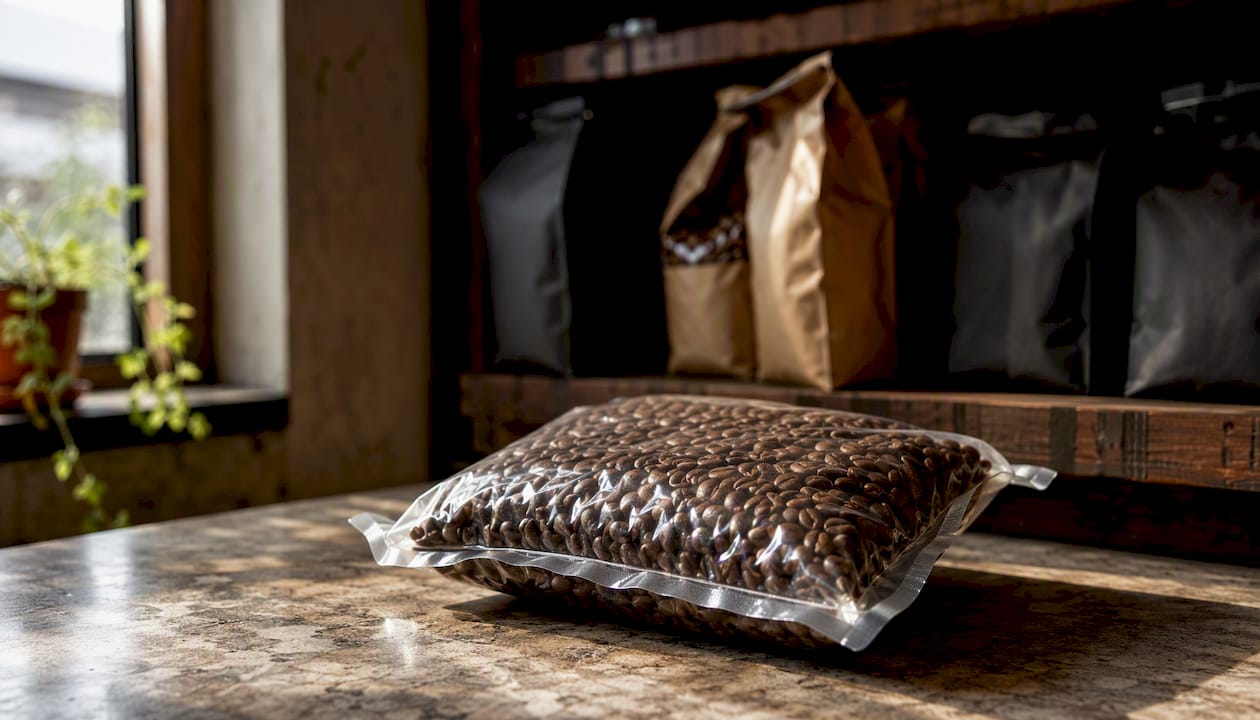
Freezer-grade zipper bags work well for storage up to 4–6 weeks if you press out as much air as possible before sealing. They’re inexpensive and widely available. Reusable silicone bags (Stasher-style) are a more sustainable version of the same idea — they seal tightly and can be squeezed to remove air, though they don’t match the oxygen barrier of a vacuum seal.
Small rigid containers — glass jars with rubber-gasket lids, for example — are good for single-dose strategies. They’re easy to label, reusable, and provide a solid odor barrier. The downside is bulk: a freezer full of glass jars takes up more space than flat-packed bags.
Original roastery bags are fine if the bag is still sealed and you tape the one-way valve before freezing. Once opened, they’re not reliable for freezer storage — the reseal is rarely airtight enough, and the valve becomes a liability.
- Vacuum-seal bags: best for 2–4 months; highest upfront cost; lowest air exposure.
- Zipper freezer bags: good for 4–6 weeks; low cost; requires careful air removal.
- Silicone reusable bags: similar to zipper bags; better for the environment; moderate seal quality.
- Rigid containers: best odor barrier; bulky; ideal for single-dose glass-tube strategies.
- Original roastery bags (sealed): acceptable if valve is taped; not recommended once opened.
How long do frozen beans stay good, and how should you store them?
Place frozen packages at the back of the freezer, not in the door shelf. Door shelves cycle through temperature swings every time someone grabs the milk. The back of the freezer stays coldest and most consistent.
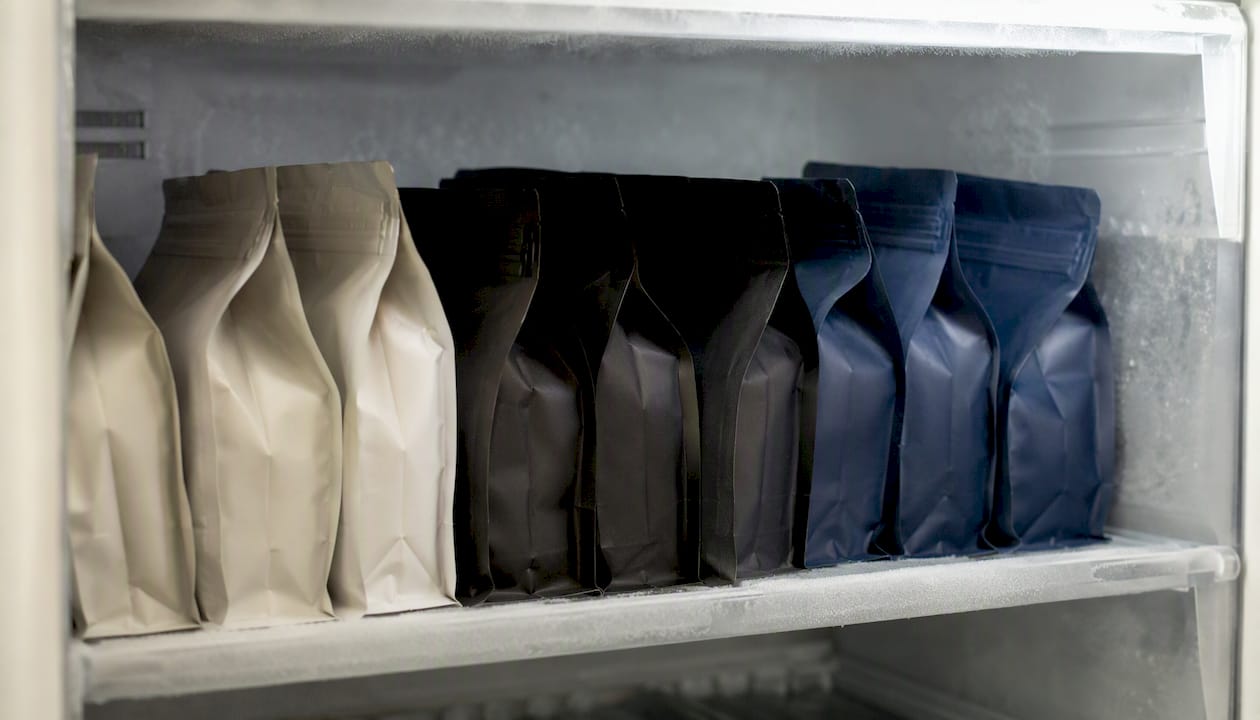
Keep the packages sealed until you’re ready to use them. Don’t open the freezer to “check” on your coffee — every unnecessary opening adds a small amount of moisture and temperature fluctuation.
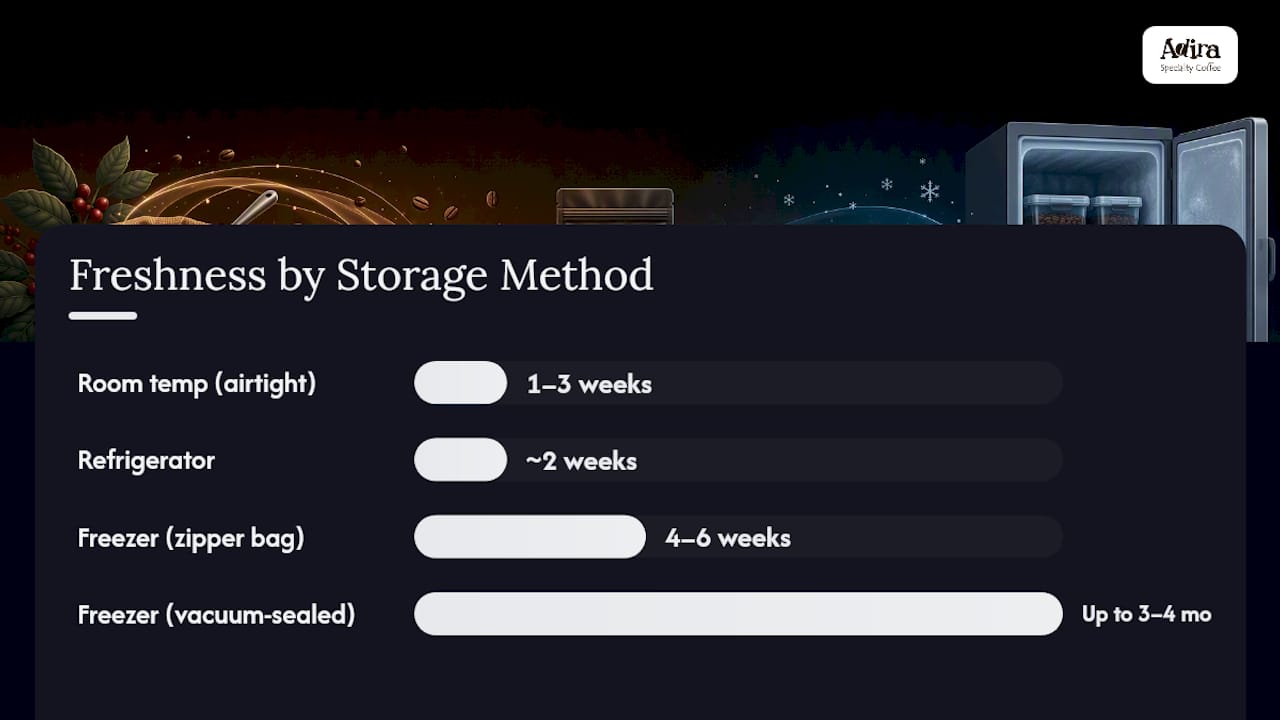
The NCA puts the realistic freshness window for properly frozen roasted beans at roughly 3–4 months. At room temperature in an airtight container, the same beans stay fresh for about 1–3 weeks. Refrigeration is generally not recommended — the fridge is humid, full of food odors, and doesn’t get cold enough to meaningfully slow staling compared with a proper freezer.
| Storage method | Typical freshness window | Key risk |
|---|---|---|
| Room temperature, airtight | 1–3 weeks | Oxygen, heat exposure |
| Refrigerator | ~2 weeks | Moisture, odor absorption |
| Freezer, vacuum-sealed | Up to 3–4 months | Condensation on thaw if opened cold |
| Freezer, zipper bag | 4–6 weeks | Air infiltration over time |
A Beverages (MDPI) study found that frozen samples maintained aroma intensity and pleasantness across a nine-week test period, with dark roasts showing particularly strong preservation. That’s a meaningful signal, though it’s worth noting the study’s controlled lab conditions don’t perfectly replicate a home freezer with varying door traffic and mixed food odors.
Should you grind from frozen or thaw first?
Both approaches work. The choice depends on your brewing method and how much you care about grind consistency.
Grinding directly from frozen has a real advantage: frozen beans are more brittle, which means the burr grinder breaks them into more uniform particles. WIRED and grind research associated with Christopher Hendon found that freezing can improve grind uniformity, particularly for light roasts, producing slightly more consistent particle sizes. For espresso, where particle distribution directly affects extraction, this matters.
If you grind from frozen:
- Use a burr grinder, not a blade grinder. The uniformity benefit disappears with a blade.
- Weigh your dose before grinding — frozen beans can be denser and harder to eyeball.
- Let the ground coffee sit for 30–60 seconds before tamping (espresso) or dosing (filter). Cold grounds clump slightly and a brief rest helps them settle.
If you thaw before grinding:
- Leave the bag sealed on the counter for 20–30 minutes.
- Don’t open it until it’s at room temperature. Condensation forms on cold beans the moment they hit warm air, and wet beans grind unevenly and stale faster.
- Once opened, use the full portion. Don’t reseal and refreeze.
Pro Tip: For espresso, try grinding directly from frozen at least once. Many home baristas find they need to adjust their grind slightly finer, but the shot consistency often improves noticeably.
How roast level changes what freezing does for your coffee
Roast level shapes how much freezing helps — and the research here is more nuanced than most guides suggest.
Penn State research found that dark roast samples stored frozen were judged similar to fresh samples by a sensory panel across a nine-week period. The Beverages journal study reinforced this: dark roasts showed notable aroma preservation when frozen. The practical implication is that dark roasts, which are more porous and lose aroma faster at room temperature, benefit most visibly from freezer storage.
Light roasts are more stable at room temperature and lose aroma more slowly to begin with. Freezing still helps, but the gap between frozen and room-temperature storage is smaller over a 4–6 week window. Where light roasts do benefit from freezing is in grind consistency — the brittleness effect is more pronounced in denser, less-porous light roast beans.
For highly aromatic single-origin coffees — an Ethiopian natural process, a Geisha, a washed Costa Rican with bright acidity — freezing is especially worth the effort. These are the beans where identifying quality and preserving it are both worth the extra steps.
Common mistakes that undo the benefits of freezing
Most freezing failures come down to one of three errors.
Repeatedly opening the same large bag. This is the most common mistake. Every time you open a frozen bag, you expose all the remaining beans to warm, humid air. The fix is portioning before freezing — pull one small package at a time and leave the rest sealed and undisturbed. Serious Eats and most specialty coffee sources treat this as the cardinal rule.
Using low-quality or non-freezer bags. Standard sandwich bags are too thin and too porous. They allow odor transfer from surrounding food and let enough air through over weeks to noticeably degrade the coffee. Use freezer-grade bags at minimum, vacuum-seal bags when possible.
Opening the frozen bag immediately. Cold beans pulled from the freezer and immediately exposed to room-temperature air collect condensation fast. That moisture settles into the beans and accelerates staling. Always let the sealed package reach room temperature before opening.
Red flags that your frozen coffee has been compromised:
- Visible frost or ice crystals inside the package (moisture got in).
- A cracked or broken seal on the bag.
- The package was stored near strong-smelling foods (fish, onions) without a rigid outer container.
- You can smell the coffee through the sealed bag (the barrier has failed).
What the research actually says about freezing beans
The evidence base for freezing coffee is real but still developing. Here’s what the key sources actually found.
The NCA provides the clearest shelf-life comparison: roasted beans at room temperature stay fresh for 1–3 weeks; properly frozen beans retain freshness for roughly 3–4 months. That’s the practical baseline most home drinkers should plan around.
The Penn State Sensory Evaluation Center ran sensory and chemical analysis over nine weeks and found that frozen dark-roast samples were judged comparable to fresh samples. The Beverages (MDPI) study corroborated this with measured aroma intensity and pleasantness scores. Both studies used controlled conditions — a useful signal, but home freezers vary more than a lab.
Roaster-run cupping tests at Royal Coffee found that frozen samples showed less decline in sweetness and fewer stale or musty notes compared with room-temperature controls over multi-week tests — a real-world complement to the lab findings.
Perfect Daily Grind documents professional practice: vacuum sealing and single-dose portioning are the standard among specialty roasters who freeze coffee, not a hobbyist workaround. The Food & Wine reporting adds practical roaster techniques — taping valves, grinding from frozen — that translate directly to home use.
The honest caveat: freezing slows chemical change, it doesn’t stop it. Aroma loss continues at a much slower rate in the freezer. Beans stored for five or six months will show some degradation even under ideal conditions. The goal is slowing deterioration enough that a prized coffee remains genuinely enjoyable months later, not preserving it indefinitely.
A roaster’s perspective on freezing specialty beans
Freezing coffee is a tool, not a default. At Adiracoffee, we roast in small batches and ship within days of roasting precisely because freshness is the point — and for most customers, a subscription or a smaller bag ordered more often is a better answer than freezing a large one.
That said, freezing makes real sense in specific situations: a limited-lot single origin you want to hold for a special occasion, a bag that arrived while you were traveling, or a bulk order you got a good deal on. In those cases, the research and roaster practice align — vacuum-seal, portion small, freeze at the back, and don’t refreeze.
My practical suggestion: freeze only the portion of the bag you won’t realistically use within the next month. The rest stays at room temperature in an airtight container and gets used at its peak. Freezing the whole bag “just in case” usually means pulling out portions more often than you planned, which defeats the purpose.
Fresh beans delivered to your door, no freezer required
The simplest way to avoid long-term storage is to never need it. Adiracoffee roasts single-origin coffees and signature blends to order in small batches in California, shipping within days of roasting so the beans arrive at peak freshness.

A coffee subscription delivers fresh beans on your schedule — every two, three, or four weeks — with 10% off every order and free US shipping over $35. No bulk buying, no freezer logistics, no guessing whether a bag is still good. If you want to try something specific, the Mushroom Coffee Medium Roast and Mushroom Coffee Dark Roast are two small-batch options worth ordering fresh rather than freezing. Browse the full coffee beans collection and find your next bag.
Sources
- National Coffee Association (NCA)
- Beverages (MDPI)
- Wake up and smell the coffee: Research shows freezing beans can preserve aroma | Penn State University
- Freezing roasted coffee: best practices | Perfect Daily Grind
- Freezing Your Coffee Beans Keeps Them Fresher for Longer | Food & Wine
- How to freeze coffee beans | WIRED