
TL;DR:
- Visual checks reveal high-quality beans by uniform size, color, and absence of defects.
- Freshness indicators include aroma, bloom strength, and CO2 release, tested via the ziplock bag method.
- Sensory evaluation of aroma, bloom, and sound guides assessment of bean quality and freshness.
You spend good money on a bag of beans, follow your usual routine, and still end up with a flat, lifeless cup. It happens more often than it should, and the culprit is almost always the beans themselves. Knowing what separates genuinely great coffee from a disappointing batch is not guesswork. There are concrete, repeatable signs you can check at home before you ever heat your water. This guide walks you through visual cues, freshness tests, sensory evaluation, and scoring systems so you can make confident decisions every single time you buy.
Table of Contents
- Visual and physical checks: The first line of defense
- Optimal moisture content and freshness indicators
- Sensory evaluation: Aroma, bloom, and sound
- Comparing roast levels, origins, and specialty scores
- Why your own palate matters more than expert scores
- Upgrade your brew with expertly sourced beans
- Frequently asked questions
Key Takeaways
| Point | Details |
|---|---|
| Visual quality checks | Inspect beans for uniform color, size, and the absence of defects. |
| Moisture and freshness | Fresh beans with 10-12% moisture content provide better flavor and prevent spoilage. |
| Use your senses | Rely on aroma, bloom, and even sound to spot high-quality beans. |
| Taste preferences matter | Expert scores help, but your own flavor preference is the best guide. |
Visual and physical checks: The first line of defense
The fastest way to gauge bean quality is to look at them. Before any brewing, pour a small amount onto a white plate under natural or bright artificial light. This simple setup reveals a surprising amount about what you are working with.
High-quality beans share a few consistent physical traits. They are uniform in size and shape, which matters because uneven beans roast inconsistently. A bag full of varied sizes means some beans will be over-roasted while others are under-roasted, and that imbalance shows up directly in the cup. Color should also be consistent across the batch. Blotchy, streaky, or dramatically uneven coloring is a red flag. According to color analysis for roasters, combining visual checks like defect spotting with sensory and empirical tests gives you the most reliable picture of quality.
Here is what to look for and what to avoid:
- Even color throughout the batch — patchiness suggests uneven roasting or processing issues
- No visible cracks along the bean surface — hairline fractures indicate brittleness from over-roasting or low moisture
- No insect damage or holes — tiny holes are a sign of coffee berry borer infestation, a common defect in lower-grade lots
- No broken or chipped beans — these will extract unevenly and add bitterness
- No foreign debris — sticks, stones, or husks indicate poor sorting at origin
- Uniform size — consistent sizing means a more even roast and balanced extraction
The float test is another practical tool. Drop a handful of beans into a glass of water. Beans that float tend to be lower density, which often means they are defective, underdeveloped, or have lost significant moisture. Sinking beans are generally denser and more likely to deliver a full, complex cup. This is the same logic behind choosing coffee beans based on physical integrity rather than just price or packaging.
Understanding the differences between types of coffee beans also helps here. Arabica beans, for example, tend to be larger and more oval-shaped, while Robusta beans are rounder and smaller. Knowing what you are supposed to be looking at makes defects much easier to spot.
Pro Tip: Always inspect beans in natural daylight or under a bright white LED. Yellow-tinted bulbs mask color inconsistencies that would otherwise be easy to catch.
Optimal moisture content and freshness indicators
Once you have cleared the visual hurdles, the next layer of quality assessment is less obvious but just as critical. Moisture content and freshness are invisible to the eye but have an enormous impact on flavor.
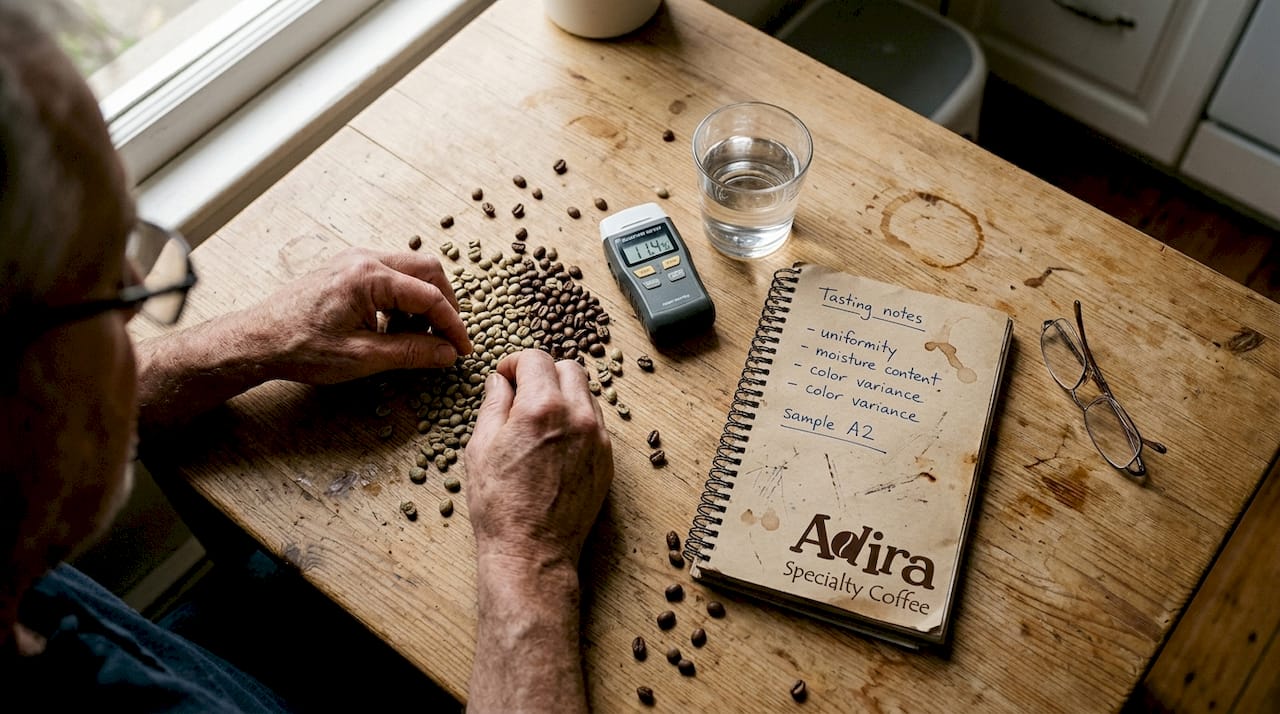
For green (unroasted) beans, moisture content of 10-12% is the accepted standard for specialty-grade coffee. Too much moisture and you risk mold development during storage. Too little and the beans become brittle, leading to uneven grinding and a thin, papery cup. This is a number you will not be able to measure at home without a moisture meter, but it is worth asking your roaster about, especially when buying green beans for home roasting.
For roasted beans, freshness tells a different story. After roasting, beans release carbon dioxide (CO2) in a process called degassing. This is actually a good sign. It means the beans are recent and still chemically active. The problem is that this CO2 also escapes over time, and once it is gone, oxidation accelerates and flavors flatten out.
| Freshness indicator | Fresh beans | Stale beans |
|---|---|---|
| Bloom during brewing | Strong, foamy rise | Weak or no bloom |
| Ziplock bag test | Bag inflates overnight | Bag stays flat |
| Aroma when bag opens | Bright, complex, distinct | Dull, faint, or musty |
| Surface appearance | Slight oily sheen (medium-dark) | Excessively oily or bone dry |
The ziplock bag test is one of the easiest home methods available. Seal a small amount of your beans in a ziplock bag, squeeze out the air, and leave it overnight. If the bag inflates by morning, CO2 is still being released, which means the beans are fresh. A bag that stays flat suggests the beans have already off-gassed and are past their prime.
Warning signs of moisture problems in roasted beans include:
- Clumping — beans sticking together suggest excess humidity during storage
- Cracking sounds when handled — overly dry beans are brittle and grind inconsistently
- No aroma when the bag is opened — a sign that volatile compounds have already escaped
Proper storing beans for freshness extends the window of peak flavor significantly. And understanding freshness and flavor in coffee helps you appreciate why buying in smaller quantities, more frequently, beats buying in bulk every time.
Sensory evaluation: Aroma, bloom, and sound
Your senses are more reliable than most people give them credit for. Once you know what to look for, a few seconds of focused attention can tell you more than any label.
Aroma is the most immediate indicator. Open the bag and take a slow, deliberate sniff. Fresh, high-quality beans smell complex. Depending on origin and roast, you might catch notes of fruit, chocolate, caramel, florals, or nuts. The key word is distinct. Stale beans smell flat, generic, or faintly musty. That mustiness is often a sign of moisture damage or improper storage, either at origin, during transit, or at the retailer.
When you grind the beans, the aroma should intensify noticeably. If grinding produces little to no fragrance, the beans have lost most of their volatile compounds and will produce a dull cup regardless of your technique.
The bloom is your in-cup freshness test. When you pour hot water over fresh grounds, CO2 escapes rapidly and creates a foamy, bubbling rise called the bloom. A strong bloom is a reliable sign of freshness. A weak or absent bloom means the beans have off-gassed already.
“For home baristas and connoisseurs, the most reliable quality assessment combines sensory cues like aroma and bloom with empirical markers such as roast date and SCA scores above 80.” — Perfect Daily Grind
Here is a quick sensory checklist before you brew:
- Smell the dry grounds — complex and distinct is good, flat or musty is not
- Watch the bloom — a vigorous rise means fresh; little activity means stale
- Listen when grinding — a smooth, consistent sound is normal; rattling or hollow pops suggest underdeveloped or defective beans
- Feel the grounds — they should feel slightly tacky, not powdery or clumpy
Pairing strong sensory habits with the right brewing methods for home baristas makes a real difference. And if you want to get precise about extraction, a specialty coffee brewing guide can help you dial in every variable.
Comparing roast levels, origins, and specialty scores
Now that you have the tools to assess individual beans, it helps to zoom out and understand how roast level, origin, and scoring systems fit into the bigger picture.
| Roast level | Flavor profile | Quality cues |
|---|---|---|
| Light | Bright, fruity, floral, high acidity | Best showcases origin character |
| Medium | Balanced, caramel, nutty, moderate acidity | Versatile, forgiving for most brew methods |
| Dark | Bold, smoky, low acidity, bittersweet | Roast flavor dominates over origin notes |
Light roasts preserve the most origin character, which is why specialty roasters often favor them for high-scoring single-origin lots. If a bean has exceptional terroir, a light roast lets that shine. Dark roasts, while popular, tend to mask origin nuances. That is not inherently bad, but it means you are tasting the roast more than the bean itself.
Single-origin coffees tell you something specific about sourcing transparency. When a roaster can name the farm, region, and processing method, it usually reflects a closer relationship with producers and a higher standard of quality control. Blends can be excellent too, but they offer less traceability.
The SCA (Specialty Coffee Association) scoring system rates coffee on a 100-point scale. An SCA score of 80 or above qualifies as specialty grade, meaning it passed rigorous cupping evaluations for aroma, flavor, aftertaste, acidity, body, and balance. Scores above 85 are considered exceptional.
Here is how to prioritize your selection based on flavor goals:
- For bright, complex cups — choose light-roast, single-origin beans from Ethiopia or Colombia with SCA scores above 85
- For balanced, everyday drinking — medium-roast beans from Costa Rica or Guatemala offer consistency and approachability
- For bold, low-acid cups — dark-roast blends or Sumatra single-origins deliver body and earthiness
- For sweet, chocolatey notes — Brazil naturals processed beans are a reliable choice
- For versatility across brew methods — medium-roast beans with SCA scores in the 82 to 86 range work well in most setups
Understanding the coffee roasting process gives you context for why these differences exist. And if you want to push your results further, coffee roasting tips and guidance on grinding for best flavor round out the picture nicely.
Pro Tip: Request sample sizes from roasters before committing to larger bags. Most specialty roasters offer this, and it lets you compare origins and roast levels side by side without a major investment.
Why your own palate matters more than expert scores
Here is something most quality guides will not tell you: an SCA score of 90 does not guarantee you will enjoy the cup. Scoring systems are built on consensus preferences, not yours specifically. A panel of trained cuppers might award a natural-processed Ethiopian a near-perfect score for its intense fruit complexity, but if you find fermented fruit notes off-putting, that coffee is not a quality experience for you.
We have seen this pattern repeatedly. Customers come to us with a highly rated bean they did not enjoy, confused about what went wrong. Nothing went wrong. The bean was excellent by every measurable standard. It just was not their cup.
Use the criteria in this guide as a starting framework, not a final verdict. Check the visuals, test the freshness, evaluate the aroma. But then brew it, taste it honestly, and trust what you find. The home roasting journey is ultimately about building a personal vocabulary for what you love, not chasing scores assigned by someone else’s palate.
Upgrade your brew with expertly sourced beans
Putting all these criteria into practice is much easier when the sourcing work has already been done for you. At Adira Coffee, every bean we offer has been evaluated against the exact standards covered in this guide: visual integrity, freshness from small-batch roasting, sensory complexity, and traceable origins.
We work directly with around 50 farms across Colombia, Ethiopia, Costa Rica, Guatemala, Brazil, and Sumatra to bring you beans that are roasted to order and shipped at peak freshness. Whether you want to start with our Colombia single-origin beans or browse the full range of specialty coffee beans, you will find options that match the quality markers you now know how to look for. Explore everything Adira Coffee has to offer and taste what genuinely fresh, expertly sourced coffee feels like in the cup.
Frequently asked questions
How can I tell if coffee beans are fresh at home?
The easiest methods are the bloom test and the ziplock bag test. Fresh beans will produce a strong, foamy bloom when you brew and will inflate a sealed bag overnight as they release CO2.
What moisture level is ideal for green coffee beans?
Green beans should have a moisture content of 10-12% to stay free of mold and avoid becoming too brittle to grind properly.
Does bean appearance impact cup quality?
Absolutely. Even color and uniform shape with no visible defects signal a well-processed, consistently roasted bean that will extract more evenly and taste better.
How does roast level affect coffee quality?
Roast level determines how much of the bean’s original origin character comes through. Light roasts highlight terroir and complexity, while dark roasts emphasize roast-driven flavors like smoke and bittersweet chocolate. Match the roast level to what you actually enjoy drinking.