
Standing in front of a wall of coffee bags at your local roaster or grocery store can feel overwhelming. Every bag promises something different, yet most of us grab whatever looks familiar. The truth is, the bean you choose shapes everything about your cup, from the first smell when you open the bag to the last sip. Arabica, Robusta, Liberica, Excelsa — these are not just labels. Each species brings a completely different flavor experience to your morning routine. This guide breaks down the main coffee bean types, explains what makes each one unique, and helps you figure out which one belongs in your grinder.
Table of Contents
- How to evaluate coffee beans: Key criteria
- Arabica: The classic favorite
- Robusta: Bold and buzzy
- Liberica and Excelsa: Rare and adventurous
- Comparing the main coffee bean types
- The real secret to choosing your best coffee bean
- Explore specialty coffee beans with Adira
- Frequently asked questions
Key Takeaways
| Point | Details |
|---|---|
| Four main bean types | Arabica, Robusta, Liberica, and Excelsa each offer distinct flavors and uses. |
| Bean impacts flavor | The type of coffee bean strongly influences the taste and aroma of your brew. |
| Arabica is most popular | Arabica represents about 60-70% of world coffee production and is known for sweetness and complexity. |
| Try before you decide | Experimenting with different beans is key to finding your perfect match. |
How to evaluate coffee beans: Key criteria
Before you can pick the right bean, it helps to understand what actually separates one type from another. Most people focus on roast level, but roast is only part of the story. The species of bean you start with determines the flavor ceiling, the caffeine level, and even how forgiving the bean is during brewing.
When choosing coffee beans, four main factors deserve your attention:
- Bean species: The genetic foundation of flavor, caffeine content, and aroma
- Origin: Where the bean was grown, including altitude, soil, and climate
- Processing method: How the cherry was removed from the bean after harvest
- Freshness: How recently the bean was roasted and how it has been stored
Of these, species is the starting point. The four main commercial species are Arabica (Coffea arabica), Robusta (Coffea canephora), Liberica (Coffea liberica), and Excelsa, which is often classified as a variety of Liberica. Each one has a distinct genetic profile that no roast level or brewing method can override.
Origin and processing add nuance on top of that foundation. An Ethiopian Arabica tastes nothing like a Brazilian Arabica, even though both are the same species. Processing methods like washed, natural, or honey add another layer of complexity.
Pro Tip: When you are just starting to explore, focus on species first. Once you find a species you enjoy, then start exploring origins and processing styles within that category.
Arabica: The classic favorite
Arabica is the bean most specialty coffee brands, including us here at Adira, reach for first. It is the most widely grown coffee in the world, and for good reason. Arabica accounts for 60 to 70% of global coffee production, grown at high altitudes between 1,000 and 2,000 meters, and it delivers sweet, complex flavors with fruity, floral, and chocolate notes. Its caffeine content sits lower, between 0.9% and 1.5%, and it is more susceptible to disease than hardier species.
Those high-altitude growing conditions are not just a detail. The slower growth at elevation forces the plant to develop more sugars and aromatic compounds, which translates directly into the cup. You get layers of flavor that shift as the coffee cools.
Key characteristics of Arabica beans:
- Flavor: Sweet, complex, often fruity or floral with chocolate undertones
- Caffeine: Lower than Robusta, roughly 0.9% to 1.5% by weight
- Growing altitude: 1,000 to 2,000 meters above sea level
- Price: Generally higher due to more demanding growing conditions
- Best for: Pour-over, drip, and any method where clarity of flavor matters
Because Arabica expresses origin so clearly, it is the go-to choice for single origin coffee programs. A single origin Ethiopian Arabica can taste like blueberries and jasmine. A Colombian Arabica from the same species can lean toward caramel and red apple. That range is part of what makes Arabica so endlessly interesting to explore.

If you want to taste the full potential of Arabica, consider the whole bean coffee benefits of grinding right before brewing. Pre-ground Arabica loses its delicate aromatics fast, and that is where so much of the magic lives.
Robusta: Bold and buzzy
If Arabica is the nuanced, thoughtful choice, Robusta is the one that grabs you by the collar. After Arabica, many coffee fans consider Robusta for different reasons, and it earns its place in the lineup.
Robusta grows at lower altitudes, typically below 800 meters, and thrives in conditions that would stress an Arabica plant. It is more resistant to pests and disease, which makes it cheaper to grow and more consistent in yield. That resilience comes with a trade-off in flavor complexity, but Robusta brings things to the table that Arabica simply cannot.
Key characteristics of Robusta beans:
- Flavor: Bold, earthy, and bitter with a grainy or nutty quality
- Caffeine: Roughly twice the caffeine of Arabica, often 2% to 2.7% by weight
- Growing altitude: Below 800 meters, in tropical lowland regions
- Price: Generally lower and more widely available
- Best for: Espresso blends, strong brews, and anyone who wants a serious caffeine kick
Robusta is a staple in Italian-style espresso blends because it produces a thick, persistent crema that Arabica alone cannot match. That dense foam layer is not just visual. It carries aromatic compounds and contributes to the texture of the shot. Understanding coffee roast profiles matters a lot with Robusta, since darker roasts tend to mellow its harsher edges.
Pro Tip: If you love a dark roast with a strong, punchy character, try a blend with 20 to 30% Robusta. It adds body and crema without overwhelming the cup if the ratio is right.
The four main commercial species each have a role, and Robusta’s role is power. It is the workhorse of the coffee world.
Liberica and Excelsa: Rare and adventurous
While most coffee drinkers choose Arabica or Robusta, Liberica and Excelsa offer something truly different for those willing to seek them out.
Liberica is a large-fruited species native to West Africa but now grown primarily in the Philippines and parts of Southeast Asia. The beans themselves are noticeably bigger and more irregular in shape than Arabica or Robusta. The flavor is unlike anything else in the coffee world. Smoky, floral, and woody notes combine with a slightly fruity finish that some drinkers love and others find jarring. It is genuinely an acquired taste.
Key characteristics of Liberica and Excelsa:
- Liberica flavor: Smoky, woody, floral, with a full body and unusual finish
- Excelsa flavor: Tart, fruity, and wine-like with a brightness that stands out in blends
- Growing region: Primarily Southeast Asia, particularly the Philippines and Malaysia
- Availability: Rare outside specialty shops and online retailers
- Best for: Adventurous drinkers and blending to add complexity
Excelsa, niche at under 1% of global production, delivers tart, fruity, and wine-like flavors that add brightness to blends. It is taxonomically a variety of Liberica, but its flavor profile is distinct enough that roasters treat it separately. Most home baristas will encounter Excelsa as part of a blend rather than as a standalone single origin.
“Liberica and Excelsa remind you that coffee is an incredibly diverse crop. Most of the world drinks two species, but there are flavors out there that will completely reframe what you think coffee can taste like.”
If you are curious about how roasting affects these unusual beans, understanding the roasting process can help you get the most out of them when you do find them.
Comparing the main coffee bean types
With all the key beans described, here is how they stack up side by side. The four main commercial species — Arabica, Robusta, Liberica, and Excelsa — each occupy a different space in the flavor and utility spectrum.
| Bean | Flavor profile | Caffeine level | Growing region | Availability |
|---|---|---|---|---|
| Arabica | Sweet, fruity, floral, complex | Low (0.9–1.5%) | High altitudes, 60+ countries | Very common |
| Robusta | Bold, earthy, bitter, nutty | High (2–2.7%) | Tropical lowlands | Common |
| Liberica | Smoky, woody, floral | Medium | SE Asia, Philippines | Rare |
| Excelsa | Tart, fruity, wine-like | Medium-low | SE Asia | Very rare |
Knowing which bean fits your situation makes the decision much easier. Here is a simple guide:
- Choose Arabica if you want nuanced, sweet flavors and enjoy exploring origins
- Choose Robusta if you want a strong, high-caffeine cup or a thick espresso crema
- Choose Liberica if you want to try something genuinely unusual and enjoy smoky, bold flavors
- Choose Excelsa if you want to experiment with blending or taste something tart and wine-like
Once you know your bean, grinding coffee beans correctly for your brew method is the next step. Grind size affects extraction, and different beans respond differently to the same grind setting. For a balanced everyday cup, medium roast coffee tends to show off Arabica’s full flavor range without pushing into bitter territory.
The real secret to choosing your best coffee bean
Here is something the coffee world does not say enough: popularity is not a flavor preference. Arabica dominates shelves because it is commercially successful, not because it is objectively the best bean for every person. We have met plenty of coffee lovers who genuinely prefer a well-sourced Robusta or a Liberica blend over any Arabica on the market.
The most rewarding approach is to treat bean selection like a tasting experiment. Buy small quantities of different species, brew them the same way, and take notes. What do you actually taste? What do you want more of? That process teaches you more about your palate in two weeks than years of drinking the same bag on autopilot.
Blending is also underrated among home baristas. Mixing 70% Arabica with 30% Robusta gives you complexity plus body. Adding a small amount of Excelsa to a blend can introduce a brightness that makes the whole cup feel more alive.
Finding your coffee match is not about following rules. It is about paying attention to what you enjoy and being willing to try something outside your comfort zone. The best cup you have ever had might be a bean you have not tried yet.
Explore specialty coffee beans with Adira
Now that you know what separates each bean type, the next step is tasting them for yourself. At Adira Coffee, we source directly from around 50 farms across Colombia, Ethiopia, Costa Rica, Guatemala, Brazil, and Sumatra, so you can experience how origin and species work together in the cup.
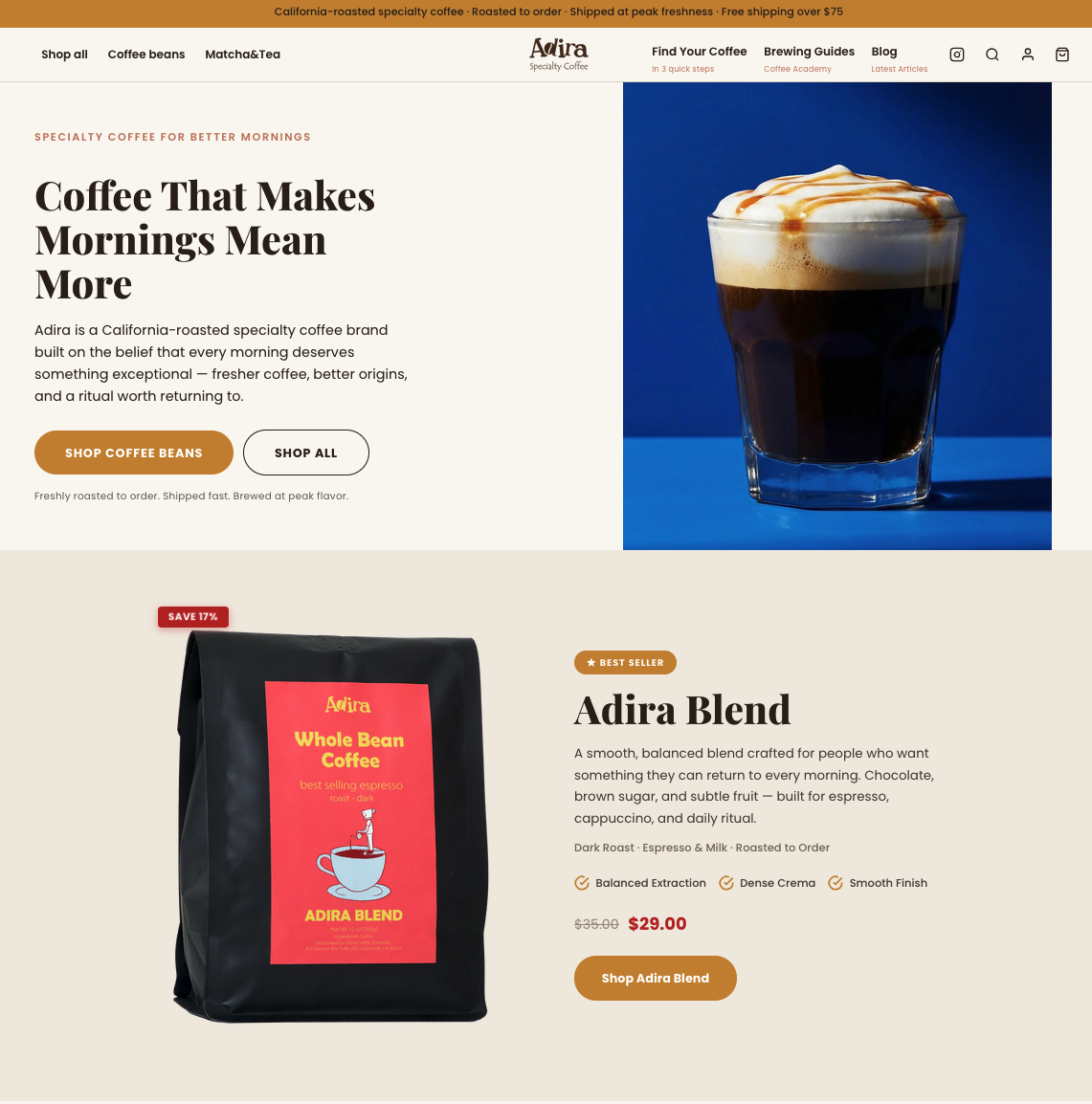
We roast in small batches and ship at peak freshness, which means you are getting beans at their best, not sitting in a warehouse. Whether you want to start with a classic Colombian coffee, explore the bright acidity of our Costa Rican beans, or browse our full coffee bean collection to find something new, we have options that match every preference and curiosity level.
Frequently asked questions
What are the main types of coffee beans?
The four main species are Arabica, Robusta, Liberica, and Excelsa, each with distinct flavor profiles, caffeine levels, and growing regions.
Which coffee bean is best for espresso?
Robusta beans are widely used in espresso for their strong body and thick crema, though blends combining Robusta and Arabica are popular for balancing boldness with sweetness.
Are Liberica and Excelsa beans easy to find?
Excelsa and Liberica are rare outside Southeast Asia and specialty retailers, so most home baristas will need to seek them out online or at dedicated coffee shops.
Which coffee bean has the most caffeine?
Robusta beans contain roughly twice the caffeine of Arabica, making them the highest-caffeine option among the four main commercial species.
How do I know which coffee bean type I’ll like?
The most reliable method is sampling different species side by side using the same brew method, then noting which flavors and body levels you enjoy most.