
Grinding coffee beans correctly transforms your brewing experience, yet many home baristas struggle with inconsistent results that lead to flat or bitter flavors. The grind size you choose directly influences how water extracts compounds from the beans, making it the single most important variable in your brewing process. This guide will teach you how to grind coffee beans properly for every brewing method, helping you unlock the full potential of your specialty coffee and achieve cafe-quality results at home.
Table of Contents
- What You Need: Choosing Your Grinder And Tools
- How To Grind Coffee Beans Step By Step For Your Brewing Method
- Managing Grind Temperature And Consistency For Optimal Flavor
- Troubleshooting Common Grinding Mistakes And Optimizing Your Grind
- Enhance Your Coffee Experience With Adira Coffee
- FAQ
Key takeaways
| Point | Details |
|---|---|
| Grind size controls extraction | The particle size determines how quickly water extracts flavors, affecting taste balance and strength. |
| Burr type shapes flavor profile | Conical burrs emphasize body and sweetness while flat burrs enhance clarity and separation. |
| Temperature affects quality | Grinding generates heat that can degrade delicate aromatics and alter extraction chemistry. |
| Consistency ensures even brewing | Uniform particle size prevents over-extraction of fines and under-extraction of larger particles. |
| Fresh grinding maximizes flavor | Grinding immediately before brewing preserves volatile aromatics that dissipate within minutes. |
What you need: choosing your grinder and tools
Selecting the right grinder is the foundation of excellent coffee preparation. Your grinder determines shot quality more than your machine does, making it worth investing in quality equipment that matches your flavor preferences and brewing style. The two primary burr geometries, conical and flat, produce distinctly different particle distributions that shape your coffee’s final taste profile.
Conical burr grinders feature cone-shaped burrs that crush beans between an outer ring and inner cone. These grinders generate 15-20% more sub-200-micron fines than flat burrs at identical settings, creating a particle distribution that emphasizes body, sweetness, and syrupy texture. The additional fines dissolve quickly during extraction, contributing to fuller mouthfeel and enhanced perceived sweetness. Conical grinders excel for brewing methods that benefit from rich body, such as espresso with creamy texture or French press with substantial presence.
Flat burr grinders use two parallel ring-shaped burrs that shear beans between horizontal surfaces. This geometry produces tighter particle size distribution with fewer extreme fines and boulders, resulting in cleaner flavor separation and enhanced clarity. Flat burrs highlight nuanced tasting notes and origin characteristics, making them ideal for filter methods like pour-over or drip where transparency matters most. The uniform particle size also simplifies dialing in espresso, though the process generates more heat than conical alternatives.
Your choice between conical and flat burrs should align with your flavor priorities and primary brewing methods:
- Choose conical burrs for espresso-focused setups prioritizing body, sweetness, and forgiving extraction
- Select flat burrs for filter coffee emphasizing clarity, complexity, and precise flavor separation
- Consider stepped grinders for ease of use or stepless models for maximum adjustment flexibility
- Verify the grinder offers sufficient range for your brewing methods, from Turkish fine to French press coarse
Beyond the grinder itself, essential tools include a digital scale accurate to 0.1 grams for consistent dosing, a timer to track grinding duration and prevent overheating, and airtight containers for storing whole beans away from light and moisture. Pairing quality equipment with proper coffee bean selection ensures you extract maximum value from your grinding efforts.
Pro Tip: Store your grinder in a cool, dry location and clean the burrs every two weeks to prevent rancid oil buildup that imparts stale flavors to fresh grinds.
How to grind coffee beans step by step for your brewing method
Mastering the grinding process requires understanding how particle size affects extraction speed and flavor balance. Grind size is the bridge between your beans and your cup, determining which compounds dissolve during brewing and how quickly extraction occurs. Follow these steps to achieve optimal results for any brewing method.
-
Measure your beans precisely. Weigh whole beans on a digital scale before grinding, using your target brew ratio as a guide. For espresso, start with 18-20 grams for a double shot. For pour-over, use 15-17 grams per 250ml of water. Accurate measurement ensures consistency across multiple brews and simplifies troubleshooting when adjusting variables.
-
Set your grind size for the brewing method. Coarse grinds resembling sea salt work best for French press and cold brew, where longer contact times require larger particles to prevent over-extraction. Medium grinds similar to sand suit drip coffee makers and Chemex, balancing extraction speed with flavor development. Fine grinds like table salt are essential for espresso, where 25-30 second extraction windows demand maximum surface area. Refer to our brewing guides for specific starting points.
-
Use cold beans for optimal grinding. Beans at room temperature or slightly cooler grind more uniformly and generate less heat during processing. Avoid grinding beans straight from the freezer, as condensation can introduce moisture that clumps grinds and affects extraction. Let frozen beans rest at room temperature for 10-15 minutes before grinding.
-
Grind in single doses. Load only the amount you need for immediate brewing rather than grinding large batches. Single-dosing minimizes heat buildup, prevents stale exposure, and ensures maximum freshness for each cup. This approach also reduces retention in the grinder, eliminating stale grounds from previous sessions.
-
Adjust incrementally when dialing in. Make small changes to grind size, moving one or two steps at a time on stepped grinders or tiny rotations on stepless models. Brew and taste after each adjustment, noting extraction time and flavor characteristics. For espresso, finer grinds slow extraction and increase strength, while coarser grinds speed flow and reduce intensity.
-
Clean your grinder between major changes. When switching between brewing methods or coffee origins with distinct flavors, purge the grinder by running a small amount of the new beans through and discarding the grinds. This removes residual particles that might contaminate your fresh dose with previous flavors.
Pro Tip: Keep a grinding journal noting your settings, bean origins, and resulting flavors to build a reference library that accelerates dialing in new coffees or methods.
Managing grind temperature and consistency for optimal flavor
Grinding generates friction heat that can degrade delicate aromatics and alter extraction chemistry, making temperature management crucial for preserving coffee quality. Different grinder geometries produce varying heat levels, requiring distinct approaches to maintain optimal grinding conditions and consistent particle distribution.
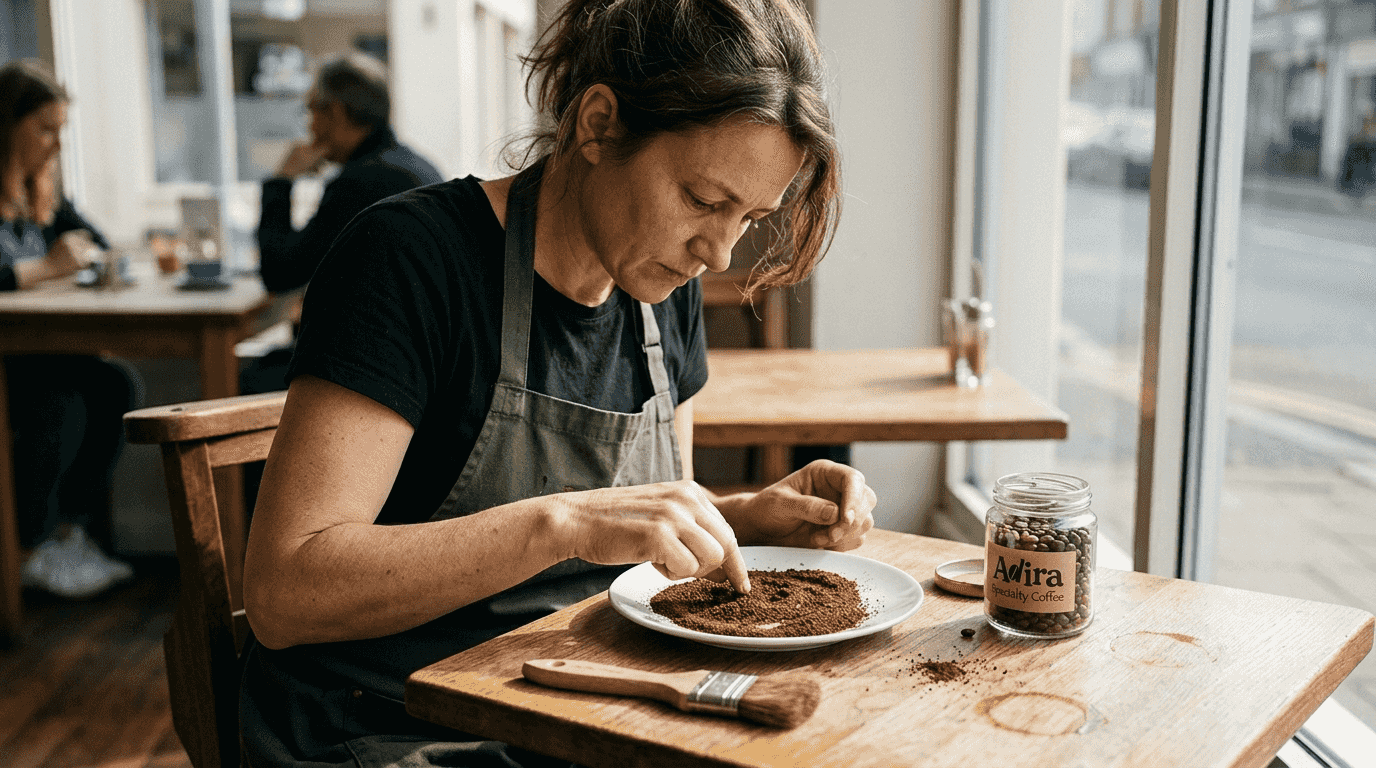
Conical burr grinders operate more efficiently with less friction, raising bean temperature 3-5°C during single-dose grinding. This modest increase rarely impacts flavor noticeably for most home brewing scenarios. However, flat burr grinders generate significantly more heat, increasing temperature 6-9°C per dose due to the shearing action between parallel burrs. The temperature impact becomes severe during consecutive grinding sessions, where back-to-back doses push temperatures to 12-15°C above ambient without cooling periods.
Excessive heat accelerates the volatilization of aromatic compounds that define coffee’s fragrance and flavor complexity. Temperature increases above 10°C can also trigger premature oxidation reactions that dull brightness and introduce stale characteristics before brewing even begins. Managing heat requires strategic grinding practices:
- Allow 60-90 seconds between grinding sessions when preparing multiple drinks to let burrs cool naturally
- Run the grinder empty for 3-5 seconds before dosing to clear residual grounds and assess motor temperature
- Grind at slower motor speeds if your grinder offers variable RPM settings, reducing friction heat generation
- Consider refrigerating beans for 15-20 minutes before grinding during hot weather, though avoid freezing which introduces moisture
Consistency in particle size distribution matters equally for achieving balanced extraction. Uniform grinds ensure water contacts similar surface areas across all particles, extracting compounds at comparable rates and preventing the simultaneous over-extraction of fines and under-extraction of boulders that creates muddled flavors. Burr alignment, motor stability, and regular maintenance all influence consistency.
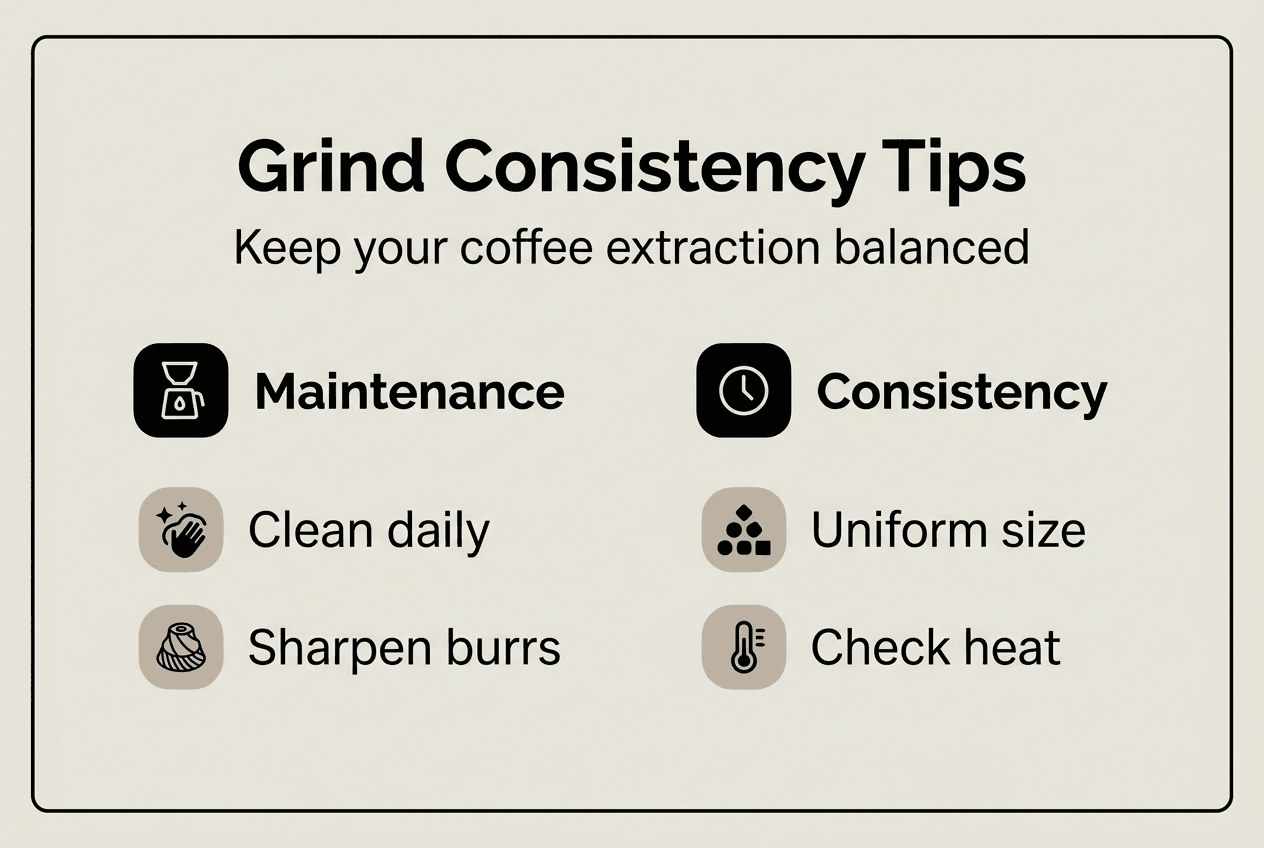
| Factor | Impact on Consistency | Maintenance Frequency |
|---|---|---|
| Burr sharpness | Dull burrs crush unevenly, creating more fines | Replace every 500-800 pounds ground |
| Burr alignment | Misalignment produces uneven gaps and particle sizes | Check annually or after impacts |
| Static buildup | Causes fines to cling and clump, affecting dosing | Use RDT or grind into container |
| Oil accumulation | Rancid oils coat burrs and taint fresh grinds | Deep clean every 2-4 weeks |
Maintaining your grinder preserves consistency and extends equipment life. Brush out the grinding chamber daily to remove accumulated chaff and fines. Disassemble and clean burrs monthly using grinder cleaning tablets or uncooked rice to absorb oils. Check burr wear annually by examining the cutting edges for rounding or smoothing that indicates diminished sharpness.
Pro Tip: Use the Ross Droplet Technique by misting beans lightly with water before grinding to eliminate static cling and improve particle flow, especially helpful for light roasts prone to static.
For more insights on maintaining equipment that complements your grinding setup, explore our espresso machine cleaning tips to ensure every component of your brewing process operates at peak performance.
Troubleshooting common grinding mistakes and optimizing your grind
Even experienced home baristas encounter grinding challenges that compromise coffee quality. Recognizing symptoms and implementing targeted corrections transforms frustrating results into consistently excellent cups. The most common issues relate to particle distribution, grind setting errors, and freshness management.
Uneven particle distribution manifests as simultaneous bitterness and sourness in the same cup, indicating that fines over-extracted while larger particles under-extracted. This problem often stems from dull burrs, misaligned grinding mechanisms, or blade grinders that chop rather than grind uniformly. Solutions include upgrading to quality burr grinders, replacing worn burrs, or having professionals realign your grinder’s burr assembly. Some unevenness is inevitable, as both geometries reach identical extraction yields when properly dialed despite different particle distributions.
Grinding too fine for your brewing method creates over-extraction characterized by harsh bitterness, astringency, and hollow aftertaste. Water flows too slowly through the coffee bed, dissolving undesirable compounds after optimal flavors have already extracted. Conversely, grinding too coarse produces weak, sour coffee lacking body and sweetness as water rushes through without sufficient contact time. Adjust your grind setting in small increments, moving coarser to reduce bitterness or finer to eliminate sourness.
Overheating during grinding introduces roasted or burnt notes that mask origin characteristics and subtle flavors. Symptoms include noticeably warm grounds immediately after grinding, diminished aroma intensity, and flat taste lacking vibrancy. Prevent overheating by grinding in single doses with cooling intervals, avoiding extended grinding sessions, and selecting grinders with efficient burr geometries and adequate motor cooling.
Stale grounds result from grinding too far in advance or improper storage after grinding. Coffee begins losing aromatic compounds within 15 minutes of grinding as increased surface area accelerates oxidation. Always grind immediately before brewing. If you must grind ahead, store grounds in an airtight container in a cool, dark location and use within 30 minutes for acceptable results.
Optimizing your grind requires systematic experimentation and careful observation:
- Change only one variable at a time when troubleshooting to isolate the cause of flavor issues
- Taste critically at each adjustment, noting specific flavor characteristics rather than vague impressions
- Document successful settings for different beans and brewing methods to build a personal reference
- Consider water temperature, brew time, and coffee-to-water ratio alongside grind size when diagnosing problems
- Trust your palate over arbitrary rules, as personal preference ultimately defines the perfect grind
When flavor issues persist despite grind adjustments, examine your coffee selection to ensure bean quality, roast freshness, and origin characteristics align with your taste preferences and brewing method. Sometimes the solution lies in the beans themselves rather than grinding technique.
Pro Tip: Create a simple cupping session by grinding the same beans at three different settings and brewing side by side to directly compare how particle size affects flavor, body, and finish.
Enhance your coffee experience with Adira Coffee
Mastering coffee grinding unlocks the potential hidden in quality beans, but exceptional results demand exceptional ingredients. Adira Coffee delivers freshly roasted, ethically sourced beans from over 50 partner farms across Colombia, Ethiopia, Costa Rica, Guatemala, Brazil, and Sumatra directly to your door at peak flavor. Our small-batch roasting ensures you receive coffee within days of roasting, maximizing the aromatics and complexity your grinding skills can extract.
Explore our curated selection of premium coffee beans to find origins that match your flavor preferences and brewing methods. Whether you prefer bright, fruity Ethiopian naturals or rich, chocolatey Colombian washed coffees, our collection offers diverse profiles that reward careful grinding and preparation. Complement your grinding knowledge with our expert brewing guides that provide detailed instructions for every method, from espresso to cold brew. Visit Adira Coffee to elevate your home brewing with beans roasted fresh for your perfect cup.
FAQ
How do I know what grind size to use?
Grind size depends entirely on your brewing method and desired extraction time. Coarse grinds work best for French press and cold brew where contact times exceed four minutes, while fine grinds suit espresso with 25-30 second extractions. Medium grinds serve drip coffee and pour-over methods with 3-4 minute brew times. Consult our brewing guides for specific starting points, then adjust based on taste.
Why does my coffee taste bitter or sour after grinding?
Bitter flavors typically indicate over-extraction from grinding too fine, brewing too long, or using water that’s too hot. Sour tastes signal under-extraction caused by grinding too coarse, insufficient brew time, or water that’s too cool. Adjust your grind size incrementally, moving coarser to reduce bitterness or finer to eliminate sourness. If adjustments don’t resolve the issue, examine your coffee selection and brewing parameters.
How can I reduce heat buildup during grinding?
Single-dose grinding minimizes heat by processing only what you need immediately, preventing prolonged motor operation and friction buildup. Allow your grinder to cool for 60-90 seconds between doses when preparing multiple drinks. Conical burr grinders generate less heat than flat burrs, making them preferable if temperature concerns dominate your brewing priorities. Maintaining clean burrs also improves grinding efficiency and reduces unnecessary friction heat.
Is fresh ground coffee always better than pre-ground?
Freshly ground coffee dramatically outperforms pre-ground alternatives by preserving volatile aromatic compounds that define coffee’s fragrance and flavor complexity. Grinding increases surface area exposure to oxygen, accelerating stale oxidation reactions that begin within 15 minutes. Pre-ground coffee loses most aromatic intensity within hours, leaving flat, one-dimensional flavors. Invest in quality fresh coffee beans and grind immediately before brewing to experience the full spectrum of flavors your coffee offers.
Recommended
- How to choose coffee beans for the perfect brew in 2026 – Adira Coffee US
- Clean your espresso machine for perfect flavor in 2026 – Adira Coffee US
- Find Your Coffee – Adira Coffee US
- Brewing Guides – Adira Coffee US
- How to choose coffee beans for the best home brew in 2026 – Z’s Coffee
- How to store coffee beans for optimal freshness in 2026