

TL;DR:
- Precise tools like burr grinders, scales, and proper water are essential for consistent, high-quality brewing.
- Proper preparation, including weighing, preheating, and controlling water temperature, greatly impacts flavor outcomes.
- Adjusting variables like grind size and brew time based on sensory feedback improves overall coffee quality.
You’ve invested in premium beans from a trusted source, followed a recipe you found online, and still ended up with something that tastes flat, bitter, or just… off. It’s one of the most common frustrations among home coffee enthusiasts, and the gap between what you taste at a great café and what comes out of your kettle at home is rarely about the beans alone. It’s about precision, process, and understanding why each step matters. This guide walks you through the exact tools, preparation steps, brewing methods, and tasting techniques that separate a forgettable cup from a genuinely exceptional one.
Table of Contents
- Essential tools and ingredients for specialty coffee
- Preparation: Setting up for the perfect brew
- Brewing methods: Pour-over, French press, and AeroPress compared
- Troubleshooting and perfecting your specialty brew
- Verifying results: Tasting and evaluating your coffee
- Why obsessing over small details sets true specialty coffee apart
- Ready to level up? Explore fresh specialty beans and guides
- Frequently asked questions
Key Takeaways
| Point | Details |
|---|---|
| Precision tools matter | Using a burr grinder, scale, and good water unlocks better flavor and consistency. |
| SCA standards guide success | Applying industry benchmarks for ratios and temperature ensures consistently great coffee. |
| Refine your method | Experimenting and adjusting every variable helps perfect your specialty brew at home. |
| Taste and evaluate | Savoring and critiquing your cup promotes learning and helps track improvement. |
Essential tools and ingredients for specialty coffee
To gain consistent results, you need the right tools and ingredients. This isn’t about spending a fortune. It’s about understanding what each piece of equipment actually does for your cup.
Here’s what you need to get started:
- Burr grinder — produces uniform particle size for even extraction
- Digital scale — measures coffee and water by weight, not volume
- Gooseneck kettle — gives you precise control over pour speed and direction
- Timer — keeps your brew time consistent across every session
- Specialty filter — paper filters produce clarity; metal filters allow more oils through
- Fresh coffee beans — roasted within the last two to four weeks
- Filtered water — free of chlorine and off flavors that muddy your cup
Each of these tools plays a specific role. Precision tools like a scale, timer, gooseneck kettle, and burr grinder are essential for repeatability, and the SCA (Specialty Coffee Association) provides empirical benchmarks that make these tools meaningful rather than optional.
Basic vs. advanced gear: what changes with each upgrade
| Tool | Basic option | Advanced option | Impact on brew |
|---|---|---|---|
| Grinder | Blade grinder | Burr grinder | Huge: even grind = even extraction |
| Scale | Kitchen scale | 0.1g precision scale | Medium: accuracy improves ratios |
| Kettle | Standard kettle | Gooseneck with thermometer | High: controls temp and pour |
| Filter | Generic paper | Specialty paper or metal | Medium: affects body and clarity |
| Beans | Supermarket bag | Freshly roasted specialty | Huge: freshness defines flavor |
For beans, we work directly with around 50 farms across Colombia, Ethiopia, Costa Rica, Guatemala, Brazil, and Sumatra. Freshness matters more than most people realize. A bag roasted six weeks ago has already lost a significant portion of its volatile aromatics. Explore coffee grind size to understand how particle uniformity shapes your final flavor, and check our brewing guides for method-specific setup tips.
Pro Tip: A burr grinder crushes coffee between two abrasive surfaces, creating uniform particles. A blade grinder chops randomly, producing a mix of fine dust and chunky pieces that extract at wildly different rates. The result is a cup that’s simultaneously bitter and sour. If you upgrade one thing first, make it the grinder.
Preparation: Setting up for the perfect brew
With your equipment assembled, the next step is dial-in preparation. This is where most home brewers skip steps and wonder why their results vary day to day.
Follow these steps before every brew:
- Weigh your beans. Use your scale to measure your dose in grams. Don’t eyeball it.
- Set your grind size. Match it to your chosen brew method. Coarser for French press, medium for pour-over, fine for AeroPress espresso-style.
- Preheat your equipment. Run hot water through your dripper, carafe, and cup before brewing. This stabilizes temperature throughout the process.
- Measure your water. Weigh it, don’t measure by volume. Water density varies with temperature.
- Heat to the right temperature. Aim for the SCA Golden Cup range: 195 to 205°F (90 to 96°C), with a coffee-to-water ratio of 1:15 to 1:18 (55g per liter), targeting an extraction yield of 18 to 22% and a TDS (total dissolved solids) of 1.15 to 1.35%.
Water quality is often underestimated. Tap water with high chlorine content or heavy mineral loads will interfere with extraction and mask the nuanced flavors you’re paying for in specialty beans. Filtered water with a moderate mineral content, around 150 ppm, is the sweet spot.
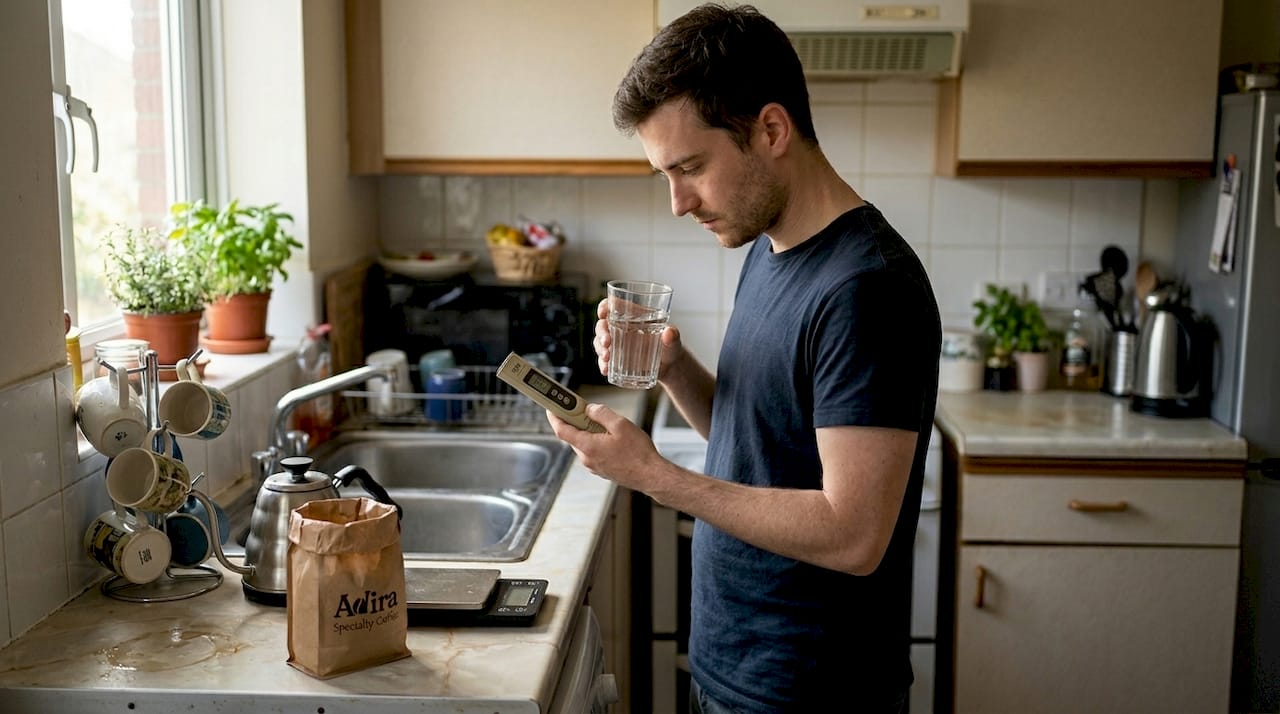
When choosing coffee beans, keep roast date in mind. Beans need a short rest after roasting (two to seven days for lighter roasts, one to three days for darker ones) before they’re at peak flavor.
Pro Tip: Always pre-wet your paper filter with hot water before adding grounds. This removes the papery taste that can sneak into your cup and warms the brewer at the same time. Discard that rinse water before you brew.
Brewing methods: Pour-over, French press, and AeroPress compared
Once you’re set up, it’s time to explore different brewing techniques. Each method pulls different qualities from the same bean.
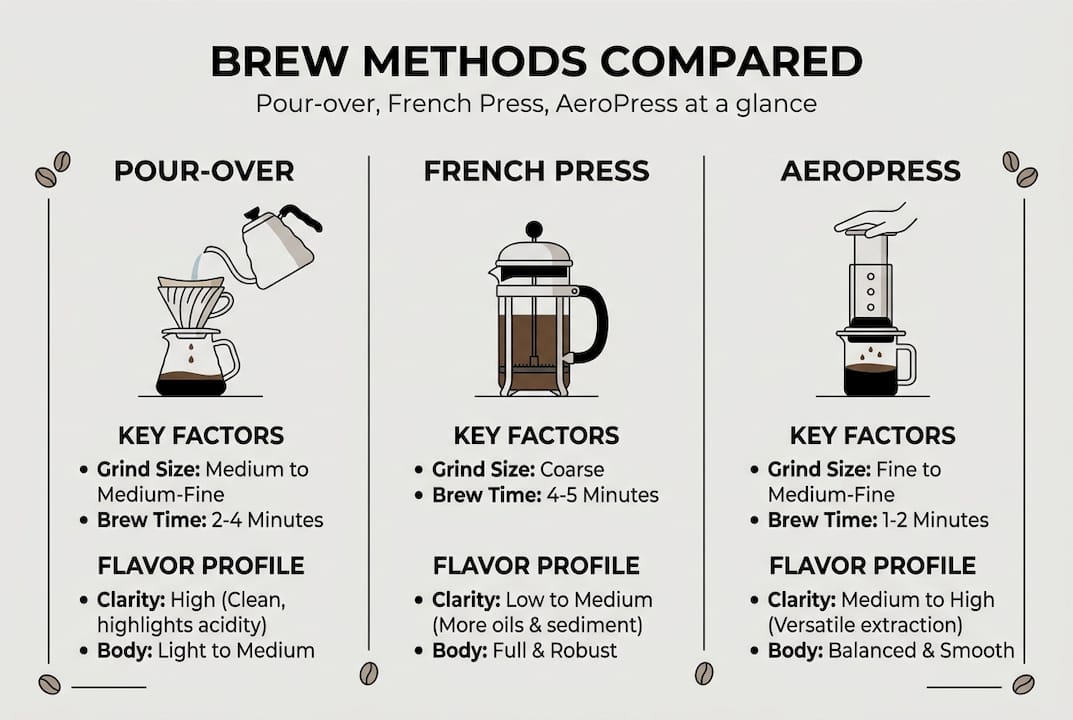
| Method | Grind size | Ratio | Water temp | Brew time | Flavor profile |
|---|---|---|---|---|---|
| Pour-over | Medium | 1:15 to 1:17 | 200 to 205°F | 3 to 4 min | Clean, bright, complex |
| French press | Coarse | 1:15 | 200°F | 4 min | Full-bodied, rich, heavier |
| AeroPress | Medium-fine | 1:12 to 1:15 | 185 to 205°F | 1 to 2 min | Versatile, smooth, concentrated |
French press uses a coarse grind, a 1:15 ratio, 200°F water, and a four-minute steep, producing a full-bodied cup that’s richer but less filtered than pour-over methods.
Pour-over steps:
- Place filter, rinse with hot water, discard rinse water
- Add grounds, create a small well in the center
- Start timer, pour 2x the coffee weight in water (bloom phase, 30 seconds)
- Pour slowly in circles until you reach your target weight
- Total brew time: 3 to 4 minutes
French press steps:
- Add coarse grounds to the press
- Pour all water at once, stir gently
- Place lid on (plunger up), steep for 4 minutes
- Press slowly and pour immediately
AeroPress steps:
- Insert filter, rinse, attach cap to chamber
- Add grounds, pour water to target weight
- Stir for 10 seconds, steep for 60 to 90 seconds
- Press slowly over 30 seconds
“Pour-over excels for clarity and origin notes in specialty coffee, while AeroPress offers versatility and speed, both superior to drip for home baristas seeking nuance.”
For more context on which method fits your taste goals, explore our home brewing methods overview or our cold brew guide if you prefer something chilled.
Troubleshooting and perfecting your specialty brew
Even advanced gear and techniques sometimes yield less-than-perfect results. Knowing how to read your cup and make targeted adjustments is what separates a developing home barista from a confident one.
Common problems and fixes:
- Bitter coffee: Over-extracted. Try a coarser grind, shorter brew time, or lower water temperature.
- Sour or weak coffee: Under-extracted. Try a finer grind, longer brew time, or higher water temperature.
- Flat, lifeless cup: Likely stale beans or poor water quality. Check roast date and switch to filtered water.
- Inconsistent results: Probably a measurement issue. Start weighing everything, every time.
To measure extraction objectively, use a TDS (total dissolved solids) meter. The SCA benchmarks for specialty brews target an extraction yield of 18 to 22% and a TDS of 1.15 to 1.35%. If your numbers fall outside that range, adjust one variable at a time.
Bean freshness directly affects how your coffee extracts. Older beans are denser in CO2 loss, which means they extract faster and can go bitter more quickly. Freshly roasted beans bloom more vigorously and reward a slightly longer brew time. For more on how roast level affects extraction behavior, see our coffee roasting tips.
Pro Tip: Keep a simple brewing log. Write down your dose, grind setting, water temp, brew time, and tasting notes after every session. After two weeks, patterns emerge. You’ll know exactly which variables to pull when something tastes off.
Verifying results: Tasting and evaluating your coffee
Now that you’ve refined your process, it’s time to savor and assess your creation. Tasting isn’t just enjoyment. It’s data.
Follow these sensory evaluation steps:
- Aroma: Smell the dry grounds, then the wet grounds after blooming. Notice fruit, floral, nutty, or earthy notes.
- Acidity: Take your first sip and notice the brightness. Is it sharp and pleasant, or harsh and aggressive?
- Sweetness: Good extraction brings natural sweetness forward. No sugar needed in a well-brewed specialty cup.
- Body: How does the coffee feel in your mouth? Light and tea-like, or heavy and coating?
- Finish: What lingers after you swallow? A long, pleasant finish is a sign of quality beans and good extraction.
Common flavor attributes to look for in specialty coffee:
- Fruity: berry, citrus, stone fruit (common in Ethiopian and Kenyan origins)
- Floral: jasmine, rose, lavender (often in light-roasted washed coffees)
- Nutty or chocolatey: almond, hazelnut, dark chocolate (common in Brazilian and Guatemalan origins)
- Caramel or brown sugar: sweetness from well-developed medium roasts
- Earthy or herbal: forest floor, tobacco, cedar (often in Sumatran coffees)
Using the SCA Coffee Taster’s Flavor Wheel helps you build vocabulary over time. It maps hundreds of flavor descriptors from basic (sweet, sour, bitter) to specific (bergamot, tamarind, red apple). The more you practice, the faster your palate calibrates. For deeper context, read about understanding coffee roasting to connect roast decisions to flavor outcomes, and use our find your coffee tool to match beans to your tasting preferences.
Why obsessing over small details sets true specialty coffee apart
Here’s the uncomfortable truth most coffee content won’t say out loud: there is no single perfect recipe. Every bag of beans is different. Every water source is different. Humidity, altitude, even your kettle’s heating element affects results in ways no recipe can fully predict.
The baristas who consistently brew exceptional coffee aren’t following a script. They’re paying attention. They notice when the bloom looks sluggish (a sign of older beans) or when the drawdown is faster than usual (a sign of a coarser grind than intended). They adjust. They stay curious.
We’ve seen home brewers with a $50 setup outperform others with $500 gear simply because they kept a log, tasted critically, and weren’t afraid to change one variable at a time. Mistakes aren’t failures. They’re calibration. Every bitter cup tells you something. Every sour shot is a clue.
Our specialty brewing guides are built around this philosophy: give you the framework, then trust you to adapt it. The joy of specialty coffee isn’t in achieving a fixed result. It’s in the ongoing conversation between you, your beans, and your process.
Ready to level up? Explore fresh specialty beans and guides
You now have the framework to brew with intention and taste with purpose. The next step is putting it into practice with beans that are actually worth the effort.
At Adira Coffee, we source directly from around 50 farms across Colombia, Ethiopia, Costa Rica, Guatemala, Brazil, and Sumatra, roasting in small batches so your coffee arrives at peak freshness. Browse our full range of specialty coffee beans to find your next favorite origin, and pair it with our expert brewing guides for method-specific instructions. Whether you’re dialing in your first pour-over or experimenting with AeroPress ratios, shop Adira Coffee and start brewing something worth savoring.
Frequently asked questions
What is the ideal coffee-to-water ratio for specialty coffee?
The SCA recommends a coffee-to-water ratio between 1:15 and 1:18, or about 55 grams of coffee per liter of water, as the Golden Cup standard for balanced extraction.
How important is grind size in brewing specialty coffee?
Grind size is critical. Too fine causes over-extraction and bitterness; too coarse leads to weak, sour coffee. Always match your grind to your brew method, and use precision tools like a burr grinder for consistent particle size.
Which brewing method brings out the most flavor in specialty coffee?
Pour-over excels at highlighting clarity and origin-specific notes, while AeroPress delivers impressive nuance with more speed and flexibility for home baristas.
How do I fix bitter or weak specialty coffee at home?
Bitter coffee usually means over-extraction: try a coarser grind or lower water temperature. Weak or sour coffee signals under-extraction, so use a finer grind or extend brew time to hit the SCA target range of 18 to 22% extraction yield.
Do I need expensive equipment to brew specialty coffee at home?
Not at all, but a burr grinder, digital scale, and filtered water make a measurable difference in consistency and flavor clarity that you’ll notice immediately in your cup.