
For most home baristas, single dosing beats a hopper for espresso because it protects freshness and gives you gram-level control shot to shot. A hopper still wins if you brew high volumes daily or never switch beans. The trade-off comes down to freshness and low retention versus raw speed and convenience, and beans from a roaster like Adiracoffee, shipped within days of roasting, make that freshness gap the whole point.
TL;DR:
- Switching to single dosing reduces cross-contamination of flavors, especially when rotating beans frequently, and prevents stale beans from affecting the current shot.
- Roast date significantly impacts freshness; beans are at their peak between 4 and 21 days after roasting, and buying small quantities from a roaster who ships quickly ensures optimal flavor.
- Retention inside the grinder is less critical for single beans, but when changing origins, even small amounts of retained grounds can contaminate new flavors, making dedicated grinders beneficial.
- Hopper grinders are better suited for high-volume households with consistent beans, as they offer faster prep and less daily maintenance, while single dosing requires discipline and precise timing.
- Static buildup and cleaning are common challenges in single dosing, but techniques like misting beans and using bellows help reduce static and keep the workflow clean.
Table of Contents
- What Is Single Dosing vs Hopper Grinding, Really?
- How Roast Date and Degassing Change Your Cup
- Why Grinder Retention Matters More Than You Think
- The Real Trade-Offs: Time, Waste, and Daily Hassle
- How to Actually Run Each Workflow Well
- Which Workflow Fits Your Coffee Routine?
- What Roast-to-Order Coffee Teaches You About Both Workflows
- The Bottom Line on Single Dosing vs Hopper
- The Overrated Debate Nobody Frames Correctly
- Try Fresher Beans Before You Chase a New Grinder
- Sources
What Is Single Dosing vs Hopper Grinding, Really?
Single dosing means weighing out exactly the coffee you need for one shot or one brew, dropping it into the grinder, and grinding nothing extra. There’s no reserve bean sitting in the machine waiting for tomorrow. Hopper grinding does the opposite: you load a large container of beans on top of the grinder, and it feeds beans down as needed, sometimes for days or weeks before you refill it.
The real technical difference between these two workflows isn’t really about the beans. It’s about retention, the coffee that stays trapped inside the grinder’s burr chamber, chute, and exit funnel after a dose passes through. Every grinder retains some ground coffee. The question is how much, and what happens to it. In a hopper setup, retained grounds from yesterday’s Colombian roast can linger and blend into today’s Ethiopian natural, muddying the cup in ways you might blame on the beans instead of the machine. Single dosing exists largely to solve this problem, since a nearly empty chamber has almost nothing old left to contaminate the new dose.
Grinder hardware has evolved to serve both camps, and the hardware you own often decides which workflow actually makes sense:
- Large hoppers hold 200 to 500 grams or more, built for cafés and households that grind the same bean constantly.
- Mini-hoppers hold a smaller reserve, a compromise that still stores beans but limits how much goes stale before use.
- Single-dose cups or trays sit where a hopper would, designed to be filled and emptied each time, often with a lid to control static.
- Bellows are flexible chambers, usually rubber or silicone, that you squeeze after grinding to push out lingering grounds and clear the chute.
Some grinders are purpose-built single-dosers with no hopper option at all. Others are coppered machines that home baristas retrofit for occasional single dosing, with mixed results you’ll see in a later section.
How Roast Date and Degassing Change Your Cup
Coffee has a freshness window, and it’s narrower than most people assume. Beans go through a predictable arc after roasting: 1 to 3 days out, they’re still releasing so much carbon dioxide that espresso shots run erratically fast and taste thin no matter how you dial in the grind. From roughly 4 to 21 days, beans hit their peak for both espresso and filter brewing, with enough degassing to pull a stable shot but enough aromatic compound left to taste vivid. From 21 to 45 days, flavor declines gradually. Past 45 days, most coffee reads as flat or stale, according to the freshness timeline research from Brewed Barista.
Freshness by the numbers: Beans typically peak for espresso and filter extraction between 4 and 21 days post roast, decline gradually through day 45, and read as stale beyond that window.
This is where a lot of home baristas get tripped up in the opposite direction. Beans under 7 to 10 days old can produce fast, erratic shots that get misread as a “bad batch” when the real issue is excess CO2, a pattern sometimes called the freshness trap. The fix isn’t cranking the grind size finer. It’s giving the bag a few more days to rest before you touch the dial.
Grinding timing multiplies all of this. Whole beans stale slowly because their surface area is small and their oils are sealed inside a relatively intact structure. The moment you grind, surface area explodes, and so does the rate of oxidation. A whole bean sitting in a hopper for two weeks loses aroma slowly. Ground coffee sitting exposed for even twenty minutes loses aroma fast. That’s the entire argument for grinding close to brew time rather than pre-grinding a batch, and it’s a big part of why a hopper full of beans, exposed to air and light every time you brew, accelerates staling compared to a sealed bag opened only at dose time.
The practical takeaway is simple even if it runs against habit: buy amounts you’ll actually finish inside that 2 to 4 week peak window, and grind each dose right before you brew rather than staging ground coffee ahead of time. If you’re working through a 12 ounce bag solo, that usually means buying smaller and buying more often, not stockpiling.
Pro Tip: Check the roast date, not the “best by” date, when a bag arrives. Most specialty roasters print the actual roast date somewhere on the bag, and that’s the number that tells you where you sit on the freshness curve.
Why Grinder Retention Matters More Than You Think
Retention is the hidden variable that decides whether single dosing is even worth the extra effort. Purpose-built single-dose grinders can hold onto under 1 gram of coffee between doses, while many hopper-style grinders retain somewhere between 2 and 8 grams inside the burr chamber and chute, according to Clive Coffee’s breakdown of the two designs. That gap sounds small until you realize it’s not really about quantity. It’s about what that retained coffee is and when it shows up.
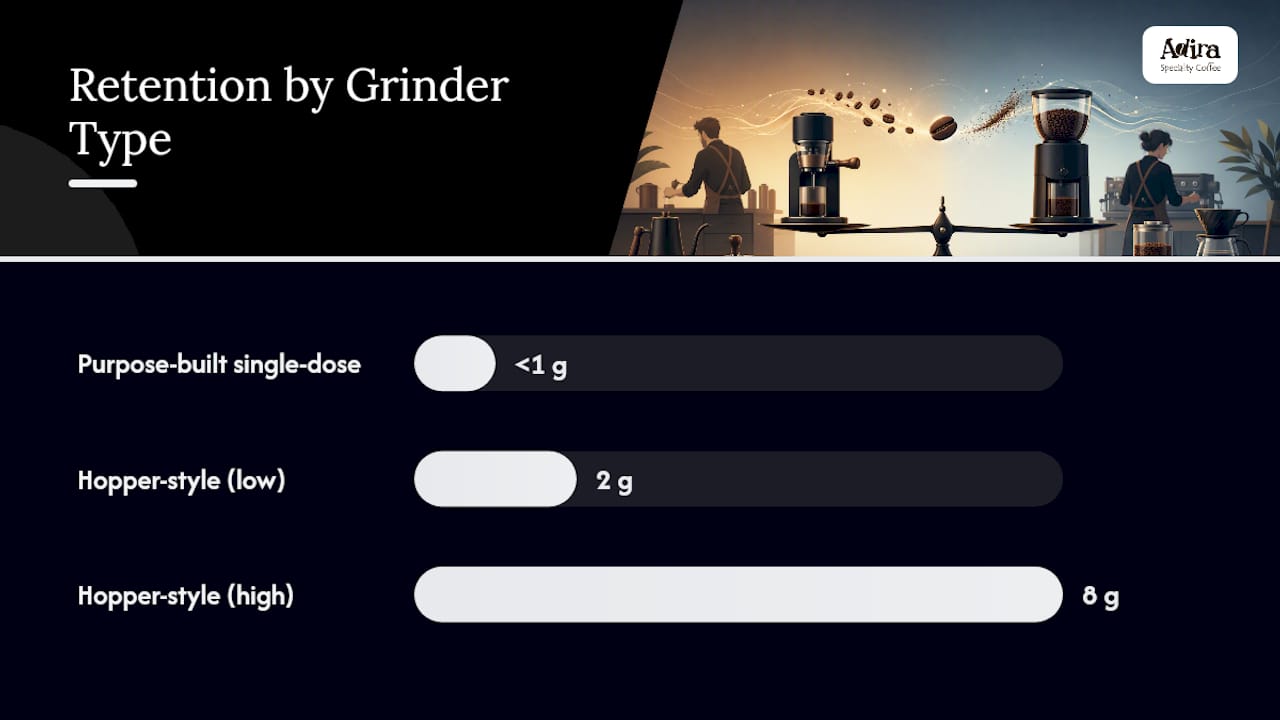
Retention only becomes a real problem when you switch beans. If you drink the same Ethiopian natural every single day, 4 grams of yesterday’s Ethiopian mixed into today’s dose changes almost nothing, since it’s the same coffee. Switch to a Sumatra the next morning, and that same 4 grams of leftover Ethiopian is now contaminating a completely different flavor profile. This is why Clive Coffee’s own analysis points out that retention matters far less for single-bean households than for anyone rotating origins regularly.
Certain design features exist specifically to fight retention:
- Bellows attachments let you squeeze air through the chamber after grinding, physically pushing loose grounds out the chute.
- Angled or vertical burr chutes rely on gravity instead of a flat catch tray, so grounds fall clear instead of resting on a ledge.
- Removable burr housings let you pop the top burr out and brush or vacuum the chamber directly, something a sealed hopper design won’t allow.
Retrofitting a hopper grinder to behave like a single-doser is possible but has real limits. The common trick is running two short “clearing” grinds with no beans loaded before your actual dose, letting the burrs spin dry to knock loose grounds free, then following with a light bellows purge, a technique detailed in Clive Coffee’s retention guide. It helps, but it’s a workaround, not a fix. A grinder engineered from the ground up for single dosing, with tight tolerances and minimal internal geometry for coffee to hide in, will always run cleaner than a repurposed hopper grinder no matter how disciplined your tapping routine gets.
The Real Trade-Offs: Time, Waste, and Daily Hassle
The honest case for a hopper is speed, plain and simple. Scoop beans in once, and every shot after that is grind, tamp, pull. Single dosing adds a weighing step and usually a bit of cleanup, which typically tacks on roughly 30 to 60 seconds per shot compared to grabbing beans straight from a hopper. That sounds trivial written out, but multiply it by two people making espresso before work on a Tuesday and it starts to matter.
Where the math flips is bean switching. Here’s what actually happens each time you swap beans on a hoppered grinder:
- Empty the hopper of the old bean, which usually means grinding it down to nearly nothing or scooping out the remainder by hand.
- Run a purge grind or two to clear retained grounds from the chamber and chute.
- Load the new bean and run another clearing grind before your first real dose, since the first pass typically pulls a mix of old and new.
- Discard that purge coffee, which on many machines runs 3 to 5 grams every single time.
Do that twice a week because you like rotating between an Ethiopian natural and a Sumatra, and you’re tossing meaningful coffee purely to keep the grinder honest. Single dosing sidesteps the whole ritual because there’s nothing left to purge.
Maintenance cuts the other way. Hopper grinders mostly just need periodic cleaning. Single dosing introduces static, coffee grounds clinging to the chamber walls, the chute, even your fingers, thanks to the friction of grinding a small isolated dose with nothing buffering the charge. It’s the single most common complaint from people who switch to single dosing and the reason so many end up troubleshooting grinder static fixes within the first month.
Pro Tip: If you only brew one cup a day and never rotate beans, don’t let anyone talk you into single dosing purely because it sounds more “serious.” A well-loaded hopper with beans inside their peak window will serve you just as well with a fraction of the fuss.
How to Actually Run Each Workflow Well
Single dosing rewards a little discipline up front, then runs on autopilot. Here’s the routine that keeps it clean:
- Weigh your dose on a scale accurate to 0.1 gram. Espresso is unforgiving about a gram or two either way, so precision here isn’t fussy, it’s foundational.
- Optionally mist the beans with a fine spray of water before grinding, known as the Ross Droplet Technique, which cuts static dramatically compared to grinding dry beans, according to BaristaPath’s single-dosing guide.
- Load the dose into the single-dose cup or hopper opening (small container designed for single doses).
- Grind, then clear any remaining grounds with a bellows squeeze or a couple of gentle taps on the chute.
- Dose directly into your portafilter basket and brew while the grounds are still at their most aromatic.
If you’re sticking with a hopper, the goal is narrowing the gap rather than abandoning convenience. A mini-hopper or short hopper holds noticeably less bean reserve than a full-size one, which limits how long beans sit exposed to air between refills, a middle path several hopper design guides recommend for exactly this reason. Store your reserve bag sealed and away from light rather than pouring an entire pound into the hopper at once. And when you do switch beans, treat the purge grind as non-negotiable rather than an occasional afterthought.
Static deserves its own attention regardless of which workflow you run, but it hits single dosing harder because there’s no bulk of beans to dilute the charge. Beyond RDT, some baristas keep an anti-static dosing cup on hand, or use a small spray bottle to mist beans right before they hit the burrs. Adiracoffee’s own breakdown of the grinder static fix walks through the water-ratio details if clumping keeps showing up in your dosing cup.
Which Workflow Fits Your Coffee Routine?
Run through this before you buy a grinder or change your morning routine:
- How many shots or cups do you actually pull per day? One or two favors either workflow; five or more starts to favor a hopper purely on time.
- How often do you switch between different beans or origins? Weekly rotation strongly favors single dosing.
- How much extra prep time can you tolerate before your first sip? If mornings are already rushed, that 30 to 60 second gap matters more than it sounds.
- Do you care about squeezing out every bit of freshness, or is “good enough” genuinely good enough for your palate?
| Your situation | Better fit | Why |
|---|---|---|
| Rotate beans weekly, want to compare origins | Single dosing | Zero cross-contamination between switches |
| Drink the same bag daily, high volume household | Hopper | Retention barely matters with one bean; speed wins |
| New to specialty coffee, want to learn dial-in | Single dosing | Removes dose variability while you learn other variables |
| Multiple coffee drinkers, mornings are rushed | Hopper (mini-hopper as compromise) | Keeps prep time low without a full-size stale reserve |
If you’re experimenting with origins, sample-friendly bags of Adiracoffee’s Ethiopia Natural or Colombia give you a clean single-dosing comparison without a big bag going stale before you finish it. If convenience is the priority and you’re not rotating origins often, a consistent blend like Ocean Blend or African Blend suits a hopper workflow just fine.
What Roast-to-Order Coffee Teaches You About Both Workflows
Roasting to order changes how seriously you take everything above. When beans ship within days of roasting instead of sitting in a distribution warehouse for weeks, you actually get to use that 4 to 21 day peak window instead of buying a bag that’s already past it before you open the seal. That’s the entire premise behind how Adiracoffee operates, small batches, roasted and shipped fast, so the freshness timeline discussed earlier isn’t theoretical.
Practical storage and dosing guidance that holds true regardless of which grinder workflow you run:
- Keep beans in an airtight container away from light and heat, and resist the urge to refrigerate or freeze an opened bag.
- If you’re single dosing, weigh straight from the sealed bag each time rather than transferring beans into a hopper reservoir “for convenience.”
- If you’re running a hopper, load only what you’ll use within a week or two, not the entire bag at once.
- Buy quantities sized to your actual drinking pace. A couple sharing two cups a day empties a 12 ounce bag faster than they think, which works in their favor for freshness.
For readers who want the mechanics of grind size and dose weight explained further, Adiracoffee’s guide on grinding coffee for perfect flavor and its grinder workflow guide both go deeper into dialing in specific machines.
The Bottom Line on Single Dosing vs Hopper
The verdict from the start holds up under every angle covered here: single dosing is the better default for anyone who rotates beans, chases fresh flavor, or is still learning to dial in a grinder, while a hopper earns its place in high-volume households running one consistent bean. Freshness science backs the freshness side; the purge-and-waste math backs the convenience side. Neither workflow is wrong, they just solve different problems.
Two things to do today: weigh out your next dose instead of eyeballing it, and check the roast date on whatever bag is currently open in your kitchen. If it’s past three weeks old, that’s your answer to why the last few shots tasted flat.
The Overrated Debate Nobody Frames Correctly
Most articles treat single dosing versus hopper as a gear war, like the answer lives in which machine you buy. It doesn’t. The answer lives in how you already drink coffee. I’d argue the freshness science gets undersold in most grinder reviews entirely, buried under retention specs and burr geometry nobody outside a coffee forum cares about.
Here’s what the conventional advice misses: retention numbers only matter once you’ve solved the bigger problem, which is whether your beans are fresh enough to be worth protecting in the first place. A perfectly clean single-dose grinder feeding you beans that shipped six weeks ago from a warehouse is still going to taste tired. The grinder was never the bottleneck.
Prioritize the bean’s age before you prioritize the burr chamber’s retention spec. Buy smaller quantities from a roaster that ships fast, and the single dosing versus hopper question becomes a workflow preference instead of a flavor emergency. Get the freshness right first. The grinder workflow is the second decision, not the first.
— Stefan
Try Fresher Beans Before You Chase a New Grinder
Adiracoffee exists for the exact problem this article keeps circling back to: stale beans undercut even the best grinder workflow. We roast single-origin and signature blends in small batches in California and ship within days of roasting, so when a bag lands on your counter, you’re inside that 2 to 4 week peak window instead of guessing how long it sat on a warehouse shelf.

If you’re testing single dosing and want to compare origins side by side, start with something distinct like Sumatra or the Love Blend. If you’re running a hopper for a household that drinks the same coffee daily, a dependable option like Cold Brew or the Adira Blend keep things simple without sacrificing roast quality. Pick a bag, check the roast date the moment it arrives, and put this article’s advice to work on your very first dose.
Sources
- Coffee Freshness Timeline: From Roast Date to Stale (2026) – Brewed Barista
- What is single dosing in a coffee grinder? — Coffee Equipment Reviews (BaristaPath)
- Single Dose vs Hopper Grinder: Key Differences – Clive Coffee