
Spray a fine mist of distilled water on whole beans before grinding. That single move, known as the Ross Droplet Technique, cuts the static charge on your grounds and often slashes grinder retention by half. It’s the fastest, cheapest, most repeatable grinder static fix available to anyone with a burr grinder and a spray bottle.
Here’s the practical version: aim for roughly 10 microliters of water per gram of beans. For an 18 gram espresso dose, that means 1 to 2 fine sprays from a misting bottle, just enough to leave beans slightly damp, never wet. Stir the beans gently so the moisture spreads evenly, then grind right away.
If you’d rather skip water entirely, a dry fallback works too: use a dosing funnel to contain fines, grind directly into a metal catch cup, and make sure your portafilter is fully seated before you pull the trigger. It won’t match RDT’s results, but it keeps your counter clean.
- RDT: a small amount of fine mist spray of distilled water per typical espresso dose, stirred before grinding
- Dry fallback: dosing funnel + metal catch bin + fully seated portafilter
- Grind immediately after wetting beans; don’t let them sit
Pro Tip: Keep a small labeled spray bottle of distilled water right next to your grinder. The friction that kills this habit isn’t the technique, it’s having to walk to the sink every morning.
Key Takeaways
RDT reduces grinder static charge by roughly half and can cut retention from over 10 percent to about 2.5 percent in dark roast beans, making it the most reliable home fix available.
| Point | Details |
|---|---|
| Use RDT as your default fix | Spray whole beans with distilled water at roughly 10 microliters per gram before grinding. |
| Watch for caking | Too much water causes clumping; back off the spray volume if grounds stop falling freely. |
| Dark roasts need more spray | Lower bean moisture in dark roasts means slightly higher water doses than light roasts. |
| Ionizers help mess, not retention | They neutralize charge at the chute but leave internal grinder buildup untouched. |
| Pair the technique with the right beans | Adiracoffee’s dark roast and single-origin lots respond well to RDT, with fresh-roasted beans giving the most predictable results. |
Table of Contents
- Why Grinder Static Happens in the First Place
- How to Do RDT Safely and Get Repeatable Results
- Dry Fixes and Anti-Static Hardware: What Actually Works
- What to Look for in a Low-Static Grinder Setup
- Roast Level and Bean Moisture Change Your Static Math
- Cleaning Your Grinder After RDT Sessions
- Stefan’s Testing Notes From the Adira Roastery
- Choosing RDT vs. Hardware: My Take
- Beans Worth Grinding Once Your Static Problem Is Solved
- Sources
Why Grinder Static Happens in the First Place
Static in your grinder isn’t random bad luck. It’s basic physics playing out every time a bean fractures against steel or ceramic burrs.
When coffee beans break apart under the shearing force of a burr grinder, two separate charging mechanisms kick in. The first is triboelectric charging, which happens when two different materials rub against each other, in this case, coffee particles against metal burrs and plastic chutes. The second is fractoelectric charging, which occurs the instant a solid material fractures and splits its surface charge unevenly between the resulting pieces. Both happen simultaneously inside every grind cycle, and together they leave your grounds carrying a real electrical charge.
That charge doesn’t just sit there quietly. Charged fines cling to the inside walls of the grinding chamber, stick to the exit chute, and cake onto the doser or catch cup. This changes two things you actually care about: how much coffee ends up in your cup (retention pulls mass out of your dose) and how evenly sized your particles are once they land in the basket.
The downstream effects show up in ways every home barista has noticed without necessarily connecting them to static:
- Grounds flying off the counter and clinging to your portafilter rim
- Dose weights that drift from day to day even when you set the same grind size
- Shot times and flow rates that wander because retained fines skew your particle distribution
Researchers who studied this directly found that adding water to whole beans before grinding reduces the charge to mass ratio of expelled grounds significantly, and in dark roast tests, grinder retention dropped substantially. That’s the difference between losing a tenth of your dose to the grinder body and barely losing any of it.
How to Do RDT Safely and Get Repeatable Results
RDT is simple in concept, but doing it the same way every time is what actually makes it useful. Sloppy application gets you inconsistent results, which defeats the entire purpose.
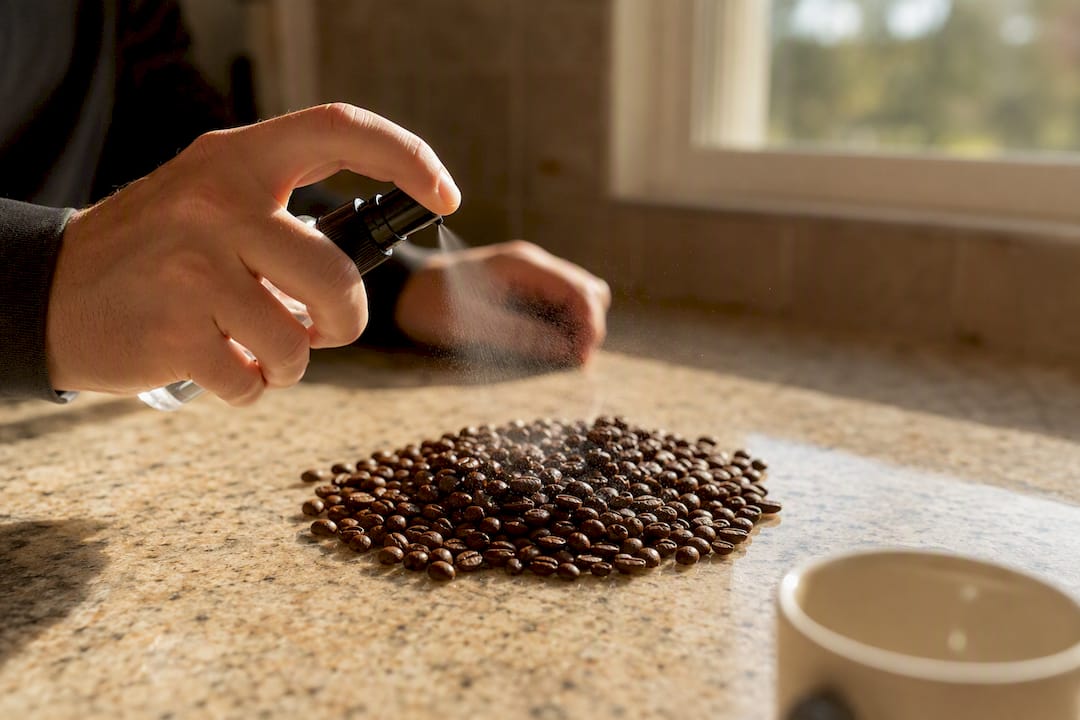
You need four things before you start: a fine-mist spray bottle or atomizer (not a spray bottle meant for cleaning products), distilled water, a small kitchen or coffee scale, and a dosing cup or single-dose funnel if your grinder supports one.
Here’s the sequence that works:
- Weigh your beans first, before anything touches them. Know your target dose.
- Spray the beans directly, using your target amount as a guide, roughly 10 microliters per gram. For 18 grams, that’s about 180 microliters total, which usually works out to 1 or 2 fine pumps depending on your nozzle’s droplet size.
- Stir or gently tumble the beans in their container for a few seconds so the moisture doesn’t pool on just the top layer.
- Grind immediately. Don’t let sprayed beans sit for more than a minute or two; you want the water working during the fracture, not evaporating beforehand.
- Weigh what comes out the chute and compare it to your input weight. That gap is your retention number.
Roast level changes the math slightly. Darker roasts are drier and more brittle, so they tend to need a touch more water than lighter roasts to see the same static reduction. Watch for caking on the burrs as your ceiling. If grounds start clumping instead of falling loose, you’ve oversprayed.
Verification matters more than most people bother with. After a week of consistent RDT, check three things: whether your scale shows less variance between dose weights, whether grounds still stick to the portafilter spout, and whether your shot times have tightened up. Peer-reviewed testing in Matter found that appropriately wetted beans produced measurable increases in espresso TDS and improved shot timing consistency in one trial.
Pro Tip: If you brew multiple doses back to back, spray a small batch of beans all at once rather than spritzing right before each grind. Just don’t let sprayed beans sit around for more than 10 to 15 minutes, or you lose the timing advantage.
Dry Fixes and Anti-Static Hardware: What Actually Works
Not everyone wants to introduce water into their grinder routine, whether because of a shared machine, a grinder that doesn’t tolerate moisture well, or simple preference. Several dry alternatives exist, though each comes with real limitations worth knowing before you buy anything.
Ionizers work by neutralizing charge right where grounds exit the chute. They’re genuinely effective at reducing the visible mess, fewer flyaway fines on your counter. But research shows ionizers act only at the output point and don’t address retention happening deeper inside the grinding chamber. Fines already stuck to internal walls stay stuck. Some lab work even found ionization can produce a modest TDS bump, but the improvement is smaller and less consistent than what water-based methods deliver.
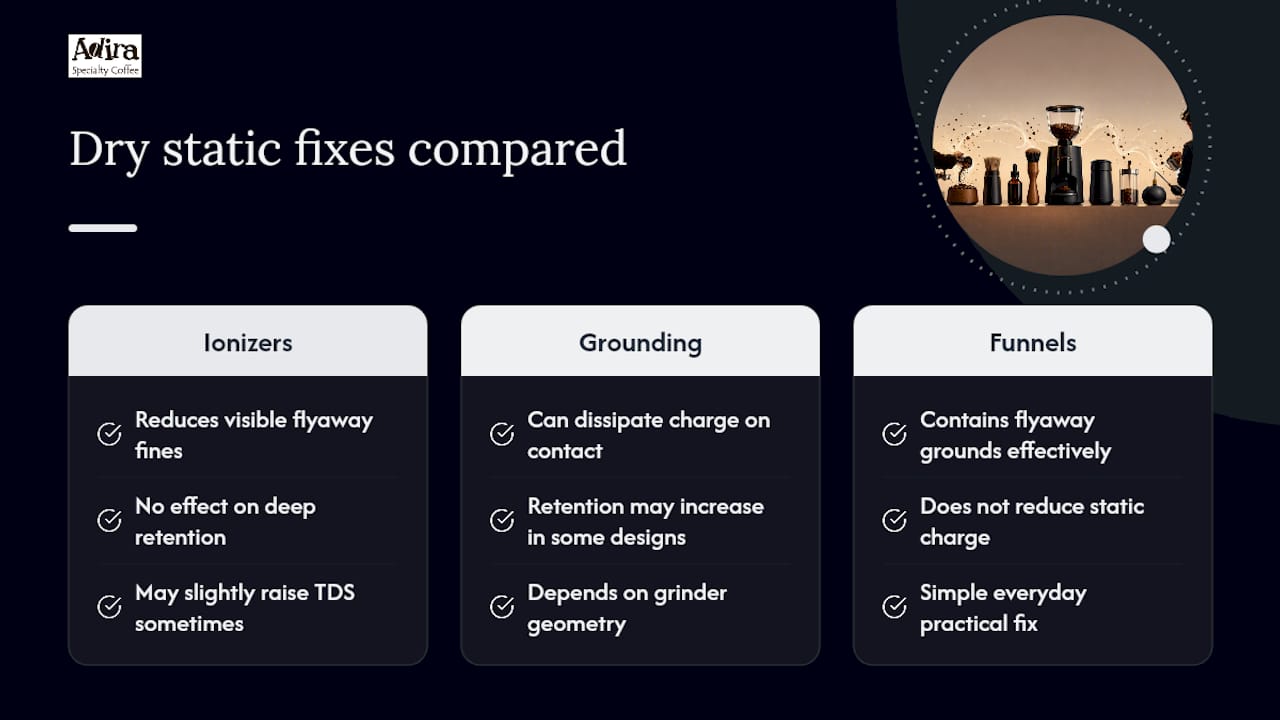
Grounding and metal catch bins offer a mixed bag. A conductive metal catch can help dissipate charge as grounds land in it, but depending on the grinder’s internal geometry, some designs actually see retention increase rather than decrease, because the charge has fewer places to go before it finds a static surface to cling to.
Dosing funnels and grinding straight into a covered container remain the simplest everyday fix for the mess factor, even if they don’t touch the underlying charge. You’re containing the problem rather than solving it, which is still worthwhile if flyaway grounds are your main complaint.
Humidity control sounds appealing on paper, since damp air theoretically reduces static everywhere. In practice it’s a dead end for home use. Studies show humidity only meaningfully reduces charging above roughly 60 percent relative humidity, and typical indoor humidity sits between 25 and 45 percent. Running a humidifier next to your grinder won’t get you there, and cranking whole-house humidity to 60 percent would make your home unpleasant and your walls moldy.
What to Look for in a Low-Static Grinder Setup
If you’re shopping for a new grinder or considering upgrades, a few design features genuinely move the needle on static, and a few marketing claims don’t.
Look for grinders with metal or grounded catch bins rather than plastic ones, since plastic is a worse conductor and holds charge longer. Single-dose grinders, where you weigh beans in and grind the full amount out, tend to show static problems more visibly than hopper-fed grinders, simply because there’s no buffer of beans diluting the effect. Anti-static coatings on exit chutes can help marginally, though they’re not a substitute for RDT or proper cleaning.
Be skeptical of vague marketing language like “anti-static technology” without specifics. Ask what material the chute is made from and whether the catch cup is actually grounded, not just labeled as “anti-static coffee grinder” on a box.
- Metal or grounded catch bins beat plastic every time
- Single-dose configurations show static more but respond well to RDT
- Minimal plastic surface area at the grind exit reduces cling
- Regular cleaning often matters more than small hardware differences between models
Roast Level and Bean Moisture Change Your Static Math
Darker roasts consistently show more static and higher retention than lighter roasts, and the reason comes down to moisture. Roasting drives water out of the bean, and the longer and hotter that roast runs, the drier and more brittle the final bean becomes. Drier beans generate more triboelectric charge when they fracture.

Lab testing found that darker roasts and their lower internal moisture correlate with higher charge and retention, while lighter roasts show smaller, though still measurable, improvements from the same RDT treatment.
The practical adjustment: if you’re grinding a dark roast, lean toward the higher end of your spray range and watch closely for caking, which is your signal you’ve crossed from “damp” into “wet.” Too much water doesn’t just risk clumping, it can leave behind mineral residue over time if you’re using tap water instead of distilled. Balance beats maximum saturation here.
Cleaning Your Grinder After RDT Sessions
RDT works best as part of a maintenance rhythm, not a one-off trick you forget about until static comes back.
- After each RDT session, run a short empty grind with no beans loaded. This clears residual moisture from the burrs and chute before it has a chance to sit.
- Wipe the exit chute and catch cup weekly with a dry cloth or brush, removing any caked grounds per your grinder’s manufacturer guidance.
- Let the grinder air out for a few minutes after cleaning rather than sealing it up immediately, especially if you’ve been using tap water instead of distilled.
- Watch for warning signs that call for a deeper service: visible corrosion on burrs, grounds caking instead of falling freely, or new grinding noises that weren’t there before.
Distilled water minimizes mineral buildup long-term compared to tap water, which matters if you’re running RDT daily. For a full walkthrough of grinder upkeep beyond static, Adiracoffee’s guide on how to clean your coffee grinder the right way covers burr removal and chute maintenance in more depth.
Stefan’s Testing Notes From the Adira Roastery
Testing RDT across different roast profiles taught us something the lab papers only hint at: bean behavior varies more by roast than most home baristas expect. Lighter roasts like our Ethiopia natural barely needed adjustment, a single light spray on an 18 gram dose did the job. Dark roasts needed a slightly heavier hand and closer attention to avoid caking.
The biggest surprise wasn’t that RDT worked, it was how forgiving it is once you find your bean’s sweet spot. You stop thinking about static entirely after the first week.
We generally recommend pairing RDT with darker, oilier roasts where retention tends to run highest, and going lighter on the spray for naturally drier, lower-moisture lots. If you want the fuller grinding workflow we use in-house, our post on mastering your coffee grinding workflow walks through dosing and dialing in alongside static control.
- Dark roasts: lean toward the higher end of the spray range
- Lighter, drier lots: a single light spray is often enough
- Consistency in application matters more than the exact volume
Choosing RDT vs. Hardware: My Take
RDT earns its place for anyone doing single-dose espresso, especially with darker roasts, where the retention drop is largest and easiest to measure. If you share a grinder in a household where someone doesn’t want water involved, or you’re running a grinder that’s fussy about moisture, an ionizer or a simple dosing funnel is the more realistic daily habit.
My honest workflow: RDT most mornings, dry fallback when I’m rushed. The tradeoff is a few extra seconds of prep against a cleaner counter and steadier shots. For most home setups, that trade is worth making.
— Stefan
Beans Worth Grinding Once Your Static Problem Is Solved
Fixing static only pays off if the beans behind it are worth the extra care. Adiracoffee roasts every order in small California batches, so the beans reaching your grinder are days off the roaster, not weeks off a warehouse shelf, which matters because fresher beans respond more predictably to RDT than stale ones.

If dark roasts are where your static problems run worst, our Mushroom Coffee Dark Roast is a solid place to put the technique to work, dense, low-moisture, and exactly the profile that benefits most from a fine mist before grinding. Prefer something brighter for a morning pour-over? Our Ethiopia Natural needs a lighter touch on the sprayer and rewards it with a cleaner cup. Every bag ships within days of roasting, and a subscription saves you 10 percent with free shipping over $35.
Pick a roast, dial in your spray, and start weighing what actually lands in your cup. Explore Adiracoffee’s roasts and find the one that fits your grinder and your morning.
Sources
- Strategies to mitigate electrostatic charging during coffee grinding - PMC
- Matter / ScienceDirect — study on moisture mitigating static during grinding