Coffee Bean Density: What It Means and How It Changes Your Brew

Coffee bean density is how much a given volume of beans weighs, and it explains why two bags can behave differently in the same grinder, with the same scoop, at the same setting. A dense, high-altitude bean is harder to crack and packs more grams into a scoop. A dark roast is puffed up and light, so the same scoop holds fewer grams. The fix at home is simple: weigh your dose, change one thing at a time, and start from a recipe written for your machine. That last part is what we do: every Adira bag is roasted after you order, and comes with a starting recipe for the brewer you already own.
TL;DR
- Density is mass divided by volume. For coffee, the number depends heavily on how it is measured, so only compare figures from the same method.
- Roasting cuts bulk density roughly in half: beans lose mass and swell. Dark roasts are the lightest per scoop.
- Altitude, origin and processing push green bean density up or down, which is one reason an Ethiopian and a Sumatran grind and flow differently.
- Scoops lie. Weigh your dose in grams before you touch the grind setting.
- Density is context, not a rule. Taste and flow decide the next adjustment.
In this guide
- What coffee bean density actually means
- How density is measured
- What density looks like in numbers
- Why roasting lowers density
- What makes one green bean denser than another
- How density shows up at your grinder and brewer
- Weigh the dose: the one habit that fixes most of it
- How density and roasting connect to freshness
- Our view on density
- A fresh bag, with a recipe for your machine
- FAQ
- Sources
What coffee bean density actually means
Density is mass divided by volume. For green coffee, buyers usually express it in grams per milliliter (the same as g/cm³), meaning how many grams of beans fit into a given space. Project Origin’s quality control protocol describes it as total weight in a space, not bean size or bean count. A bag of small beans and a bag of large beans can have the same density.
There is a catch that trips up most online comparisons. “Density” can mean three different things:
- Bulk density counts the air gaps between beans. Pour beans into a container, level it, weigh it. This is what a scoop or a hopper actually sees.
- Bean (apparent) density uses the bean’s own volume.
- True density is measured by displacing liquid or gas, and it comes out far higher because it ignores the air.
A number is only meaningful next to numbers taken the same way. When you read that green coffee “sinks in water” and is over 1 g/mL, that is true density. When you read 0.7 g/mL, that is bulk density. Both can be correct about the same bag.
How density is measured
The formal method is ISO 6669, the international standard for free-flow bulk density of whole green coffee beans. Beans are poured from a specified hopper into a receptacle of known volume, leveled, and weighed to 0.1 g. The result is expressed in grams per liter or kilograms per cubic meter, and moisture is measured at the same time, because wetter beans weigh more.
You can borrow the idea at home with a small graduated cylinder and a kitchen scale that reads to 0.1 g:
- Fill a 100 mL cylinder with whole beans, tapping lightly so the fill is consistent each time.
- Weigh the beans.
- Multiply the grams by ten to get grams per liter.
That is not a lab result, but it is a fair way to compare two bags of the same roast level against each other. It is optional: most home brewers get everything they need from the weigh-your-dose habit below.
What density looks like in numbers
Here are a few published measurements, so you can see the scale of the effect.
| What was measured | Result | Source |
|---|---|---|
| Green arabica, bulk density | 0.784 ± 0.025 g/mL | Acta Innovations, 2023 |
| Green robusta, bulk density | 0.692 ± 0.025 g/mL | Same study |
| Roasted arabica, 180 to 220 °C | 0.396 to 0.404 g/mL | Same study |
| Green arabica, bulk density | 680 kg/m³ | Cornell eCommons, 2003 |
| Light to medium roast, bulk | 314 to 369 kg/m³ | Same study |
| Medium to dark roast, bulk | 265 to 289 kg/m³ | Same study |
The two green arabica figures differ (0.784 g/mL against 680 kg/m³, which is 0.68 g/mL). That is the method and the sample talking, exactly the point of the previous section. What the sources agree on is the direction and the size of the change: roasting takes bulk density from the high 0.6s or 0.7s down to roughly 0.3 g/mL.
Why roasting lowers density
During roasting a bean loses moisture and other mass, while its cell structure swells. The same Cornell study found particle density falling from 1,260 kg/m³ in green arabica to 550 kg/m³ at light to medium roast and 470 kg/m³ at medium to dark. Less mass in more volume is a lower density, and the darker you go, the further it falls.

For your kitchen, this has one practical consequence. A scoop of dark roast holds fewer grams than the same scoop of a light roast. If your recipe says 18 g and your scoop is your measure, switching from a dark blend to a lighter single origin quietly changes your dose, and with it your strength, flow and extraction.
What makes one green bean denser than another
Before roasting, density varies by species, growing conditions and processing.
Species. In the Acta Innovations measurements, arabica came in denser than robusta (0.784 against 0.692 g/mL).
Altitude. Cooler temperatures at elevation slow cherry ripening, and slower maturation generally builds harder, denser seed. A Nepal study of farms between 800 and 1,500 meters, reported by Roast Magazine, found the highest mean density (687.5 kg/m³) at 1,400 to 1,500 m and the lowest (619.75 kg/m³) at 800 to 900 m. Our own guide to altitude and coffee taste goes further into how elevation shows up in the cup.
Origin and processing. Dense, hard beans tend to come from high-altitude washed coffees, which is why buyers often prize them. Perfect Daily Grind notes that harder, denser beans generally fetch higher prices, and that a crooked, closed fissure line (the center crease) can hint at a denser bean, while a straight, slightly open one suggests a less dense bean.
You do not need to hunt for any of this on a label. It simply explains why a bright Ethiopian and a heavy, earthy Sumatran feel different at the grinder even before you taste them.
How density shows up at your grinder and brewer
Here is what is reasonable to expect, and what is not.
Dense beans are often harder to fracture. Roast level, burr condition and bean freshness also matter, so two coffees can produce different particle mixes at the same grind setting. Dense, light-roasted coffee often needs a finer or more adjusted grind and hotter water to reach full extraction, while a darker, more brittle roast extracts easily and usually wants a coarser grind and slightly cooler water.
Fines can stall a filter brew. Hard, dense coffee can shed a lot of very fine particles in the grinder. In a V60 or similar cone, those fines can slow the draw-down. If a brew that normally takes three minutes drags on, opening the grind one or two clicks coarser is the usual first move. Our grind size guide and grinding workflow article walk through it step by step.
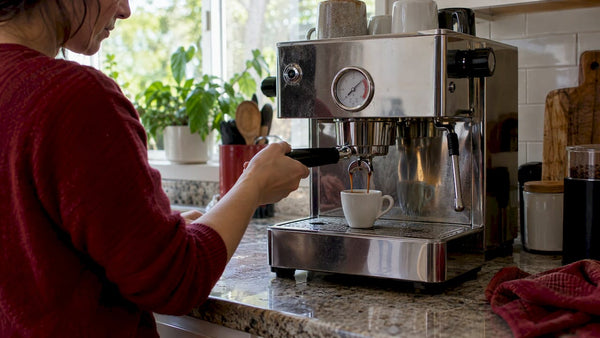
Espresso is the least forgiving. Finer grinding extracts more, up to a point. Beyond it, uneven flow through the puck can make shots both weaker and less repeatable. If you own a Breville, our Barista Express settings and recipe shows a dose and grind that works as a starting point.
Do not chase density with a formula. There is no universal conversion from a density number to a grind setting. Your grinder, your burrs and the flow through your puck decide that. Use density as background, then let taste lead.

Weigh the dose: the one habit that fixes most of it
Because density changes between roasts and origins, volume is an unreliable way to measure coffee. A scoop that delivers 16 g of one coffee may deliver 18 g of another, and that 2 g gap is enough to change an espresso shot noticeably. Meanwhile a level tablespoon of ground coffee is often quoted near 5 g, and it moves with roast and grind.
The routine:
- Weigh the beans on a scale that reads to 0.1 g, whether you use a drip machine, pour-over, French press or espresso machine.
- Keep the ratio fixed at first. A common drip starting point is around 55 g of coffee per liter of water, with water near 200 °F.
- Brew and taste. Sour and thin suggests under-extraction. Bitter and harsh suggests over-extraction.
- Change one variable. Go slightly finer for sour, slightly coarser for bitter, or adjust water temperature or contact time for pour-over.
- Return to baseline if the cup gets worse, and try a different single change.
One more point from tasting research: a UC Davis sensory study found that brew strength changed how coffee tasted more than extraction yield did. So before you fight your grinder, check that your ratio is right. A scale fixes both.
How density and roasting connect to freshness
Roasters use density to plan how much heat to apply. Denser beans absorb heat more slowly at first and then conduct it inward efficiently, so roasters often charge the drum hotter and manage heat carefully near first crack to avoid stalling, as Roast Magazine reports. Even so, one consultant quoted there stresses that density only informs how you drive the roaster: origin, variety and the flavor you want come first.
That is the right way to think about it as a drinker too. Density is one input. If you are curious about the craft, our home roasting guide and roasting tips cover what happens in the drum.
Our view on density
Stale coffee is the density problem nobody talks about. Beans that sit for weeks lose the freshness you paid for, and then you spend your mornings adjusting the grinder to rescue them.
That is why we roast after you order and ship within days. A bag that arrives fresh is a bag where the grind and the recipe do what they should. And we know most people do not own a density cup or want to. They own a Breville, a Moccamaster, a French press or a moka pot, so every coffee comes with a starting recipe for the machine you already have.
Our advice is the same whether you pick a bright Ethiopia or our Adira Blend: weigh your dose, change one thing at a time, and trust your tongue over a number. Density explains the behavior. It does not replace tasting.
Stefan
A fresh bag, with a recipe for your machine
If you are changing from a supermarket bag to a specialty coffee, the biggest shift is usually a different grind and dose. Adira roasts to order and ships in 3 to 7 business days. Each coffee comes whole bean or ground for your brewer, with a starting recipe for the machine you own.

To feel the effect of origin on density and flow, try one of our single origins, for example the Ethiopia Natural, next to a signature blend from our coffee blends. Your first bag ships free with the code FIRSTBAG, and orders over $35 always ship free. If you brew every morning, Autopilot delivers every 2 weeks or every month with up to 15% off, free shipping, and the option to skip, pause or cancel anytime. Every bag also sends $1 to young leaders in Bulgaria.
Curious about Central American coffees, which are often grown at altitude? Our Central American coffee guide covers what to expect.
FAQ
How do you measure the density of coffee beans?
The standard method, ISO 6669, pours whole green beans from a set hopper into a container of known volume, levels it and weighs it. At home you can fill a 100 mL cylinder, weigh the beans, and multiply by ten for grams per liter. Only compare numbers taken with the same method.
Is a denser coffee bean better?
Dense beans, usually high-altitude and washed, are prized by buyers and often fetch higher prices. But “better” depends on the cup you like. Origin, variety, processing and roast all shape flavor, and density only tells you how the bean behaves in heat and at the grinder.
Does roast level change bean density?
Yes, a lot. Beans lose mass and expand as they roast. In one study, bulk density dropped from 680 kg/m³ green to 314 to 369 kg/m³ at light to medium roast, and 265 to 289 kg/m³ at medium to dark. That is why a scoop of dark roast weighs less than a scoop of light roast.
Should I change my grind for a denser coffee?
Start with your usual recipe and a weighed dose, then taste. Sour or thin means go slightly finer. Bitter or harsh means go slightly coarser. Change one variable at a time, because density alone cannot tell you the right setting for your grinder.
Sources
- Project Origin, Quality Control Protocol 2022
- ISO 6669:1995, free-flow bulk density of whole green coffee beans
- Acta Innovations, 2023, green and roasted coffee density
- Cornell eCommons, 2003, density changes during roasting
- Roast Magazine, Beyond Elevation
- Perfect Daily Grind, Understanding coffee bean density
Recommended
Brew it with the right coffee
The bag this guide was written around. Roasted after you order, shipped from California.
More to try
All coffee Dark roastLightDark
Adira Blend
Dark chocolate, Caramel, Roasted nuts
Invests in young leaders in Bulgaria
$24.99
 Medium-light roastLightDark
Love Blend
Milk chocolate, Caramel, Floral lift
Invests in young leaders in Bulgaria
$24.99
 Medium-dark roastLightDark
Ocean Blend
Cocoa, Soft caramel, Clean vanilla finish
Invests in young leaders in Bulgaria
$24.99
Never run out.
Never pay shipping.
Any Adira coffee with Monthly Sender: up to 15% off every delivery, free shipping every time, skip, pause or cancel whenever you like.
Set up Monthly Sender