Espresso Pressure: Why 9 Bar Matters and How to Use It

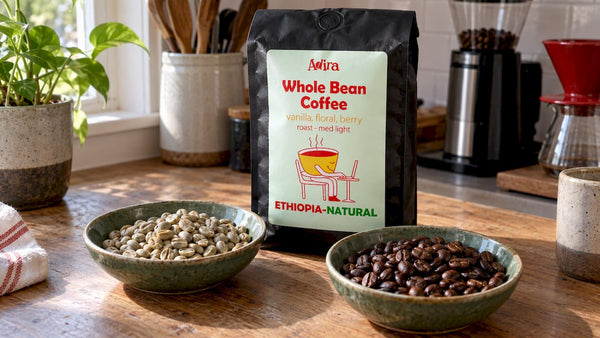
Espresso is brewed at about 9 bar of pressure, roughly nine times the air pressure around you. At home you rarely control that number directly. The pump sets a ceiling, and your coffee decides how much of it shows up: the grind, the dose and how fresh the beans are. If you want better shots, you work on the puck, not the pump. We roast every Adira bag after you order and ship it within days, so the beans you grind are still giving off CO2 and building the resistance a pump needs to push against.
TL;DR
- About 9 bar at the coffee is the long-standing target. Treat it as a good starting point, not a pass-or-fail rule.
- A “15 bar” label describes what the pump can do at most. The machine regulates the pressure used for brewing.
- The pump cannot create pressure on its own. Resistance from fine, evenly packed coffee creates it, so grind and dose are your real pressure controls.
- Most home machines have a fixed pressure setting. Adjusting it is a job for the manufacturer or a qualified technician.
- Freshly roasted beans and a recipe matched to your machine make a steadier shot than any gauge number.
In this guide
- What espresso pressure actually means
- Why 9 bar became the benchmark
- “15 bar” on the box: what it really tells you
- Why the gauge and the puck disagree
- What pressure does in the cup
- How to tell your machine is reaching pressure
- Can you adjust the pressure yourself?
- Pressure for your type of machine
- Choosing beans that work with the pressure
- Getting a starting recipe for your own machine
- Our view on pressure
- FAQ
- Sources
What espresso pressure actually means
A bar is a unit of pressure. One bar is about the normal atmospheric pressure at sea level, so 9 bar is nine times that. In an espresso machine, a pump pushes hot water through a compact bed of finely ground coffee, called the puck, held in a basket. The puck resists the water, and that resistance is what builds pressure.
That last point trips up many owners. As a technician’s guide in Daily Coffee News explains, everything after the pump is a restriction. If the coffee is too coarse or the dose too light, no amount of pump power gives you proper extraction pressure in the brew chamber. The pump cannot make pressure that the puck does not resist.
So when someone asks “what is my espresso pressure,” the honest answer is: it depends on the pump setting and on the coffee in the basket. Both matter.
Why 9 bar became the benchmark
Nine bar is the figure most professional machines are set around. Slayer’s manuals, for example, describe a factory 9-bar setting that should not normally be adjusted. A machine maker’s brewing guide puts the optimal pump-driven pressure at 8 to 9 bar and says pressure above 9 bar can make espresso very bitter.
Testing reported by a commercial machine maker shows why the middle works. In its comparison of pressure levels, shots at 6 bar were thinner in body and rarely matched 9 bar quality even with a finer grind or bigger dose. At 9 bar, flow rate, puck resistance and extraction time balanced well. At 12 bar, results became inconsistent, and some tasters noted over-extraction, especially in milk drinks.

It is not a law of nature, though. The same sources note that lighter roasts can tolerate a little more pressure and darker roasts often do well slightly lower. Slayer’s own manual says espresso is best brewed between 6 and 10 bar, with dense, light-roasted coffees handling higher pressure and less dense, darker ones preferring lower. Think of 9 bar as the place to start and adjust for taste.
“15 bar” on the box: what it really tells you
Many home machines advertise 15 bar or even 19 bar. That number is the pump’s maximum capacity, not the pressure used to make your shot. A brewing guide from a machine seller says plainly that ratings above 9 bar describe pump capacity rather than better espresso. The same guide explains that its home machines have an expansion relief valve that opens above 11 to 12 bar and diverts the excess to the drip tray or water tank, protecting the pump and lessening the chance of over-extraction.
So a bigger pump number does not mean a stronger or better cup. When you shop or compare, a machine that regulates its pressure around 9 bar is doing what you want.
Why the gauge and the puck disagree
If your machine has a pressure gauge, it is tempting to treat the needle as the truth. It is useful, but it is not the whole story.
Barista Hustle’s lesson on measuring pressure at the puck states that the pressure at the puck differs from the pump gauge reading, unless the machine measures puck pressure directly, and that it changes with the resistance in the basket. Parts between the gauge and the coffee, such as small restrictors in the water path, use up some pressure as water flows.
A few practical consequences:
- Gauge position matters. A manufacturer guide warns that a boiler gauge is not a direct indicator of brew pressure. On a dual-gauge machine, work out which needle shows the boiler and which shows the brew circuit.
- The reading moves during the shot. It usually climbs as water meets the puck and can drift as the coffee gives up its soluble material and the bed changes.
- A reading with no coffee describes the pump. With a blind basket (a basket with no holes) there is no flow, so you see what the pump can reach, not what your coffee experiences.
The takeaway: use the gauge to spot patterns from shot to shot, not to chase an exact number.
What pressure does in the cup
Pressure itself does not add flavor. It makes water move through a bed that would barely drip on its own. Flavor comes from how evenly and completely the water dissolves what is in the coffee.
When the pressure and resistance are out of balance, you taste it:
- Too little resistance (grind too coarse, dose too light): the shot runs fast and the pressure stays low. The cup tastes thin, sour and weak.
- Too much resistance (grind too fine, dose too heavy, tamp uneven): the shot crawls and tastes bitter and harsh.
- Uneven puck: water finds the weak spots and races through them, called channeling, so the shot is sour and bitter at once.
A brewing guide from a machine maker gives a handy frame: a double shot of 2 to 3 fl oz in 23 to 27 seconds. Too much resistance pushes the shot past 27 seconds, too little finishes under 23. Our guide to espresso shot time walks through how to read the clock, and if a shot tastes off, this espresso flavor troubleshooting guide matches each taste to a fix.
How to tell your machine is reaching pressure
Here is a simple routine for a machine with a gauge. It is the same logic technicians use.
- Run a blind-basket check. Lock in a blind basket or backflush disc and start the pump. A healthy pump reaches its set pressure quickly. Slayer’s manual describes verifying that a blind insert reads about 10 bar, which settles near 9 bar once real coffee is in the basket. Your machine’s manual gives the figure for your model.
- Pull a normal shot. Use a fine, even grind and a consistent dose. Watch where the needle settles.
- Compare the two. If the pump reaches pressure with the blind basket but not during a shot, the problem is usually preparation: a grind that is too coarse to offer enough resistance. A low reading with coarse grind or channeling does not automatically mean the pump has failed.
- Fix the puck first. Grind finer in small steps, level the dose and tamp evenly. Our guide on how to tamp espresso covers pressure and levelness.
- Only then suspect the machine. If the pump struggles even with the blind basket, or you hear unusual noises, contact the manufacturer or a qualified technician.
This is also where fresh coffee earns its place. Freshly roasted beans hold CO2, which helps build a resistant, even puck and a good flow under pressure. Stale beans tend to flow fast and give a thin shot no matter what the gauge says. Roasting after you order, as we do, means you start from the beans’ best point.
Can you adjust the pressure yourself?
On most home machines, no. Entry-level machines with vibration pumps generally have a fixed pressure that is not user-adjustable without technical intervention. Higher-end machines have an adjustable pump or valve, and the procedure differs by model.
Even the makers of adjustable machines are cautious. Slayer’s manuals say that installation and adjustments must only be performed by qualified, authorized technicians, and that under normal circumstances the factory 9-bar setting should not be changed. They advise contacting technical support first.
So if your shots taste off, the order of operations is:
- Check freshness and the roast date of your beans.
- Adjust grind size, then dose.
- Check your water. Mineral content affects both taste and machine health, as we explain in water quality for espresso.
- Try pre-infusion if your machine offers it, a gentle low-pressure soak before full pressure. See what pre-infusion does.
- Contact the manufacturer or a qualified technician if the pump itself seems to be the problem.
Pressure for your type of machine
Pump machines with a portafilter (Breville Barista Express, Pro and Bambino, De’Longhi Dedica): the pressure is set for you. Your levers are grind, dose and tamp. If you own a Barista Express, our Breville Barista Express recipe gives grind, dose and a recipe that works.
Machines with pressurized baskets: these baskets have a built-in restriction that creates pressure even when the grind is imperfect. They are forgiving and are common on entry-level machines. A fresh, evenly roasted coffee still makes a visible difference in taste.
Super-automatics: the machine manages pressure and grinding for you. Choosing a bean that suits the grinder and keeping the hopper fresh does the most good.
Moka pot and AeroPress: these make strong, concentrated coffee, but at far lower pressure than a true espresso machine. They are excellent brewers in their own right. For types of drinks you can build from each, see our guide to espresso drinks at home.
Choosing beans that work with the pressure
Because lighter, denser coffees tolerate more pressure and darker ones less, the bean you choose shapes how forgiving your shots feel. Our piece on how origin shapes espresso flavor and extraction goes deeper.
For an everyday, rich, chocolatey espresso, Adira Blend is our best-selling espresso and drip coffee. If you like a different profile, African Blend and Ocean Blend are signature blends too, and our single origins come from Colombia, Ethiopia, Costa Rica, Mexico and Sumatra, sourced from cooperatives and small farms.

Getting a starting recipe for your own machine
Every Adira coffee comes whole bean or ground for your brewer, with a starting recipe for the machine you already own. That matters for pressure: the right grind and dose for your machine are what give your puck the resistance your pump is built to work against. If you are not sure where to begin, a 3-question coffee quiz helps you choose.
We roast after you order and ship in 3 to 7 business days. The first bag ships free with the code FIRSTBAG, and orders over $35 always ship free. If you want coffee to simply show up, Autopilot delivers every 2 weeks or every month with up to 15% off, free shipping and the freedom to skip, pause or cancel anytime. You can browse our coffee blends or set up Autopilot.

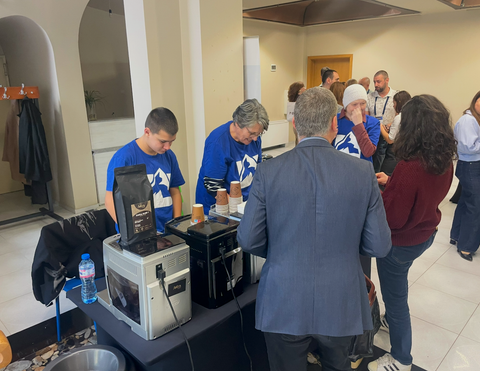
Every bag also sends $1 to young leaders in Bulgaria, so your morning shot supports free coffee at their gatherings and practical teaching about business and money.
Our view on pressure
Stefan and I started Adira because we could not find supermarket coffee worth a second cup. When people ask us about espresso pressure, we understand why: the numbers on the box and the gauge sound like the secret. We do not think they are.
In our experience the cup is decided before the pump starts. A pump gives you pressure only when the coffee pushes back, and coffee pushes back best when it is freshly roasted, ground right for your machine and dosed evenly. That is why we roast to order and why each bag comes with a starting recipe for the machine you own, whether that is a Breville, a De’Longhi, a Moccamaster or a moka pot.
So here is our advice. Keep 9 bar in mind as a good target, use the gauge to notice patterns, and spend your effort on grind, dose and fresh beans. Taste every shot. The cup tells you more than any number.
Stefan
FAQ
What is a good pressure for espresso?
About 9 bar at the coffee is the long-standing benchmark, and a good place to begin. Some sources describe a workable range of roughly 8 to 10 bar, with lighter roasts tolerating slightly more and darker roasts slightly less. Taste is the final judge.
Is 9 bar a lot of pressure?
It is about nine times normal atmospheric pressure, which is what it takes to push hot water through a tightly packed bed of fine coffee in roughly half a minute. It is modest compared with industrial equipment, and your machine is built to handle it.
Does a 15 bar machine make better espresso than a 9 bar machine?
No. The 15 bar figure is the maximum the pump can reach, and the machine regulates the pressure actually used for brewing, usually near 9 bar. A machine’s pump rating over 9 bar describes capacity rather than better espresso.
Why does my gauge read low during a shot?
Usually the puck is not offering enough resistance. The grind may be too coarse, the dose too light, or the coffee may be stale. Try a finer grind in small steps. If the gauge is also low with a blind basket, contact the manufacturer or a qualified technician.
Can I change the pump pressure on my home machine?
On most entry-level machines the pressure is fixed. On machines with an adjustable pump, the manufacturer’s manual should be your guide, and some makers state that adjustments must be done by authorized technicians.
Sources
- Pressure and Flow: A Guide for Espresso Technicians, Daily Coffee News
- Slayer Espresso Single Group manual
- Slayer Espresso user manual, version 2.0
- Measuring Pressure at the Puck, Barista Hustle
- Espresso Machine Pressure: How It Impacts Your Coffee, UNIC
- Espresso Science: Brewing Guide, 1st-line
- What Is a Pressure Gauge on an Espresso Machine?, CASABREWS
Recommended
Get this recipe for your setup
Pick your brewer and grinder. You see the starting recipe right here (grind setting, dose, water, temperature and time) and we e-mail it to you with the coffee it was made for.
✓ On its way to your inbox. Here it is now:
Too sour or thin? Grind a little finer. Too bitter? A little coarser.
Brew it with the right coffee
The bag this guide was written around. Roasted after you order, shipped from California.