
Espresso Shot Time: How Long a Shot Should Take

A well-pulled espresso shot usually takes 25 to 30 seconds, timed from the moment you start the pump. That number is a starting point, not a pass-or-fail grade. Your coffee, your grind and your machine decide the right time for your cup, and your taste buds are the final judge. If you tune the grind until a shot lands near 25 to 30 seconds and tastes sweet, you have found your recipe. The rest of this guide shows how to get there, and why coffee roasted to order makes it easier to repeat.
TL;DR
- Aim for about 25 to 30 seconds for a standard 1:2 shot, such as 18 g of ground coffee in and 36 g of liquid espresso out.
- Start the timer when you press the brew button, and note the same convention every time. Pre-infusion counts in this method.
- A single and a double shot take about the same time. Only the dose and the yield change.
- Too fast and sour: grind finer. Too slow and bitter: grind coarser. Change grind before anything else.
- Taste decides. A shot a few seconds outside the range can still be excellent.
In this guide
- What espresso shot time actually measures
- When to start the timer
- Target times by recipe
- Single versus double: does the time change?
- Let the cup overrule the clock
- What to do when the shot runs too fast
- What to do when the shot runs too slow
- Why fresh, consistent coffee makes shot time easier
- Start with a recipe for your own machine
- Fresh espresso beans, shipped to your door
- Our view on shot time
- FAQ
- Sources
What espresso shot time actually measures
Shot time is the length of the extraction: how long hot water is in contact with the coffee puck before the shot reaches its target weight. A common home target is a 1:2 ratio, meaning 18 g of coffee yields 36 g of espresso in the cup, pulled in 25 to 30 seconds.
Why does the clock matter? Water takes the easy-to-dissolve flavors out of coffee first, then the heavier, more bitter ones. Time is one way to see how far that process went. Perfect Daily Grind reports that fast extractions of 15 to 20 seconds tend toward acidity and reduced sweetness, standard extractions of 21 to 35 seconds tend to be sweet and well-bodied, and slower 36 to 40 second shots can turn bitter and thin.

That is why the window exists. It is not magic. It marks the stretch where acidity, sweetness and bitterness usually balance.
Breville’s U.S. guide gives the same 25 to 30 second ideal and adds that a great-tasting espresso can take anywhere from 20 to 40 seconds. So think of 25 to 30 as the center of a wider target.
When to start the timer
This is where most home baristas get confused, because two conventions are in use.
- Press-to-pour: the clock starts when you press the brew button and runs until you stop the pump. Pre-infusion, the gentle wetting phase before full pressure, is included. Breville says to count from the moment you activate the brewing cycle.
- First-drop: the clock starts when the first drop falls from the portafilter. Home Espresso Lab notes this is common in cafe training, and that first drop typically lands 6 to 10 seconds after the pump starts.
The gap matters. A shot that reads 28 seconds press-to-pour is roughly an 18 to 22 second shot by the first-drop clock. If you compare your time to a recipe, check which clock the recipe used. Most home machine manuals use press-to-pour, and that is the easiest convention to stay consistent with.
Pick one and stick with it. A shot time is only useful when you compare it with your own earlier shots.
Pre-infusion and the first drops
Pre-infusion is a short, low-pressure soak that lets the puck swell before full pressure arrives. On most home machines it adds a few seconds before the first drop. If you want the full picture of what it does and how to use it, we wrote a separate guide on espresso pre-infusion.
A handy check is the first drop. Many guides suggest espresso should begin dripping about 6 to 10 seconds in. Dripping immediately can point to a grind that is too coarse or a dose that is too low. Waiting past 15 seconds can point to a grind that is too fine or a dose that is too high. That is the closest thing to a “10 second rule” in espresso, and it is a diagnostic, not a target for the whole shot.
Target times by recipe
Not every shot should take the same time. Roast level, coffee density and recipe style all move the number. These ranges, all timed press-to-pour, come from Home Espresso Lab’s guide:
| Recipe | Typical time |
|---|---|
| Standard 1:2 shot, medium roast | 25 to 32 seconds |
| Light specialty roast | 32 to 42 seconds |
| Dark, Italian-style roast | 22 to 28 seconds |
| Single from a single basket (9 g in, 18 g out) | 22 to 30 seconds |
| Ristretto (short shot) | 18 to 24 seconds |
| Lungo (long shot) | 35 to 45 seconds |
The pattern is useful. Darker roasts and lower-grown coffees extract quickly, so they finish sooner. Lighter roasts and higher-grown coffees resist water more, so they often need longer. Clive Coffee’s explainer puts all espresso preparation roughly between 23 and 45 seconds depending on the coffee’s solubility.
The Specialty Coffee Association’s barista standards treat 20 to 30 seconds as a useful training target, while experienced baristas may use whatever time yields a balanced, flavorful cup. In other words, the range is a guide rail for learning, not a law.
Single versus double: does the time change?
No. This surprises many people. A single shot does not run for half the time of a double. Both aim for about the same extraction time. Gaggia’s North American guide gives a single shot (about 7 g of coffee) and a double (about 14 g) the same 20 to 25 second extraction. Home Espresso Lab describes a single as roughly 9 to 10 g in and 18 to 21 g out, and a double as roughly 18 to 21 g in and 36 to 42 g out, both in 25 to 35 seconds.
What changes is the dose and the yield:
| Shot | Dose in | Liquid out | Time |
|---|---|---|---|
| Single | about 9 to 10 g | about 18 to 21 g | about the same as a double |
| Double | about 18 to 21 g | about 36 to 42 g | 25 to 35 seconds |
Specialty coffee defaults to doubles for a practical reason. More coffee in the basket spreads water pressure more evenly, so a double is more forgiving to extract evenly than a single. Most home machines are built around double baskets. If you own a Breville Barista Express, Pro or Bambino, or a De’Longhi Dedica, the double basket is the one to learn first.
Let the cup overrule the clock
A stopwatch tells you what happened. Your mouth tells you whether it was good. Clive Coffee makes the point that most balanced espresso lands in 25 to 35 seconds at a 1:2 ratio, with shots under 20 seconds often tasting sour and shots past 40 risking bitterness, but that taste, not the clock, decides balance. Bariscope likewise suggests 25 to 35 seconds only as an initial working window: a shot just outside it may suit your coffee, and one inside it can still be unpleasant.
Here is a simple routine that uses time and taste together:
- Fix the dose. Use the weight your basket is rated for, often 18 g for a standard double.
- Fix the yield. Stop at 36 g of liquid in the cup, using a small scale under the cup.
- Time from the button. Note the seconds when the scale hits 36 g.
- Taste. Is it sour, bitter or sweet?
- Change one thing. Adjust grind first, then repeat.
This follows the workflow JayArr Coffee describes: if the shot is sour and under 25 seconds, grind finer; if it is bitter and over 30 seconds, grind coarser. If the time is right but the cup is still sour, a longer yield such as 45 g can help; if it is bitter, a shorter one such as 27 g can help.
For a deeper walk through the same loop, see our guide to dialing in your espresso grinder at home.
What to do when the shot runs too fast
A gusher under 20 seconds usually tastes sour, thin and sharp. Fellow’s U.S. support team says a fast shot usually means the puck offers too little resistance: the grind is too coarse, the dose is too low, or water is channeling through cracks in the puck. Work through the causes in this order:
- Grind finer. Make small steps. Fellow advises tiny adjustments rather than a full setting change. Mastering Coffee suggests 2 to 3 clicks on a stepped grinder for shots under 20 seconds.
- Check the dose. If your grinder cannot go finer, Fellow suggests adding about 0.2 g or using a double-wall basket.
- Level and tamp evenly. Uneven pressure invites channeling. Our guide on how to tamp espresso covers the motion.
Breville adds that if a fast shot tastes sour and thin, you can also increase the dose by a gram or two. Grind size is still the first place to make a change.
What to do when the shot runs too slow
A shot that drips for 35 seconds or more, or chokes the machine, is usually over-extracted: bitter, dry, sometimes ashy. Mastering Coffee recommends going 2 to 3 clicks coarser for shots over 35 seconds and keeping the dose at the basket’s rated weight, because changing the dose and the grind together introduces too many variables. Breville agrees: coarser grind, or a slightly smaller dose.
Stop the shot when the stream turns pale. Bean Poet describes this as blonding, a thin, watery, light tan flow that signals bitterness beyond that point. Cutting the shot there protects the cup even when the clock says you have time left.
If bitterness persists after the time is right, read our bitter espresso fix, and for any other off flavor, the espresso flavor troubleshooting guide.
Why fresh, consistent coffee makes shot time easier
Shot time is a comparison tool, and a comparison only works when the beans stay the same from one shot to the next. If you pull a shot at 27 seconds on Monday and the bag behaves differently by Friday, you chase a moving target. That is why we roast to order: Adira coffee is roasted after you place your order and ships within 3 to 7 business days, so you open a bag close to its roast date and begin dialing in right away.
When you start a new coffee, treat the first few shots as calibration. Pull one at your usual grind, note the time and the taste, then move the grind a small step. Two or three shots usually find the window. Write the setting on the bag, and the next shot starts from a known place.
The same logic applies to a new roast. Light roasts often want longer times and longer pre-infusion than dark ones, while dark roasts finish sooner. Home Espresso Lab gives pre-infusion windows of 2 to 4 seconds for dark oily roasts and 6 to 10 seconds for medium-light American specialty roasts. If you switch between a chocolatey blend and a fruity single origin, expect the best time to shift a few seconds.

Start with a recipe for your own machine
A shot time means little without a dose, a yield and a grind setting that suit your equipment. Our bags come with a starting recipe for the machine you already own. If you pull shots on a Breville Barista Express, our Barista Express settings guide and starting recipe give you the grind, dose and target to aim for, so your first shot lands close to the window instead of far from it.
New to the drinks themselves? Our overview of espresso drink types for home brewing shows how the same shot becomes a latte, a cortado or an americano, and what espresso is covers the basics. If you want to plan your beans, the espresso blend recipes give three spec-driven starters.
Fresh espresso beans, shipped to your door
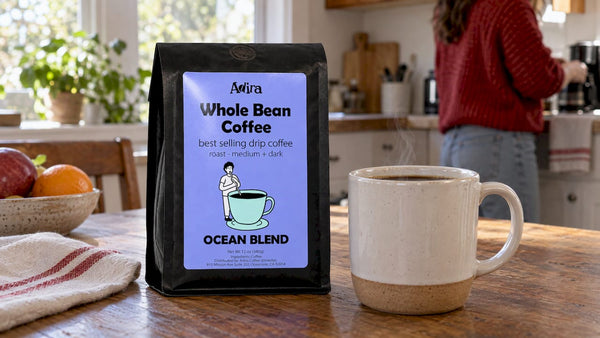
If your shots are inconsistent, the beans are the easiest variable to fix. Adira Blend is our best-selling espresso and drip coffee, roasted after you order and available whole bean or ground for your brewer. Prefer to explore? Browse the single origins from Colombia, Ethiopia, Costa Rica, Mexico and Sumatra, or the full set of coffee blends.

Your first bag ships free with the code FIRSTBAG, and orders over $35 always ship free. If you want the same coffee on your counter without reordering, Monthly Sender delivers every 2 weeks or every month, ships free, and lets you skip, pause or cancel anytime. Every bag also sends $1 to young leaders in Bulgaria.
Our view on shot time
We started Adira because we could not find a supermarket coffee worth a second cup, and espresso made that frustration louder. A shot is unforgiving. Stale or inconsistent beans show up in the cup in seconds.
Here is what we tell friends who ask about shot time. Do not chase a number. Chase a repeatable shot. Fix your dose, fix your yield, time from the button, and taste every one. When the time lands between 25 and 30 seconds and the cup is sweet, you are done. When it does not, change one thing, usually the grind, and try again.
That is also why every coffee we sell comes with a starting recipe for the machine you already own. We want your first shot to be close, so the dial-in is a few small adjustments and not a week of guessing. Roasting after you order keeps the coffee you open this week close to the coffee you tuned last week.
Good espresso at home should feel like a morning routine you look forward to, not a lab exercise. Use the timer as a friend, and let your taste have the last word.
Stefan
FAQ
How long should a shot of espresso take?
For a standard double at a 1:2 ratio, aim for about 25 to 30 seconds from pressing the brew button. A great-tasting shot can fall anywhere between 20 and 40 seconds, as Breville’s guide notes. Treat 25 to 30 as the center of your target and adjust by taste.
Does pre-infusion count toward shot time?
In the press-to-pour method used by most home machine manuals, yes. The clock starts when you hit the button and includes pre-infusion. Some cafe methods start at the first drop instead, which gives a number 6 to 10 seconds shorter. Choose one method and keep it.
Is a 20-second shot bad?
Not automatically, but it often tastes sour and thin. Shots under 20 seconds are usually under-extracted. Grind a small step finer and pull again. Short styles like a ristretto are meant to run faster.
Should a single shot be faster than a double?
No. Both target about the same time, and the difference is dose and yield. Gaggia’s guidance gives single and double shots the same extraction time of about 25 seconds.
What is the 10-second rule for espresso?
It is a quick check on the first drops. Espresso should begin dripping from the portafilter at roughly 6 to 10 seconds. Immediate dripping can mean a coarse grind or low dose, and a wait beyond 15 seconds can mean a fine grind or high dose.
Sources
- The Perfect Espresso: How to Pull a Perfect Espresso Shot
- How To Better Control Your Espresso’s Brew Ratio, Perfect Daily Grind
- How to dial in espresso: The beginner’s guide, Breville
- Espresso Extraction Time: How Long Should a Shot Take
- Espresso Brew Ratios and Basket Sizes Explained, Clive Coffee
- SCA Barista Drink Standards Guide
- Brewing, Gaggia North America
- Double Espresso: What It Is and How to Pull One
- Dialing In Espresso By Taste, Clive Coffee
- Espresso Shot Time: When to Start and Adjust, Bariscope
- How to Dial In Espresso: A Step-by-Step Workflow, JayArr Coffee
- What to Do if the Shot Was Too Fast, Fellow Products
- Espresso Pulling Too Fast or Slow? Diagnose It Fast
- How To Time Your Espresso Shots for a Perfect Pull, Bean Poet
Recommended
Get this recipe for your setup
Pick your brewer and grinder. You see the starting recipe right here (grind setting, dose, water, temperature and time) and we e-mail it to you with the coffee it was made for.
✓ On its way to your inbox. Here it is now:
Too sour or thin? Grind a little finer. Too bitter? A little coarser.
Brew it with the right coffee
The bag this guide was written around. Roasted after you order, shipped from California.