
TL;DR:
- Coffee cupping is a structured sensory evaluation process that assesses ten attributes, revealing complex flavor profiles often missed by home drinkers. Following a standardized protocol, cuppers evaluate aroma, flavor, and defects, building a refined palate to make better coffee choices. Regular practice enhances sensory perception, helping home baristas understand quality factors and deepen their appreciation for specialty coffees.
Most coffee drinkers think tasting is simple: you sip, you enjoy, maybe you notice it’s “fruity” or “bold.” Coffee cupping breaks that assumption wide open. It’s a structured sensory evaluation process used by professional buyers, roasters, and Q graders to assess not just flavor but ten distinct attributes, from fragrance to clean cup finish. What surprises most home baristas is how much they’ve been missing. This guide walks you through the complete cupping protocol, how to score what you taste, and how to start building a genuinely trained palate at home.
Table of Contents
- Understanding coffee cupping: Purpose and history
- The official coffee cupping protocol: Step-by-step
- How to assess coffee attributes and detect defects
- Tips for refining your palate and running cupping at home
- What most home baristas miss about coffee cupping
- Explore specialty coffees and cupping tools
- Frequently asked questions
Key Takeaways
| Point | Details |
|---|---|
| Standardized scoring | Coffee cupping uses precise forms and ratios to objectively evaluate quality and identify specialty-grade beans. |
| Sensory evolution | Tasting at different temperatures exposes changing acidity, aroma, and flavors for richer analysis. |
| Defect detection | Identifying taints and faults is essential for guaranteeing coffee quality and clean cup status. |
| Practical home application | Home baristas can replicate the protocol, refine their palate, and deepen coffee appreciation with professional methods. |
| Specialty coffee access | Discovering higher-quality beans is achievable for enthusiasts with scoring knowledge and cupping practice. |
Understanding coffee cupping: Purpose and history
Coffee cupping started as a quality control tool for traders and roasters who needed a reliable, repeatable way to evaluate green and roasted beans. Today, it’s the foundation of the entire specialty coffee industry. Every lot that gets labeled “single-origin” or “specialty grade” has gone through some version of this process before it reaches your doorstep.
The Specialty Coffee Association (SCA) formalized the practice with a standardized cupping protocol and scoring form. That specialty coffee scoring system gives buyers and roasters a shared language to compare coffees across different origins, processing methods, and roast profiles objectively.
Here’s what the SCA scoring form actually measures:
- Fragrance/Aroma – Dry and wet smell of ground and brewed coffee
- Flavor – Overall taste impression on the palate
- Aftertaste – Length and quality of flavor after swallowing
- Acidity – Brightness and vibrancy, not sourness
- Body – Weight and texture of the liquid in the mouth
- Balance – How well all attributes complement each other
- Uniformity – Consistency across all five cups in the sample
- Clean cup – Absence of off-flavors or distracting notes
- Sweetness – Perceived natural sweetness in the cup
- Overall – The taster’s holistic impression
The SCA scoring system evaluates all ten of these attributes on a 6 to 10 scale, with the total reaching up to 100 points. Any coffee that scores 80 or above qualifies as specialty grade. Below that, it’s commodity coffee, regardless of how pretty the bag looks.
“Cupping isn’t about finding the perfect cup. It’s about understanding the full range of what a coffee can offer, and where it falls short.”
For home baristas, cupping isn’t about gatekeeping or playing professional. It’s about building real sensory vocabulary. Once you learn to identify acidity as a positive “bright” quality versus a defect-driven sourness, your entire approach to brewing and buying coffee changes.
The official coffee cupping protocol: Step-by-step
Understanding the “why” sets the stage for mastering the “how.” Here’s the exact protocol for authentic coffee cupping.
Equipment and ratios
Before you grind anything, get your measurements right. The SCA protocol uses 8.25g of medium-coarse ground coffee per 150ml of water at 93°C (199°F), with five cups per sample for reliability. That five-cup setup isn’t arbitrary. It protects against variability and makes defect detection more statistically meaningful.
Here’s a quick reference table for scaling up or down:
| Number of cups | Coffee (g) | Water (ml) |
|---|---|---|
| 1 cup | 8.25g | 150ml |
| 3 cups | 24.75g | 450ml |
| 5 cups | 41.25g | 750ml |
| Equipment item | Specification |
|---|---|
| Grind size | Medium-coarse |
| Water temperature | 93°C / 199°F |
| Cup size | 150-225ml vessels |
| Steep time | 4 minutes |
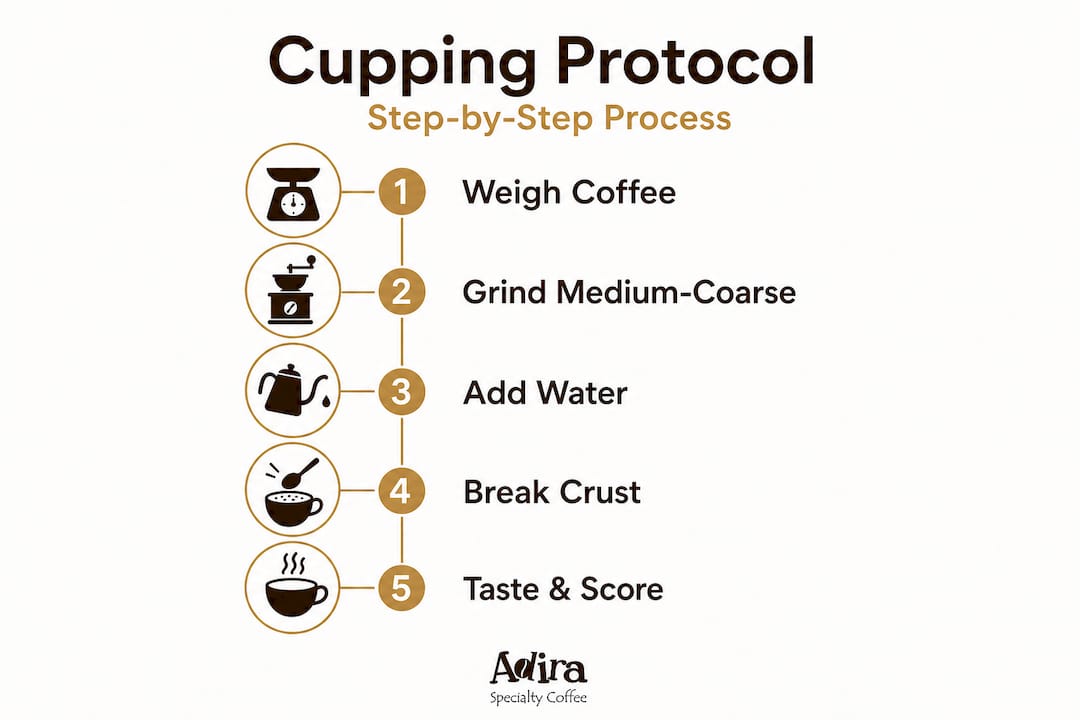
The cupping sequence
Follow this exact sequence for consistent, comparable results:
- Grind your coffee fresh to a medium-coarse consistency, about the same as rough sea salt. Grind each sample directly into your cupping bowls.
- Evaluate dry fragrance by placing your nose close to the dry grounds and inhaling. Note any aromas: floral, nutty, chocolatey, fruity, earthy.
- Pour hot water at 93°C in a circular motion, fully saturating all grounds. Start your timer.
- Steep for four minutes without stirring. A crust of grounds will form on the surface.
- Break the crust at the four-minute mark by pushing through it with your spoon and inhaling the released steam. This “wet aroma” step often reveals the most volatile aromatic compounds in the coffee.
- Skim the remaining foam and floating grounds from the surface using two spoons.
- Begin slurping at around 8 to 10 minutes, when the coffee has cooled slightly to a safe tasting temperature. The key steps of this process involve evaluating dry fragrance, steeping for four minutes, breaking the crust, skimming, and then slurping at multiple temperatures starting around 8 to 10 minutes.
- Continue tasting as the coffee cools, noting how attributes shift at different temperatures.
- Score each attribute on your form while tasting.
Pro Tip: Slurp loudly and deliberately. It’s not rude in this context, it’s science. Slurping forces coffee across the entire palate and sprays it toward the back of your throat, triggering retronasal olfaction (the smell pathway that activates when aromatic compounds travel from your mouth upward toward your nasal cavity). This dramatically expands what you actually perceive in each sip.
Using coffee brewing tips alongside cupping helps you understand how variables like grind size and water temperature connect to what you experience in the cup. And starting with quality coffee beans is equally critical since cupping only reveals what’s already in the bean.
How to assess coffee attributes and detect defects
With the protocol in hand, it’s crucial to know what you’re detecting and scoring. Let’s break down attribute assessment and defect identification.

Scoring each attribute
Each of the ten SCA attributes gets a score between 6 and 10. A score of 6 means “good,” 7 is “very good,” 8 is “excellent,” 9 is “outstanding,” and 10 is near-perfect. Most solid specialty coffees score between 7.5 and 8.5 on individual attributes.
Pay special attention to these three that beginners often undervalue:
- Acidity often gets marked low by people who associate it with bitterness or sourness. High-quality acidity should feel bright and clean, like biting into a fresh apple or a ripe citrus. Ethiopian naturals often score high here.
- Body is the weight and mouthfeel of the liquid. Sumatran coffees tend to be heavy and syrupy. Ethiopian washed coffees lean light and tea-like. Neither is better, but both should be noted.
- Aftertaste tells you a lot about roast quality and bean health. Lingering sweetness and complexity are positive. A quick, hollow, or bitter finish is a red flag.
Defect identification
This is where cupping gets serious. Defects fall into two categories, and the scoring penalty is clear. According to cupping score evaluations, taints are minor off-flavors that subtract 2 points each, while faults are severe defects subtracting 4 points each, both evaluated across five cups.
| Defect type | Flavor description | Typical cause | Score penalty |
|---|---|---|---|
| Taint | Mild rubber, slight mustiness | Minor fermentation issue | -2 per cup |
| Fault | Medicinal/phenolic, rotten, mold | Processing failure | -4 per cup |
The most common processing defects in the cup include phenolic flavors (sharp, medicinal, like antiseptic), musty notes (damp cardboard or mold), and stinker flavors (distinctly rotten or fermented). These indicate problems in fermentation, drying, or storage at the farm or processing station level.
Pro Tip: If something about a coffee tastes “wrong” but you can’t identify it, start with these three categories. Phenolic, musty, and stinker are the most common culprits and the easiest to train yourself to recognize with repeated exposure.
Understanding farm practices and how they impact flavor makes defect detection easier. When you know that a musty note often comes from rushed or uneven drying, you start connecting what’s in the cup to decisions made on the farm.
Consider these key defect-detection habits:
- Taste each of the five cups individually, not just one representative sample
- Note any cup that tastes noticeably different from the others, even if you can’t name the defect yet
- Smell the grounds before and after steeping, as many defects show up earlier in dry or wet aroma than in taste
- Let the coffee cool completely before your final evaluation, since some defects only emerge at lower temperatures
For those seriously detecting defects at home, keeping a detailed log of each session and returning to review your notes builds pattern recognition faster than any other method.
Tips for refining your palate and running cupping at home
Once you’re familiar with how to assess coffee, focus on elevating your tasting skills and making cupping a regular part of your coffee exploration.
Building a trained palate is not a talent. It’s a practice. The more frequently and intentionally you cup, the faster your sensory library grows.
- Cup at least twice a month. Consistency matters more than intensity. Two focused sessions per month beats one marathon once a quarter.
- Always cup two or more coffees side by side. Comparative tasting is how your brain learns contrast. Tasting a washed Ethiopian next to a natural Colombian makes the differences in body, acidity, and sweetness immediately obvious.
- Use the SCA form every time, even casually. Scoring gives you structure and a record. Over months, you’ll notice how your perception of specific attributes sharpens.
- Taste at three temperature stages. Evaluate first at hot (around 65°C), then warm (around 45°C), then cool (below 30°C). The full flavor profile emerges across all three, with acidity and delicate aromatics often becoming much more distinct as the coffee cools.
- Join a cupping community. Local specialty coffee shops often host public cuppings. Online cupping events have also expanded since 2020. Tasting with others accelerates your learning faster than solo sessions alone.
- Explore brewing tips for home cupping to understand how your preparation variables affect what you experience, keeping your cupping setup as consistent as possible so it doesn’t introduce variables into your evaluation.
Pro Tip: Use a small notepad, not your phone, during cuppings. Writing by hand engages different cognitive processes and helps memory consolidation. Your flavor vocabulary grows faster when you’re committing words to paper in real time.
Cupping with a focused mind and a clean palate (avoid strong food, coffee, or mint at least 30 minutes before) gives you a massive advantage in sensitivity and accuracy.
What most home baristas miss about coffee cupping
Here’s something that gets overlooked: most hobbyists approach cupping as a flavor experience and miss the whole architecture of the evaluation. They focus on whether it tastes “good” and skip the structural work of assessing aroma separately from flavor, or acidity as its own dimension rather than a component of general taste.
That separation is not bureaucratic. It’s the entire point. Flavor is what your taste buds pick up. Aroma is what your nose detects. These are physiologically different pathways, and training them independently is what makes a real cupper accurate rather than just enthusiastic.
There’s also a widespread misconception that defect detection is only for professionals buying green coffee. In reality, learning to spot even mild taints and faults changes how you shop for roasted coffee and how you evaluate your roaster’s consistency. It’s one of the most practical skills a home barista can develop.
We’ve seen tasters at Adira Coffee go from “I just like what tastes good” to confidently identifying phenolic notes in a poorly processed natural in under six months of regular cupping. The shift isn’t mysterious. It’s repetition plus intentional attention.
The other thing experienced cuppers know is that quality beans for flavor is not a cliché. When you start cupping seriously, the difference between a well-sourced 87-point Ethiopian and a generic “dark roast” becomes obvious within thirty seconds of smelling the dry grounds. No scoring form required.
Cupping is not elitist. It’s just structured curiosity. Applied consistently, it turns every coffee you drink into a learning opportunity rather than just a morning habit.
Explore specialty coffees and cupping tools
If you’ve been inspired to start cupping at home, the quality of your starting material matters enormously. There’s no better way to build your palate than working with clearly differentiated, freshly roasted single-origin coffees.
At Adira Coffee, we source directly from around 50 farms across the world’s most distinct growing regions. Our Colombia specialty beans are an excellent starting point for cupping, offering well-defined caramel sweetness, stone fruit notes, and a clean, balanced body that makes scoring each attribute straightforward. For something more complex and layered, our Costa Rica specialty beans bring bright acidity and honey-like sweetness that really shine in a side-by-side cupping session. Both are roasted fresh in small batches and shipped at peak flavor so what arrives in your cup reflects exactly what our sourcing team tasted during evaluation.
Frequently asked questions
What equipment do I need for home coffee cupping?
You need medium-coarse ground coffee, cupping bowls or deep mugs, a gooseneck kettle, cupping spoons, and a kitchen scale. The 8.25g per 150ml ratio requires accurate measurement, so a precise scale is essential.
How do I know if my coffee is specialty grade?
Coffee scoring 80 or above on the SCA form is classified as specialty grade. The SCA’s 10-attribute evaluation totals up to 100 points, and any score below 80 places the coffee in commodity territory regardless of marketing claims.
Why taste coffee at different temperatures?
Different temperature ranges reveal different aspects of the coffee. Acidity and aroma evolve as the coffee cools, with delicate floral and fruit notes often becoming much clearer below 45°C than they are at first sip.
What are taints and faults in coffee? How are they scored?
Taints are mild off-flavors and subtract 2 points per affected cup; faults are severe defects that subtract 4 points per affected cup. Both are evaluated across all five cups in a standard cupping sample, making defect presence highly consequential to a coffee’s final score.