
TL;DR:
- Manual brewing offers control over variables like grind size and water temperature, improving flavor.
- Pour-over yields a clean, bright cup, while French Press provides a full-bodied, rich experience.
- Consistent technique and precise measurements are key to brewing café-quality coffee at home.
You bought beautiful specialty beans, followed a recipe, and still ended up with a flat, bitter, or sour cup. You’re not alone. Most home brewers struggle not because of bad beans, but because small, controllable variables like grind size, water temperature, and pour speed are slightly off. The good news is that manual brewing methods like pour-over and French Press give you direct control over every one of those variables. This guide walks you through precise, science-backed techniques so your next cup tastes the way your beans were meant to taste.
Table of Contents
- Manual brewing essentials: Equipment and ingredients
- Step-by-step guide: Pour-over technique
- French Press immersion: Full-bodied manual brew
- Key variables and troubleshooting for consistent results
- Why precision (not gadgets) is the real difference-maker in manual brewing
- Explore specialty beans and gear for manual brewing
- Frequently asked questions
Key Takeaways
| Point | Details |
|---|---|
| Precision matters most | Small adjustments in ratio, grind, and temperature dramatically impact flavor. |
| Choose the right method | Pour-over highlights clarity, while French Press offers rich, full-bodied coffee. |
| Control your variables | Change only one variable at a time to consistently refine your results. |
| Use proper tools | A quality grinder, scale, and gooseneck kettle are investments in repeatability. |
Manual brewing essentials: Equipment and ingredients
Before you brew a single gram of coffee, your setup needs to be right. Great technique with poor equipment still produces inconsistent results, and the reverse is equally true. The most common coffee brewing tips from experienced baristas all circle back to the same starting point: know your tools and use them correctly.
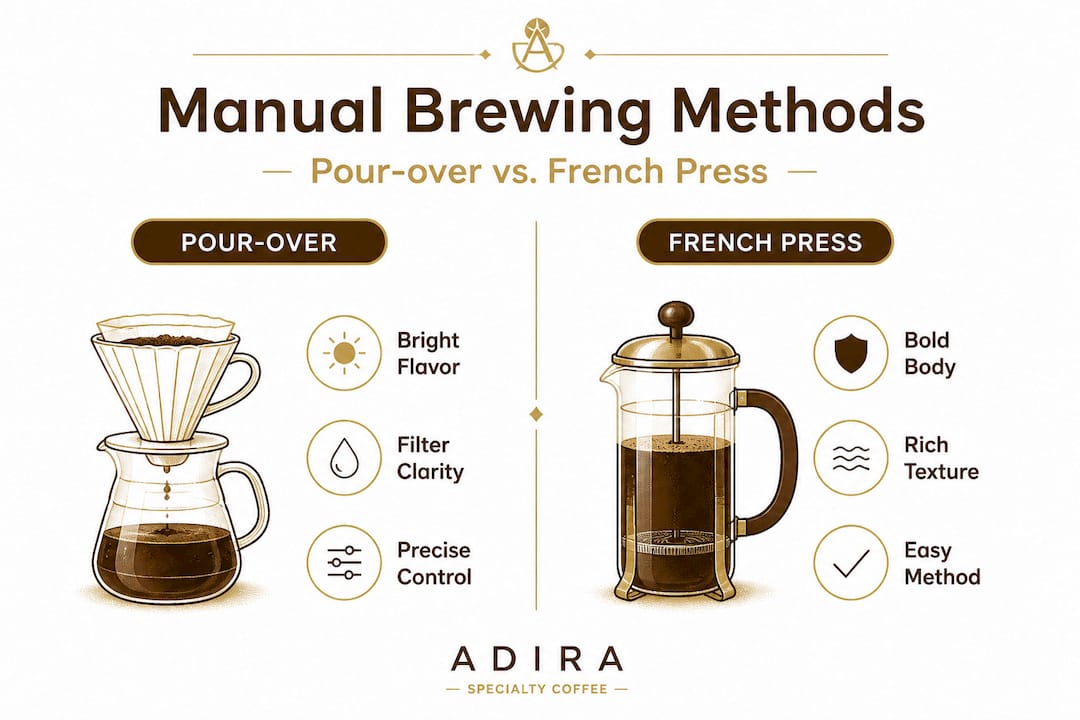
The two manual methods we focus on here are pour-over (using a V60 or Chemex dripper) and French Press. The Aeropress is worth exploring later, but pour-over and French Press cover the full spectrum of manual brewing styles: one produces a clean, bright cup, the other a rich and full-bodied one.
Essential equipment overview
| Equipment | Pour-over spec | French Press spec |
|---|---|---|
| Dripper/brewer | Hario V60 or Chemex | 350ml or 1L French Press |
| Grinder type | Burr grinder (not blade) | Burr grinder (not blade) |
| Scale | 0.1g precision | 0.1g precision |
| Kettle | Gooseneck with thermometer | Standard kettle works |
| Filters | Paper (rinsed before use) | Metal mesh (built in) |
| Water | Filtered, 195–205°F | Filtered, 195–205°F |
When it comes to beans, always buy whole-bean, specialty-grade coffee and grind right before brewing. Pre-ground coffee begins losing volatile aromatics within minutes of grinding. Freshness is everything. Look for a roast date on the bag, not just a “best by” date, and use beans between 7 and 30 days off roast for the best flavor development.
Water quality is often overlooked. Distilled water tastes flat because it strips flavor compounds from the coffee. Use filtered tap water or a quality bottled water with moderate mineral content. The SCA Golden Cup Standard recommends a coffee-to-water ratio between 1:15 and 1:18, a brew water temperature of 195–205°F, a total dissolved solids (TDS) reading of 150 ppm in your water, and a target extraction yield of 18–22% from the grounds.
Among the best brewing methods available to home enthusiasts, pour-over and French Press consistently deliver café-quality results when you control these parameters correctly.
Pro Tip: A digital scale and a gooseneck kettle are the two purchases that will improve your cup more than any premium dripper. Consistency starts with measurement.
Step-by-step guide: Pour-over technique
Pour-over coffee rewards patience and attention. The method uses gravity to pull hot water through a bed of coffee grounds, producing a cup with remarkable flavor clarity. Every expert perspective on manual brewing points to the pour-over as the best method for showcasing the nuanced, origin-driven flavors in high-quality beans.
What you need
Hario V60 or Chemex, paper filter, burr grinder, gooseneck kettle, digital scale, and a timer.
Step-by-step pour-over recipe
- Heat your water to 200–205°F for medium to light roast beans.
- Rinse the paper filter with hot water to remove papery taste and preheat the dripper. Discard the rinse water.
- Grind your coffee to a medium-fine consistency, similar to table salt. Use 15–18 grams of coffee per 250ml of water.
- Add grounds to the rinsed filter and gently shake to level the bed.
- Start the bloom. Pour 2x the weight of your coffee in water (e.g., 30ml for 15g of coffee), saturating all the grounds. Start your timer.
- Wait 30–45 seconds. The grounds will bubble and expand as CO2 releases. This is a sign of freshness.
- Pour slowly in a spiral from the center outward. Keep water level steady, not flooding the dripper.
- Finish your pour by 2:30–3:00 minutes. Total brew time including the bloom should land between 3:00 and 3:30 minutes.
“Grind size and pour pattern are the two most direct levers in pour-over brewing. A grind that’s too fine clogs the filter; a chaotic pour causes channeling where water rushes through one path and under-extracts the rest of the bed.” Pour-over brewing mechanics confirm this is where most home brewers lose control of flavor.
James Hoffmann’s V60 technique uses a 1:16.67 ratio (e.g., 30g coffee to 500ml water), a 45-second bloom with two gentle swirls, then one continuous circular pour finishing by 3:30 minutes. It is one of the most widely tested recipes in the specialty coffee community.
Pour-over variable comparison
| Variable | SCA guideline | Hoffmann method | Typical home recipe |
|---|---|---|---|
| Coffee ratio | 1:15 to 1:18 | 1:16.67 | 1:15 |
| Grind size | Medium-fine | Medium-fine | Medium |
| Bloom time | 30 seconds | 45 seconds | 30 seconds |
| Total brew time | 3:00–3:30 min | 3:30 min | 4:00+ min |
If your brew runs long and tastes bitter, grind coarser. If it runs short and tastes sour, grind finer. Refer to our specialty coffee guide for a deep look at how roast profile changes these targets, and explore coffee extraction science to understand exactly why each adjustment works.
Pro Tip: Only change one variable per brew session. If you adjust grind size and ratio at the same time, you won’t know which change fixed or broke the cup.
French Press immersion: Full-bodied manual brew
French Press is the easiest manual method to master, yet it consistently produces one of the most satisfying cups you can make at home. The difference between percolation vs. immersion brewing is fundamental: in pour-over, water passes through grounds once; in French Press, grounds steep fully submerged in water for several minutes.
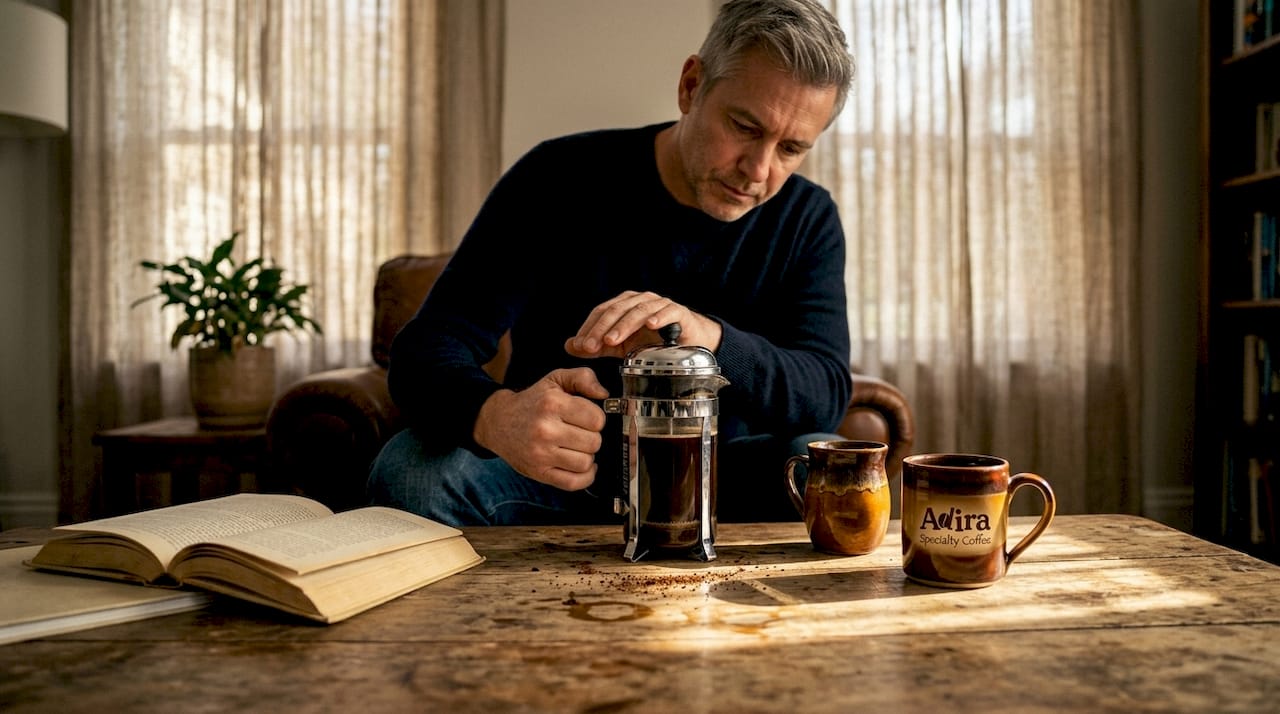
That extended contact time pulls more oils and heavier compounds into your cup, which is exactly why French Press coffee has that distinctive richness and mouthfeel that many coffee drinkers love.
Step-by-step French Press recipe
- Grind coarsely, similar to coarse sea salt or breadcrumbs. Too fine and grounds slip through the mesh.
- Heat water to 195–200°F. Slightly lower than pour-over works well here.
- Add coffee to the press. Use a 1:15 ratio, steep 4 minutes as your baseline (e.g., 30g coffee for 450ml water).
- Pour water evenly over all the grounds. Place the lid on top without pressing.
- Steep for 4 minutes. Do not stir aggressively. A gentle break of the crust at 4 minutes is optional.
- Press slowly and steadily. Pushing too fast forces fine particles under the filter and into your cup.
- Pour immediately. Leaving coffee on the grounds after pressing leads to over-extraction and bitterness.
French Press vs. pour-over: A direct comparison
| Feature | Pour-over | French Press |
|---|---|---|
| Flavor profile | Clean, bright, nuanced | Rich, full, bold |
| Body and texture | Light to medium | Full, oily |
| Sediment | None | Present (fine particles) |
| Clarity | High | Low |
| Technique difficulty | High | Low to medium |
| Best for | Floral, fruity, delicate beans | Chocolate, nutty, earthy beans |
Immersion brewing naturally hits the SCA target extraction yield of 18–22% because the long steep ensures thorough saturation of the coffee bed. Where pour-over demands precise pouring to achieve even extraction, French Press handles that for you through full immersion. The tradeoff is sediment and a cloudier cup.
Advantages of French Press:
- No filters to buy or run out of
- More forgiving with less-precise grind consistency
- Produces bold flavors ideal for milk-based drinks
- Easy to scale up for multiple servings
Disadvantages of French Press:
- Sediment in the cup (can be reduced with a 4-minute rest after plunging)
- Less flavor clarity compared to pour-over
- Easy to over-extract if you forget it on the counter
Check our brewing methods comparison to see how these two stack up against other manual methods, or explore how coffee blends techniques can help you choose the right bean profile for each method.
Key variables and troubleshooting for consistent results
Even with a solid recipe and quality equipment, small variables can quietly ruin your cup. Mastering manual brewing means understanding what each variable does and how to adjust it with intention.
The five core variables to control
- Grind size: The single biggest lever in coffee extraction. Finer grinds extract faster; coarser grinds extract slower. Match grind size to your method and brew time target.
- Coffee-to-water ratio: More coffee produces a stronger, denser cup. Less coffee yields a thinner, weaker one. Always measure by weight, not volume.
- Water temperature: Light roasts need hotter water (203–205°F) to unlock their complex acids and florals. Dark roasts do better at 195–198°F to avoid harsh bitterness.
- Bean freshness: Freshly roasted beans release CO2 aggressively during bloom. Older beans bloom weakly and extract unevenly. Always check your roast date.
- Agitation: Stirring or swirling increases extraction. Gentle spiral pours distribute extraction evenly. Aggressive pouring causes channeling.
Precision tools are not a luxury. A gooseneck kettle controls your pour speed and direction. A scale eliminates the guesswork of scoops. Together, they make every variable measurable and repeatable rather than approximate.
For scientific feedback on your extraction quality, measuring TDS and extraction yield with a refractometer gives you objective data on whether your brew is hitting the 18–22% extraction window.
Rapid troubleshooting guide
| Cup problem | Likely cause | Fix |
|---|---|---|
| Sour or weak | Under-extracted | Grind finer, use hotter water, extend bloom |
| Bitter or astringent | Over-extracted | Grind coarser, lower water temp, shorten brew time |
| Muddy or cloudy | Too fine grind or French Press over-steep | Coarser grind, pour immediately after plunging |
| Flat or dull | Stale beans or low water temp | Use fresher beans, increase water temp |
Dialing in your perfect grind size is often the fastest path to a dramatically better cup. Understanding how coffee roasting effects change the extraction behavior of your beans gives you the full picture.
Pro Tip: Keep a simple brew log. Write down your ratio, grind setting, water temp, and brew time for each session. You will identify patterns far faster than relying on memory alone.
Why precision (not gadgets) is the real difference-maker in manual brewing
Here is something worth saying directly: the coffee community has a gadget problem. Every few months, a new dripper, a limited-edition grinder, or an upgraded kettle promises to transform your morning cup. Most of those upgrades deliver marginal improvements. The biggest jumps in cup quality almost always come from better technique, not better tools.
We have seen home brewers using a $30 ceramic V60 and a $60 hand grinder produce cups that rival cafés charging $7 per pour-over. What made the difference? They kept a brew log. They adjusted one variable at a time. They paid attention to bloom behavior as a freshness indicator. They knew their ratio by heart. None of that requires new equipment.
The real extraction improvements come from understanding cause and effect inside your cup. When you taste sourness, you know you need more extraction. When you taste bitterness, you back off. That feedback loop is a skill, and it sharpens every time you brew intentionally.
There is also a case to be made for hybrid methods like the Hario Switch, which combines immersion steeping with pour-over filtration. For home brewers who want consistency with less manual technique, that is a completely legitimate and smart choice. The best brewing method is always the one you can execute consistently.
Taste your coffee at every stage of your dialing-in process. Record what changed and how the cup responded. Precision is a practice, not a product you can buy.
Explore specialty beans and gear for manual brewing
Ready to put these brewing techniques into practice? The best recipes in the world still depend on starting with beans worth brewing carefully.
At Adira Coffee, we source directly from around 50 farms across Colombia, Ethiopia, Costa Rica, Guatemala, Brazil, and Sumatra, roasting in small batches to ensure peak freshness when beans arrive at your door. Our Adira Colombia beans are an ideal match for the pour-over technique, offering clean stone fruit and caramel notes that shine with a 1:16 ratio and a 200°F brew. If you prefer the fuller body of a French Press, our Costa Rica beans deliver brown sugar sweetness and gentle acidity that holds up beautifully through immersion. Browse our manual brewing essentials to find curated gear and beginner kits that pair perfectly with the recipes above.
Frequently asked questions
What is the best coffee-to-water ratio for manual brewing?
Use a ratio between 1:15 and 1:18 (1g coffee per 15–18g water) as your baseline, with the SCA Golden Cup Standard recommending this range for optimal extraction and balanced flavor.
How does grind size affect manual coffee brewing?
Grind size directly controls extraction speed and flavor. Pour-over uses medium-fine, French Press uses coarse because longer steep times need larger particles to avoid over-extraction.
How should I adjust brewing for light vs. dark roast?
Light roasts need hotter water around 203–205°F to unlock complex flavors, while dark roasts brew better at 195–198°F. These light/dark roast adjustments prevent bitterness in darker beans and ensure full extraction from denser lighter ones.
What’s the difference between pour-over and French Press coffee?
Pour-over produces a cleaner, brighter cup with more nuanced flavors, while French Press delivers fuller body, more oils, and some sediment. The percolation vs. immersion distinction explains why the two methods taste so different even using the same beans and ratio.