
TL;DR:
- Coffee extraction is the process by which water dissolves flavor compounds, affecting taste and balance.
- Key variables like grind size, temperature, and brew time control extraction, influencing sourness or bitterness.
- Sensory tasting and understanding brew methods help achieve optimal extraction beyond just numbers.
Most home brewers blame their beans when a cup tastes sour, flat, or harsh. The beans are rarely the problem. What’s actually happening is extraction gone wrong, and once you understand why, you’ll never make the same cup twice without knowing exactly how to fix it. Extraction is the invisible engine behind every coffee’s flavor, balance, and aroma. It’s what separates a bright, syrupy pour-over from a thin, acidic disappointment. This guide breaks down the science in plain terms and gives you the tools to take real control of what ends up in your cup.
Table of Contents
- What is coffee extraction?
- The core variables: What controls coffee extraction?
- How much is enough? Extraction yield and measuring flavor
- Brewing methods compared: Immersion vs percolation
- Beyond the basics: Espresso, roast profiles, and water chemistry
- The myth of perfect extraction: What most guides miss
- Explore premium coffees and improve your extraction journey
- Frequently asked questions
Key Takeaways
| Point | Details |
|---|---|
| Extraction drives flavor | Controlling extraction is the single biggest factor influencing your coffee’s taste and balance. |
| Five key variables | Grind size, water temperature, brew time, agitation, and ratio let you fine-tune flavor at home. |
| No single perfect yield | Experimenting with your taste and measuring extraction yield helps you find your personal best brew. |
| Method matters | Immersion and percolation methods require different extraction targets and techniques. |
| Small tweaks, big impact | Simple changes to one variable can noticeably improve your coffee experience. |
What is coffee extraction?
At its core, extraction is the process by which water dissolves flavor compounds from coffee grounds. Every time you brew, hot water is doing the work of pulling hundreds of distinct compounds out of the ground coffee and into your cup. The result is what you taste, for better or worse.
Not everything dissolves at the same rate. Acids and fruity compounds are the first to extract, followed by sugars and sweetness, and finally the heavier, more bitter compounds. This sequence is exactly why timing and temperature matter so much when brewing specialty coffee at home.
The three broad flavor categories you’re managing are:
- Acids: Bright, citrusy, and the first to extract. Too much gives you sourness.
- Sugars: Sweet, caramel, and balanced. These are the compounds you want most.
- Bitters: Heavy, dry, and last to extract. Too much leads to harshness.
When extraction stops too early, acids dominate and the cup tastes sour or sharp. That’s under-extraction. When it goes too long, bitters overwhelm everything and the cup turns astringent. That’s over-extraction. The sweet spot is finding a balance where all three play nicely together.
“Extraction is the single most important variable in brewing. Master it, and beans from almost any origin can shine.”
Understanding this basic sequence reframes how you think about dialing in a recipe. It’s not guesswork. It’s chemistry you can actually control.
The core variables: What controls coffee extraction?
Knowing what extraction is, the next question is: what actually moves the needle? There are five main levers, and water temperature, grind size, brew time, agitation, and coffee-to-water ratio are the biggest extraction variables you can control at home.
Here’s how each one works:
- Grind size: Finer grinds increase surface area, meaning water contacts more of the coffee and extracts faster. Coarser grinds slow extraction down. If your cup is sour, try grinding finer. If it’s bitter, go coarser.
- Water temperature: Higher heat extracts more and faster. The SCA recommends 195 to 205°F. Brewing below this range under-extracts; above it, you risk pulling too many bitter compounds.
- Brew time: Longer contact between water and grounds pushes extraction further. A French press needs 4 minutes; espresso needs 25 to 30 seconds. Timing isn’t arbitrary.
- Agitation: Stirring or blooming your coffee during brewing promotes even extraction. Without it, dry pockets form and some grounds barely extract while others over-extract.
- Coffee-to-water ratio: More coffee with the same water means stronger concentration but not necessarily more extraction. Ratio affects strength and TDS, not just yield.
A common mistake is tweaking multiple variables at once. You end up not knowing which change made the difference. Find your brewing tips for better flavor by isolating one variable per session and tasting carefully.
Pro Tip: Start with grind size first. It’s the single fastest and most impactful variable to adjust, and a small change produces a noticeably different cup.
Exploring different home brewing methods also helps you see how the same variables behave differently across equipment.
How much is enough? Extraction yield and measuring flavor
Extraction yield (EY) is the percentage of the coffee’s dry mass that actually dissolved into your cup. If you start with 20 grams of coffee and 4 grams of soluble mass ends up in the brew, your extraction yield is 20%.
The formula is simple: (brewed weight minus water weight, divided by dry coffee weight) multiplied by 100. But you don’t need to do the math manually. A refractometer measures TDS (total dissolved solids) in your cup and, combined with your brew ratio, gives you EY automatically.
“The optimal extraction yield is 18-22% for most brews (SCA standard), with TDS 1.15-1.35%; below 18% yields sour notes, above 22% becomes bitter.”
Here’s a practical reference by brew type:
| Brew method | Target TDS | Target EY |
|---|---|---|
| Filter/pour-over | 1.15 to 1.35% | 18 to 22% |
| French press | 1.0 to 1.3% | 18 to 21% |
| Espresso | 8 to 12% | 18 to 22% |
| Cold brew | 1.3 to 2.0% | 16 to 20% |
But here’s something the charts often leave out: recent studies reveal wider TDS preference clusters, challenging the strict 18 to 22% guideline. Some people genuinely prefer slightly under-extracted cups for their brightness. Others love the body and depth that nudges past 22%.
Think of those numbers as a useful starting zone, not a law. Learning about roast profiles and extraction also helps you understand why the same EY target produces different results depending on your beans.
Brewing methods compared: Immersion vs percolation
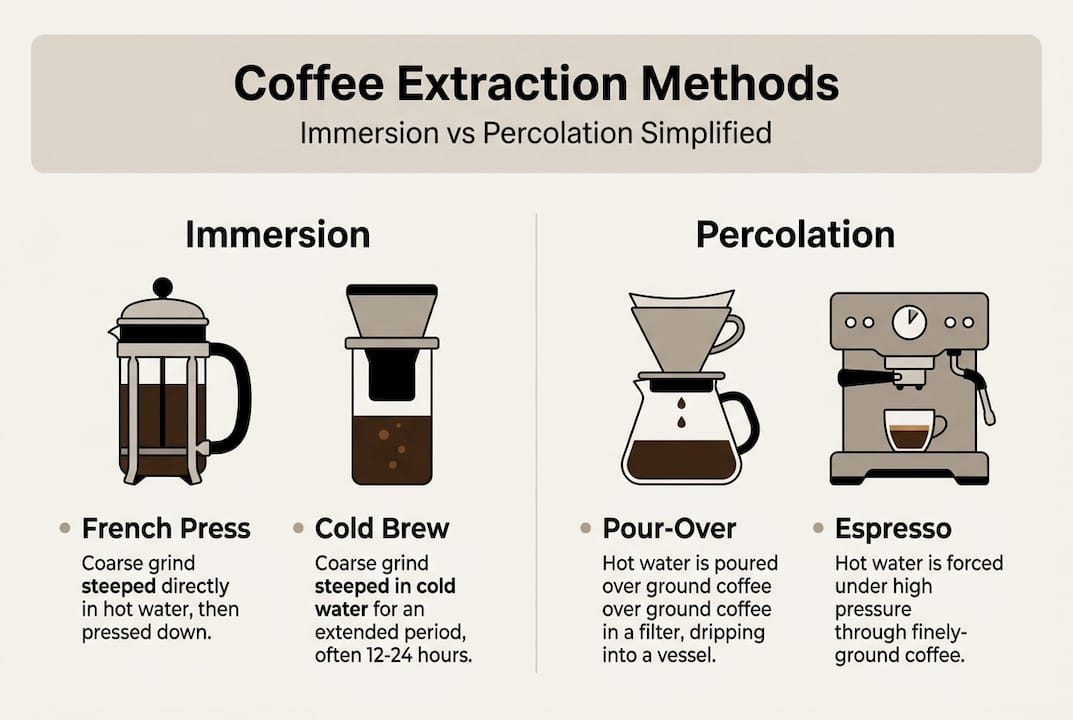
Every brewing method falls into one of two categories: immersion or percolation. The category your method belongs to shapes how extraction behaves and what your cup will taste like.
Immersion means coffee grounds and water share the same space for the full brew time. French press and cold brew are classic examples. Because the water becomes saturated gradually, immersion is forgiving, harder to over-extract accidentally, and tends to produce a fuller body with a balanced, mellow flavor profile.
Percolation means fresh water continuously flows through the coffee grounds. Pour-over and espresso work this way. Fresh water is always arriving, so extraction is more aggressive and sensitive to small changes. The result is often more clarity, brightness, and complexity, but the margin for error is narrower.
| Factor | Immersion | Percolation |
|---|---|---|
| Body | Full, heavier | Lighter, cleaner |
| Forgiveness | High | Lower |
| Extraction sensitivity | Lower | Higher |
| Best for beginners | Yes | Requires more practice |
| Typical EY target | 18 to 21% | 20 to 23% |
Key things to keep in mind when choosing:
- If you’re new to dialing in recipes, start with French press or AeroPress (immersion).
- If you want to experiment with clarity and origin-specific flavors, move toward pour-over.
- Cold brew is immersion taken to an extreme, long time and cold temperature, so check out cold brew workflow tips before jumping in.
- You can explore both with a single bag of beans when you look at home brewing methods side by side.
Beyond the basics: Espresso, roast profiles, and water chemistry
Espresso is extraction on hard mode. Everything happens in 25 to 30 seconds at 9 bars of pressure with a 1:2 ratio. There’s almost no margin for error. A grind that’s slightly off, a tamping inconsistency, or a water temperature change of just a few degrees will show up clearly in the cup.
Espresso TDS runs much higher at 8 to 12% compared to filter brewing, which is why espresso tastes so concentrated. That intensity amplifies both the good and the bad in your extraction.
Roast level changes everything:
- Light roasts are denser and harder for water to penetrate. They need higher temperatures (around 200 to 205°F), finer grinds, and generally benefit from slightly higher extraction targets to develop their complex, fruity notes.
- Dark roasts are more porous and extract quickly. Lower temperatures and coarser grinds help prevent over-extraction of bitter, ashy compounds.
Understanding roast profiles directly shapes how you dial in your recipe. The same grind setting that works for an Ethiopian light roast will over-extract a Sumatra dark roast.
Pro Tip: Water chemistry matters more than most brewers realize. Aim for mineral content around 150 ppm and a pH between 6.5 and 7.5. Distilled water actually makes bad coffee because it lacks the minerals needed to carry flavor compounds.
When choosing coffee beans, factor in the roast level so you can anticipate the extraction adjustments you’ll need to make.
The myth of perfect extraction: What most guides miss
Every extraction guide eventually points you toward a target number: 18 to 22%. It’s useful. It gives beginners a place to start. But treating it like the finish line is where most home brewers get stuck.
No single ideal extraction exists because roast level, grinder quality, and personal taste all pull in different directions simultaneously. A 20% EY from a blade grinder tastes nothing like 20% from a quality burr grinder. A 21% extraction of a Costa Rica natural process tastes nothing like a 21% extraction of a washed Ethiopian.
The real skill is sensory awareness. Taste your coffee before reaching for a refractometer. Notice what’s missing or too loud. Adjust one thing, brew again, taste again. That iterative loop teaches you more than any number on a chart. Roasting tips for flavor reinforces this: flavor is the only honest scorecard.
We’ve seen customers dial in genuinely outstanding cups at 17.5% and others that tasted flat at exactly 20%. The range is a guide. Your palate is the judge.
Explore premium coffees and improve your extraction journey
Now that extraction science makes sense, the next step is putting it into practice with beans that reward your effort. Fresh, single-origin coffee reveals the impact of your adjustments far more clearly than a generic blend.
At Adira Coffee, we roast in small batches directly from farms across Colombia, Costa Rica, Ethiopia, and beyond, so you’re working with coffee at its flavor peak. Explore Colombia beans for bright acidity that responds beautifully to percolation experiments, or discover Costa Rica coffee for a clean, balanced cup that makes extraction variables easy to hear. When you’re ready to browse everything, shop Adira Coffee and find your next extraction experiment.
Frequently asked questions
What does coffee extraction mean?
Coffee extraction is the process by which hot water dissolves flavor compounds from ground coffee, creating your finished cup. Everything you taste, brightness, sweetness, bitterness, comes from how well that process was controlled.
What happens if you over-extract coffee?
Above 22% extraction yield leads to bitter and astringent flavor because too many late-stage compounds, the ones responsible for harshness, dissolve into the brew. Coarser grind, lower temperature, or shorter brew time will bring it back into balance.
How can you measure coffee extraction at home?
A refractometer enables precision for both pros and home baristas by measuring TDS in your brewed cup. You can also rely on taste: a balanced cup with no dominant sourness or bitterness is a strong indicator you’re in a good range.
What’s the difference between immersion and percolation brewing?
Immersion versus percolation comes down to water movement: immersion steeps grounds in static water, while percolation continuously flows fresh water through the coffee bed. Immersion is more forgiving; percolation delivers more clarity and brightness.
Does roast level affect extraction?
Yes, significantly. Light roasts need higher extraction temperatures and finer grinds to unlock their complexity, while dark roasts extract faster and benefit from cooler water and coarser grinds to avoid bitterness.