
For the best ethically sourced coffee right now, start with Adiracoffee’s roast-to-order lineup. Every bag ships within days of roasting from small farms and cooperatives in Colombia, Ethiopia, Costa Rica, Mexico, and Sumatra, with origin details published and traceable. That combination of freshness, transparency, and producer relationships is what separates genuinely ethical coffee from a label.
Three things to look for immediately:
- Third-party certifications: Fair Trade, USDA Organic, Rainforest Alliance, or Bird Friendly on the bag are meaningful starting points.
- Farm or cooperative naming: A roaster who publishes the actual farm or co-op name is accountable in a way a generic “sourced ethically” claim never is.
- Roast date on the bag: Fresh coffee isn’t just better tasting. It signals a roast-to-order model that typically supports higher producer premiums and shorter supply chains.
Table of Contents
- Why does ethically sourced coffee matter for farmers and ecosystems?
- What do the main certifications actually guarantee?
- How do you judge a roaster’s ethical claims before you buy?
- Why transparency often matters more than a single certification
- How to build ethical coffee into your routine without overpaying
- What does ethical sourcing actually do for farmers’ incomes?
- How do you evaluate taste and quality in ethically sourced coffee?
- What does ethical coffee actually cost, and is the premium worth it?
- Key Takeaways
- Why we source this way
- Adiracoffee products that meet the ethical sourcing checklist
- Useful sources and further reading
Why does ethically sourced coffee matter for farmers and ecosystems?
The short answer: buying ethical coffee directly affects whether farmers earn a living wage, whether forests stay standing, and whether workers are protected from exploitation.
Commodity coffee prices have historically fallen well below what farmers need to cover production costs, let alone support a family. Fair Trade standards address this with price floors and Community Development Funds. In 2021 alone, Fair Trade coffee partners generated $31 million in those funds, directed toward education, healthcare, and farm improvements in producing communities.
The environmental side is just as concrete. Shade-grown coffee can support around 19 times more biodiversity than conventional full-sun monocultures, and stores significantly more carbon. When you buy from a roaster committed to agroforestry sourcing, you’re supporting a farming system that keeps bird habitat intact and reduces the need for synthetic inputs.
Stat to know: Consumers consistently accept a price premium for certified ethical coffee — and Fair Trade Certified products have shown a sales lift at national retailers after adding the label.
Child labor and unsafe working conditions remain real risks in uncertified supply chains. Certification and transparency together are the most reliable tools buyers have to push back on those practices.
Pro Tip: Look for roasters who source from sustainable coffee farms with documented agroforestry practices — not just a seal on the bag.
What do the main certifications actually guarantee?
No single seal covers every ethical issue. Each certification addresses a different slice of the problem, and knowing which is which prevents you from being misled by a label that looks comprehensive but isn’t.
| Certification | Social standards | Environmental standards | Price floor/premium | Traceability |
|---|---|---|---|---|
| Fair Trade | Yes — minimum price, labor rights, community funds | Partial — limits pesticides, prohibits deforestation | Yes — price floor + premium | Moderate |
| Rainforest Alliance | Partial — worker welfare criteria | Yes — biodiversity, water, soil | No price floor | Moderate |
| USDA Organic | None | Yes — no synthetic pesticides or fertilizers | None | Limited |
| Bird Friendly | None | Strongest — requires organic + native canopy + agroforestry | None | Limited |
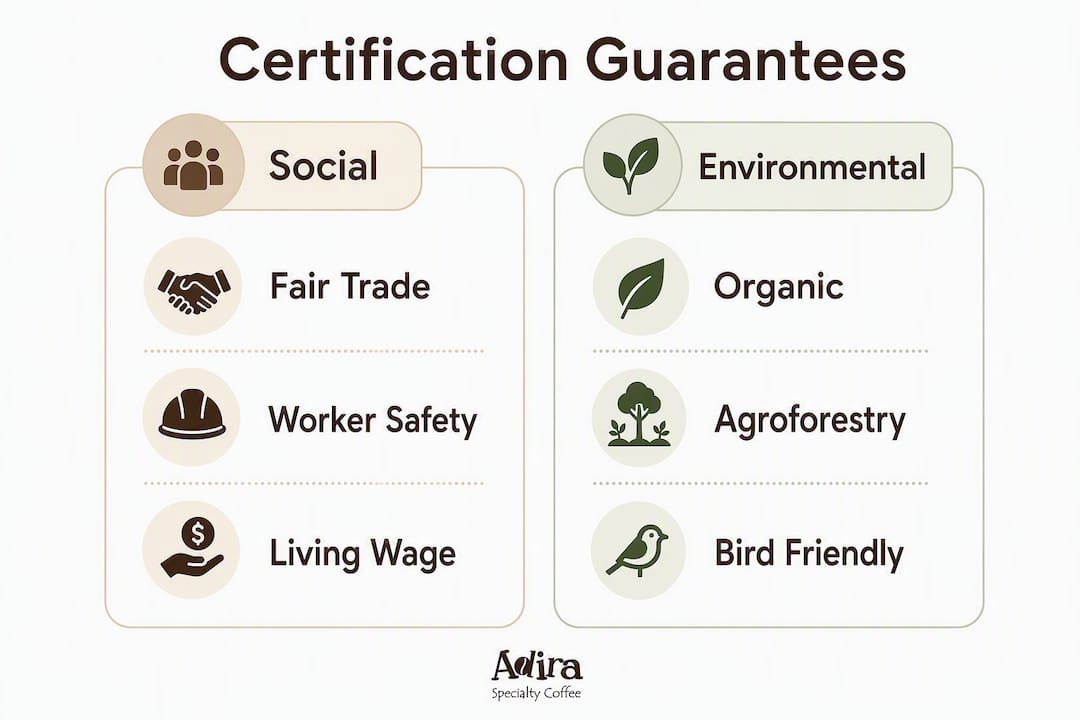
The Smithsonian Migratory Bird Center considers Bird Friendly the environmental gold standard because it requires certified organic production plus specific canopy cover and native tree diversity criteria. Rainforest Alliance covers broader farm management but doesn’t require the same habitat depth. USDA Organic tells you nothing about wages. Fair Trade addresses wages and community investment but doesn’t mandate the agroforestry practices that protect ecosystems.
The practical gap: certification costs money, and smaller farms with genuinely strong practices sometimes can’t afford the audit process. Ethical Consumer notes that voluntary third-party certifications help but aren’t a substitute for structural accountability. A roaster who publishes sourcing reports and names the farms they work with fills that gap more reliably than a single seal.
Pro Tip: The strongest signal on a coffee bag is Bird Friendly or Organic paired with a social certification like Fair Trade. That combination covers both environmental and economic dimensions — something no single seal achieves alone. You can learn more about eco-friendly coffee certifications and what each one actually requires.
How do you judge a roaster’s ethical claims before you buy?
Prioritize traceability, published origin, farm or co-op naming, and price paid to producers. Those four signals are harder to fake than a certification and reveal more about a roaster’s actual supply chain relationships.
The buying checklist
- Check the roast date. If it’s not on the bag, the roaster isn’t prioritizing freshness or transparency. Roast-to-order models almost always publish it.
- Look for farm or cooperative naming. “Sourced from Colombia” is not traceability. “Sourced from the Huila region, Cooperativa de Caficultores del Sur” is.
- Count the certifications. One seal is a start. Two covering different dimensions (e.g., Fair Trade + Organic) is meaningfully stronger.
- Find a sourcing report or transparency page. Roasters serious about ethical sourcing publish this. If it doesn’t exist, that’s a data point.
- Assess pricing and subscription options. Roast-to-order subscriptions often indicate ongoing producer relationships rather than spot-market buying.
Questions to ask before you buy
- “What farm or cooperative supplied this lot?”
- “What farm-gate price did you pay, and how does that compare to Fair Trade minimums?”
- “Is this coffee certified, and by whom?”
- “When was this roasted?”
Red flags
- Vague language like “ethically sourced” or “sustainably grown” with no specifics
- A single charity partnership highlighted while supply chain details stay hidden
- No roast date anywhere on the bag or product page
- Origin listed only as a country, with no region, farm, or co-op named
Greenwashing is common in the coffee industry. Brands can highlight small good deeds while obscuring larger supply chain problems. The checklist above cuts through that.
Why transparency often matters more than a single certification
The most reliable indicator of ethical sourcing isn’t one seal. It’s a roaster who publishes origin data, names the cooperative, and discloses what they paid. That combination makes accountability verifiable rather than assumed.
CoffeeWatch recommends prioritizing traceability to the farm, deforestation-free sourcing, shade-grown or agroforestry practices, living income commitments, and zero tolerance for child or forced labor. No single certification checks all of those boxes. Bird Friendly comes closest on the environmental side. Fair Trade comes closest on the economic side. Together, they cover most of the ground.
Pairing third-party certifications with radical transparency — public origin data and farm-gate pricing — creates real accountability beyond seal recognition.
Here’s a scenario that illustrates the difference. Two bags sit side by side at the same price. One carries a Rainforest Alliance seal and lists “Central America” as the origin. The other carries no seal but names the farm, the region, the cooperative, the harvest date, and the price paid per pound above Fair Trade minimums. The second bag gives you more to verify and more reason to trust the claim. Certifications matter, but traceable sourcing is what makes them meaningful rather than decorative.
The Smithsonian Bird Friendly standard is worth singling out. Because it requires organic certification plus native canopy cover and agroforestry criteria, it’s the one seal that directly protects migratory bird habitat. For buyers who care about biodiversity specifically, it’s the most defensible environmental signal available.
How to build ethical coffee into your routine without overpaying
Choose roast-to-order or a subscription when freshness and producer premiums matter to you. The price difference over supermarket coffee is real but smaller than most people expect, and the quality gap is larger.
Practical buying tips
- Subscribe for savings and consistency. Adiracoffee’s subscription saves 10% and includes free U.S. shipping over $35. Subscriptions also signal to roasters that they can commit to longer-term producer contracts.
- Read the roast date, not the “best by” date. Specialty coffee is best within 2–4 weeks of roasting. A “best by” date 12 months out tells you nothing useful.
- Match grind size to your brew method. Roast-to-order roasters like Adiracoffee will often dial in the grind for your specific equipment, which matters more for flavor than most buyers realize.
- Store in an airtight container away from light and heat. A valve bag is fine for the first week; after that, transfer to a sealed ceramic or glass container.
How to compare prices fairly
- Find the per-pound cost including shipping.
- Check the roast date. A cheaper bag roasted six weeks ago is not a better deal than a fresher bag at a higher price.
- Factor in the subscription discount if you drink coffee daily.
- Compare against what you’d spend at a café for the same number of cups.
Specialty ethical coffee typically runs higher per pound than supermarket brands, but the per-cup cost is often comparable to a mid-range café drink. Small-batch roasters also tend to offer better value on quality than large commercial brands at similar price points.
Single-origin coffees make traceability easier to verify and tend to have more distinct flavor profiles. Blends can still be ethically sourced when each component is traceable, and they’re often more consistent cup to cup.
What does ethical sourcing actually do for farmers’ incomes?
Certifications set floors, not ceilings. Fair Trade’s price floor protects farmers when commodity markets drop, but the real income gains come from direct relationships, quality premiums, and long-term contracts that let farmers invest in their farms.
The gap between commodity pricing and a living income for coffee farmers has been documented repeatedly. Commodity prices fluctuate based on global markets that have nothing to do with the cost of growing coffee in a specific region. A roaster who pays above Fair Trade minimums and publishes what they paid is doing something structurally different from one who simply buys certified lots on the open market.
Direct trade relationships, where a roaster works directly with a farm or cooperative over multiple seasons, tend to produce the strongest income outcomes. They also tend to produce better coffee, because the roaster has an incentive to help the farm improve quality rather than just meet a minimum standard. Direct sourcing creates that alignment between quality and ethics in a way that certification alone doesn’t.
How do you evaluate taste and quality in ethically sourced coffee?
Ethical sourcing and great flavor aren’t in tension. They’re usually correlated. The practices that protect ecosystems and pay farmers fairly also tend to produce better-tasting coffee.
Shade-grown, agroforestry coffee ripens more slowly, which concentrates sugars and develops more complex flavor compounds. Farms that invest in post-harvest processing, because they’re earning stable premiums, produce cleaner, more consistent lots. The specialty coffee scoring system used by the Specialty Coffee Association rates coffees on a 100-point scale, with 80+ considered specialty grade. Most ethically sourced single-origin coffees from traceable farms score in that range.
What to look for on the bag: tasting notes that are specific (jasmine, brown sugar, stone fruit) rather than generic (“smooth,” “bold”). Specific notes indicate the roaster cupped the coffee carefully enough to describe it. Roast date within the last three weeks. And a roast level that matches your brew method — lighter roasts for pour-over and filter, medium to dark for espresso and cold brew.
For espresso specifically, medium roasts from Ethiopia or Colombia tend to produce bright, complex shots. A dark roast from Sumatra or a blend designed for espresso will give you the heavier body and lower acidity that works well in milk drinks.
What does ethical coffee actually cost, and is the premium worth it?
Expect to pay more than supermarket coffee, but the range is wide. Specialty ethical coffee in the U.S. typically runs higher per pound than commodity brands, though exact pricing varies by roaster, origin, and certification level. The premium reflects real costs: higher farm-gate prices, certification audits, small-batch roasting, and direct shipping.
The value calculation changes when you factor in freshness. A bag of commodity coffee that sat in a warehouse for months before hitting a supermarket shelf is not the same product as a bag roasted to order and shipped within days. Stale coffee tastes flat regardless of price.
Subscriptions reduce the per-bag cost and eliminate the friction of reordering. Free shipping thresholds, like Adiracoffee’s $35 minimum, make the math work better for regular buyers. The honest comparison isn’t ethical specialty coffee versus supermarket coffee. It’s ethical specialty coffee versus what you’d spend on café drinks for the same number of cups — and on that basis, the premium is modest.
Key Takeaways
The best ethically sourced coffee combines third-party certification, published farm or cooperative origin, and roast-to-order freshness — no single seal replaces that combination.
| Point | Details |
|---|---|
| Prioritize transparency | Look for roasters who name the farm or co-op and publish what they paid producers. |
| Stack certifications | Bird Friendly plus a social cert like Fair Trade covers both environmental and economic dimensions. |
| Verify the roast date | Fresh coffee signals a roast-to-order model that typically supports stronger producer relationships. |
| Use subscriptions | Recurring orders help roasters commit to long-term producer contracts and save you 10% with Adiracoffee. |
| Adiracoffee’s approach | Roasts single-origin and blend coffees to order from traceable farms in Colombia, Ethiopia, Costa Rica, Mexico, and Sumatra. |
Why we source this way
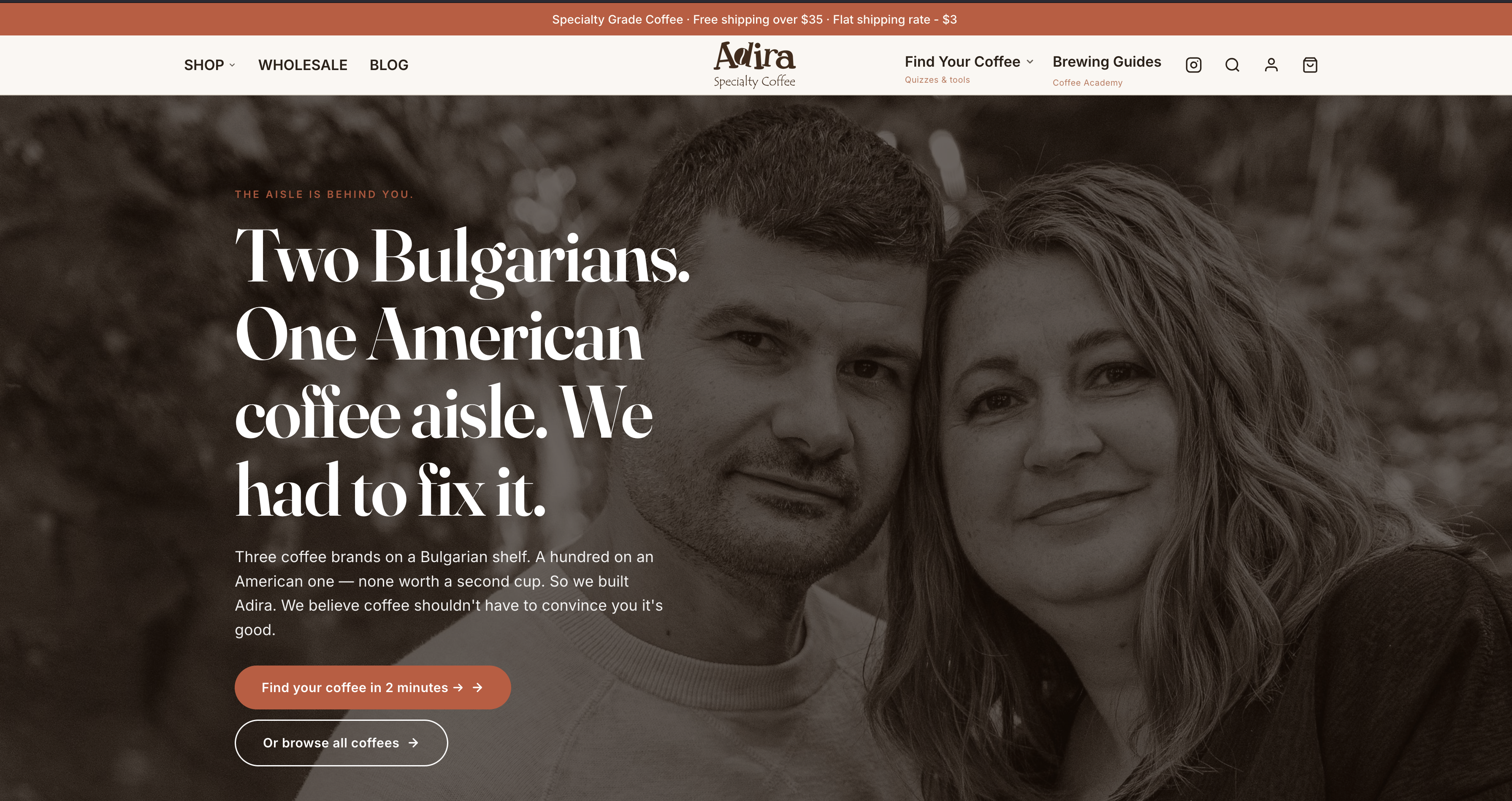
Direct sourcing wasn’t a marketing decision for us. Stefan and Ekaterina Nedelchev came to the U.S. from Bulgaria and spent years unable to find a bag of coffee at the supermarket worth finishing. That frustration led to Adiracoffee, and it shaped every sourcing decision we’ve made since.
We work with cooperatives and small farms in Colombia, Ethiopia, Costa Rica, Mexico, and Sumatra because those relationships give us something a spot-market purchase never can: the ability to tell you exactly where your coffee came from and to stand behind what we paid. Roasting in small batches in California and shipping within days isn’t just about freshness. It’s about keeping the supply chain short enough that we can actually know what’s in it.
Transparency isn’t a feature we added. It’s the reason the brand exists.
Adiracoffee products that meet the ethical sourcing checklist
If you want to act on what this article covers, Adiracoffee’s current lineup checks the boxes: traceable single-origin and blend coffees, roasted to order in California, with origin details published and subscriptions available.
- Mushroom Coffee (Medium Roast): A functional medium roast with traceable origin and roast-date transparency. Clean, balanced, and dialed in for filter brewing.
- Mushroom Coffee (Dark Roast): The same traceable sourcing in a darker profile built for espresso and cold brew. Roasted to order, shipped fresh.
- Love Blend: Adiracoffee’s signature blend, sourced from traceable farms and roasted in small batches. A consistent, ethically sourced option for everyday brewing.
- Cold Brew: Sourced and roasted with the same transparency standards as the rest of the lineup.
Subscribe through the Adiracoffee coffee plan for 10% off every order and free U.S. shipping over $35. Every bag ships within days of roasting, with the roast date on the label.
Useful sources and further reading
- Smithsonian Migratory Bird Center — Bird Friendly Coffee FAQs: Check the specific canopy and habitat criteria that make Bird Friendly the environmental gold standard.
- CoffeeWatch — How to Buy Truly Ethical Coffee: Use the traceability and living income checklist here to evaluate any roaster’s claims.
- Fair Trade Certified — Coffee: Verify Fair Trade price floors, community fund requirements, and producer organization standards.
- Ethical Consumer — Tea and Coffee Certification Schemes: Understand the structural limits of voluntary certifications and why transparency matters alongside them.
- Salon — What Does “Ethical Coffee” Actually Mean?: A useful reality check on greenwashing and how to read marketing language critically.
- Adiracoffee — Coffee Transparency Explained: How Adiracoffee approaches origin disclosure and what to look for on any roaster’s product pages.
- Wild Foodz — Sustainability in Food Services: 2026 Operator Guide: Broader context on Bird Friendly and regenerative sourcing practices across the food service industry.