
TL;DR:
- Small business coffee brands prioritize ethical sourcing through direct trade relationships that support farmers.
- They offer fresher, higher-quality coffee by roasting in small batches and shipping promptly.
- Supporting these brands promotes fair farmer wages, sustainable agriculture, and strengthens local communities.
Why Small Business Coffee Brands Matter: Freshness & Ethics
Most people assume that coffee is coffee. You pick up a bag at the grocery store, brew it, and move on with your day. But that assumption skips over something significant: the difference between a commodity product and a carefully sourced, freshly roasted specialty coffee is enormous, and it affects farmers, communities, and your morning cup in ways that are hard to overstate. Small business coffee brands sit at the intersection of quality, ethics, and genuine human connection. This article will show you exactly why supporting these brands creates real, measurable change, and why more California buyers are making the switch.
Table of Contents
- How small business coffee brands source ethically
- Why freshness and quality stand out with small roasters
- Comparing small business vs. big brand coffees
- How supporting small business coffee brands creates real change
- A coffee expert’s perspective: What most guides miss about small business roasters
- Discover your next favorite coffee from a specialty small business
- Frequently asked questions
Key Takeaways
| Point | Details |
|---|---|
| Ethical sourcing matters | Small business coffee brands use direct relationships, paying premiums for quality and sustainability. |
| Freshness sets them apart | Small batch roasting means customers enjoy fresher, more flavorful coffee. |
| Community impact is real | Supporting small coffee brands boosts both local economies and farming communities. |
| Transparency is vital | Look for detailed sourcing information to ensure your coffee supports ethical practices. |
How small business coffee brands source ethically
When most people hear “ethically sourced,” they picture a generic certification label on a mass-market bag. The reality of how small business roasters actually source coffee is far more intentional and far more impactful than any sticker can communicate.
The most important concept here is direct trade. Unlike Fairtrade, which is a formal certification with fixed price floors, direct trade is a relationship model. Small roasters build ongoing, personal partnerships with specific farms or cooperatives. They negotiate prices directly, often visit the farms, and pay well above commodity market rates. Small business roasters frequently pay premiums above C-market or Fairtrade rates, enabling ethical sourcing, sustainability, and higher farmer incomes that allow real investment in quality.
Those higher payments matter enormously at origin. When a farmer in Colombia or Ethiopia receives a stable, above-market price for their coffee, they can afford to hire more workers during harvest, invest in fermentation infrastructure, or dry their beans on raised beds instead of on bare ground. Each of those decisions directly improves the flavor in your cup.
“The best cup of coffee starts with a farmer who had the resources to care about every detail of the harvest.” This is a principle that guides how Adira Coffee approaches every farm relationship.
Here is a quick comparison of how premium payments affect outcomes at origin:
| Sourcing approach | Price paid to farmer | Farmer investment capacity | Coffee quality outcome |
|---|---|---|---|
| C-market commodity | Lowest (market floor) | Very limited | Inconsistent, often blended |
| Fairtrade certified | Slight premium | Moderate | Better, but still variable |
| Direct trade (small roaster) | Highest (negotiated) | Strong | High, traceable, distinctive |
One important thing to know: there is no official certification for “direct trade.” Any roaster can use the term. This means transparency is everything. The best small business coffee brands publish sourcing details, name specific farms and regions, and share price information openly.
Sustainability is another major benefit of this model. When farmers receive fair payment consistently, they are more likely to maintain shade-grown practices, avoid harmful pesticides, and protect surrounding ecosystems. The relationship creates an incentive structure that benefits the land long term. You can read more about small-farm coffee impact to understand how these farm-level decisions ripple outward.
Pro Tip: Before buying from any small coffee brand, check their website for farm names, origin details, and any mention of the prices they pay farmers. Vague language like “ethically sourced” without specifics is a red flag.
Why freshness and quality stand out with small roasters
After understanding the ethical roots of small business coffee, it is time to look at quality and freshness, two things that define the small batch approach and separate it sharply from what you find in commercial grocery aisles.
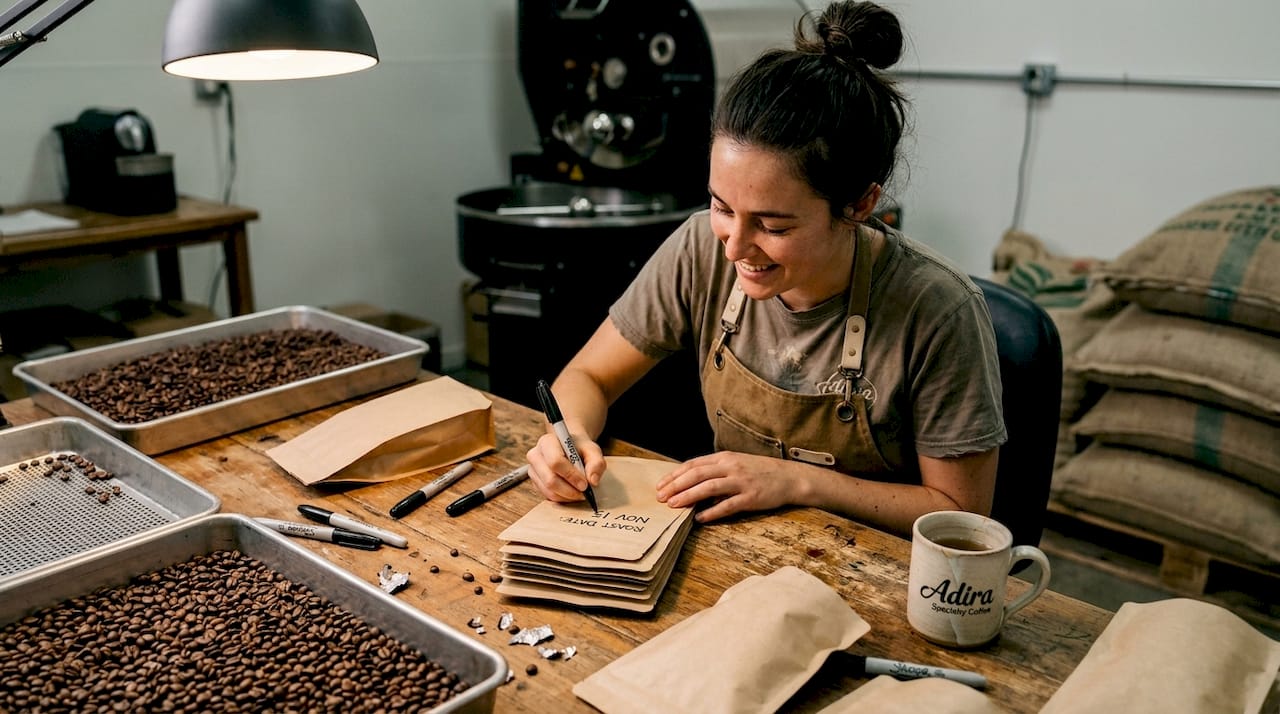
Coffee is a perishable product. Most people do not realize that roasted beans begin losing their peak flavor compounds within days of roasting. The oils that carry your favorite fruity, chocolatey, or floral notes start oxidizing almost immediately. Large commercial roasters roast in massive quantities, ship to warehouses, and then distribute to stores. By the time a bag reaches your kitchen, it could be weeks or even months past its roast date.
Small roasters work differently. Understanding small batch roasting helps clarify why this matters: smaller volumes roasted more frequently means beans ship within days of leaving the roaster, not weeks. You are tasting coffee at its actual peak, not its long-past prime.
Here are the specific ways small business roasters deliver better quality:
- Frequent roasting cycles. Because they sell smaller volumes, they roast more often, sometimes multiple times a week. Beans are always fresh.
- Green coffee selection. Small roasters buy carefully selected “green” (unroasted) lots, often from single farms or specific microclimates. Quality coffee beans make a fundamental difference in what ends up in your cup.
- Skilled, attentive roasting. A small roaster can monitor every batch closely, adjusting heat and timing for each specific lot. Large commercial operations prioritize consistency across enormous volumes, which means averaging out the unique qualities of each bean.
- Cupping and quality control. Many small roasters cup (taste-test) every lot before offering it for sale. This is a level of quality assurance that simply does not exist at industrial scale.
- Traceability. When you buy from a small roaster, you often know the farm name, the variety, the altitude, and the processing method. This is not just interesting trivia. It is evidence of a sourcing process that prioritizes quality at every step.
Agility is another underappreciated advantage. Small roasters gain agility in volatile markets, even as their limited scale creates different challenges. When a new harvest arrives from a specific region, a small roaster can pivot immediately, offering that coffee to customers within weeks. Large brands lock in contracts far in advance and move far too slowly to respond to seasonal quality shifts.
Pro Tip: Always check the roast date on any bag of specialty coffee. If the bag does not display a roast date (not just a “best by” date), that is a sign the roaster is not prioritizing freshness transparency.
Comparing small business vs. big brand coffees
Knowing what small roasters do differently, let us compare those benefits directly against the big coffee brands so the differences become concrete and clear.
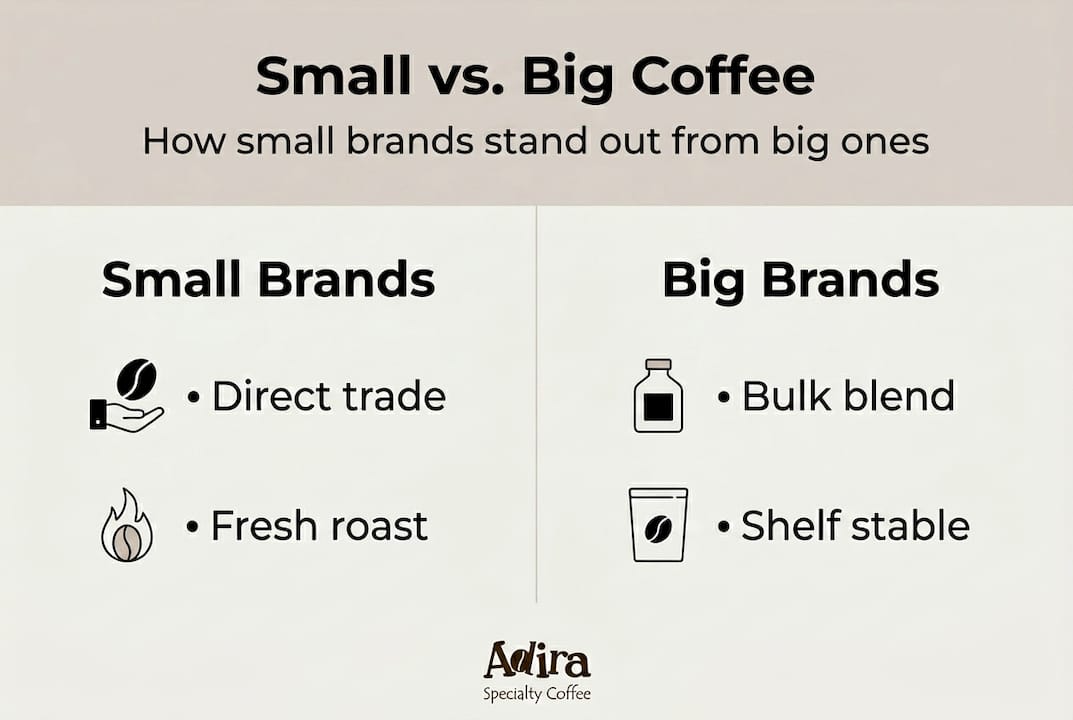
| Category | Small business roasters | Large commercial brands |
|---|---|---|
| Sourcing model | Direct trade with named farms | Commodity brokers, blended origins |
| Farmer relationship | Long-term, personal, transparent | Transactional, anonymous |
| Price paid to farmers | Above market, often 20 to 50% higher | At or near commodity floor |
| Roast freshness | Days from roast to delivery | Weeks to months in warehouses |
| Flavor complexity | Distinctive, traceable, origin-specific | Standardized, blended for consistency |
| Community investment | Local and at-origin | Primarily shareholder-focused |
| Transparency | High (farm names, prices, practices) | Low (generic claims) |
Large commercial coffee brands are optimized for three things: cost reduction, volume consistency, and shelf life. Those are legitimate business priorities, but they produce a coffee that is fundamentally different from what a small roaster offers.
Here is a numbered breakdown of what drives large brand decisions, and why it matters to you as a buyer:
- Cost efficiency over quality. Large brands blend beans from multiple origins to hit a consistent price point, which means the distinctive character of any single origin is diluted or lost entirely.
- Shelf stability over freshness. Beans are roasted darker than optimal in many cases because darker roasts mask staleness. By the time you open the bag, you are tasting roast, not coffee.
- Volume over relationships. When a brand buys millions of pounds of coffee per year, individual farmer relationships become logistically impossible. Sourcing goes through brokers, and farmers have no leverage.
- Brand recognition over transparency. Marketing budgets go toward building brand trust through advertising, not through publishing sourcing practices.
“Buying coffee from a small roaster is one of the few purchasing decisions where paying more genuinely means more for everyone in the chain, from the farmer to your kitchen.”
Small business roasters take the opposite approach. They pay meaningful premiums that support quality investments at origin. The result shows up in cup scores, in flavor complexity, and in the stories you can actually verify about where your coffee came from. For a deeper look at what those quality differences mean in practice, the breakdown of bean quality vs big roasters is worth reading.
How supporting small business coffee brands creates real change
With the differences clear, let us focus on the positive outcomes that follow when you choose a small business coffee brand over a commercial alternative. The impact is broader than most buyers realize.
At origin, the difference starts with income. When farmers receive above-market premiums that go well beyond Fairtrade floors, families can access better healthcare, send children to school, and invest in farm improvements that compound over years. This is not charity. It is a fair price for exceptional work.
Here are the direct benefits that flow from supporting small business coffee brands:
- Higher farmer income leads to reinvestment in soil health, better processing equipment, and improved worker wages at origin farms.
- Sustainable agriculture becomes economically viable when farmers are not forced to cut costs by using harmful pesticides or clearing shade trees.
- Long-term contracts reduce the income volatility that forces many coffee farming families to abandon their land during low-price years.
- Community infrastructure at origin often improves when roasters invest directly in farm projects, from water systems to drying beds to cooperative equipment.
- Local economic growth in California happens when you buy from a California-based small roaster. Money stays in the local economy, supporting jobs and businesses here as well as at origin.
The California coffee culture angle is worth emphasizing. The state has one of the most vibrant specialty coffee communities in the world. Small business roasters are the engine of that culture. They train baristas, educate consumers, and push quality standards in ways that larger brands simply do not.
A meaningful statistic: the Specialty Coffee Association estimates that specialty coffee now accounts for nearly 60% of all coffee consumed by American adults, a figure that has grown steadily as consumers prioritize quality and ethics over convenience. That shift creates real opportunity for small roasters to grow while maintaining the values that make them worth supporting.
Choosing a small roaster also creates a feedback loop of quality. When buyers reward quality with their purchases, roasters can afford to pay more for better lots, which incentivizes farmers to invest more in quality, which produces better coffee, which attracts more buyers who care. The bigger impact of small coffee is not just economic. It is cultural and environmental, spanning continents and connecting communities that would otherwise never interact.
A coffee expert’s perspective: What most guides miss about small business roasters
Most articles about specialty coffee focus on the romance: exotic origins, passionate farmers, and the sensory poetry of tasting notes. That story is true, but it skips over something harder and more important.
The real challenge for small business roasters is sustained transparency. Visiting a farm once and building a relationship over years are completely different commitments. The brands that genuinely move the needle are the ones doing the second thing, not just the first. Direct trade without ongoing due diligence is just marketing.
At Adira Coffee, we think about specialty coffee standards seriously, not as a box to check but as a living practice. Sourcing from around 50 farms across Colombia, Ethiopia, Costa Rica, Guatemala, Brazil, and Sumatra means constantly staying current with harvests, relationships, and quality benchmarks.
For California buyers, the practical advice is this: go beyond the label. Ask what farms a roaster works with. Ask when the coffee was roasted. Ask what they pay. A roaster who cannot answer those questions clearly is not actually doing the work. The best small business brands have nothing to hide and everything to share.
Limited scale is not a weakness. It is the whole point. The inability to scale infinitely is precisely what forces small roasters to stay selective, stay accountable, and stay honest about what they are putting in the bag.
Discover your next favorite coffee from a specialty small business
You now understand what separates small business coffee brands from the commercial alternatives, from the sourcing relationships to the freshness advantage to the real-world community impact. The next step is experiencing it firsthand.
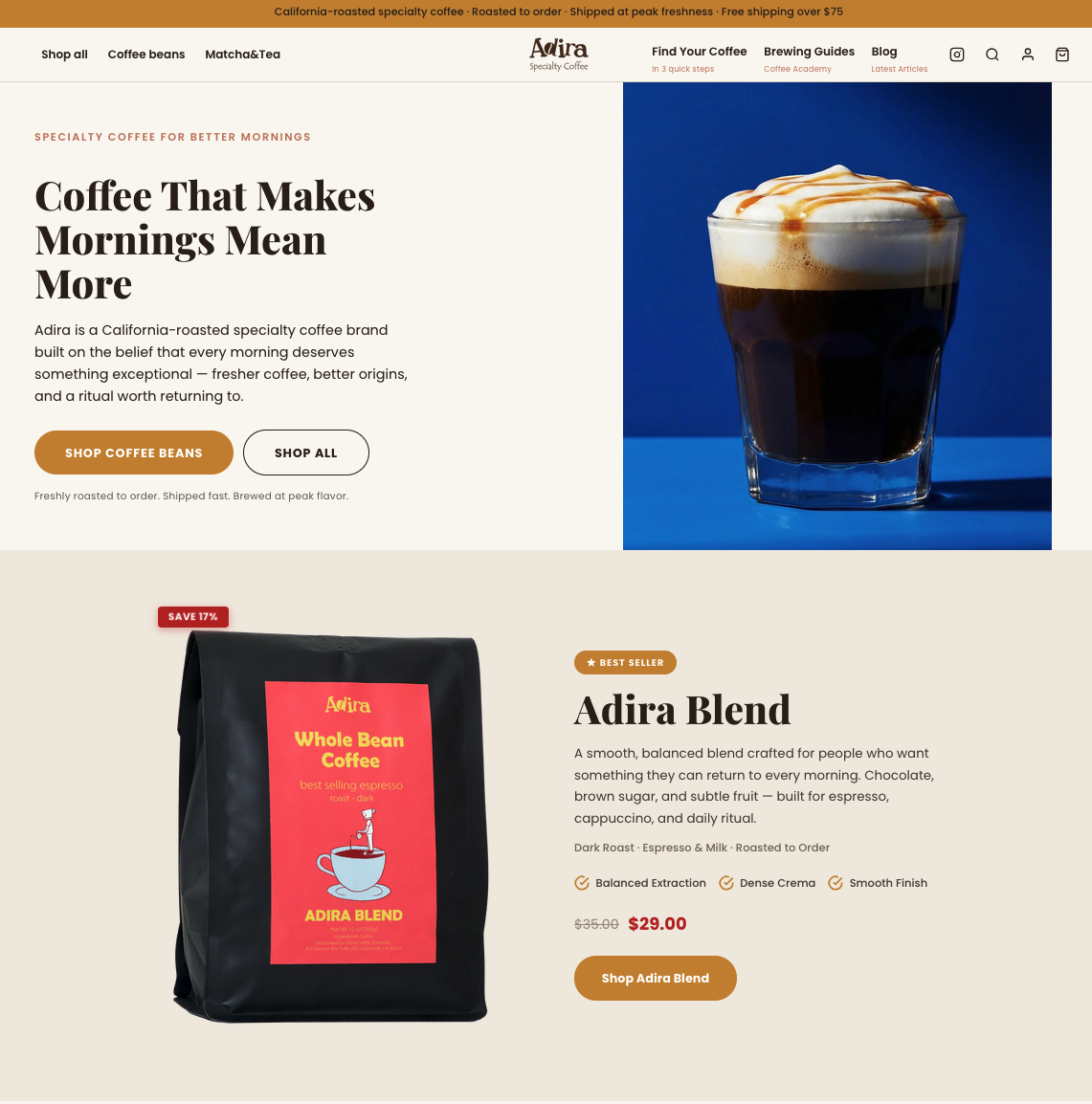
Adira Coffee connects California buyers directly to freshly roasted, ethically sourced specialty coffees from farms we know by name. Whether you are new to specialty coffee or looking to deepen your appreciation, our curated coffee selection makes it easy to find something exceptional. If you want to start with a standout origin, our Colombia specialty coffee is a great first choice, offering bright, complex flavors from farms we source with full transparency. Every bag ships fresh, every purchase supports a farmer paid fairly. That is the small business coffee difference in action.
Frequently asked questions
What does ‘direct trade’ mean for small business coffee brands?
Direct trade means small business coffee brands work directly with farmers to pay higher premiums and ensure ethical sourcing, but buyers should always verify transparency through published sourcing details rather than relying on the term alone.
Why does coffee from small roasters taste fresher?
Small roasters produce in smaller batches and roast more frequently, which means beans ship within days of roasting and arrive at your door at their actual flavor peak rather than weeks past it.
How do small coffee brands help farmers?
They often pay above commodity rates and establish long-term, stable contracts that give farmers the financial security to invest in quality practices, better equipment, and sustainable agriculture.
What should I look for in a transparent small coffee brand?
Look for brands that name specific farms and origins on their packaging, publish information about the prices they pay, and align their practices with recognized quality benchmarks like those set by the Specialty Coffee Association.