
TL;DR:
- Most coffee is grown by smallholder farmers who receive a small share of retail value. Small farms produce distinctive, high-quality coffee through traditional and shade-grown methods. Supporting small farm coffee promotes ethical trade, environmental sustainability, and better livelihoods for farmers.
Most people pour their morning coffee without knowing that 70-80% of it was grown by a smallholder farmer working just a few acres of land. Yet despite doing the hardest work in the chain, these farmers capture only a fraction of what you pay at the register. That gap between labor and reward is one of the most overlooked stories in coffee. This guide breaks down what makes small farm coffee different, why it tends to taste better, how it shapes global supply chains, and why your buying decisions carry real consequences for farming families around the world.
Table of Contents
- Understanding small farm coffee: Who grows it and why it matters
- Flavor, quality, and uniqueness: What sets small farm coffee apart
- Economic and ethical impact: Supporting small farms matters
- Sustainability, challenges, and the future of small farm coffee
- What most people miss about small farm coffee
- Explore small farm coffee with Adira
- Frequently asked questions
Key Takeaways
| Point | Details |
|---|---|
| Most coffee is small-farm grown | Despite producing most of the world’s coffee, small farms receive just a fraction of the final value. |
| Flavor uniqueness | Small farm coffees offer distinct profiles thanks to individual care, terroir, and traditional methods. |
| Ethical and economic benefits | Buying small farm coffee supports farming families and ethical supply chains. |
| Sustainability edge | Traditional, shade-based smallholder systems often deliver sustainability advantages. |
| Consumer choice matters | Your coffee selection influences both taste experience and positive change for growers. |
Understanding small farm coffee: Who grows it and why it matters
A smallholder coffee farm is typically defined as a family-operated plot of five hectares or fewer. These farms are the backbone of global coffee production. Smallholder farmers produce 70-80% of the world’s coffee, a statistic that surprises most consumers who picture sprawling, machine-harvested estates when they think about where coffee originates.
These farms are spread across dozens of countries in the “bean belt,” a region roughly between the Tropics of Cancer and Capricorn. You’ll find them on volcanic hillsides in Colombia and Guatemala, under forest canopies in Ethiopia, and along misty mountain ridges in Sumatra. Each location brings its own microclimate and soil chemistry, which directly shapes the flavor in your cup.
“The overwhelming majority of the world’s coffee is produced by smallholder families, yet they receive a disproportionately small share of the economic value created at origin.”
Small farms operate under fundamentally different conditions than large commercial estates. Here’s a quick comparison of how they differ:
| Feature | Small farms | Large plantations |
|---|---|---|
| Plot size | 1 to 5 hectares | 100+ hectares |
| Harvesting method | Handpicked, selective | Mechanical, strip-harvested |
| Variety selection | Heirloom and rare types | High-yield, uniform cultivars |
| Market access | Limited, often via co-ops | Direct contracts with traders |
| Environmental impact | Lower input, more biodiversity | High input, often monoculture |
Understanding why smallholder coffee farming matters goes deeper than economics. These farmers carry generations of agricultural knowledge, and their methods preserve local ecosystems and rare plant genetics. When you support them, you’re also protecting the diversity of coffee itself.
The challenges they face are real and persistent:
- Limited access to financing and credit
- Exposure to volatile commodity markets
- Lack of bargaining power with middlemen
- Fewer resources for infrastructure or technology
- Vulnerability to weather events and crop disease
Exploring the ethics of small farm coffee helps explain why sourcing decisions made by roasters and consumers ripple all the way back to these families. The system is interconnected, and every purchase sends a signal through it.
Flavor, quality, and uniqueness: What sets small farm coffee apart
Now that you know who grows your coffee, let’s examine why beans from small farms taste so distinctive compared to big-brand blends.
When a single family tends every tree on a small plot, coffee gets treated more like a craft than a commodity. Cherries are picked by hand at peak ripeness, not stripped all at once. Fermentation and drying are monitored closely, not left to industrial timelines. These details pile up, and the result lands in your cup as brightness, complexity, and a flavor you can actually describe.
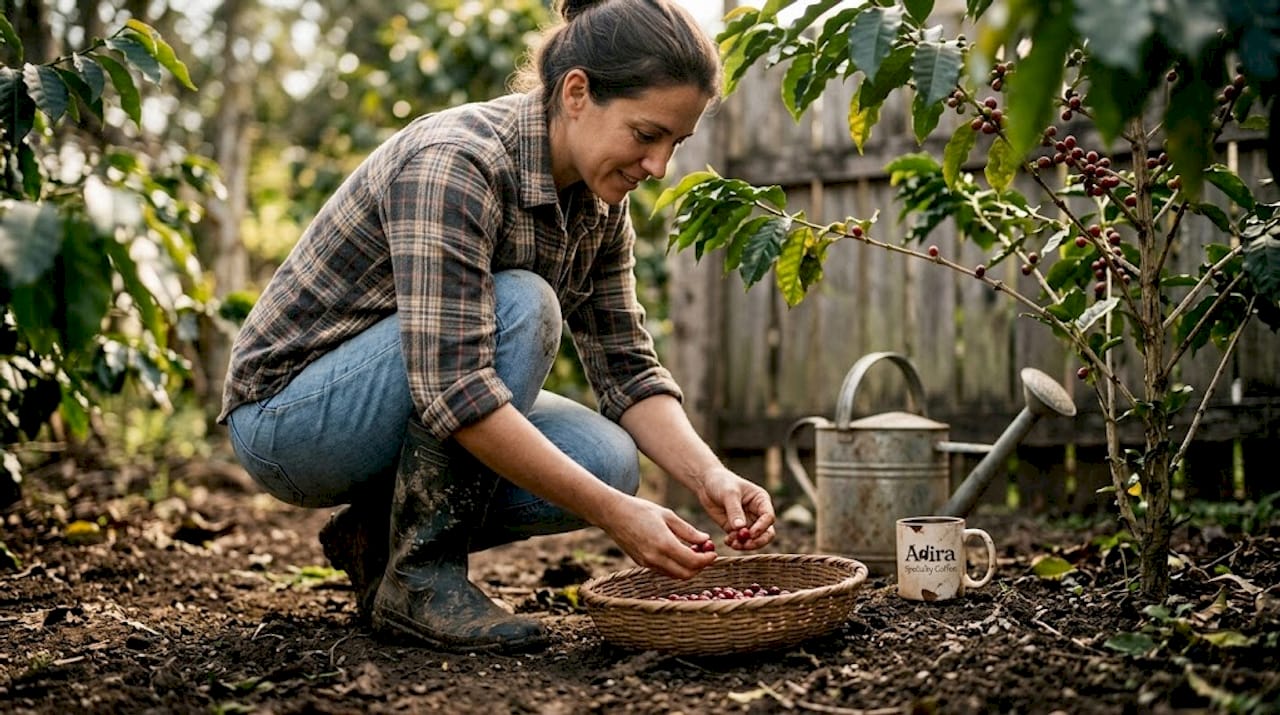
Farming practices and flavor are deeply connected. Small farms are more likely to grow heirloom varieties like Ethiopian Heirloom or Gesha, which have narrower yields but far more nuanced flavor potential than commercial cultivars bred purely for volume. They also tend to use agroforestry systems, where coffee grows under the shade of larger trees alongside other crops.
Research confirms this approach pays off. Shade-grown systems can match or outperform monocultures in both quality and long-term economics. The slower cherry development under shade concentrates sugars and aromatic compounds, which translates into a denser, more interesting cup.
| Attribute | Small farm coffee | Mass-market coffee |
|---|---|---|
| Flavor complexity | High, origin-specific | Blended for consistency |
| Traceability | Farm or co-op level | Rarely available |
| Harvest method | Hand-selected | Machine stripped |
| Variety diversity | Broad, often rare | Limited, yield-focused |
| Processing care | Monitored closely | Standardized |
Pro Tip: When shopping for small farm coffee, look for bags that list the farm name, region, and processing method. That level of detail signals that the roaster has a real relationship with the source, not just a commodity contract.
This is exactly why specialty coffee standards exist. The Specialty Coffee Association scores beans on a 100-point scale, and farms that invest in quality practices consistently score higher. Most high-scoring lots come from smallholders, not industrial estates.
Understanding roast profiles and specialty coffee adds another layer. When you start with a high-quality, traceable bean, the roaster can develop a profile that highlights its unique character rather than masking defects behind heavy roasting.
Economic and ethical impact: Supporting small farms matters
The unique qualities of small farm coffee have ethical implications. Here’s what supporting these producers really means.
The conventional coffee supply chain is long and complicated. Coffee changes hands multiple times between the farmer who grew it and the café that serves it. Each intermediary takes a cut. By the time a bag of coffee reaches retail, small farmers capture only a small share of its retail value, despite doing the foundational work.
That imbalance has direct human consequences. Many smallholder families earn below the living income benchmark for their region, meaning they can’t consistently cover basic needs. Paying more for transparently sourced coffee is one of the most direct ways to shift that equation.
Here are four key frameworks that push value back toward producers:
- Fair Trade certification sets minimum price floors and pays a social premium that communities use for schools, clinics, and infrastructure.
- Direct Trade cuts out middlemen entirely, letting roasters pay above-market prices in exchange for exceptional lots and long-term relationships.
- Organic certification pays a price premium and rewards farmers for practices that protect soil health and reduce chemical exposure.
- Relationship sourcing builds multi-year partnerships that give farmers income stability to invest in quality improvements.
“When roasters build direct relationships with small farms, the benefits aren’t just financial. Farmers gain technical support, market knowledge, and the security to try new approaches.”
Consider coffee ethics and buying choices from this angle: buying a $20 bag of ethically sourced coffee instead of a $10 commodity bag often means the difference between a farming family covering its costs or going into debt during a difficult harvest year.
The benefits for coffee growers extend beyond income. When farmers earn fairly, they invest in soil health, biodiversity, and quality practices. That virtuous cycle produces better coffee for you and a more resilient livelihood for them.
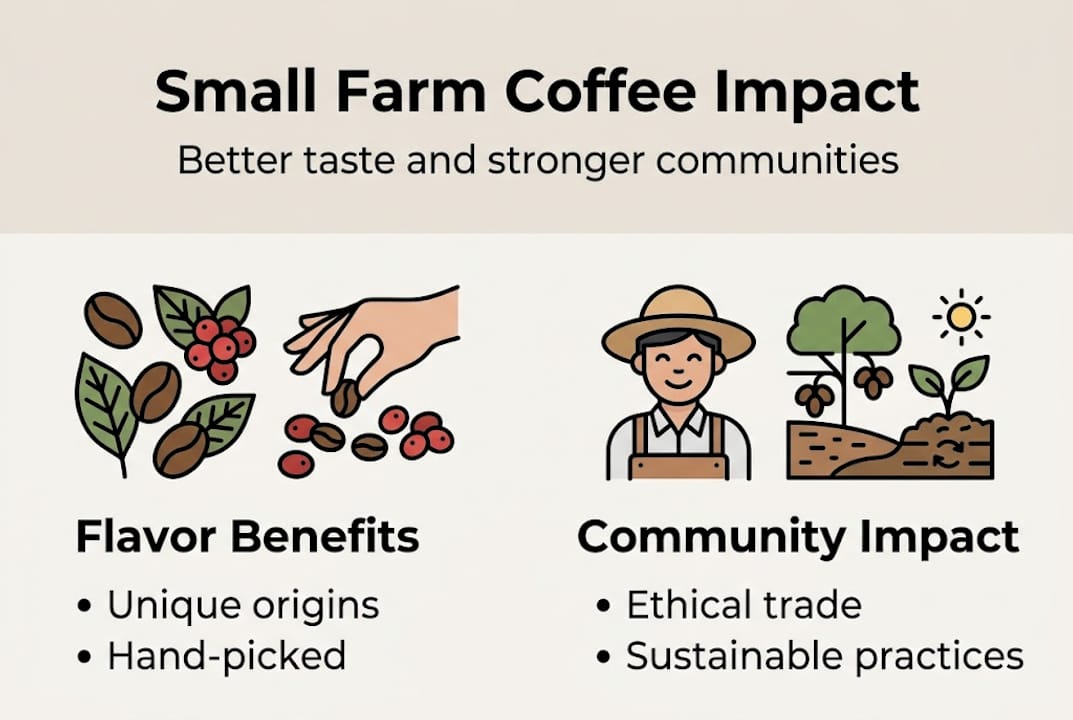
Stat to know: Despite producing the majority of the world’s coffee, smallholder farmers receive roughly 20 cents or less of every dollar spent on retail coffee in high-income countries.
Sustainability, challenges, and the future of small farm coffee
Knowing the ethical impact, it’s equally important to consider the challenges and future promise of small farm coffee.
Small farms are resilient in many ways, but they are also uniquely exposed to external pressures. Smallholders face lower productivity, greater climate risk, and more difficulty adopting improved varieties than large estates. Climate change is sharpening these vulnerabilities, shrinking suitable growing zones, increasing the frequency of leaf rust outbreaks, and making rainfall less predictable.
The barriers stack up quickly:
- Limited access to disease-resistant seedlings and technical training
- Inconsistent water access during dry seasons
- Aging farm infrastructure without capital to upgrade
- Price volatility on commodity exchanges that can wipe out a year’s income
- Knowledge gaps around processing innovations that could improve cup quality
Pro Tip: When you read about a coffee’s harvest season on the bag, that information matters more for small farm lots than for commodity blends. Freshness windows are shorter for high-quality beans, so buying in season supports both flavor and the farmer’s cash flow cycle.
The good news is that some regions are proving alternative models work. Peruvian small farms with shade and moderate inputs can economically outperform high-input, unshaded systems. That’s a significant finding. It means the path forward for smallholders isn’t necessarily to industrialize. It may actually be to deepen their commitment to traditional, agroforestry-based methods while accessing better markets.
| Challenge | Potential solution |
|---|---|
| Climate vulnerability | Shade-grown and diversified systems |
| Market volatility | Direct trade and long-term contracts |
| Technology gaps | Cooperative training programs |
| Low yield varieties | Supported transition to resistant types |
| Limited market access | Specialty and relationship-based roasters |
Understanding farming practices and sustainable quality reveals that the environmental and economic futures of small farms are not in conflict. Biodiversity-friendly farming is both a quality driver and a survival strategy. And the farming origins and challenges faced across regions like Sumatra and Colombia remind us that no two farming contexts are the same, which is why relationship sourcing matters.
What most people miss about small farm coffee
Here’s something worth saying plainly: most coffee content treats small farm sourcing as a marketing badge rather than a real commitment with real trade-offs.
When we source from around 50 farms across Colombia, Ethiopia, Costa Rica, Guatemala, Brazil, and Sumatra, we accept that the coffee will vary. A lot from a family farm in Huila, Colombia will taste different than last year’s lot from the same farm. The trees aged. The rains came early. The farmer tried a new fermentation method. That variability isn’t a flaw. It’s the proof of authenticity.
Ethical consumers sometimes want traceability and consistency at the same time. Those goals are in tension. True small farm coffee is seasonal, variable, and sometimes unavailable. If a bag always tastes exactly the same year after year, someone in the supply chain is blending or masking to create that predictability.
What we’d encourage instead is to develop a relationship with variability. Learn to appreciate a different brightness in a Kenya lot, or a deeper earthiness in a Sumatran natural. That curiosity is what small batch roasting benefits are designed to serve. Small batches let us honor each lot’s character rather than force it into a single flavor profile.
The cup is better for it. And so is the farmer.
Explore small farm coffee with Adira
If this has made you want to taste the difference directly, we’ve made it simple to start.
At Adira Coffee, we work with small farms across the world’s best growing regions, roasting in small batches to keep every lot at peak freshness. Our Colombia small farm coffee brings the bright, fruit-forward character that high-altitude Colombian farms are known for. Our Ethiopia small farm beans offer a natural-process experience full of berry and floral depth. Both are sourced with full transparency and roasted to honor the farmer’s work. You can explore these and every other origin we carry when you shop small farm coffee at Adira.
Frequently asked questions
What is the difference between small farm and commercial coffee?
Small farm coffee is grown on smaller plots by independent farmers, often using traditional and handpicked methods, while commercial coffee comes from large plantations focused on high yields and flavor uniformity. Smallholders account for the majority of global producers, in stark contrast to large commercial estates.
Why does small farm coffee often taste better?
Small farms use attentive harvesting and processing practices that preserve a bean’s unique flavor potential, rather than optimizing purely for volume. Agroforestry and shade-grown techniques specifically improve cup quality by slowing cherry development and concentrating flavor compounds.
How does buying small farm coffee help producers?
It directs more value toward farming families, supporting ethical trade, sustainable growing practices, and rural livelihoods that depend on fair prices. Small farmers capture only a small value share and depend heavily on buyers who prioritize transparency and fair compensation.
Is small farm coffee more sustainable?
Yes, small farms typically use shade-grown and traditional methods that preserve biodiversity and require far less agrochemical input than industrial monocultures. Shade and traditional systems can be economically and environmentally superior over the long term.
Recommended
- How Coffee Farms Define Flavor: Practices That Impact Quality – Adira Coffee US
- Expert coffee brewing tips for better flavor at home – Adira Coffee US
- Why Hand-Picked Coffee Beans Deliver a Superior Brew – Adira Coffee US
- Why Quality Coffee Beans Matter for Flavor and Ethics – Adira Coffee US
- Why Small-batch Ham Delivers Unrivalled Flavour