
TL;DR:
- Hand-picking ensures uniform ripeness, leading to cleaner and more complex flavors.
- Ripe cherries have higher sugar content, directly improving coffee taste quality.
- Selective harvesting is essential for producing high-quality, specialty-grade coffee.
Even a handful of unripe coffee cherries can ruin an entire premium batch. Most coffee lovers focus on roast profiles, grind size, or brew ratios, yet the single most impactful decision happens long before the bean reaches your grinder. It happens on the farm, in the hands of a skilled picker. Ripe cherries carry 18-22% brix sugar content compared to just 8-12% in underripe ones, and that gap shows up directly in your cup. This article breaks down what hand-picking really means, why ripeness is the foundation of great flavor, and how to use this knowledge to choose better coffee.
Table of Contents
- What does hand-picking coffee beans mean?
- Why ripeness matters: The science behind selective harvesting
- Hand-picked beans and specialty coffee: What sets them apart
- Is hand-picking worth it? Costs, challenges, and the impact on your cup
- Why high-end coffee always starts with human hands
- Taste the hand-picked difference with premium beans
- Frequently asked questions
Key Takeaways
| Point | Details |
|---|---|
| Selective ripeness | Hand-picking ensures only ripe cherries are harvested, avoiding bitterness and off-flavors. |
| Superior quality | Beans picked by hand deliver cleaner, sweeter, and more complex flavor profiles. |
| Worth the effort | Though more labor-intensive, the resulting cup justifies the investment for specialty coffee fans. |
| Specialty coffee standard | Hand-picking is essential for meeting the highest specialty coffee criteria. |
What does hand-picking coffee beans mean?
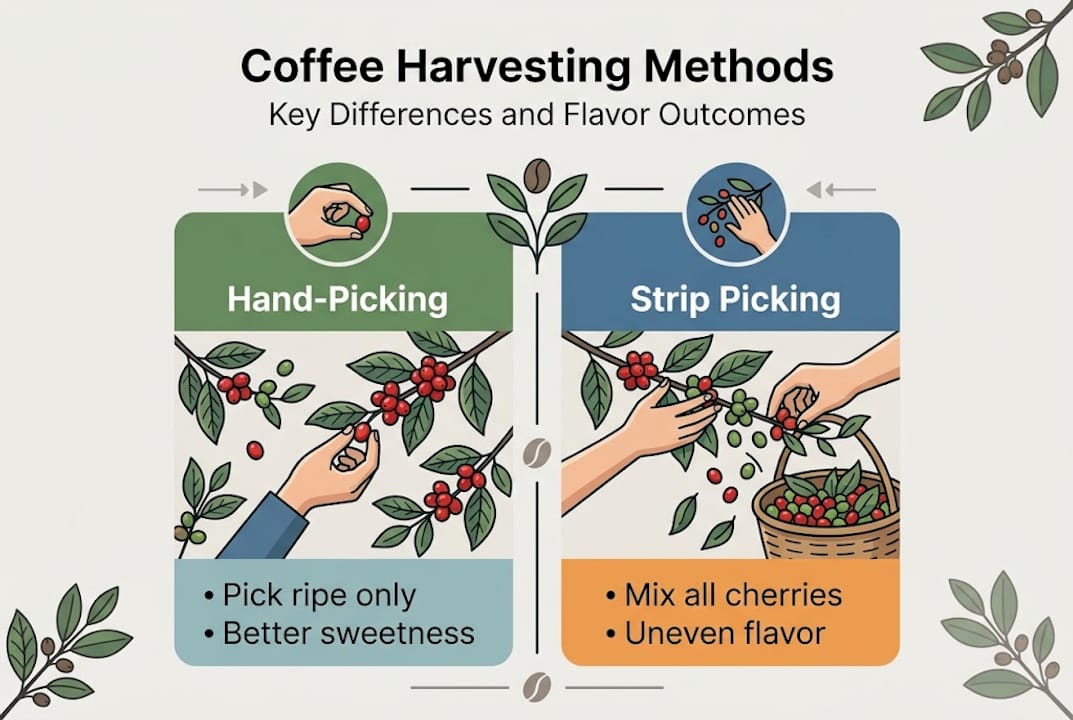
Hand-picking is exactly what it sounds like: trained workers move through coffee trees and select only the cherries that have reached full, deep-red (or yellow, depending on the variety) ripeness. Nothing gets pulled that isn’t ready. That level of precision is what separates it from the two most common alternatives.
Strip picking means workers strip every cherry off a branch in one pass, ripe or not. It’s fast and cheap, but the batch ends up a mix of underripe, ripe, and overripe fruit. Mechanical harvesting uses machines that vibrate or comb the trees, collecting everything at once. Efficient for flat terrain and large estates, but completely blind to ripeness.
Selective hand-picking avoids unripe cherries that introduce bitterness and astringency, and overripe ones that cause fermentation off-notes. That one fact explains why specialty roasters treat hand-picking as a non-negotiable starting point.
| Factor | Hand-picking | Strip picking | Mechanical harvesting |
|---|---|---|---|
| Ripeness control | High | None | None |
| Labor cost | High | Low | Very low |
| Defect rate | Low | High | High |
| Quality outcome | Specialty grade | Commercial grade | Commercial grade |
| Best suited for | Steep terrain, small farms | Large flat farms | Large flat estates |
The trade-off is real. Hand-picking is slow and expensive. A single skilled picker might harvest 100 to 200 pounds of coffee cherries per day, which yields only about 20 to 40 pounds of green coffee. But that labor is where quality is born.
- Uniform ripeness across the batch
- Fewer defective beans entering the processing stage
- Cleaner, more defined flavors in the final cup
- Higher cupping scores recognized by specialty graders
Pro Tip: When shopping for specialty coffee, look for terms like “selective pick” or “hand-selected” on the bag. Roasters who source from farms using this method are usually proud to say so. You can also learn more about identifying quality coffee beans to sharpen your eye before your next purchase. Understanding the types of coffee beans also helps, since some varieties are more forgiving of mixed ripeness than others.
Why ripeness matters: The science behind selective harvesting
Ripeness isn’t just a visual cue. It’s a chemical event. As a coffee cherry matures, starches convert to sugars, acids mellow, and aromatic compounds develop. Pick too early, and you lock in grassy, sour, astringent notes. Pick too late, and fermentation begins on the tree, producing musty or vinegary flavors that no roaster can fix.
The brix scale measures dissolved sugar content in liquid, and it tells a clear story for coffee cherries:
| Ripeness stage | Brix sugar content | Flavor impact |
|---|---|---|
| Underripe | 8-12% | Grassy, sour, bitter |
| Fully ripe | 18-22% | Sweet, fruity, complex |
| Overripe | 22%+ | Fermented, musty, off-notes |
That roughly 10-point difference in sugar between underripe and ripe cherries is enormous. It translates directly into whole bean coffee flavor complexity and sweetness in your cup. Coffee freshness matters too, but freshness can only preserve what was already there at harvest.
Research backs this up at scale. A selective hand-picking study in Ethiopia found that 49.4% of farmers use selective hand-picking at full maturity as their primary harvest method, specifically to protect cup quality. That’s nearly half of surveyed farmers making a deliberate, informed choice to invest the extra labor.
Pro Tip: When tasting a new coffee, pay attention to fruit clarity, natural sweetness, and a clean finish. These are the hallmarks of a well-harvested, fully ripe cherry. If the cup tastes muddy, sharp without complexity, or oddly sour, mixed-ripeness harvesting could be part of the problem.
The key takeaway here is that no amount of roasting skill or brewing technique can manufacture sugars that were never in the cherry. The ceiling for your cup is set at the moment of harvest.
Hand-picked beans and specialty coffee: What sets them apart
Specialty coffee is defined by a cupping score of 80 points or above on the Specialty Coffee Association scale. Achieving that score consistently requires a clean, uniform, defect-free lot. Hand-picking is one of the most reliable ways to get there.
When cherries are harvested selectively, the processing stage (whether washed, natural, or honey) works with a consistent raw material. Processors aren’t fighting to compensate for a mix of ripeness levels. The result is a lot that expresses its origin clearly, whether that’s the bright citrus of an Ethiopian natural or the caramel depth of a Colombian washed.
“In Ethiopia, 49.4% of farmers use selective hand-picking at full maturity, maintaining cup quality versus stripping methods used by only 30.6% of farmers.”
Here’s what hand-picking actually enables at the quality level:
- Uniformity: Every bean in the lot went through the same ripeness window, so roasting is more predictable.
- Clean flavors: No underripe astringency or overripe fermentation muddying the profile.
- Higher cupping scores: Defect reduction directly lifts SCA scores.
- Defect reduction: Fewer floaters, fewer damaged beans, fewer processing failures.
- Traceability: Farms that hand-pick tend to invest in full documentation of their practices.
One misconception worth clearing up: not all manual harvesting is the same. Some farms use manual labor but still strip entire branches at once. The precision of selective picking is what matters, not just the absence of machines. When you explore specialty coffee standards, you’ll see that the scoring system rewards exactly the kind of uniformity that selective hand-picking produces. If you’re still figuring out where to start, a guide on choosing coffee beans can help you ask the right questions.
Is hand-picking worth it? Costs, challenges, and the impact on your cup
Let’s be honest about the economics. Hand-picking is more labor-intensive and leads to higher costs at every stage of the supply chain. That cost gets passed on, and you’ll often pay a premium for specialty-grade, selectively harvested coffee. Is it worth it?
Here are the main cost drivers:
- Labor volume: Selective picking requires multiple passes through the same trees as different cherries ripen at different times. One field might need three or four harvest passes per season.
- Skill and training: Pickers need to recognize ripeness by color, texture, and sometimes feel. That takes experience and consistent oversight.
- Time: Slower harvest means higher per-pound labor costs and more logistical coordination for farm managers.
- Geography: Steep, mountainous terrain (common in Colombia, Ethiopia, and Guatemala) makes mechanization impossible anyway, but it also makes manual labor harder and slower.
Some regions and producers choose strip or mechanical methods not out of indifference to quality but out of economic necessity. A small farmer with a narrow harvest window and limited labor access may not have the option to do multiple selective passes.
Pro Tip: On retail packaging, look for language like “multiple selective passes” or “hand-sorted at origin.” Vague terms like “hand-crafted” or “artisan-harvested” don’t tell you anything specific about the picking method. Ask your roaster directly if you’re unsure.
For the drinker, the payoff is real. A selectively harvested cup delivers clarity, natural sweetness, and a complexity that lingers. You’re not just tasting roast. You’re tasting place, variety, and the discipline of a skilled picker. Pair that with proper storing coffee beans practices and a reliable coffee delivery source, and you’ve built a foundation for consistently excellent coffee at home.

Why high-end coffee always starts with human hands
Here’s something the industry doesn’t say loudly enough: technology has not replaced human judgment at harvest, and it probably won’t anytime soon. Sensors can measure color. Machines can shake trees. But no device yet replicates the intuitive, tactile assessment a trained picker makes dozens of times per minute.
We’ve seen what shortcuts cost. Mechanized harvests save money on paper, but they introduce defects that ripple through processing, roasting, and eventually your cup. The flavor loss is real, and it’s not subtle. Every truly great coffee we’ve encountered traces back to a farm where someone cared enough to pick only what was ready.
This is why small-batch roasting matters so much to us. Small batches are only worth the effort when the raw material is worth protecting. And that raw material starts with hands in a coffee tree, making hundreds of precise decisions per hour.
The uncomfortable truth is that most coffee drinkers have never tasted what a fully selective harvest actually produces. Once you do, it’s hard to go back. The sweetness isn’t added. The clarity isn’t a roasting trick. It’s the direct result of obsessive attention at the very first step.
Taste the hand-picked difference with premium beans
If this has you curious about what a truly selective harvest tastes like in your cup, the best move is to try it side by side with something you already know.

At Adira Coffee, we source our coffee beans from around 50 farms across origins where hand-picking is standard practice, not a marketing claim. Our Colombia coffee and Ethiopia Natural beans are excellent starting points if you want to experience the flavor clarity that selective harvesting produces. Both are small-batch roasted to order and shipped at peak freshness. Start with a single origin, brew it simply, and taste what careful hands at harvest actually deliver.
Frequently asked questions
What are the main differences between hand-picked and machine-harvested coffee beans?
Hand-picked beans are selected for ripeness while machines gather all cherries regardless of maturity, leading to mixed quality and a higher rate of flavor defects in the final cup.
Does hand-picking coffee beans really make a difference in flavor?
Yes. Because ripe cherries carry 18-22% brix sugar versus 8-12% in underripe ones, selectively harvested coffee produces noticeably sweeter, cleaner, and more complex flavors.
How can I tell if my coffee beans are hand-picked?
Look for specific language like “selective pick” or “multiple harvest passes” on the bag, and check if the roaster provides farm-level sourcing details. Hand-picking is a key indicator of specialty-grade production.
Is it worth paying more for hand-picked coffee?
For anyone who values flavor depth and cup clarity, yes. Hand-picking leads to superior quality that no post-harvest processing can fully replicate from a lower-quality starting point.