
TL;DR:
- Roast profiles, not color, primarily determine coffee’s flavor by controlling chemical reactions.
- Adjusting variables like end temperature and development time influences acidity, fruitiness, and bitterness.
- Precise profiling enables repeated, intentional roasts that unlock complex, customized coffee flavors.
Most coffee lovers assume that roast darkness is the main driver of flavor. Go light, get bright. Go dark, get bold. But that oversimplification misses nearly everything that actually matters. Roasting profiles are time-temperature curves that control how heat is applied across every minute of the roast, shaping acidity, sweetness, body, and aroma in ways that roast color alone never could. At Adira Coffee, we’ve spent years working with beans from over 50 farms across Colombia, Ethiopia, Costa Rica, and beyond, and we can tell you: the profile is where the real flavor decisions get made.
Table of Contents
- Understanding roasting profiles: The science behind the curve
- Key variables: How RoR, DTR, and temperature shape your cup
- Flavor development in action: From lab data to your mug
- Applying profiles at home: Crafting custom flavors
- Why most home roasters underestimate the power of profiling
- Ready to taste the difference? Explore Adira’s expertly roasted coffees
- Frequently asked questions
Key Takeaways
| Point | Details |
|---|---|
| Profiles drive flavor | Roasting profiles use time and temperature control to unlock each coffee’s unique flavor potential. |
| Variables make a difference | Small changes to RoR, DTR, or end temperature significantly impact acidity, bitterness, and complexity. |
| Data meets craft | Scientific research and at-home adjustments work together to help you tailor each cup to your taste. |
| Profiling is creative | Treating profiles as artistic choices elevates your coffee from routine to a signature experience. |
Understanding roasting profiles: The science behind the curve
A roasting profile is not just a setting you dial in once and forget. It’s a planned sequence of heat inputs and temperature targets that guides green coffee through a series of chemical transformations. Think of it as a recipe, not just for temperature, but for timing, airflow, and rate of change. How the roast process works is more layered than most people realize, and the profile is the blueprint that holds it all together.
Every roast moves through four distinct phases:
- Drying phase: Green coffee contains 10 to 12% moisture. This stage drives off that water before any browning begins. Rush it, and the bean surface scorches before the core is ready.
- Maillard phase: Named after the French chemist Louis-Camille Maillard, this is where amino acids and sugars react to build hundreds of flavor and aroma compounds. It’s responsible for caramel, chocolate, and nutty notes.
- First crack: A physical and audible event. Internal pressure causes the bean to crack open, signaling the start of real flavor development. This is a critical decision point for every roaster.
- Development phase: The time after first crack. Too short, and the coffee tastes underdeveloped and sour. Too long, and bitterness dominates.
The coffee blend chemistry that makes one cup sing and another fall flat often comes down to decisions made in these phases.
Here’s a quick reference for the terms you’ll hear most:
| Term | What it means |
|---|---|
| RoR | Rate of Rise: how fast temperature climbs per minute |
| DTR | Development Time Ratio: development time as a % of total roast |
| Charge temp | Temperature of the drum when beans are loaded |
| End temp | Final bean temperature at drop |
| First crack | Audible pop signaling bean expansion and flavor shift |
“The profile is not just about how dark you roast. It’s about how you get there, and every degree and every second along the way contributes something to the cup.”
Understanding these phases gives you the vocabulary to talk about coffee with precision, and the framework to start making intentional changes.
Key variables: How RoR, DTR, and temperature shape your cup
Now that you know what a roasting profile is, let’s break down how changing variables shapes what you actually taste.
Rate of Rise (RoR 5 to 15°C per minute), DTR (16 to 30% of total roast time), charge temp, end temp, and weight loss (12 to 24%) are the core mechanics every roaster must understand. Each one pulls a different lever on flavor.
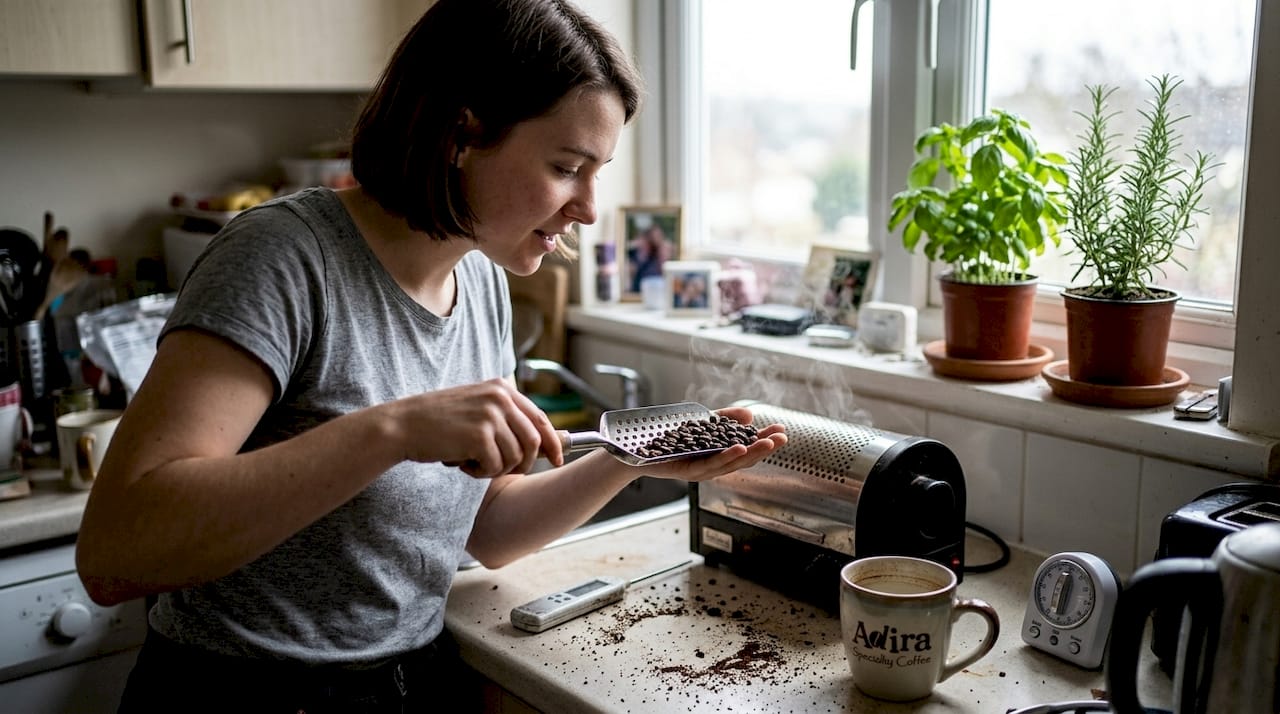
Rate of Rise (RoR) measures how quickly the bean temperature climbs each minute. A high RoR early in the roast drives fast Maillard reactions, which can produce more complex flavors. A declining RoR in the development phase is generally a sign of a well-controlled roast. Flat or rising RoR near the end often leads to harsh, baked notes.
Development Time Ratio (DTR) is the percentage of total roast time spent after first crack. Most specialty roasters target 16 to 25% DTR. Too low, and the coffee is sharp and sour. Too high, and you lose the delicate fruit and floral notes that make specialty coffee worth drinking.
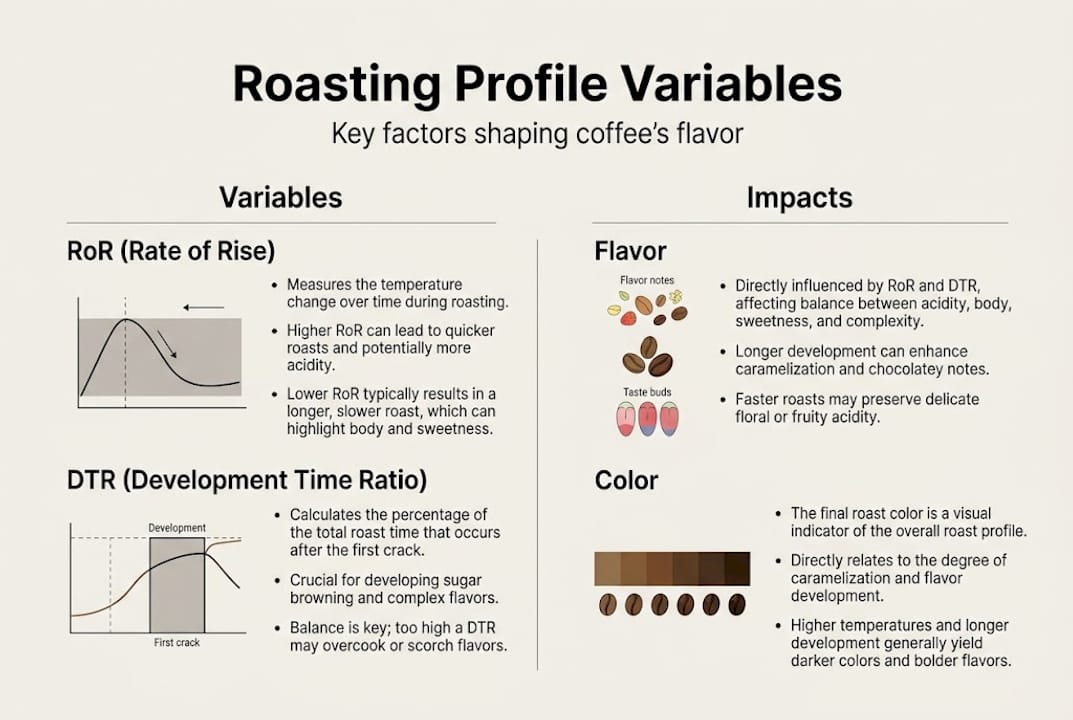
Here’s how the key variables compare across roast levels:
| Variable | Light roast | Medium roast | Dark roast |
|---|---|---|---|
| End temp | 195 to 205°C | 210 to 220°C | 225 to 240°C |
| Weight loss | 12 to 15% | 15 to 18% | 18 to 24% |
| DTR | 18 to 25% | 20 to 25% | 22 to 30% |
| Acidity | High | Medium | Low |
| Body | Light | Medium | Full |
Pro Tip: If your coffee tastes sour, extend your development time by 15 to 20 seconds before adjusting anything else. If it tastes bitter, check your end temperature first. Small changes reveal a lot.
Here’s a practical sequence for home roasters adjusting their profiles:
- Lock in your charge temperature and keep it consistent across batches.
- Track your RoR every 30 seconds and aim for a smooth, declining curve after the Maillard phase.
- Note the exact time of first crack on every roast.
- Set your target DTR based on origin (Ethiopian naturals often benefit from shorter DTR; washed Colombians can handle more).
- Record end temperature and cup the result before making any further changes.
For more practical roasting tips and guidance on small batch roasting, these resources will help you build a repeatable workflow.
Flavor development in action: From lab data to your mug
With the science of roast variables explained, let’s see what happens when experts put theory to the test in real experiments.
A UC Davis study testing 7 profiles on 5kg batches produced a striking result: despite using very different profiles, the beans followed nearly identical color curves in Lab* color space. In other words, two coffees can look identical and taste completely different. Color is not flavor. This single finding should change how you evaluate roasted coffee.
Varying power and end temperature directly affects roast time, mass loss, acidity, bitterness, and fruitiness. These aren’t abstract variables. They’re the difference between a cup that tastes like blueberry jam and one that tastes like ash.
Here’s what the sensory data shows across profile adjustments:
| Profile change | Sensory effect |
|---|---|
| Higher end temp | Increased bitterness, reduced acidity |
| Lower end temp | Brighter acidity, more fruit clarity |
| Longer DTR | Deeper sweetness, less brightness |
| Faster RoR | More complexity, risk of harsh notes |
| Slower RoR | Cleaner cup, potential for flat flavor |
The sensory attributes most affected by profile choices include:
- Acidity: Drops significantly as end temperature rises above 220°C
- Fruitiness: Most pronounced in lighter profiles with controlled DTR
- Bitterness: Climbs sharply in profiles with high power and fast development
- Body: Increases with longer development and higher mass loss
- Sweetness: Peaks in the medium range, then declines as sugars fully caramelize
For home baristas, the practical takeaway is this: if you want to understand why a bag of coffee tastes the way it does, look for roast profile data, not just the roast level label. Identifying quality beans starts with knowing what good profiling looks like on paper before you ever taste the cup.
Applying profiles at home: Crafting custom flavors
Now that research has shown what works in the lab, here’s how you can adapt those principles to craft coffee just the way you like it.
Empirical roasting experiments confirm that varying heat mechanisms and end temperature creates measurable differences in acidity, bitterness, and fruitiness. You don’t need a commercial roaster to apply these lessons. You need a process.
Here’s a step-by-step approach to designing your own roast profile at home:
- Start with a baseline. Use a known profile for your roaster type (drum, fluid bed, stovetop) and cup the result honestly.
- Change one variable at a time. Adjust only end temperature, or only DTR, never both at once. This is how you learn what each lever actually does.
- Match the profile to the bean origin. Washed Ethiopian beans are delicate and respond well to lower charge temps and shorter development. Brazilian naturals are denser and can handle more heat input early.
- Cup every batch blind. Taste without knowing which profile you used. Your palate will tell you more than your notes will.
- Refine based on what’s missing. Sour? Extend development. Flat? Increase RoR in the Maillard phase. Bitter? Drop end temp by 3 to 5°C.
Pro Tip: Keep a roast log for every session. Write down charge temp, first crack time, end temp, DTR, and your tasting notes. After 10 batches, patterns emerge that you’d never notice batch to batch.
For a deeper home roasting guide and help selecting beans for flavor, these resources will sharpen your process fast.
Common pitfalls California home baristas run into:
- Chasing roast color instead of tracking time and temperature
- Skipping the cupping step and relying on smell alone
- Using the same profile for every origin regardless of density or processing method
- Adjusting too many variables between batches
- Ignoring the drying phase and rushing to first crack
Why most home roasters underestimate the power of profiling
Most home roasters spend their energy choosing between light and dark. They treat the roast level as the creative decision and everything else as technical noise. That’s exactly backwards.
The profile is the creative act. Roast level is just the outcome. When you start thinking in terms of RoR curves, DTR targets, and phase timing, you stop chasing a color and start building a flavor. The difference in the cup is not subtle. It’s dramatic.
We’ve tasted two coffees from the same farm, same harvest, same green lot, that tasted like completely different origins because of profile differences alone. One was bright and floral. The other was round and chocolatey. Same bean. Different profile.
Repeatability is the other underrated benefit. Once you dial in a profile that produces the cup you love, you can recreate it every single time. That’s not just satisfying. It’s the foundation of a genuine craft.
“Profiling transforms roasting from routine to art, and the cup becomes your signature.”
Treat your profile log like a recipe book. The best roasters we’ve worked with across our network of 50 farms are obsessive about their notes. Not because they’re perfectionists, but because they know that precision is what separates a good cup from a great one.
Ready to taste the difference? Explore Adira’s expertly roasted coffees
Every bag we roast at Adira Coffee is built on the principles covered in this article. We’re not guessing at flavor. We’re engineering it, one profile at a time, for beans sourced from farms we know and trust.
If you want to taste what intentional profiling actually produces, start with Adira’s coffee beans and explore the full range of origins we’ve carefully developed roast profiles for. Our Colombia single origin is a great starting point: a washed Andean bean roasted to highlight its natural citrus brightness and caramel sweetness. Every bag ships fresh, within days of roasting, so you’re tasting the profile at its peak.
Frequently asked questions
What is a roasting profile and why does it matter for coffee flavor?
A roasting profile is a planned sequence of temperature changes over time that shapes coffee’s flavor, aroma, and body far more than roast level alone. Profiles control heat application to optimize the chemical reactions that build flavor.
How can I change my roast profile to get more fruity or less bitter coffee?
Lowering end temperature and extending development time preserves fruit acidity, while higher power and shorter development time push toward bitterness. Varying power and end temp directly shifts acidity, fruitiness, and bitterness in measurable ways.
What are the main phases of a coffee roasting profile?
The main phases are drying, Maillard (flavor development), first crack, and post-first crack development. Each profile phase plays a distinct role in building the final flavor of the cup.
Do different bean origins require different roast profiles?
Yes. Bean density, moisture content, and processing method all affect how heat should be applied. Empirical roasting data confirms that profile choices must be adapted to origin to highlight natural flavor characteristics.
What is the Rate of Rise (RoR) in coffee roasting?
Rate of Rise measures how quickly bean temperature increases per minute during the roast, and it’s one of the most important controls for flavor development. RoR ranges from 5 to 15°C per minute depending on the phase and the desired outcome.