
TL;DR:
- Green coffee beans are raw, dense seeds with distinct chemical and structural properties requiring roasting to develop flavor. Processing methods like natural, washed, and honey significantly influence the bean’s flavor profile and final brew characteristics. Home roasting green beans involves specific techniques and attention to detail, as they cannot be brewed directly from raw; health claims about green coffee supplements are modest and should be approached with caution.
Most coffee lovers assume green coffee beans are simply unroasted versions of what ends up in their morning cup. That assumption misses a lot. Green beans are chemically, structurally, and sensorially different from roasted coffee in ways that matter deeply to anyone serious about flavor, sourcing, or home roasting. They store longer, behave differently under heat, and carry compounds that disappear the moment a roaster applies fire. This article walks through what green coffee beans actually are, how processing shapes their flavor potential, what the health science really supports, and how you can start working with them at home.
Table of Contents
- What are green coffee beans?
- How processing shapes the flavor of green coffee beans
- Brewing and roasting green coffee beans at home
- Green coffee bean health claims: separating fact from hype
- Peaberries, high-altitude beans, and green coffee extract: specialty cases
- A fresh perspective: why most home baristas misunderstand green beans
- Discover specialty green and roasted coffees with Adira
- Frequently asked questions
Key Takeaways
| Point | Details |
|---|---|
| Green beans need roasting | You can’t brew green coffee beans directly—they must be roasted for drinkable flavor. |
| Processing shapes taste | How a green coffee bean is processed determines most of the final cup’s flavor. |
| Modest health benefits | Green coffee may offer some health effects, but results are usually mild and not guaranteed. |
| Specialty beans offer variety | Peaberries, high-altitude beans, and extracts each impact coffee flavor and function in unique ways. |
What are green coffee beans?
Green coffee beans are the raw, unroasted seeds of the Coffea plant. After the coffee cherry is harvested and the fruit is removed, what remains is a dense, pale seed with a tough outer membrane called the silver skin. That seed is what we call a green bean.
If you pick one up, you’ll notice it feels almost like a small stone. It has none of the brittleness of a roasted bean. The color ranges from pale gray-green to a deeper olive, depending on origin and processing. The smell is grassy, slightly vegetal, and faintly earthy. Nothing about it says “coffee” yet.
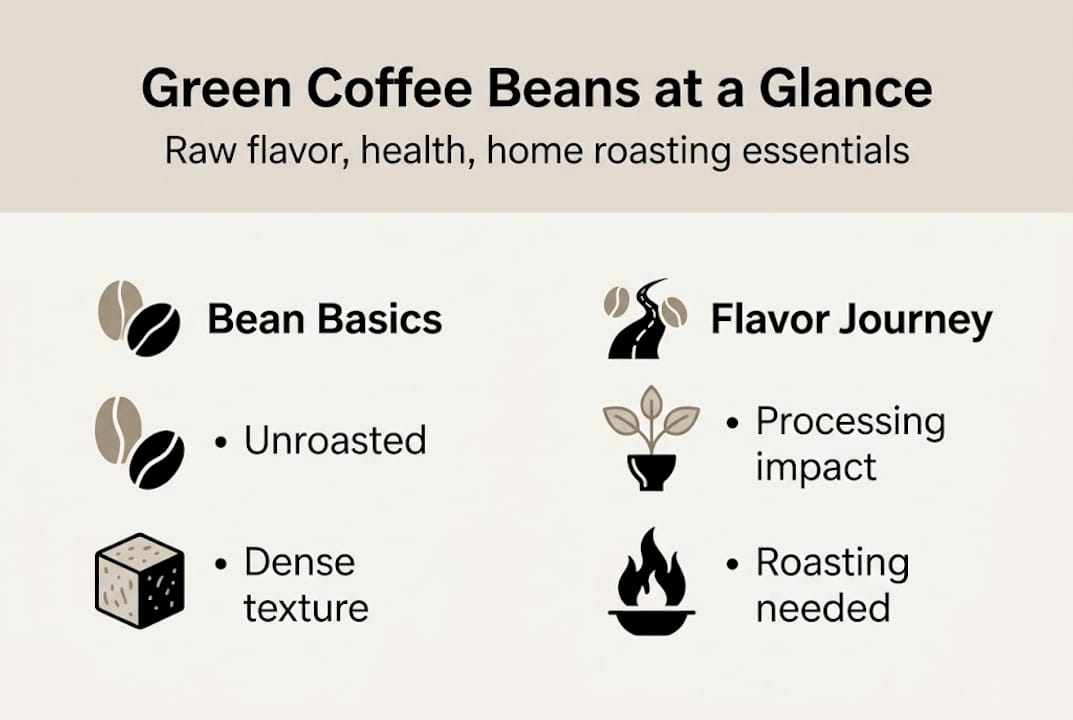
Here’s where many beginners go wrong: they assume you can grind and brew green beans the same way you’d brew roasted ones. You can’t. Green beans are too hard to grind properly, and even if you managed to extract something, it would taste grassy, sour, and unpleasant. The roasting process is what triggers the Maillard reaction and caramelization, building the complex flavors you actually want in a cup.
Green beans do have one major advantage over roasted: shelf life. While roasted coffee starts losing freshness within weeks, green beans stored correctly can remain viable for one to two years. This makes them attractive for home roasters who want to buy in bulk.
Key properties of green coffee beans:
- Density: Much harder and denser than roasted beans
- Moisture: Typically 10-12% moisture content at export
- Color: Pale green to olive, never brown
- Flavor raw: Grassy, vegetal, sour
- Storage life: Up to 2 years in cool, dry, dark conditions
Understanding roast profiles is essential once you have green beans in hand, because the roast is where their potential is either realized or wasted. The origin also matters. Learning the main types of coffee beans gives you a head start on predicting how a green bean will behave once heat is applied.
Pro Tip: Store green beans in breathable burlap or grain-pro bags, away from light and humidity. Airtight plastic containers trap moisture and can promote mold.
How processing shapes the flavor of green coffee beans
Here’s a fact that surprises most home baristas: processing determines roughly 60% of the final roasted flavor. The farm, the altitude, and the variety all matter, but how the cherry is handled after harvest has an outsized effect on what ends up in your cup.
The five major processing methods each leave a distinct fingerprint on the green bean:
- Natural (dry): The whole cherry dries in the sun. Sugars from the fruit ferment into the bean, producing fruity, wine-like, and sometimes funky flavors.
- Washed: The fruit is removed before drying. The result is a cleaner, brighter cup with more pronounced acidity and terroir clarity.
- Honey: A middle path. Some fruit mucilage is left on the bean during drying, creating sweetness without full natural fermentation.
- Wet hulled (Giling Basah): Common in Sumatra. Beans are hulled at high moisture, producing earthy, full-bodied, low-acid cups.
- Anaerobic: Fermentation happens in sealed, oxygen-free tanks. Flavor outcomes are intense, often tropical or candy-like.
| Processing method | Flavor profile | Body | Acidity |
|---|---|---|---|
| Natural | Fruity, wine, berry | Heavy | Low-medium |
| Washed | Clean, bright, floral | Light-medium | High |
| Honey | Sweet, balanced, stone fruit | Medium | Medium |
| Wet hulled | Earthy, herbal, tobacco | Full | Low |
| Anaerobic | Tropical, candy, intense | Variable | Variable |
For home roasters, this means the green bean you buy is already carrying flavor potential baked in before you touch it with heat. When choosing coffee beans for home roasting, ask about the processing method first. A natural Ethiopian and a washed Ethiopian from the same farm will roast and taste completely differently.
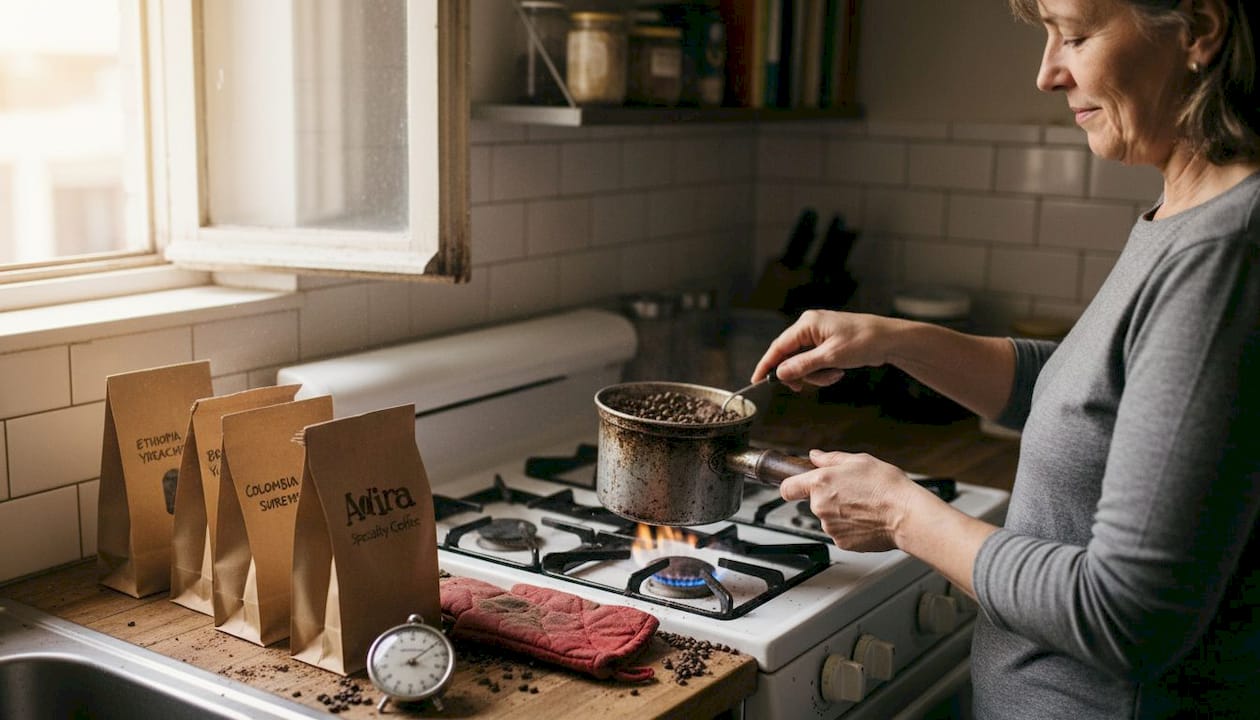
Understanding coffee roasting becomes far more intuitive once you connect it to processing. Dense, washed beans need more heat to develop. Natural-processed beans carry more sugars and can tip into burnt-fruit territory if pushed too hard. Farm practices and flavor are deeply connected to processing choices made at origin.
Brewing and roasting green coffee beans at home
Let’s be direct: you cannot brew green coffee beans like regular coffee. They are too hard, taste grassy, and lack the soluble compounds that make extraction worthwhile. Roasting is not optional. It’s the transformation that makes coffee, coffee.
Home roasting is more accessible than most people think, but it requires attention and a bit of patience. Here’s a basic step-by-step process:
- Choose your equipment. A dedicated home roaster, a cast iron skillet, or a stovetop popcorn popper all work. Each gives different control over heat.
- Start with a small batch. 100-150 grams is a good starting point. It’s easier to manage and wastes less if something goes wrong.
- Apply heat gradually. Target a bean temperature around 300-320°F (150-160°C) in the early drying phase, then ramp up.
- Listen for first crack. Around 385-400°F (196-204°C), beans will audibly crack. This marks the entry into light roast territory.
- Decide your roast level. Stop at first crack for light roast. Continue for medium or dark, watching color and smell carefully.
- Cool immediately. Dump beans into a colander and stir rapidly. Slow cooling continues the roast and can muddy flavors.
- Rest before brewing. Wait 12-24 hours minimum. CO2 needs to off-gas before the beans brew cleanly.
| Roast stage | Temperature (°F) | Flavor notes |
|---|---|---|
| Light | 385-400 | Floral, fruity, bright acidity |
| Medium | 400-430 | Balanced, caramel, mild acidity |
| Dark | 430-450+ | Bold, bitter, low acidity |
Exploring small batch roasting techniques will sharpen your results fast. And if you want to understand what separates good from great roasted output, specialty coffee standards give you a useful benchmark.
Pro Tip: Never roast indoors without ventilation. The smoke and chaff produced during roasting are significant. A garage with the door open or an outdoor setup is ideal.
Green coffee bean health claims: separating fact from hype
Green coffee beans have been marketed heavily as a weight loss supplement, and that marketing has created a lot of noise. Let’s look at what the science actually supports.
The active compound in green coffee extract is chlorogenic acid (CGA). This polyphenol is largely destroyed during roasting, which is why green coffee contains far more of it than your morning espresso. Claimed benefits include:
- Weight loss: Studies show 1-3kg loss over 8-12 weeks, but results are mixed and study quality is generally poor
- Blood pressure: A modest systolic drop of 2-5mmHg in some trials
- Glucose control: Some evidence of improved insulin sensitivity, though again, studies are small
The honest picture is that these effects are real but modest. They are not a substitute for diet and exercise, and health claims are frequently overstated in supplement marketing. Meta-analyses consistently flag poor study quality and call for larger, better-controlled trials.
Certain groups should avoid green coffee supplements entirely. Pregnant individuals, people with hypertension, and those sensitive to caffeine should consult a doctor before using any green coffee product. The caffeine content in green coffee extract is meaningful and can interact with medications.
“The evidence for green coffee extract benefits remains preliminary. Consumers should approach supplement claims with healthy skepticism and prioritize lifestyle factors.”
There is also an important distinction between drinking green coffee as a tea-like brew (which some people do) and taking a concentrated extract supplement. The former is mild; the latter delivers a much higher CGA dose with different risk considerations.
Peaberries, high-altitude beans, and green coffee extract: specialty cases
For enthusiasts who want to go deeper, green coffee beans offer some genuinely fascinating edge cases worth knowing.
Peaberries are a natural mutation where only one seed develops inside the coffee cherry instead of the usual two. The result is a small, round bean rather than the flat-sided shape you’re used to. Peaberries roast faster and more evenly because of their shape, and many roasters find they produce a more concentrated, sweeter cup. They’re worth seeking out if you’re experimenting with home roasting.
High-altitude beans are denser because the slower growth at elevation allows more complex sugars and acids to develop. Denser high-altitude beans require more heat and time to fully develop during roasting, but they reward patience with greater flavor complexity. If you’re buying green beans for home roasting, altitude data on the bag is a useful quality signal.
Green coffee extract is a different category entirely. It’s not a bean you roast or brew. It’s a concentrated supplement designed to deliver high doses of chlorogenic acids without any of the roasted flavor compounds. It’s popular in the wellness space but should be evaluated as a supplement, not a coffee product.
Specialty green bean options to explore:
- Peaberries from Tanzania or Brazil for sweet, round flavor
- High-altitude washed beans from Ethiopia or Colombia for complexity
- Natural-processed Yirgacheffe for intense fruit character
Hand-picked beans from carefully managed farms tend to produce the most consistent green beans for home roasting. And revisiting bean types and flavor will help you match specialty green beans to your preferred cup profile.
A fresh perspective: why most home baristas misunderstand green beans
Here’s something we’ve observed working with home roasters and enthusiasts: most people come to green coffee beans through the health supplement angle. They’ve read about chlorogenic acids or seen a weight loss ad. That’s the wrong door.
The real value of green coffee beans is the transparency they offer. When you hold a green bean, you’re holding the entire history of that coffee before roasting erases or transforms it. The processing method, the altitude, the variety, the farm’s practices. All of it is still there, waiting.
Most beginners rush past this. They want to roast quickly and get to the cup. But the enthusiasts who get the most out of home roasting are the ones who slow down at the green stage. They learn to identify quality beans before heat is ever applied. They ask about moisture content, density, and processing. They treat the green bean as the primary ingredient, not just a raw material.
The health hype around green coffee extract is a distraction from what makes green beans genuinely interesting: they are the purest expression of a coffee’s potential. Learning to read and work with them is what separates a home roaster from someone who just owns a roasting device.
Discover specialty green and roasted coffees with Adira
Ready to explore top-quality beans in your own kitchen? At Adira Coffee, we source directly from around 50 farms across Colombia, Ethiopia, Costa Rica, Guatemala, Brazil, and Sumatra, working with growers who prioritize processing quality and altitude-driven flavor. Whether you’re a home roaster looking for exceptional green beans or a coffee lover who wants to experience the results of careful sourcing, we have options worth exploring.
Start with our Colombian coffee beans for a clean, balanced introduction to single-origin roasting, or try our Ethiopian natural coffee for a bold, fruit-forward experience that shows what natural processing can do. Browse the full range at Adira Coffee and find your next favorite bean, green or roasted.
Frequently asked questions
Can I brew a cup of coffee directly from green coffee beans?
No. Green beans are too hard and taste grassy and sour. Roasting is required to develop the soluble compounds and flavors that make brewing worthwhile.
Are green coffee beans healthier than roasted beans?
Green coffee contains higher levels of chlorogenic acids, but proven benefits are modest and the research quality is generally low. They are not a dramatic health upgrade.
What is the difference between green coffee beans and green coffee extract?
Green coffee extract is a concentrated supplement made to deliver high chlorogenic acid doses. It is not a brewing ingredient and has no roasted coffee flavor.
Can anyone safely take green coffee bean supplements?
Not always. Pregnant individuals and those with blood pressure concerns should avoid these supplements. Anyone considering them should speak with a doctor first.
Recommended
- Understand coffee roasting: improve your home brewing – Adira Coffee US
- Coffee roasting tips to unlock incredible flavor at home – Adira Coffee US
- Why buy whole bean coffee for fresher, richer flavor – Adira Coffee US
- Home coffee roasting guide: from first batch to great cup – Adira Coffee US
- Learn How to Use Erythritol in Coffee - US Sweeteners