
TL;DR:
- Traceable coffee sourcing documents every stage from farm to cup, ensuring transparency and verified quality. It links flavor profiles to precise farming conditions, supports fair pay, and meets environmental regulations like the EU Deforestation Regulation. Technology like blockchain, geolocation, and certification systems rely on strong governance to build ethical, sustainable supply chains.
Traceable coffee sourcing is the practice of documenting and verifying every stage of a coffee bean’s journey, from the farm where it was grown to the cup where it is consumed. The industry term for this practice is supply chain traceability, and it covers farming conditions, processing methods, export logistics, and roasting records. Traceability improves all three pillars of the triple bottom line: economic, social, and environmental sustainability. For consumers, roasters, and regulators alike, it is the difference between a claim and a verified fact.
Why traceable coffee sourcing changes what’s in your cup
Traceability reveals the specific conditions that shape coffee flavor. Altitude, soil composition, processing method, and harvest timing all leave fingerprints in the cup, and none of that information reaches you unless someone documented it at the source. When a roaster knows a lot was washed-processed at 1,800 meters in Huila, Colombia, they can dial in the roast profile accordingly. Without that data, they are guessing.
Transparency reduces power imbalances and enables better value distribution across the coffee supply chain. Importers sit at the center of this information flow. They hold origin data, quality scores, and processing records that roasters and consumers rarely see in full. When that information is shared openly, roasters can price accurately, consumers can choose confidently, and farmers get recognized for quality they actually produced.
Specialty coffee brands that publish farm-level sourcing data consistently command higher consumer trust. A buyer who can scan a QR code and read the name of the farm, the farmer’s cooperative, and the harvest date is not just buying coffee. They are buying a verified story. That specificity is what separates specialty coffee standards from commodity trading.
- Traceability links flavor notes directly to documented farming and processing decisions
- Roasters use origin data to optimize roast profiles for each specific lot
- Consumers gain confidence that quality claims are verified, not marketing copy
- Importers who share data openly reduce the information gap that typically erodes farmer income
Pro Tip: When evaluating a coffee brand’s traceability, look for lot-level detail rather than country-level origin. “Ethiopia” is a country. “Yirgacheffe, Kochere cooperative, natural process, 2025 harvest” is traceability.
How traceability supports fair pay and social responsibility
The coffee supply chain has a well-documented fairness problem. Farmers typically receive a fraction of the retail price, and without transparent data linking their specific lot to its downstream value, they have little leverage to negotiate. Traceability changes that equation by making the value chain visible.
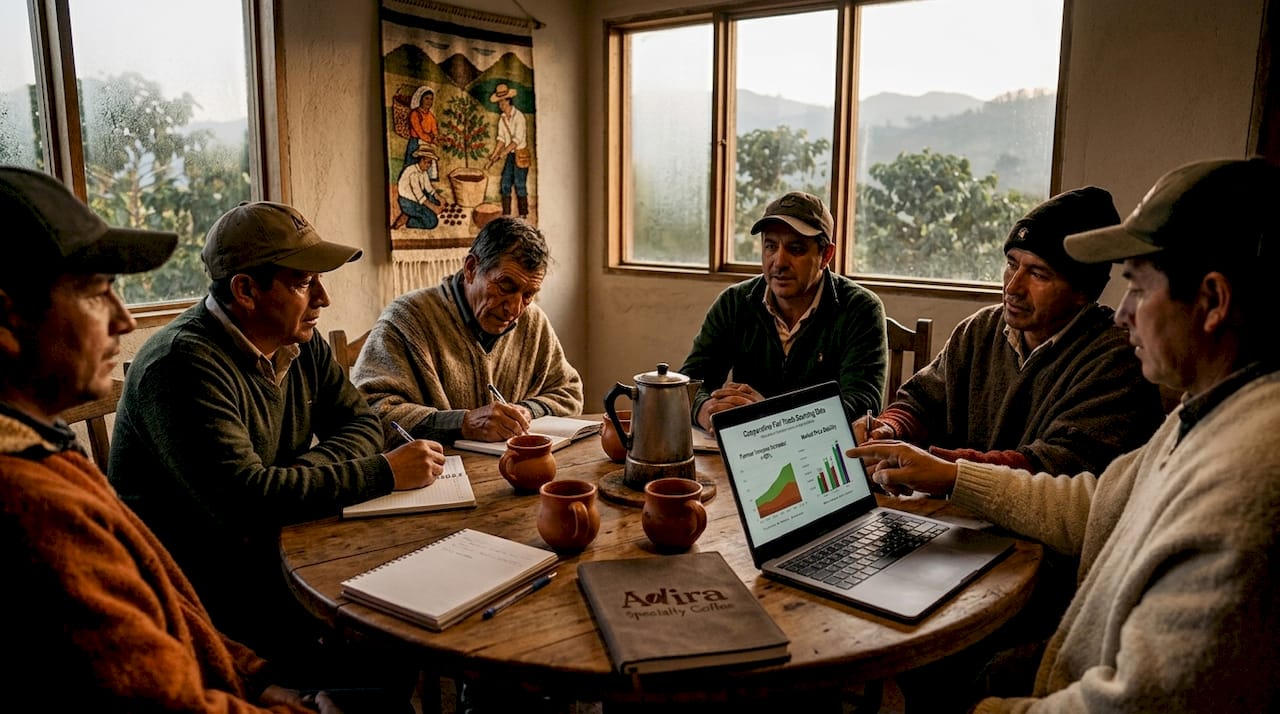
A blockchain traceability study conducted from January 2024 to June 2025 with Indonesian smallholder Arabica farmers found that blockchain adoption generated a USD 0.35/kg premium and a 13% annual household income increase. That is not a marginal gain for a smallholder family. It represents the direct financial impact of connecting verified quality to verified identity.
Here is how traceability creates fairer outcomes across the supply chain:
- Verified origin data allows farmers to prove the quality of their specific lot, not just their region, which supports premium pricing.
- Documented processing records reduce the risk of quality disputes between farmers and buyers, protecting farmer income.
- Transparent contracts tied to traceability data make it harder for intermediaries to undervalue lots without evidence.
- New buyer relationships open up when farmers can demonstrate consistent, documented quality over multiple harvests.
- Cooperative-level records give smallholder groups collective bargaining power they rarely hold individually.
The challenge is that adoption is limited by connectivity and digital literacy, and the benefits tend to favor larger producers who already have infrastructure. A farmer with a smartphone and reliable internet captures the full benefit of a blockchain system. A farmer in a remote area with neither is excluded from the same system. This is why governance and capacity building matter as much as the technology itself.
Pro Tip: When choosing a fair trade certified coffee, check whether the brand publishes farm-level sourcing data alongside the certification. Certification sets a floor. Traceability shows you what’s above it.
What environmental regulations now require from traceable sourcing
The EU Deforestation Regulation is the most significant regulatory shift in coffee sourcing in a generation. Effective December 30, 2026, operators must submit geo-coordinates of every plot of land where their coffee was produced as part of a mandatory due diligence declaration. Coffee imported into the EU without this documentation will not clear customs.
This is not a voluntary sustainability label. It is a legal requirement that links downstream sales directly to upstream land records. A roaster in Berlin selling Colombian coffee must be able to prove, with GPS coordinates, that none of the farms in their supply chain contributed to deforestation. That proof only exists if someone collected it at the farm level and maintained the documentation chain all the way to the port.
Costa Rica’s response to this challenge is instructive. A pilot project used georeferencing and satellite imagery to certify deforestation-free coffee, successfully shipping 19 metric tons to Italy and certifying 800,000 units of coffee cherries. The project demonstrated that EUDR compliance is achievable at scale, but it required coordinated mapping, documentation chains, and institutional support that most producing countries are still building.
| Traceability requirement | What it means in practice |
|---|---|
| Geo-coordinates of production land | GPS data for every farm plot in the supply chain |
| Due diligence declaration | Formal documentation submitted to EU authorities before import |
| Deforestation-free verification | Satellite or mapping evidence that land was not cleared after 2020 |
| Documentation chain | Unbroken records linking farm to export to import |
| Compliance deadline | December 30, 2026 for operators; June 30, 2026 for SMEs |
Environmental traceability is not just about regulatory compliance. It is about accountability. When a roaster can show that their beans came from a specific mapped plot that has been forested continuously since 2020, that claim is verifiable. When they cannot, the claim is marketing. The EUDR forces the entire industry to close that gap.
What technologies actually power coffee traceability
Blockchain is the most discussed technology in coffee traceability, but it is not the only one. The practical toolkit includes blockchain ledgers, QR code systems, geolocation mapping, satellite imagery, and digital cooperative management platforms. Each solves a different part of the documentation problem.
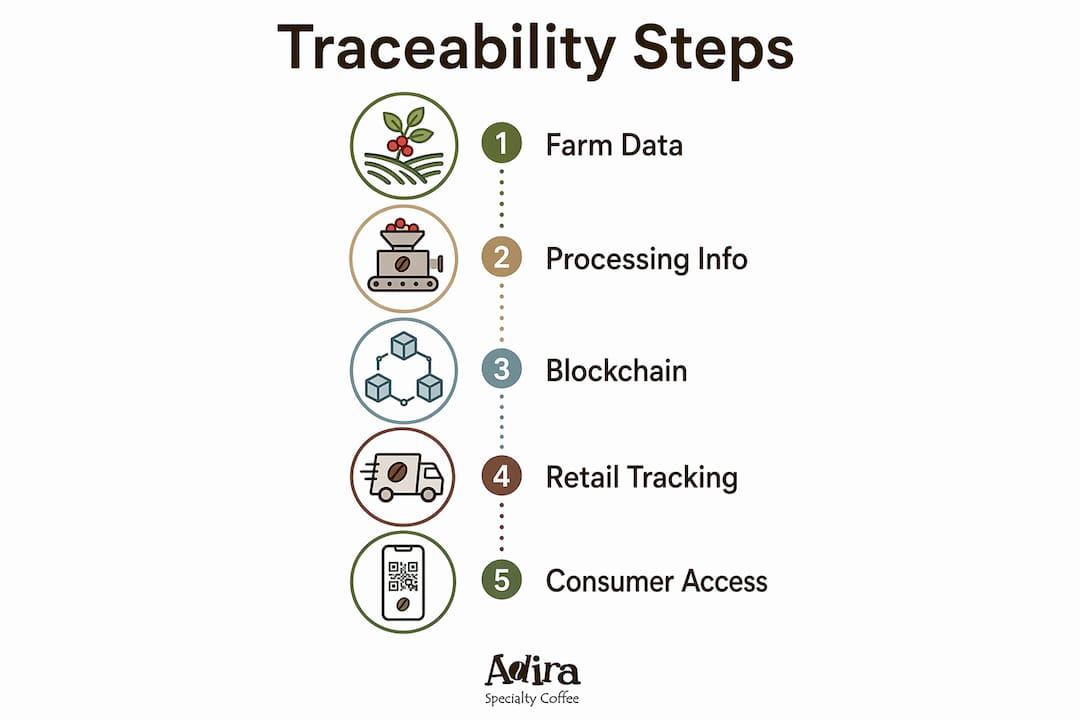
Blockchain’s specific contribution is immutability. Once a transaction or quality record is written to a distributed ledger, it cannot be altered without detection. Blockchain reduces information asymmetries and strengthens certification credibility by making the audit trail tamper-resistant. That matters in a supply chain where fraud, mislabeling, and quality misrepresentation are documented problems.
| Technology | Primary function | Key limitation |
|---|---|---|
| Blockchain | Immutable transaction records | Requires consistent data input at farm level |
| QR codes | Consumer-facing origin access | Only as accurate as the data behind them |
| Geolocation mapping | Land use and deforestation verification | Depends on farmer cooperation and GPS access |
| Satellite imagery | Independent deforestation monitoring | Cannot verify processing or quality claims |
| Digital cooperative platforms | Aggregated farmer data management | Requires infrastructure and training |
The critical insight from recent research is that technology alone may fail to reduce information gaps without proper institutional practices. A blockchain system built on incomplete or inaccurate farm-level data produces a perfectly immutable record of bad information. The technology is only as good as the governance around it.
- Blockchain creates tamper-resistant records but requires accurate data entry at the source
- QR codes give consumers direct access to origin stories but depend entirely on backend data quality
- Satellite imagery provides independent land use verification that does not rely on farmer self-reporting
- Cooperative platforms aggregate smallholder data but require sustained training and connectivity support
How to use traceability information when choosing coffee
Reading traceability data is a skill, and most coffee packaging gives you more information than you might realize. The key is knowing what to look for and what it actually guarantees.
Common certifications each signal something specific. Rainforest Alliance certification covers environmental and social standards, and actual sales of certified coffee under Rainforest Alliance reach 59% of the certified market. Fairtrade certification focuses on minimum price guarantees and democratic cooperative structures. Organic certification covers pesticide and chemical use but says nothing about labor conditions. No single certification covers everything, which is why farm-level traceability data adds context that certifications alone cannot provide.
Here is what to look for when evaluating a coffee’s traceability:
- Country and region: “Colombia, Huila” is more traceable than “South America”
- Farm or cooperative name: Named sources are verifiable; anonymous ones are not
- Processing method: Washed, natural, or honey process affects flavor and is a sign of documented handling
- Harvest year or season: Fresh crop data signals that someone tracked the timeline
- QR codes or batch numbers: These link the bag to a specific documented lot
- Certifications with scope: Check what each certification actually covers before treating it as comprehensive
For businesses, implementing traceability starts with sourcing coffee ethically through importers or direct trade relationships that provide lot-level documentation. Brands that publish this data build consumer trust that generic sustainability claims cannot replicate. With EUDR compliance now a legal requirement for EU market access, traceability is also a business continuity issue, not just a values statement.
Key takeaways
Traceable coffee sourcing delivers verified quality, fairer farmer income, and environmental accountability that certifications alone cannot guarantee.
| Point | Details |
|---|---|
| Traceability defines quality | Lot-level origin data lets roasters optimize profiles and consumers verify claims. |
| Fair pay requires visible data | Blockchain traceability generated a USD 0.35/kg premium for Indonesian smallholders in 2025. |
| EUDR makes traceability mandatory | EU coffee imports require GPS farm coordinates and due diligence declarations by December 2026. |
| Technology needs governance | Blockchain and mapping tools only work when embedded in institutional practices and accurate data collection. |
| Certifications have limits | Rainforest Alliance, Fairtrade, and organic each cover different standards. Farm-level data fills the gaps. |
Traceability is not a feature. It’s the baseline.
I have spent years sourcing coffee directly from cooperatives and small farms in Colombia, Ethiopia, Costa Rica, Mexico, and Sumatra. The most consistent thing I have observed is this: the farms that can tell you exactly what happened to their coffee, from picking date to export container, are almost always the farms producing the best coffee. That is not a coincidence.
What frustrates me about the current traceability conversation is how often it gets reduced to technology. Blockchain this, QR code that. The technology is a tool. The real work is building relationships where farmers trust that sharing their data will benefit them, not just the roaster or the retailer. Strong traceability governance requires value-sharing contracts and symmetrical transparency obligations. Without those, you are just giving farmers a new way to be monitored without being compensated for the information they provide.
I am genuinely optimistic about where this is heading. The EUDR is forcing the entire industry to build documentation infrastructure that should have existed decades ago. Costa Rica’s georeferencing pilot shows it is possible at scale. But I am cautious about the assumption that compliance equals ethics. A farm can be deforestation-free and still pay poverty wages. Traceability is the foundation. What you build on it still depends on the choices you make as a buyer. The consumers who push for transparent sourcing practices are the ones who actually move the industry forward.
— Stefan
Taste the difference that traceable sourcing makes
At Adiracoffee, every bag starts with a sourcing decision we can stand behind. Stefan and Ekaterina built this brand because they wanted coffee worth a second cup, and that meant knowing exactly where the beans came from and who grew them. Adiracoffee sources from cooperatives and small farms in Colombia, Ethiopia, Costa Rica, Mexico, and Sumatra, roasting each batch to order in California and shipping within days.
If you want to experience what traceable, single-origin sourcing actually tastes like in the cup, the single-origin collection is the place to start. Each offering reflects a specific farm or cooperative, a specific harvest, and a specific roast profile built around that lot’s character. For a blend that brings together ethically sourced beans from multiple origins, the Love Blend is roasted fresh and ships directly to your door. Subscriptions save 10%, with free US shipping over $35.
FAQ
What is traceable coffee sourcing?
Traceable coffee sourcing is the practice of documenting every stage of a coffee bean’s journey from farm to consumer, including origin, farming conditions, processing, and export records. It allows buyers and consumers to verify ethical and quality claims rather than relying on marketing alone.
Why does traceability in coffee matter for farmers?
Traceability gives farmers documented proof of their coffee’s quality and origin, which supports premium pricing and fairer income. A blockchain traceability study found that Indonesian smallholder farmers earned a USD 0.35/kg premium and a 13% household income increase after adopting traceable systems.
What is the EU Deforestation Regulation and how does it affect coffee?
The EU Deforestation Regulation requires coffee importers to submit GPS coordinates of every production plot and prove deforestation-free sourcing as part of a due diligence declaration, effective December 30, 2026. Coffee without this documentation will not be permitted to enter the EU market.
How can consumers identify traceable coffee?
Look for farm or cooperative names, harvest year, processing method, batch numbers, and QR codes that link to sourcing documentation. Country-level origin alone is not traceability. Lot-level detail is the standard that separates verified sourcing from generic claims.
Does certification replace traceability?
Certifications like Fairtrade, Rainforest Alliance, and organic each cover specific standards but none covers everything. Farm-level traceability data provides the context that certifications cannot, including specific quality records, land use documentation, and direct farmer identification.