
TL;DR:
- Fair trade coffee is a certification system designed to protect small farmers through minimum prices and community premiums, but much of the additional consumer payment benefits intermediaries rather than farmers.
- Most of the fair trade premium paid by consumers is captured by roasters, retailers, and intermediaries, with only a fraction reaching the farmers directly.
When you pick up a bag labeled “fair trade,” you probably feel good about your choice. The assumption is simple: the farmer who grew those beans got paid fairly. But that assumption, while well intentioned, skips over a supply chain with many hands between the farm and your cup. Fair trade coffee is certified under standards set by organizations like Fairtrade International or Fair Trade USA, guaranteeing producers a minimum price and a social premium. What happens to that premium after it leaves your wallet is a different story entirely.
Table of Contents
- What does fair trade coffee mean?
- How fair trade pricing and premiums really work
- Who benefits from fair trade coffee: farmers, roasters, or retailers?
- Fair trade in practice: impact and real-world challenges
- How to shop for truly ethical and sustainable coffee
- The uncomfortable truth about fair trade coffee: what most guides miss
- Discover ethical, fresh-roasted specialty coffees for your next cup
- Frequently asked questions
Key Takeaways
| Point | Details |
|---|---|
| Not all premiums reach farmers | Most fair trade coffee premiums are captured by intermediaries, not producers. |
| Certifications guarantee minimums | Fair trade ensures a minimum price and adds a social premium for community projects. |
| Impacts vary in practice | Real-world studies show fair trade helps but faces challenges like debt and market volatility. |
| Transparency is crucial | Choosing brands with clear sourcing transparency increases your coffee’s positive impact. |
| Ethical buying is proactive | Consumers can drive change by researching and prioritizing truly ethical coffee brands. |
What does fair trade coffee mean?
Fair trade coffee is not just a marketing phrase. It is a regulated certification system designed to protect small-scale coffee farmers from the volatility of global commodity markets. Two major organizations manage most of these certifications: Fairtrade International, based in Germany, and Fair Trade USA, which operates primarily in the American market. Both set standards, audit supply chains, and require certified buyers to pay above a floor price.
The system is built around several core commitments:
- Minimum price guarantee: Farmers receive a floor price regardless of how low market prices drop
- Social premium: An extra payment above the purchase price, directed toward community projects like schools, clinics, or water infrastructure
- Labor standards: Certifications require safe working conditions and prohibit forced or child labor
- Environmental requirements: Certified farms must meet sustainability benchmarks and restrict certain pesticides
- Democratic governance: Cooperatives must operate transparently and give farmers a voice in how premiums are spent
The coffee transparency explained lens matters here because fair trade is only one tool in the ethical sourcing toolbox. It addresses price floors and community investment, but does not automatically guarantee the kind of direct relationship between buyer and farmer that more hands-on sourcing models offer.
“Fair trade is not charity. It is a structural attempt to rebalance power in a market where farmers have historically had the least.”
The certification process involves third-party audits and annual reviews. For a cooperative to maintain its certification, it must keep detailed records, hold elections for leadership positions, and demonstrate how the social premium was used each year. That accountability layer is meaningful, even if it does not fix every problem in the system.
How fair trade pricing and premiums really work
Understanding the price structure behind fair trade is where most coffee drinkers’ eyes open wide. The numbers are specific and published publicly. Fairtrade minimum prices for washed conventional Arabica coffee sit at $1.40 per pound FOB (free on board, meaning at the port of origin). Organic Arabica commands $1.70 per pound, and every purchase includes a $0.20 per pound social premium on top.
These floor prices matter most when global coffee commodity prices fall below them. In good market years, when coffee prices are strong, fair trade minimums can actually be lower than what open-market buyers pay. That is a detail most fair trade marketing quietly ignores.
| Coffee type | Fairtrade minimum price (FOB) | Social premium |
|---|---|---|
| Arabica washed conventional | $1.40/lb | $0.20/lb |
| Arabica washed organic | $1.70/lb | $0.20/lb |
| Robusta conventional | $0.86/lb | $0.20/lb |
| Robusta organic | $1.06/lb | $0.20/lb |
Now here is the part that challenges the narrative. Research published on the Swedish coffee market found that roasters and retailers capture 61 to 70 percent of the Fairtrade premium paid by consumers. Producer countries received only 24 to 31 percent, while Fairtrade Sweden itself kept 6 to 8 percent. That means for every extra dollar you pay for fair trade coffee in a supermarket, as little as 24 cents reaches the country that grew it.
Pro Tip: Buying both organic and fair trade certified together may strengthen your impact because the organic premium adds a meaningful amount above the conventional floor price. But always read the label and research how the brand sources its coffee beyond the logo.
The takeaway is not that fair trade is a scam. The takeaway is that the premium you pay gets redistributed across a long chain. Knowing who stands in that chain, and how transparent they are, is what separates a meaningful purchase from a feel-good one. For a deeper look at how direct sourcing in coffee compares to certification-based models, the differences in pricing transparency are striking. And understanding how coffee farm practices and quality relate to fair trade standards adds even more context.
Who benefits from fair trade coffee: farmers, roasters, or retailers?
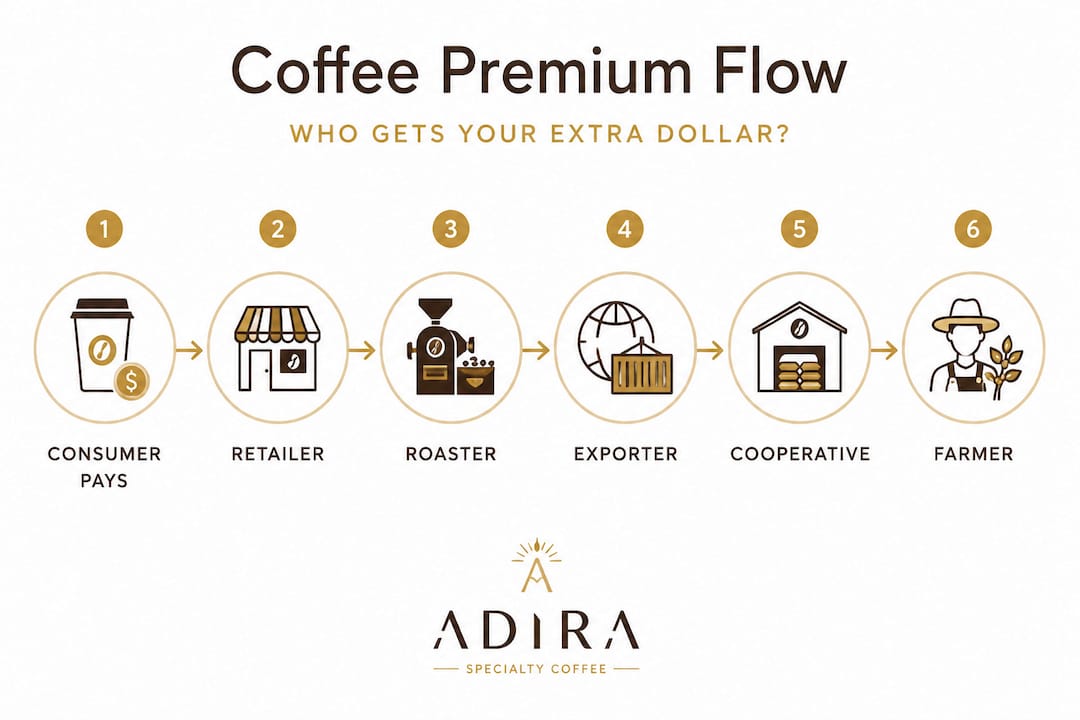
Let us follow the money more directly. When a consumer in Chicago pays a $2 premium for a pound of fair trade coffee, that extra $2 does not travel directly to a farmer in Huila, Colombia. It flows through an importer, a roaster, a distributor, and a retailer before it reaches any certification-related payment structure. Each step involves a margin.
Research consistently shows that much of the consumer premium benefits intermediaries rather than farmers directly. The Fairtrade system does guarantee that the certified price reaches the cooperative, but the markup a consumer pays at retail is not the same as the certified premium. These are two different numbers, and conflating them is where most people get misled.
| Stakeholder | Share of Fairtrade premium (Swedish market data) |
|---|---|
| Roasters and retailers | 61 to 70% |
| Producer countries | 24 to 31% |
| Fairtrade administration | 6 to 8% |
That said, the benefits farmers do receive are real:
- Price floor protection during market downturns
- Community investments through social premiums, ranging from school repairs to clean water projects
- Market access that smaller cooperatives would struggle to obtain independently
- Negotiating leverage as part of a certified network
The challenge is that the certified minimum is not a living wage in many regions. A farmer earning $1.40 per pound FOB on coffee that sells for $15 a bag in a specialty store is still absorbing the bulk of the production risk while receiving the smallest share of the final value. Understanding why small business coffee brands matter and why buying local roasted coffee matters puts this in context. Roasters who work directly with farms, share pricing publicly, and pay well above minimums are often doing more structural good than a certification logo alone guarantees.
“Certification creates a floor, not a ceiling. The most ethical purchases push wages far above that floor.”
For those curious about the difference between premium coffee explained as a quality concept versus as a trade concept, the two ideas are more connected than you might expect. Farmers who produce higher quality beans have more negotiating power and a stronger case for higher premiums across every model.
Fair trade in practice: impact and real-world challenges
Theory is one thing. What happens when fair trade certification meets a drought, a price crash, or a corrupt cooperative board? On the ground in Central America, the picture is nuanced. Studies from Nicaragua, Costa Rica, and Guatemala show mixed results: some meaningful poverty reduction and better household stability, but serious limitations tied to debt burdens, market volatility, and institutional inefficiencies within cooperatives themselves.
Here are the most documented challenges that limit fair trade’s real-world effectiveness:
- Debt cycles: Many farmers take loans from cooperatives to cover harvest costs. If commodity prices drop, they may earn just enough to repay debt without building savings.
- Market volatility: Even with a price floor, sudden demand shifts or supply gluts in producing regions can affect how much coffee cooperatives actually sell at fair trade prices.
- Institutional problems: Not all cooperatives are well managed. Leadership quality, transparency, and how the social premium is spent varies enormously.
- Partial certification: Many farmers sell only a fraction of their crop as fair trade certified. If market prices are higher than the floor, they may sell to non-certified buyers and receive higher prices anyway.
- Certification costs: The annual cost of maintaining fair trade certification can strain small cooperatives, sometimes consuming a meaningful chunk of the social premium itself.
Pro Tip: When you want to know whether a brand genuinely supports farmers, ask for their transparency report or sourcing page. A brand that publishes detailed information on farm relationships, pricing paid, and how premiums are used is showing you real accountability, not just a logo. Explore how to source ethical coffee to learn what genuine transparency looks like in practice.
Costa Rica offers an interesting case study. The country has strong government institutions and a robust domestic coffee authority that already enforces minimum prices. In that environment, fair trade certification adds relatively less structural benefit than it does in countries with weaker institutions. Adira’s sourcing from Costa Rica specialty coffee farms reflects exactly this nuance: quality and ethics coexist when you build real farm relationships.
How to shop for truly ethical and sustainable coffee
Armed with this knowledge, you can make coffee choices that have more genuine impact. Ethical sourcing is not just about labels; it is about asking better questions and supporting brands that answer them honestly.
Here is a practical framework for shopping with both conscience and palate:
- Look for certifications as a starting point, not a finish line. A fair trade or Rainforest Alliance logo tells you a baseline was met. It does not tell you what the roaster paid above that baseline.
- Read sourcing pages carefully. Reputable brands will name specific farms or cooperatives, share the country and region of origin, and ideally publish the price paid per pound. Use this ethical coffee sourcing guide as a reference for what genuine transparency looks like.
- Prioritize direct trade or traceable sourcing. Brands that cut out unnecessary middlemen and build long-term farm partnerships typically pay more to producers and deliver better flavor.
- Diversify your origins. Rotating between Colombia, Ethiopia, Guatemala, and other origins supports a wider network of farmers and cooperatives. It also expands your palate.
- Connect quality to ethics. The Fairtrade certified standards provide a framework, but exceptional cup quality often signals that a farmer invested heavily in their crop. Supporting great quality directly rewards that investment.
- Ask questions and expect answers. Email the brand. Ask where your coffee came from, how the farmer was paid, and how the brand chooses its farm partners. A brand with integrity will answer clearly.
The uncomfortable truth about fair trade coffee: what most guides miss
Most articles on this topic end with a reassuring pat on the back: “fair trade is imperfect but still better than nothing.” We disagree with stopping there.
The inconvenient reality is that buying the label, without asking anything more, lets you feel good while the system continues to funnel most of the premium toward Western intermediaries. The empirical data is clear: roasters and retailers in wealthy markets capture the majority of what consumers pay as a fair trade premium. That is not a reason to boycott the system. It is a reason to hold every player in that chain to a higher standard.
At Adira Coffee, we think the most powerful thing a coffee drinker can do is become genuinely curious. Ask where your coffee came from. Ask what the farmer was paid. Read transparency in coffee sourcing resources and expect the brands you buy from to hold themselves publicly accountable. When demand for that level of transparency scales up, the entire supply chain shifts.
Fair trade certification will always be a useful tool, especially in markets where farmers have few other options for guaranteed floor prices. But the label alone is not a substitute for honest relationships, direct pricing, and genuine curiosity from consumers who care enough to look deeper. The best cup of coffee you can drink is one where you know exactly who grew it, how much they were paid, and why that price reflects the value of their work.
Discover ethical, fresh-roasted specialty coffees for your next cup
Understanding what fair trade really means changes how you shop. At Adira Coffee, we source from around 50 farms across Colombia, Ethiopia, Costa Rica, Guatemala, Brazil, and Sumatra with a commitment to transparency and quality that goes beyond the label.
Not sure where to start? Take our discover your perfect coffee quiz to find the origin and roast that matches your palate and values. Our Colombia fair trade coffee and Costa Rica specialty coffee are freshly roasted in small batches and shipped at peak flavor. Every bag represents a real farm relationship, not just a certification. Explore our current offerings and taste the difference that genuine sourcing makes.
Frequently asked questions
Does buying fair trade coffee really help farmers?
It provides a meaningful safety net on minimum prices, but much of the premium paid by consumers at retail benefits roasters and retailers rather than reaching farmers directly.
How much more do farmers earn under fair trade?
Farmers receive a certified floor price plus a $0.20 per pound social premium, but roasters and retailers capture 61 to 70 percent of what consumers pay as a Fairtrade premium, while producer countries receive just 24 to 31 percent of that consumer-level markup.
Is organic coffee always fair trade certified?
No, organic certification and fair trade certification are completely separate programs. Coffee can carry one label without the other, and combining both does result in a higher minimum floor price for producers.
What are “social premiums” and how are they used?
Social premiums are extra funds paid above the certified minimum price, intended to support community development projects. Under the Fairtrade Coffee Standard, the cooperative democratically decides how to spend that premium on priorities like schools, clinics, or water systems.