
TL;DR:
- Transparency in coffee involves publicly sharing detailed sourcing and price information. High transparency standards include producer details, FOB prices, quality scores, and relationship duration. Genuine transparency can empower farmers, promote fair pricing, and support sustainability initiatives.
Most coffee drinkers have no idea what farmers are actually paid for the beans in their cup. The gap between retail price and farm-gate earnings is often shocking, with farmers earning less than 10 cents on a $5 cup. Transparency in coffee is not just a marketing trend. It is a system of disclosure that, when done right, shifts power toward farmers, rewards quality, and gives you real information to make ethical choices. This article breaks down what transparency actually means, how industry initiatives measure up, and how to use what you learn to buy better coffee.
Table of Contents
- What does coffee transparency actually mean?
- How leading transparency initiatives drive change
- The real numbers behind transparent coffee pricing
- How transparency drives sustainability and compliance
- How to spot and support truly transparent coffee brands
- The uncomfortable truth about coffee transparency
- Finding coffee you can trust: discover ethically sourced options
- Frequently asked questions
Key Takeaways
| Point | Details |
|---|---|
| Transparency defined | True coffee transparency means sharing real prices, producer details, and supply chain relationships. |
| Benchmark systems matter | Tools like the Specialty Coffee Transaction Guide and The Pledge offer ways to verify ethical sourcing. |
| Price disclosure empowers | Knowing FOB prices helps ensure fairer pay for farmers and better accountability for brands. |
| Consumers influence change | Your choices and questions can push brands toward more honest, sustainable practices. |
What does coffee transparency actually mean?
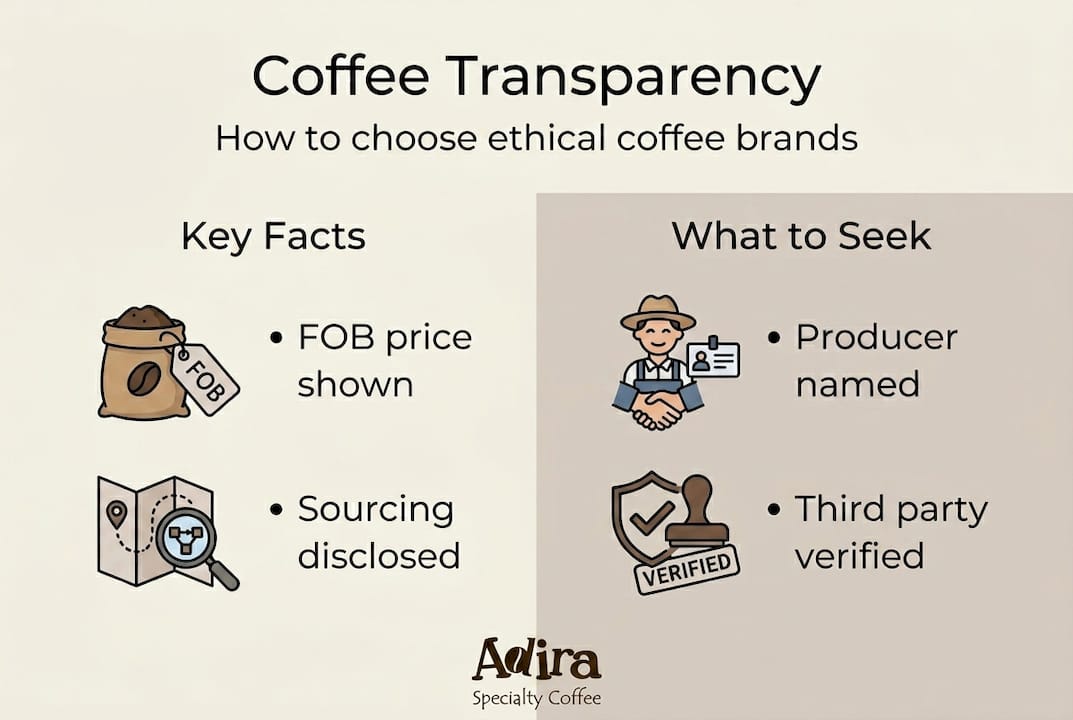
Transparency in coffee means publicly disclosing the specific details of how a coffee was bought and from whom. That includes the name of the producer or cooperative, the price paid at port (called the FOB price), the quality score, the lot size, and how long the buyer and seller have worked together. It is not a vague promise. It is a paper trail.
Here is what real transparency looks like in practice:
- Producer name and location: Not just “Colombia,” but the name of the farm or cooperative and the specific region.
- FOB price paid: The actual dollar amount per pound, disclosed publicly so anyone can compare it to market rates.
- Relationship length: How many years the buyer and seller have worked together, which signals stability for the farmer.
- SCA quality score: An objective measure of the coffee’s grade, showing that price reflects quality.
- Lot size: The quantity purchased, which helps contextualize the economic impact of the transaction.
Transparency.coffee defines this standard clearly. Its key methodology includes The Pledge, which requires public disclosure of producer name, FOB price, SCA quality score, lot size, and buyer-producer relationship length for at least one coffee per participating company.
Contrast that with vague marketing language. Phrases like “ethically sourced” or “sustainably grown” without supporting data are marketing claims, not transparency. A roaster can print those words on a bag without disclosing a single number. This is why the distinction matters: transparency is verifiable, while marketing language is not.
“Without price disclosure, there is no transparency. There is only storytelling.”
Some roasters resist transparency because it exposes uncomfortable realities. If they pay commodity rates while charging specialty prices, that gap becomes visible. But consumers are increasingly demanding better. Understanding specialty coffee standards helps you distinguish between brands that earn their claims and those that borrow the language without the substance.
How leading transparency initiatives drive change
Several frameworks now give structure to transparency in the specialty coffee industry. Each one operates differently, with different levels of rigor and adoption.
| Framework | Criteria disclosed | Transparency level | Primary users |
|---|---|---|---|
| The Pledge | FOB price, producer name, SCA score, lot size, relationship length | High | Specialty roasters globally |
| Specialty Coffee Transaction Guide | FOB benchmarks by origin, year, grade | High | Buyers, researchers, advocates |
| SCA Coffee Value Assessment (CVA) | Attributes-based quality score, value discovery | Medium | Roasters, Q-graders, buyers |
The Specialty Coffee Transaction Guide, developed at Emory University, analyzes FOB price benchmarks drawn from more than 100,000 contracts covering over 2 billion pounds of coffee. That scale makes it one of the most credible benchmarks available. When a roaster claims to pay above market rates, the Transaction Guide is how you verify it.
The SCA Coffee Value Assessment takes a different angle. Rather than just cupping and assigning a score out of 100, the SCA CVA system evaluates coffee using specific attribute categories and promotes transparent value discovery between buyers and sellers. It helps align quality claims with actual pricing conversations.
Here is a straightforward process for evaluating whether a roaster takes transparency seriously:
- Search for the roaster’s name on the Transparency.coffee Pledge signatories list.
- Check the coffee’s product page for FOB price and producer details, not just flavor notes.
- Look for published SCA scores or CVA results, not just the word “specialty.”
- Research whether the price paid exceeds the Transaction Guide’s median FOB for that origin and grade.
- Notice how long the buyer and farmer relationship has lasted. Long-term relationships suggest stability.
Pro Tip: Always look for FOB price benchmarks, not just certifications. A certification tells you a process was followed. An FOB price tells you what the farmer actually received.
The challenge here is real. Sharing pricing details means exposing business relationships that some companies guard closely. A roaster sharing its exact FOB prices gives competitors information about its sourcing strategy. That is a legitimate tension, and it is part of why transparency still has low adoption rates even in specialty coffee. Knowing how to identify quality beans alongside reading sourcing data makes you a much more powerful buyer. And understanding how roasting profiles in specialty coffee connect to origin quality helps you connect the dots from farm to cup.
The real numbers behind transparent coffee pricing
Price transparency gets real when you look at actual numbers. Here is what the data shows:
| Coffee category | Typical FOB price (per lb) | Notes |
|---|---|---|
| Commodity C-market | $1.50 to $2.60 | Volatile, often below cost of production |
| Regular specialty | $2.93 | 2024 median per Transaction Guide |
| Fancy specialty | $4.18 | Premium quality tier, 2024 median |
| Top ethical roasters | $5.00 to $10.00+ | Direct trade, long-term relationships |
The 2024 Transaction Guide data shows a median FOB of $3.48 per pound across all specialty categories. Regular specialty came in at $2.93 per pound and fancy specialty at $4.18 per pound. Compare that to C-market prices, which ranged from $1.50 to $2.60 per pound in recent years, and the gap becomes clear.
This matters because the C-market is often below the actual cost of production for smallholder farmers. When a farmer sells at $1.80 per pound and it costs them $2.10 to produce, they are losing money. That is not a sustainable system. It drives farmers out of coffee into other crops, reducing global supply and quality over time.
What does price transparency actually do for farmers?
- It gives them data to negotiate. When farmers know what buyers pay others for similar quality coffee, they can argue for better rates.
- It creates benchmarks that buyers cannot ignore. A roaster paying $2.00 for “specialty” coffee has a harder time defending that when public data shows the median is $3.48.
- It supports multi-year contract stability. When prices are disclosed and relationships are documented, farmers can plan investments in their farms rather than scrambling season to season.
- It builds accountability. A brand that publicly commits to paying X per pound has something to lose if they stop.
Roasters like Tim Wendelboe in Norway publish detailed sourcing reports with full FOB prices and relationship histories. Their prices for top lots often exceed $6 to $8 per pound. That transparency sets a benchmark that elevates the entire conversation. When choosing beans for impact, these published figures help you see who is serious. And understanding the difference between premium and specialty coffee reveals why price alone does not tell the whole story.

How transparency drives sustainability and compliance
Transparency and environmental sustainability are increasingly linked by law. The EU Deforestation Regulation (EUDR) is the clearest example of how regulatory pressure is forcing the industry to get serious about traceability.
Here is what transparent supply chains now need to demonstrate:
- Farm-level GPS coordinates for every plot of land where the coffee was grown.
- Deforestation-free proof showing the land was not cleared after December 31, 2020.
- Compliance with local laws in the country of origin, including labor and land rights regulations.
- Due diligence documentation that can be audited by regulators or importers.
- Chain-of-custody records from farm to export to import, without gaps.
According to EUDR readiness reporting, the regulation mandates farm-level geolocation, deforestation-free proof, and compliance with local laws. The challenges are significant, especially for smallholder farmers who may lack smartphones, internet access, or the technical support needed to generate GPS-verified documentation.
This is where transparency and sustainability intersect with equity. A regulation designed to protect forests can inadvertently shut out smallholder farmers who cannot afford compliance. That is why consumer demand for truly transparent coffee is so important. When buyers pay premiums and build long-term relationships, farmers have the resources to invest in compliance infrastructure.
“Traceability is not just a compliance task. It is a foundation for protecting both forests and farmers at the same time.”
Pro Tip: Support roasters who share GPS or geolocation data for their sourcing, not just general certifications. That level of detail separates brands doing real work from those riding the sustainability wave for marketing purposes.
The EUDR also fights greenwashing. Vague claims of “sustainably grown” coffee cannot survive regulatory scrutiny when farm-level data is required. This is a shift from voluntary ethics to legal accountability, and it raises the floor for everyone in the market. Roasters who prioritize local roasting and ethics are often already building the supply chain relationships that make this level of traceability possible. And understanding how farm practices define flavor shows why these on-the-ground relationships matter for quality as much as compliance.
How to spot and support truly transparent coffee brands
Knowing what transparency looks like makes it possible to vote with your dollar. Here is a practical checklist for evaluating any coffee brand:
- The Pledge: Check if the roaster is a signatory at Transparency.coffee. Signatories publicly disclose sourcing data for at least one coffee.
- C.A.F.E. Practices: Starbucks popularized this, but it applies broadly. Look for published verification reports, not just the badge.
- SCA CVA labeling: Ask if quality scores are published and whether the evaluation method is disclosed.
- Farmer co-ops and direct trade relationships: Brands that work with cooperatives give individual farmers more collective bargaining power and resilience against price swings.
- Price disclosure on product pages: If the roaster does not list what they paid, ask. A transparent roaster will answer. A brand dodging the question tells you something.
- Published sourcing reports: Annual transparency reports with real numbers, not just photos and stories, are the gold standard.
Research from Coffee Actually recommends that conscious U.S. consumers seek out Pledge signatories, C.A.F.E.-certified brands, and SCA CVA labels, and notes that farmer co-ops shift power toward producers and build resilience across the supply chain.
Asking a roaster direct questions is underrated. “What did you pay for this specific coffee?” or “How long have you worked with this farmer?” are reasonable things to ask, and the answer tells you a lot about the brand’s actual commitment versus its marketing. When you brew ethical specialty coffee at home, knowing the story behind the beans adds a layer of meaning to the experience.
The uncomfortable truth about coffee transparency
Here is what most transparency articles skip over: posting a price is not the same as creating change. A roaster can publish an FOB price of $3.50 per pound, get praised for transparency, and still be operating a system that leaves farmers without health care, education resources, or climate resilience funding. Disclosure is necessary. It is not sufficient.
The transparency movement, as powerful as it is, has a performance problem. Some brands use it the way fast fashion brands use sustainability reports. The data is real, but it is curated to show the best cases. The question is not just “did you disclose a price?” It is “what did that price actually enable for the farmer and their community?”
We have seen this up close working with farms across Colombia, Ethiopia, Costa Rica, and Guatemala. The farms where transparency has genuine impact are the ones where buyers show up in person, where contracts span multiple seasons, where the farmer’s name and story are known by the roaster’s entire team. That is a fundamentally different relationship than uploading a spreadsheet once a year.
The systemic reform the industry needs includes smallholder inclusion in data systems, not just large estates with digital infrastructure. It includes advocacy for price floors that account for production costs, not just market rates. It requires asking tough questions of true standards in specialty coffee and holding both certifiers and roasters accountable when the numbers do not add up.
Pay attention to the details behind the label. Ask who benefits from the transparency, and whether the farmers themselves have access to that data and can use it to negotiate better.
Finding coffee you can trust: discover ethically sourced options
At Adira Coffee, transparency is not a badge. It is built into how we source. We work with around 50 farms across Colombia, Ethiopia, Costa Rica, Guatemala, Brazil, and Sumatra, choosing partners based on relationship depth and shared commitment to quality and fair pricing, not just geography.
If you want to start with a coffee where the sourcing story is real and traceable, our Colombia origin coffee and Costa Rica transparent coffee are strong starting points. Both reflect long-term farm relationships and small-batch roasting that preserves what farmers worked hard to grow. Explore the full range of ethically sourced options at Adira Coffee and find a cup you can feel good about from farm to first sip.
Frequently asked questions
What does FOB price mean in coffee transparency?
FOB (Free On Board) is the price paid to exporters at the port of origin, representing what farmers earn before exporter or importer margins are added. The Transaction Guide benchmarks this figure across thousands of contracts, making it the most reliable measure for comparing what different roasters pay.
How is coffee transparency different from fair trade?
Coffee transparency discloses actual prices, producer names, and relationship details so anyone can evaluate them. Fair trade is a certification with minimum price standards, but it does not always require public disclosure of the specific amounts paid per transaction.
What questions should I ask my coffee roaster about transparency?
Ask for the farmer’s name, the specific origin, the price paid above market rates, and whether they have published contracts or certifications. The Pledge methodology requires disclosure of producer name, FOB price, and relationship length, making it a good benchmark for what a transparent roaster should be willing to share.
Why are traceability and GPS data important for coffee now?
New regulations like the EUDR require importers to prove that coffee is deforestation-free using farm-level GPS data. Without this documentation, coffee cannot legally enter certain markets, making traceability a business necessity, not just an ethical one.
How can a consumer tell if a brand is truly transparent?
Look for published price data, producer names, and sourcing reports with real numbers. Pledge signatories, C.A.F.E., and SCA CVA labels signal structured disclosure, but the best indicator is whether a brand can answer specific questions about farmer relationships directly and without hesitation.