
TL;DR:
- Coffee origin significantly influences flavor, with factors like climate, altitude, and processing shaping taste.
- Micro-regions within countries, such as Yirgacheffe or Geisha, produce distinctive, high-quality coffee profiles.
- Ethical sourcing, including certifications and direct farm relationships, ensures better quality and sustainability.
Standing in front of a wall of coffee bags at your local shop, each one labeled with a different country or region, can feel overwhelming. Most home baristas stare at words like “washed Arabica” or “natural process” without a clear map to guide their choice. Here’s the thing: the origin of your coffee beans is the single biggest factor shaping what ends up in your cup. Once you understand what makes each major growing region distinct, you stop guessing and start choosing with intention, both for flavor and for the farmers who grew it.
Table of Contents
- Criteria for recognizing the world’s top coffee regions
- Top five coffee producing countries and their specialty traits
- Specialty micro-regions that define premium coffee
- Why ethical and sustainable sourcing matters in coffee
- Our take: What most lists miss about top coffee regions
- Elevate your coffee experience with selections from top regions
- Frequently asked questions
Key Takeaways
| Point | Details |
|---|---|
| Region shapes flavor | Understanding coffee origins helps you predict and savor unique taste notes. |
| Top five dominate volume | Brazil, Vietnam, Colombia, Honduras, and Uganda/India account for nearly 74 percent of global coffee output. |
| Specialty coffee loves micro-regions | Regions like Yirgacheffe and Tarrazú set benchmarks for premium, traceable coffee. |
| Ethical sourcing matters | Prioritize certifications, traceability, and direct trade for quality and conscience in every cup. |
| You can taste the difference | Trying coffees from top regions lets you experience global flavor diversity firsthand. |
Criteria for recognizing the world’s top coffee regions
Not all coffee growing regions earn their reputations equally. A handful of key factors separate a genuinely great origin from marketing hype.
Climate, altitude, and variety set the foundation. Coffee plants need specific temperature ranges, rainfall patterns, and seasonal rhythms to develop complex sugars and acids. Higher altitudes typically slow bean maturation, giving the fruit more time to develop nuanced flavor compounds. The variety of coffee plant, whether it’s a classic Bourbon, a Typica, or a hybrid like Castillo, also shapes taste dramatically.
Harvesting and processing methods are equally important. Hand-picking selectively harvested ripe cherries produces better raw material than strip-harvesting everything at once. Processing choices, like whether the fruit is washed off the bean before drying or left on to ferment (natural process), directly influence the cup’s brightness, body, and sweetness. You can learn more about how growing practices and quality connect by looking at what happens at the farm level.
Sustainability and ethical sourcing have moved from bonus features to essential benchmarks. According to ethical sourcing best practices, you should prioritize direct trade, credible certifications like Fairtrade and Rainforest Alliance, full traceability to the farm or cooperative, premiums that cover a living income, and regenerative practices like agroforestry. This isn’t just feel-good language. Farms that invest in soil health and fair wages consistently produce better raw coffee.
Here’s a quick checklist to apply before you buy:
- Altitude above 1,000 meters (specialty quality threshold)
- Specific variety named on the bag, not just “Arabica”
- Processing method disclosed (washed, natural, honey)
- Certifications or direct trade relationship stated
- Harvest year or roast date visible
Pro Tip: Look for bags that name the specific farm or cooperative rather than just the country. That level of traceability signals that the roaster knows exactly what they’re selling and has a relationship with the producer.
If you’re still getting oriented on types of coffee beans, understanding variety differences will sharpen your ability to read any origin label.
Top five coffee producing countries and their specialty traits
Volume and quality don’t always overlap. Some of the world’s biggest producers focus on commodity coffee for blends and instant products, while others punch above their weight in the specialty segment.
| Country | Annual production (bags) | Global share | Primary variety | Specialty strength |
|---|---|---|---|---|
| Brazil | 63-65 million | 35-37% | Arabica, Robusta | Natural processed, low acidity |
| Vietnam | 29-31 million | 16-17% | Robusta | Strong espresso blends |
| Colombia | 13.8-14.8 million | 8% | Washed Arabica | Bright, balanced, fruity |
| Honduras | 7-8 million | 4% | Arabica | Value specialty, improving rapidly |
| Uganda/India | 5-7 million each | 3-4% each | Mixed | Emerging specialty |
Brazil sits at the top of every production chart, accounting for 35-37% of global supply. With around 63-65 million 60-kilogram bags produced in the 2024/25 to 2025/26 cycle, Brazil dominates sheer volume. Brazilian coffees often taste chocolatey, nutty, and low-acid. Natural and pulped-natural processing is standard, which gives beans a fuller body and subtle sweetness. These traits make Brazilian beans the backbone of countless espresso blends worldwide.
Vietnam produces about 29-31 million bags per year, ranking second globally with a 16-17% share. Nearly all of it is Robusta grown in the Central Highlands. Robusta has twice the caffeine of Arabica, a more bitter profile, and exceptional crema production. It’s not typically associated with pour-over specialty, but Vietnamese-style iced coffee with sweetened condensed milk showcases what the bean does best.
Colombia earns its reputation on quality rather than quantity, producing roughly 13.8-14.8 million bags annually. The country’s Andean topography creates a patchwork of microclimates. Washed Arabica from regions like Huila and Nariño tends to taste bright, clean, and fruity with a silky body. That consistency is why Colombian coffee appears at the top of specialty roaster sourcing lists year after year.
Honduras and Uganda are the underdogs worth watching. Honduras has quietly become a serious specialty producer with farms in Santa Bárbara and Copán growing Catuai and Bourbon at high altitudes. Uganda produces quality Robusta and is developing a Arabica segment in the Elgon region that’s turning specialty heads.
Pro Tip: Don’t overlook lesser-known producers like Honduras or Uganda when building your home coffee rotation. These origins often deliver specialty-grade complexity at lower prices than more famous regions simply because the names haven’t caught on yet.
The global production total of roughly 175-179 million bags in 2024/25 to 2025/26 shows a market under pressure. The top five countries account for about 74% of all supply, which makes any disruption in Brazil or Vietnam a global pricing event.
Understanding which flavor profiles for every taste suit you best will help you map your preferences to the right country origin. And if you’ve started buying single origin coffee, these country profiles give you the framework to evaluate each bag with confidence.
Specialty micro-regions that define premium coffee
Country rankings tell only part of the story. Within each major producer nation, specific micro-regions generate coffees so distinct they deserve their own conversation.
| Micro-region | Country | Altitude | Process | Signature flavor notes |
|---|---|---|---|---|
| Yirgacheffe | Ethiopia | 1,700-2,200m | Washed/Natural | Bergamot, jasmine, lemon |
| Kenya AA | Kenya | 1,500-2,100m | Washed | Blackcurrant, tomato, bright acidity |
| Geisha (Boquete) | Panama | 1,500-1,900m | Washed/Natural | Floral, peach, ultra-complex |
| Antigua | Guatemala | 1,500-1,700m | Washed | Chocolate, spice, medium body |
| Tarrazú | Costa Rica | 1,200-1,900m | Honey/Washed | Red apple, honey, clean finish |
Ethiopian Yirgacheffe is a benchmark origin for specialty buyers. The combination of ancient heirloom varieties, high altitude in the Gedeo Zone, and centuries of traditional processing creates a cup profile that no other region replicates. Washed Yirgacheffe is tea-like with citrus and floral notes. Natural Yirgacheffe goes wild with blueberry and tropical fruit.
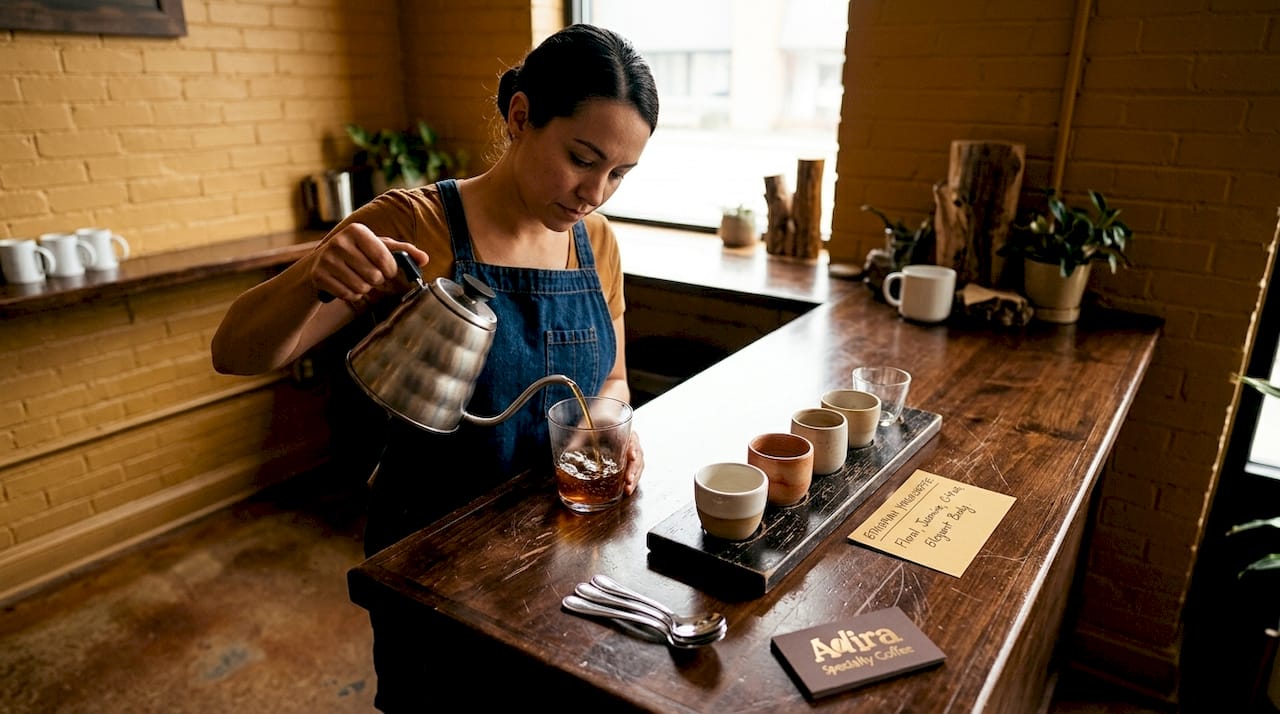
Kenya AA is a grading term that refers to the largest bean size, which correlates with slower maturation at altitude and more concentrated flavor. The double-washed (wet-fermented) processing standard in Kenya produces some of the most intense, savory-bright cups in the world. It’s not subtle. It’s not for everyone. But it’s unforgettable.
Panama Geisha is the Rolls-Royce of specialty coffee. Originally from Ethiopia but planted in Panama’s Boquete highlands in the 1960s, the variety produces an almost impossibly delicate, floral cup. It regularly fetches record prices at auction. The complexity demands a light roast and a slow brew method to fully express its character.
Guatemalan Antigua sits in a volcanic valley at altitude, surrounded by Volcán de Agua, Volcán de Fuego, and Acatenango. The volcanic soil is mineral-rich and drains well. Antigua coffee is reliably chocolatey and medium-bodied with a pleasant spice note. It’s a great entry point for specialty drinkers who want complexity without too much acidity.
Costa Rica Tarrazú is one of the cleanest, most consistent origins in Latin America. The country banned Robusta cultivation in 1988 to protect quality standards. Tarrazú farms often use honey processing (leaving some fruit mucilage on the bean during drying), which adds sweetness and body without sacrificing clarity.
“Volume rankings remain stable with Brazil leading, but specialty coffee truly prioritizes micro-regions over country-level thinking. Yirgacheffe will always outperform ‘Ethiopia generic’ for the discerning buyer.”
These origins represent the reasons why specialty roasters source by lot, not by country. For more context on espresso bean origins and how farm-level details affect the roasting process, understanding micro-region terroir is the logical next step. You can also check the full framework for specialty coffee standards to understand how these origins get scored and validated.
Why ethical and sustainable sourcing matters in coffee
Knowing where your coffee comes from is only half the equation. Knowing how it was grown and traded matters just as much.
Here’s a practical framework for home buyers to verify sustainable and ethical coffee:
-
Look for named certifications. Fairtrade ensures a minimum price floor for farmers. Rainforest Alliance certifies environmental and social standards. USDA Organic confirms no synthetic pesticide use. These aren’t perfect systems, but they set a baseline.
-
Prioritize direct trade relationships. When a roaster names the specific farm and farmer on the bag, they’ve likely visited the farm, agreed on a price above commodity rates, and verified conditions firsthand. This is the gold standard, even without formal certification.
-
Check for traceability details. Does the bag name the cooperative, the village, or the farm? Does it show a harvest year? The more specific the information, the more accountable the supply chain.
-
Research the roaster’s sourcing transparency. Does the roaster publish relationships with producers on their website? Do they talk about what they pay for green coffee? A roaster willing to be transparent about sourcing is more trustworthy than one who only talks about flavor.
-
Support shade-grown and agroforestry practices. Shade-growing and organic practices act as sustainability benchmarks in premium sourcing, protecting biodiversity while producing better-tasting beans.
The ethical sourcing framework extends beyond certifications. Ethical sourcing best practices include regenerative practices like agroforestry, where coffee grows under a canopy of native trees, improving soil health and creating habitat. Farms using these methods tend to produce more complex, higher-quality beans because healthy ecosystems translate to healthier plants.
Choosing local roasted coffee from a roaster with verified farm relationships is one of the most direct ways you influence change through your daily purchase. Supporting small business coffee brands that specialize in transparent sourcing amplifies that impact further because smaller roasters typically maintain closer relationships with fewer farms and can tell you exactly where your coffee came from.
Regenerative coffee practices are becoming a practical standard, not a fringe idea. Climate change is already affecting crop yields and bean density at origin, which means sustainable farming isn’t just an ethical preference. It’s a supply chain resilience strategy.
Pro Tip: When you find a roaster whose sourcing story checks out, buy a few different origins from them to compare. A trustworthy roaster with strong sourcing relationships will show you the real flavor range of ethical coffee, from Ethiopian florals to Colombian stone fruit to Costa Rican honey sweetness.
Our take: What most lists miss about top coffee regions
Most “top coffee regions” articles do one of two things: they list countries by production volume, or they repeat the same six famous origins everyone already knows. Neither approach actually helps you drink better coffee.
Here’s what we’ve learned working with farms across more than half a dozen countries. The country label on a bag is an introduction, not a description. When you see “Colombia” printed in big letters, you’re getting a geographic origin. You’re not getting the altitude of the specific farm, the processing method the cooperative used that harvest year, or the variety of plant the farmer chose to grow. All of those details shift the flavor in your cup more than the country name ever could.
There’s also a real risk in chasing famous names. Ethiopia, Colombia, and Costa Rica are known for good reason, but their reputations attract premium pricing that doesn’t always reflect the specific lot in the bag. We’ve tasted $14-per-pound Honduran coffees that outperformed $30 Panamanian coffees that were riding on varietal prestige without delivering the complexity to back it up.
The flavor stories hiding in lesser-known micro-regions are worth pursuing. Regions in Peru’s Cajamarca, Rwanda’s Nyamasheke, or India’s Coorg produce coffees that rarely appear on trending lists but reward curious drinkers who seek them out. These origins often come with cleaner supply chains simply because fewer buyers compete for them.
The most honest piece of advice we can give is this: use single origin insight as your primary navigation tool. A single-origin bag forces transparency. You can’t hide mediocre sourcing behind a blend. When a roaster commits to a named micro-region, a specific farm, and a clear harvest, they’re accountable to the flavor story they’re telling.
Country rankings matter for understanding market dynamics. Micro-region knowledge is what makes you a better buyer.
Elevate your coffee experience with selections from top regions
You’ve built the knowledge. Now you can put it to use.
At Adira Coffee, we source directly from farms across the regions covered in this article. Every bag we roast starts with a relationship, not a commodity contract. Our Ethiopian single origin natural process showcases everything that makes Yirgacheffe-style African coffee extraordinary: wild fruit, floral complexity, and a sweetness that needs no sweetener.
For a brighter, fruit-forward Andean experience, our Colombian coffee delivers the washed Arabica clarity that made Colombia’s reputation. If honey process sweetness from a volcanic micro-climate sounds like your thing, our Costa Rica micro-lots are roasted fresh in small batches to capture peak flavor. Browse our full selection of fresh coffee beans from top regions and start tasting the real difference that origin knowledge makes.
Frequently asked questions
What region produces the most coffee globally?
Brazil is the world’s largest coffee producer, responsible for 35-37% of global coffee supply, producing roughly 63-65 million 60-kilogram bags per year.
Which coffee regions are best for specialty coffee?
Regions like Ethiopia’s Yirgacheffe, Panama’s Boquete, and Kenya’s AA zones are celebrated for their unique flavors. The specialty coffee market prioritizes micro-regions over broad country averages.
How do climate events impact coffee growing regions?
Droughts hurt Brazil’s Arabica crops while heavy rains disrupt Colombia’s harvest schedules. Robusta is generally more climate-resilient, which partially explains Vietnam’s production stability.
What makes coffee “ethically sourced”?
Ethically sourced coffee features direct trade, credible certifications, and transparent origins that support fair wages, farm traceability, and sustainable land practices.