
TL;DR:
- Water’s mineral content, pH, and purity are critical for extracting optimal flavor from coffee, as it accounts for over 98% of each brew. Proper water chemistry enhances extraction of delicate flavors, while excess minerals or contaminants can cause bitterness or flatness; testing and adjusting water profiles is essential for consistently great coffee. Most home brewers underestimate water’s role, but small, affordable adjustments can dramatically improve flavor, elevating your brewing beyond equipment upgrades.
Water is the invisible ingredient most home baristas never question. You obsess over the roast level, dial in your grind, time your pour to the second, and still end up with a cup that tastes flat, harsh, or somehow just off. The culprit is usually sitting right in your tap. Water makes up over 98% of every cup you brew, and its mineral content, pH, and purity directly shape every flavor note your beans have to offer. This guide walks you through the science, the common mistakes, and the practical fixes that will change how you think about every brew.
Table of Contents
- Why water quality is the foundation of great coffee
- Key water parameters that influence coffee flavor
- Common coffee water mistakes and how to fix them
- Optimizing your water for specialty coffee at home
- Why most coffee lovers underestimate water—and how you can outbrew the pros
- Level up your coffee experience with Adira
- Frequently asked questions
Key Takeaways
| Point | Details |
|---|---|
| Water makes the cup | The quality and chemistry of your water directly shape the flavors in your coffee. |
| Minerals matter | Balanced calcium and magnesium help extract sweetness and complexity from beans. |
| Test and adjust | Simple home test kits and remineralization can dramatically improve your brews. |
| Avoid common mistakes | Prevent flat or bitter coffee by steering clear of overly pure or chlorinated water. |
| Pair better water with great beans | Combining ideal water with fresh specialty beans brings out the best in both. |
Why water quality is the foundation of great coffee
Coffee is not just brewed in water. Coffee is mostly water. Once you accept that, everything changes about how you approach your setup at home.
When hot water contacts ground coffee, it acts as a solvent, pulling out hundreds of flavor compounds including acids, sugars, lipids, and aromatic molecules. The minerals dissolved in that water are not passive bystanders. They actively participate in extraction. Calcium and magnesium ions bind to specific coffee compounds and help carry them into solution. Without sufficient minerals, water simply cannot extract coffee’s full flavor potential. The result is a thin, underwhelming cup.
On the flip side, too many dissolved minerals creates its own set of problems. Excess calcium carbonate, commonly found in hard water, interferes with extraction by coating coffee grounds and blocking water penetrability. This can produce bitter, chalky, or strangely muted cups even when using excellent beans.
“Water isn’t just a vehicle for flavor. It is an active chemical participant in extraction—and treating it as such is what separates good home baristas from great ones.”
Recent empirical research on water cations confirms that cations in water promote extraction from less complex proteins, particularly in darker roasts, and that water penetrability and ion interactions are key mechanisms driving flavor development. This is not abstract chemistry. It means the water you use today is either working for your coffee or against it.
Key ways water chemistry affects your cup:
- Calcium and magnesium enhance extraction by bonding with organic acids and aromatic compounds in ground coffee
- Bicarbonate acts as a buffer that can neutralize acids, making bright, fruity coffees taste flat
- Chlorine from treated tap water leaves detectable off-flavors and suppresses delicate aromas
- Sodium in excess creates a salty or metallic taste that masks sweetness
- Insufficient minerals lead to over-extraction of bitter compounds because nothing is competing for the “good” flavor molecules
For a deeper look at how variables interact during brewing, the science of coffee extraction is worth understanding before you start tweaking your water. And if you are new to the broader world of specialty brewing, our guide to specialty coffee brewing covers the full picture. The water story connects directly to how coffee flavor development begins at the farm and ends in your cup.
Key water parameters that influence coffee flavor
With a solid understanding of why water matters, let’s break down what makes water “good” or “bad” for brewing and how specific qualities affect the taste in your cup.
There are four core parameters every home barista should know. Get these right, and your brew quality will jump noticeably.
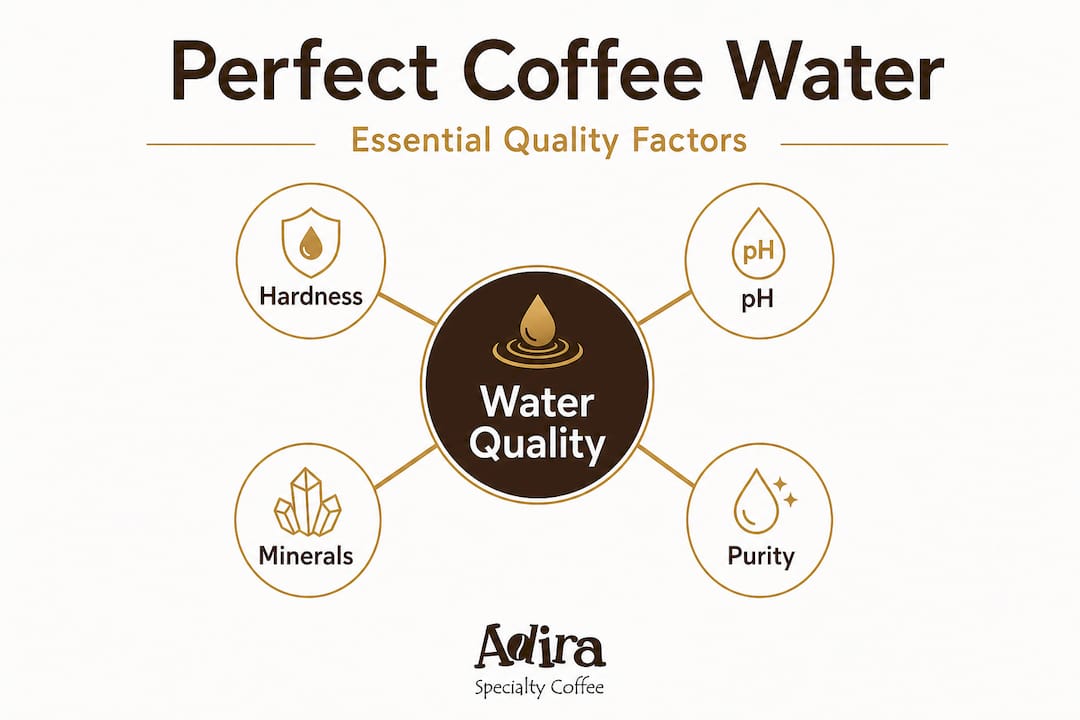
| Parameter | Ideal range for brewing | Effect when too low | Effect when too high |
|---|---|---|---|
| Total hardness (calcium/magnesium) | 50 to 175 mg/L | Thin, sour, under-extracted | Bitter, chalky, blocked extraction |
| pH | 6.5 to 7.5 | Overly acidic taste | Flat, dull, alkaline taste |
| Total Dissolved Solids (TDS) | 75 to 250 mg/L | Watery, lifeless cup | Heavy, murky, over-extracted |
| Bicarbonate/alkalinity | 40 to 75 mg/L | Sour notes unbalanced | Muted acidity, flat flavor |
Water hardness is the parameter most home baristas encounter first. Hard water (above 200 mg/L) often leaves white scale on your kettle and your coffee maker. That scale is calcium carbonate building up, and it signals that your water chemistry is working against extraction efficiency.
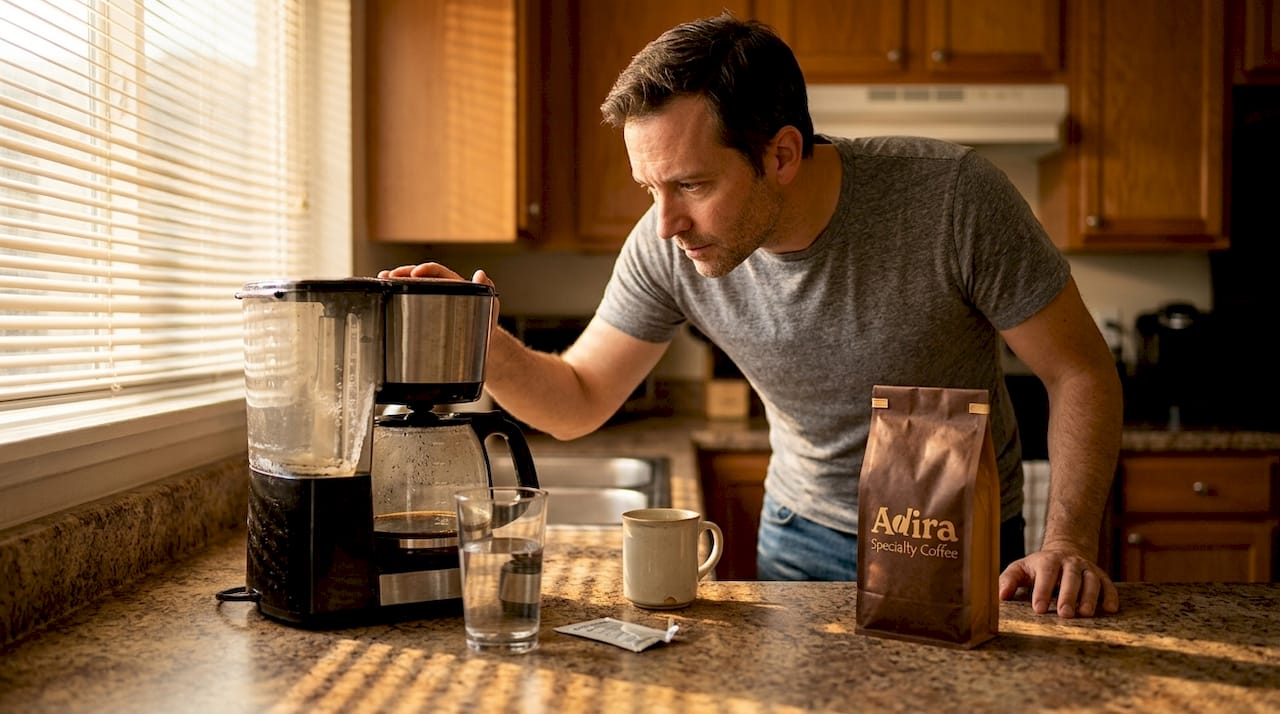
pH is equally important. Slightly acidic to neutral water (6.5 to 7.5) allows natural coffee acids to express themselves without the water amplifying or canceling them. Very alkaline water (above 8.0) essentially neutralizes those bright, fruity acids that make a well-sourced Ethiopia or Costa Rica coffee so exciting.
Total Dissolved Solids (TDS) measures everything dissolved in your water, including minerals, metals, and organic matter. Think of it as the “fullness” of your water. Distilled water has near-zero TDS and produces a coffee that tastes oddly flat and hollow because minerals are needed for extraction to work. According to water and coffee extraction science, optimal TDS creates the ionic environment that allows water to extract at the right rate.
How to prioritize water adjustments as a home barista:
- Test your current tap water for hardness, pH, and TDS using an inexpensive home test kit
- Determine if you are dealing with hard water (scale buildup, bitter cups) or soft water (flat, sour cups)
- Filter out chlorine and chloramines using an activated carbon filter as your first step
- Adjust mineral content using remineralization drops or tablets if needed
- Match your adjusted water profile to your roast: use slightly more mineral-rich water for lighter roasts, and softer water for darker roasts where extraction is already more aggressive
Pro Tip: Darker roasts are more sensitive to high mineral content because their cellular structure is more porous and extraction happens faster. If your dark roast tastes bitter and harsh, try softening your water before you blame the beans. The empirical evidence on cation interactions supports this directly. Also explore how coffee blooming interacts with water chemistry for a fuller picture of extraction dynamics.
Common coffee water mistakes and how to fix them
Understanding the parameters is one thing. Applying them to avoid common pitfalls can save you from flavor disappointment. Here’s what to avoid and how to correct course.
Mistake 1: Using distilled or over-filtered water
Reverse osmosis and distilled water sound premium. They are not ideal for coffee. These processes strip out virtually all minerals, leaving water with a TDS near zero. The result is a cup that extracts unevenly, lacks sweetness, and often tastes sour or astringent. Some specialty cafes actually add minerals back into RO water before brewing, a process called remineralization.
Mistake 2: Ignoring chlorine in tap water
Municipal tap water is treated with chlorine or chloramines for safety. Both compounds are effective at what they do, which is kill bacteria. They are also very good at suppressing aromatic compounds in coffee. Even small amounts of chlorine are detectable in the cup, especially when brewing light roasts with delicate floral and citrus notes. A simple activated carbon filter solves this almost entirely.
Mistake 3: Assuming all bottled water is brewing-friendly
Not all bottled water is created equal for coffee. Mineral water from some European brands contains bicarbonate levels above 400 mg/L, which will flatten your cup completely. Spring water varies wildly by source. Purified bottled water often has the same problem as over-filtered water. Before reaching for a bottle, check the label. Look for calcium between 40 and 80 mg/L, magnesium between 10 and 30 mg/L, and bicarbonate under 80 mg/L.
| Water type | Typical TDS | Suitable for brewing? | Notes |
|---|---|---|---|
| Distilled | Near 0 | No | Lacks minerals for extraction |
| Reverse osmosis | 10 to 50 mg/L | Only if remineralized | Needs mineral addition |
| Filtered tap (carbon) | Varies | Usually yes | Removes chlorine, keeps minerals |
| Tap water (untreated) | Highly variable | Depends on source | Test first |
| Mineral water (high bicarbonate) | 300+ mg/L | No | Flattens acids, bitter finish |
| Spring water (mid-range) | 100 to 200 mg/L | Often yes | Check label for mineral profile |
Pro Tip: Inexpensive water test strips from a home brewing or aquarium supply store can measure hardness and pH in under a minute. Test your water before your next brew session. It costs almost nothing and gives you immediate, actionable data. For more detailed home brewing improvement strategies, these small diagnostics add up to meaningful flavor gains. If you are brewing with a pour-over or French press, the manual brewing guide explains how water interacts with each method differently.
The best brewing methods for home baristas each have slightly different water chemistry sensitivities, so the investment in understanding your water pays dividends across every device you own.
Optimizing your water for specialty coffee at home
Now that you know what to avoid, let’s move toward actionable improvements. Here is how home baristas can fine-tune their water for specialty-quality results.
The good news is that you do not need a laboratory. A few affordable tools and a methodical approach will give you control over your water that most home baristas never achieve.
Step-by-step water optimization process:
- Test your baseline. Use a home test kit to measure hardness, pH, and TDS. Write down the numbers. This is your starting point, not a judgment.
- Filter first. If your tap water contains chlorine or chloramines, install or use an activated carbon filter before making any mineral adjustments. You cannot accurately assess mineral needs until off-flavors are removed.
- Decide your approach. If your tap water falls within the ideal ranges after filtering, you may already be close. If it is too hard or too soft, choose between bottled water, a remineralization product, or a custom mineral packet designed for coffee brewing.
- Match to your roast. Lighter roasts benefit from slightly harder water (around 100 to 150 mg/L hardness) to support the extraction of delicate acids and aromatics. Darker roasts perform better with softer water (around 50 to 100 mg/L) because extraction is already easier and excess minerals amplify bitterness. This pattern aligns with research on how cations affect darker roast extraction at the molecular level.
- Brew, taste, and log. Change one variable at a time. Brew the same coffee with your old water and your adjusted water, side by side. Note the differences in acidity, sweetness, bitterness, and body. Write it down. Memory alone will not serve you here.
- Repeat with consistency. Once you find a water profile that works, replicate it every time. Consistency is what separates good home brewing from great home brewing.
Pro Tip: Specialty coffee mineral packets, made specifically for coffee brewing, dissolve in distilled water to create a precisely controlled profile. This is the most repeatable and affordable route for serious home baristas who want total control. Understanding specialty coffee standards helps put your water work into context, and pairing optimized water with genuinely fresh coffee is where the real magic happens.
Why most coffee lovers underestimate water—and how you can outbrew the pros
Here is something we think about at Adira Coffee often: the coffee community spends millions of dollars on grinders, espresso machines, and limited-edition single origins, yet most people brew with whatever comes out of the tap. It is a strange gap between aspiration and practice.
Even experienced home baristas who know about water quality treat it as a future upgrade rather than an immediate priority. The mindset is usually, “I’ll sort out the beans and the grinder first, then worry about water.” But this gets the order of operations exactly backwards.
Think about it this way. If your water is wrong, it does not matter how carefully a roaster developed the quality and ethical sourcing behind those beans. The chemistry in your cup is determined more by what you add the beans to than the beans themselves. A single afternoon spent testing your water and making small adjustments will do more for your daily cup than most equipment upgrades costing hundreds of dollars.
We have seen this play out in side-by-side tastings, using identical beans, identical grind settings, and identical brew ratios but different water sources. The differences are not subtle. A cup brewed with properly mineralized, chlorine-free water at the right pH can taste like an entirely different coffee compared to one brewed with hard or over-filtered tap water. Cleaner sweetness, brighter acids, more complex finish, better body. Water is doing all of that.
The uncomfortable truth is that mastering water chemistry is the most undervalued skill in home brewing. It requires no expensive equipment, only a test kit, some filters, and perhaps a small bottle of remineralization solution. The return on that investment in flavor terms is genuinely disproportionate.
Level up your coffee experience with Adira
Once your water is dialed in, the next question is whether your beans are worthy of the effort you’re putting into your brew.
At Adira Coffee, every batch is small-roasted to order and shipped at its peak freshness. We source directly from around 50 farms across Colombia, Ethiopia, Costa Rica, Guatemala, Brazil, and Sumatra, with each origin selected for its distinct flavor character. When your water chemistry is right, those regional flavors actually reach your cup the way they were intended. Try our Colombia single origin as a benchmark, since its bright acidity and stone fruit sweetness respond exceptionally well to properly mineralized water. Browse our full range of fresh-roasted specialty beans and explore our brewing resources to keep building your skills alongside your water knowledge.
Frequently asked questions
What minerals should my water contain for the best coffee flavor?
Optimal coffee water contains a balanced mix of calcium (40 to 80 mg/L) and magnesium (10 to 30 mg/L) to enhance extraction and flavor clarity, as confirmed by research on water cation interactions in brewing.
Can bottled water improve my coffee taste?
Many bottled waters can improve coffee taste if they contain the right mineral balance—always check labels for moderate calcium and magnesium content and avoid high-bicarbonate mineral waters that flatten acidity.
Is tap water ever suitable for brewing coffee?
Tap water can work well for brewing if it has a neutral taste, medium mineral content, and no strong odors, but you should always filter out chlorine and chloramines before using it for specialty coffee.
How do I test my water quality at home?
Home water test kits available at hardware stores or online can measure hardness, pH, and TDS in minutes, giving you exactly the data you need to start adjusting your brewing water with confidence.