
TL;DR:
- Farm partnerships establish long-term, direct relationships that improve coffee quality, economic stability, and sustainability. They involve regular visits, shared standards, and multi-year commitments that build trust and consistency. Genuine partnerships lead to better clip scores, higher premiums, and more resilient supply chains.
Farm partnerships in coffee are defined as long-term, direct collaborations between producers and buyers that tie pricing to quality, sustainability, and shared investment. These relationships sit at the core of specialty coffee sourcing. They are the mechanism through which a roaster in California can guarantee that a lot from a small farm in Ethiopia meets a specific flavor profile, season after season. Adiracoffee sources from cooperatives and small farms across Colombia, Ethiopia, Costa Rica, Mexico, and Sumatra precisely because these structured relationships produce results that commodity channels cannot replicate. The role of farm partnerships in coffee extends far beyond price negotiation. It shapes quality, protects livelihoods, and builds supply chains that hold up under pressure.
How do farm partnerships enhance coffee quality from farm to cup?
Quality in specialty coffee does not happen by accident. It requires aligned expectations between the farmer who harvests the cherry and the roaster who profiles the bean. Farm partnerships create the feedback loops that make alignment possible.

Quality-based pricing is the first mechanism. When a buyer commits to paying more for higher-scoring lots, farmers have a direct financial reason to invest in selective harvesting, careful fermentation, and better drying infrastructure. That incentive does not exist in commodity channels, where all coffee is priced by weight and grade, not cup score.
The impact of partnerships on coffee quality also shows up in how knowledge moves between buyer and producer:
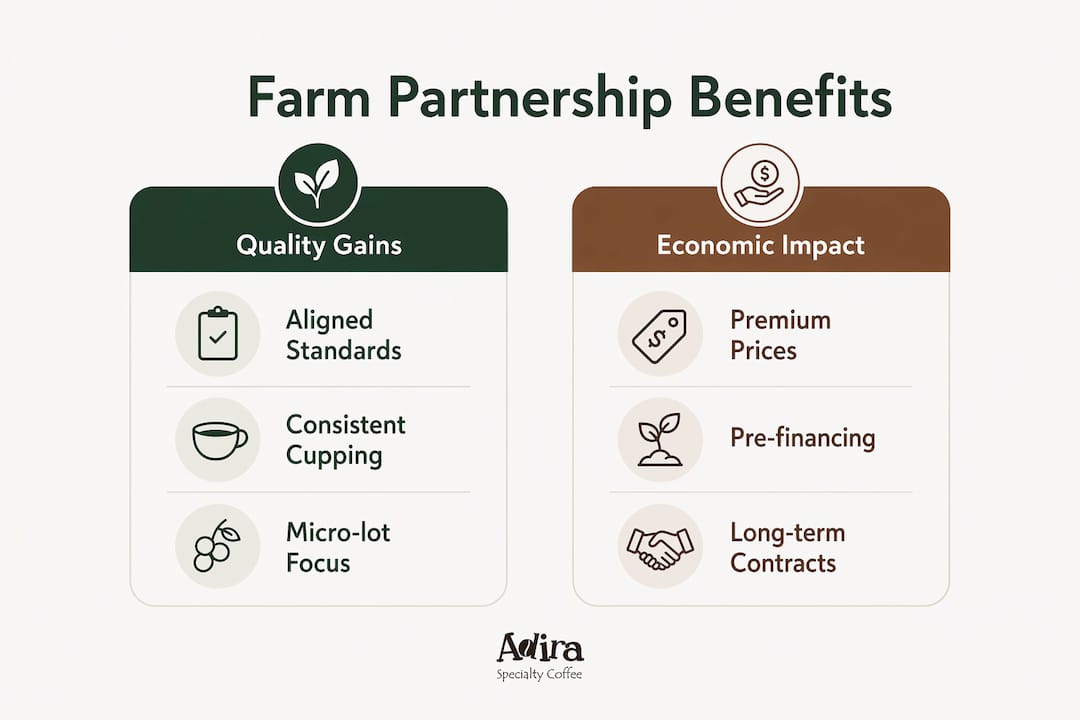
- Annual origin visits allow roasters to cup alongside farmers, align on defect thresholds, and negotiate the next season’s quality targets. At least one annual visit to origin is standard practice in direct trade.
- Q Grading certification gives both parties a shared language for evaluating coffee. When a farmer and a buyer use the same 100-point Specialty Coffee Association scale, disagreements about quality shrink.
- Micro-lot separation lets farms isolate their best-performing plots or processing methods. Buyers can then trace a specific flavor profile back to a specific field, which increases both traceability and the farm’s ability to command a premium.
- Roast profile feedback closes the loop. When a roaster shares cupping notes with the producer, the farmer learns how their processing decisions show up in the cup.
Pro Tip: If you source from a farm you have never visited, request lot-level cupping data from the exporter. That data tells you whether quality is being tracked at the farm or just at the mill.
Collaborative farming in coffee produces measurable quality gains because it treats the supply chain as a shared project, not a transaction. The practices that define flavor at origin are almost always shaped by the relationships farmers have with their buyers.
What are the economic benefits of farm partnerships for coffee producers?
The economic case for farm partnerships is direct. Direct trade premiums range from 25% to 200% above commodity prices, with some models paying up to twice the commodity rate. That gap is the difference between a farm that can invest in new processing equipment and one that cannot.
The benefits of coffee farm partnerships go beyond the price per pound. Here is how the economic impact stacks up across a multi-year relationship:
- Pre-financing and crop loans. Buyers who commit to purchasing a harvest before it is picked can offer advance payments. Farmers use that capital to hire labor, buy fertilizer, and manage cash flow during the growing season.
- Multi-year agreements. A two or three-year purchase commitment lets a farmer plan. They can plant new varieties, build a raised-bed drying station, or hire a full-time quality manager without worrying that their buyer will disappear next season.
- Collective bargaining through cooperatives. When farmers organize through cooperatives, they negotiate as a group rather than as individuals. The role of cooperatives in coffee farming is to pool volume, reduce transaction costs, and give smallholders the leverage that larger estates have by default.
- Insulation from spot market swings. Commodity coffee prices are volatile. A locked-in partnership price protects a farmer’s income when the C market drops, which it does regularly.
“Sustainability certifications often fail to improve farmer incomes without embedding sourcing into empowered, local institutions. Collective bargaining and genuine local buy-in are what move the needle, not paperwork alone.”
Institutional backing significantly increases livelihood outcomes for farmers in structured projects, compared to independent selling. That finding matters because it shifts the conversation away from certification labels and toward the quality of the relationship itself.
How do farm partnerships promote sustainability and ethical sourcing?
Sustainability in coffee sourcing is not a marketing claim. It is a set of practices that require ongoing investment, documentation, and accountability. Farm partnerships are the delivery mechanism for all three.
The environmental benefits of collaborative farming in coffee include:
- Water management investments. Wet processing uses large volumes of water. Partnerships that include agronomy support help farms install recirculation systems and reduce runoff into local waterways.
- Shade tree programs. Buyers who fund shade tree planting get better-quality coffee over time, because shade-grown arabica develops more slowly and builds more complex sugars. The farm gets a more resilient microclimate.
- Deforestation compliance. Direct trade programs increasingly integrate traceability, farm-level data, and documentation to comply with regulations like the EU Deforestation Regulation (EUDR). Lot mapping and GPS coordinates are now standard in serious partnerships.
The following table shows how different sourcing models compare on key sustainability dimensions:
| Sustainability dimension | Commodity channel | Certified-only model | Active farm partnership |
|---|---|---|---|
| Traceability to farm level | Rarely | Sometimes | Standard |
| Environmental investment | None | Audit-based | Ongoing, funded |
| Farmer income above commodity | No | Marginal | 25%–200% premium |
| Regulatory compliance support | None | Certification body | Buyer-assisted |
| Local institution involvement | None | Variable | Central to model |
Certification alone is technocratic. Without embedded local support and genuine buyer commitment, a certification label does not change what happens on the ground. The best examples of sustainable coffee farms share one trait: a buyer who shows up, invests, and stays.
What challenges do farm partnerships address in the coffee industry?
The coffee industry faces three structural pressures right now: price volatility, regulatory complexity, and climate-driven supply disruption. Farm partnerships address all three, but only when they are built with genuine commitment.
Long-term relationships serve as shock absorbers against market volatility, sustaining consistent supply and quality even when commodity prices spike or fracture. That is not a soft benefit. It is a supply chain risk management tool that experienced roasters treat as seriously as inventory hedging.
Regulatory complexity is growing. The EUDR requires importers to document the geographic origin of every lot and prove it was not grown on deforested land. That documentation does not exist in commodity channels. It requires farm-level data collection, which only happens inside an active partnership.
Common challenges that partnerships address include:
- Price volatility: Locked-in pricing protects both the farmer’s income and the roaster’s cost structure.
- Logistics and compliance: Experienced intermediaries within partnerships manage export paperwork, phytosanitary certificates, and customs documentation.
- Climate risk: Buyers who maintain multi-year relationships are more likely to support a farm through a bad harvest rather than simply switching suppliers.
- Greenwashing risk: Greenwashing of direct trade occurs when claims are made without substantive multi-year engagement and published pricing logic. Authentic partnerships leave a paper trail.
Pro Tip: Ask any supplier for evidence of repeat contracts with the same farm over at least two consecutive years. One-time purchases dressed up as “direct trade” are common and easy to spot.
How farm partnerships affect coffee at the systemic level is a question of trust built over time. A roaster who has bought from the same cooperative in Huila, Colombia for five years has a fundamentally different supply chain than one who buys on the spot market each season. The local sourcing model in food and beverage more broadly confirms this: structured, long-term producer relationships consistently outperform transactional buying on quality, reliability, and sustainability outcomes.
Best practices for establishing and maintaining successful farm partnerships
Building a genuine farm partnership takes more than a handshake and a premium price. The following practices separate authentic relationships from marketing claims.
Publish your pricing logic. Buyers who share how they calculate premiums, what quality thresholds trigger higher prices, and what volume commitments they are making give farmers the information they need to plan. Transparency through published pricing logic and lot-level data is the clearest signal of a serious buyer.
Visit origin at least once per harvest cycle. There is no substitute for cupping at the farm, walking the drying beds, and meeting the people doing the work. Annual on-site visits are the minimum standard in direct trade, not an optional extra.
Pre-finance when you can. Effective direct trade requires roasters to pre-finance crops or share financial risks to support innovation at origin. A buyer who only pays on delivery is transferring all the financial risk to the farmer.
Use formal agreements. A written contract with quality targets, volume commitments, and pricing formulas protects both parties. It also gives the farmer something to show a bank when applying for a loan.
Work with and through local institutions. Cooperatives, producer associations, and local exporters have relationships and knowledge that an outside buyer cannot replicate. Partnering with these institutions rather than bypassing them produces better outcomes for everyone, including the ethical sourcing transparency that consumers increasingly demand.
Key Takeaways
Farm partnerships are the most effective mechanism in specialty coffee for aligning quality, economic stability, and sustainability across the entire supply chain.
| Point | Details |
|---|---|
| Quality through alignment | Annual visits, Q Grading, and micro-lot separation directly improve cup scores and traceability. |
| Economic premiums matter | Direct trade pays 25%–200% above commodity prices, enabling farm investment and income stability. |
| Sustainability needs structure | Environmental and regulatory compliance requires active buyer support, not certification labels alone. |
| Long-term relationships reduce risk | Multi-year commitments protect both farmers and roasters from price volatility and supply disruption. |
| Transparency separates authentic from performative | Published pricing logic, lot data, and repeat contracts are the markers of a genuine partnership. |
What I’ve learned about partnerships after years of sourcing
The coffee industry talks about direct trade as if it is a category. It is not. It is a spectrum, and most of what gets labeled “direct trade” sits closer to the marketing end than the operational end.
What I have found after years of sourcing for Adiracoffee is that the farms producing the most consistent, interesting coffee are almost always the ones with the most stable buyer relationships. Not the most certifications. Not the most Instagram-friendly story. The most stable relationships. A farmer who knows you are coming back next year makes different decisions than one who is selling to whoever shows up at the mill.
The industry is maturing on this point, slowly. The shift from transactional buying to genuine partnership reflects a growing understanding that quality at origin is not a fixed attribute. It is something you build together, season by season. Climate pressure is accelerating that shift. When a frost hits a growing region or a drought cuts yields by a third, the roasters who maintain real relationships are the ones who still have coffee. The ones who bought on the spot market are scrambling.
The uncomfortable truth is that genuine partnerships cost more to maintain than a premium price alone suggests. They require time, travel, pre-financing, and the willingness to absorb a bad harvest without walking away. That is the investment that separates authentic sourcing from a label on a bag.
— Stefan
Adiracoffee’s sourcing: where partnerships show up in the cup
Every bag Adiracoffee roasts starts with a relationship. Stefan and Ekaterina built this brand because they wanted coffee that was worth a second cup, and that standard requires knowing exactly where the beans come from and who grew them.
Adiracoffee sources from cooperatives and small farms in Colombia, Ethiopia, Costa Rica, Mexico, and Sumatra. Each origin represents an active sourcing relationship, not a one-time purchase. The Mushroom Coffee Medium Roast and the Cold Brew both reflect that commitment: single-origin beans, roasted in small batches in California, and shipped within days of roasting. If you want to understand what farm partnerships taste like, that is a good place to start. Free US shipping on orders over $35, and a subscription option saves you 10%.
FAQ
What is the role of farm partnerships in coffee sourcing?
Farm partnerships establish long-term, direct relationships between producers and buyers that tie pricing to quality and sustainability. They are the primary mechanism through which specialty roasters secure consistent, traceable, high-quality lots.
How do farm partnerships affect coffee quality?
Partnerships improve quality by aligning expectations through annual visits, shared cupping standards like Q Grading, and micro-lot separation. Quality-based pricing gives farmers a direct financial incentive to invest in better harvesting and processing.
What economic benefits do farm partnerships provide to coffee farmers?
Direct trade premiums range from 25% to 200% above commodity prices. Multi-year agreements also enable pre-financing, better cash flow planning, and protection from spot market volatility.
What is the role of cooperatives in coffee farming?
Cooperatives pool volume and bargaining power for smallholder farmers, enabling collective negotiation with buyers. They also distribute sustainability premiums more equitably and support compliance with traceability requirements.
How can buyers avoid greenwashing in direct trade coffee?
Authentic direct trade requires published pricing logic, lot-level data, and evidence of repeat contracts over multiple years. A single purchase with a premium price does not constitute a genuine farm partnership.