
TL;DR:
- Arabica and Robusta are two main coffee species that differ in flavor, growing conditions, and caffeine content. Arabica makes up most of the world’s coffee and offers a sweeter, more complex cup, while Robusta is bolder, earthier, and contains higher caffeine levels. Choosing the right beans depends on your brewing method, flavor preferences, and caffeine needs.
Arabica and Robusta are the two dominant species of coffee beans, and the definition of arabica vs robusta comes down to their botanical origins, growing environments, and the flavor experiences they produce. Arabica accounts for 60–70% of global coffee production, making it the backbone of specialty coffee. Robusta fills the remaining 30–40%, powering espresso blends and instant coffee worldwide. Understanding what separates these two species gives you a real edge when selecting beans, dialing in your brew, and getting more from every cup.
What is the definition of arabica vs robusta?
Arabica (Coffea arabica) and Robusta (Coffea canephora) are separate plant species, not just marketing labels. Arabica produces a sweeter, more complex cup with fruity, citrus, and chocolate notes. Robusta delivers a bolder, earthier brew with heavier body and a sharper bite.
The chemical difference drives everything. Robusta contains nearly double the caffeine of Arabica, with caffeine levels of 2.2–2.7% compared to Arabica’s 1.2–1.5%. Higher caffeine means more bitterness, which is why straight Robusta can taste harsh to drinkers used to specialty Arabica. Arabica also carries more sugar and fat, which is why it tastes sweeter and feels smoother in the cup.
Neither species is universally better. The right choice depends on what you want from your coffee, how you brew it, and how much caffeine you can handle.
What are the botanical and cultivation differences?
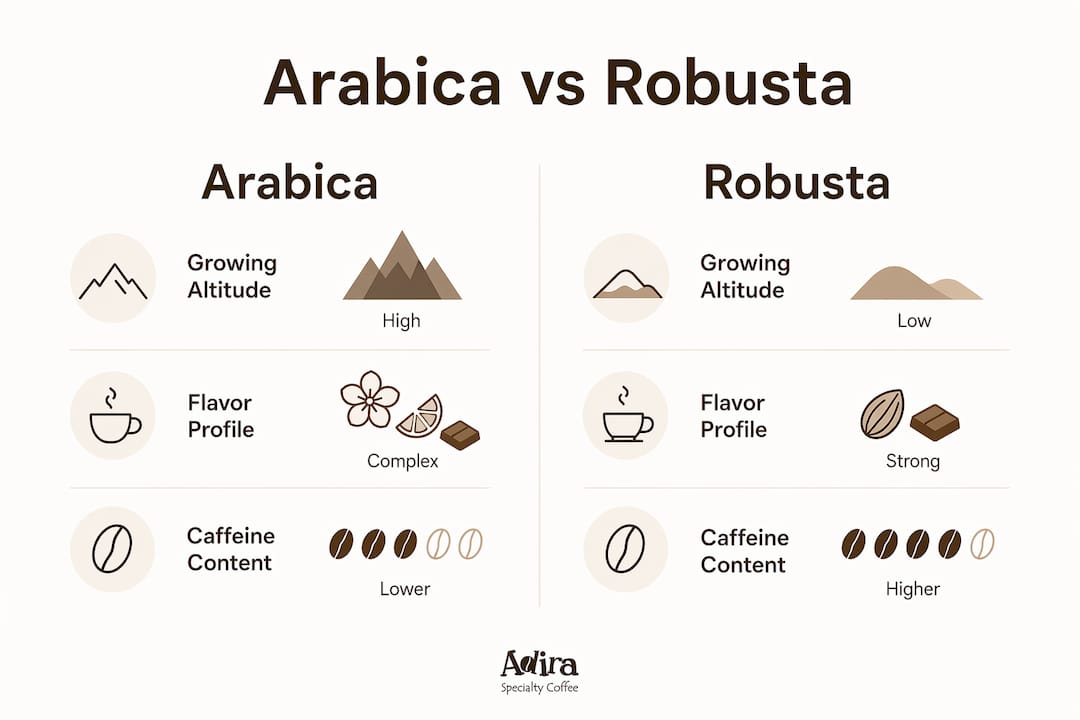
Where a coffee plant grows shapes everything about the bean it produces. Arabica and Robusta occupy completely different growing zones, and those zones explain their price, availability, and flavor.
Arabica growing conditions
Arabica thrives at altitudes of 1,000–2,000 meters in subtropical climates with consistent rainfall, cool nights, and rich soil. Ethiopia, Colombia, Costa Rica, and Mexico are classic Arabica origins. At high altitude, the plant grows slowly, and that slow growth concentrates sugars and aromatic compounds in the bean. The result is the nuanced, fruit-forward flavor that specialty roasters prize.
Arabica is also fragile. It is vulnerable to coffee leaf rust, pests, and temperature swings. Growing it demands more labor, more careful management, and more land at elevation. That complexity pushes the price up.
Robusta growing conditions
Robusta grows at lower altitudes of 0–800 meters and tolerates heat, humidity, and inconsistent rainfall far better than Arabica. Vietnam, Uganda, and Indonesia are major Robusta producers. The plant yields more cherries per tree and ripens more uniformly, which makes harvesting Robusta more efficient than picking Arabica cherries, which ripen at different rates on the same branch.
Robusta’s resilience has a biological explanation. Its high caffeine content evolved as a natural pest deterrent, protecting the plant in the warmer, lower-altitude environments where insects thrive. That built-in defense reduces the need for pesticides and keeps production costs lower than Arabica.
- Arabica altitude: 1,000–2,000 meters
- Robusta altitude: 0–800 meters
- Arabica harvest: selective picking due to uneven ripening
- Robusta harvest: strip or machine harvesting due to uniform ripening
- Arabica disease resistance: low
- Robusta disease resistance: high
How do Arabica and Robusta differ in flavor and chemistry?
The taste difference between these two types of coffee beans is not subtle. Arabica and Robusta have distinct chemical profiles, and those profiles translate directly into what you taste in the cup.

Arabica flavor profile
Arabica’s flavor ranges widely, with common notes of fruitiness, citrus, and chocolate. Its higher sugar and fat content produce a naturally sweet, smooth cup with bright acidity. Single-origin Arabicas from Ethiopia often taste of blueberry or jasmine. Colombian Arabicas tend toward caramel and red fruit. That range is why specialty coffee culture built itself almost entirely around Arabica.
Robusta flavor profile
Robusta carries earthy, woody, and sometimes rubbery notes with a heavier body and low acidity. Robusta contains 60% less fat and sugar than Arabica, which explains its blunter, more aggressive flavor. That is not a flaw. In the right context, that boldness is exactly what you want.
| Characteristic | Arabica | Robusta |
|---|---|---|
| Caffeine content | 1.2–1.5% | 2.2–2.7% |
| Sugar and fat | Higher | 60% lower |
| Acidity | Bright, noticeable | Low |
| Body | Medium | Heavy |
| Flavor notes | Fruit, citrus, chocolate | Earthy, woody, nutty |
| Bitterness | Mild to moderate | Strong |
One development worth knowing: specialty-grade Robusta, called Fine Robusta, is emerging with nuttier, cleaner flavors that rival lower-tier Arabica. Fine Robusta is harvested and processed with the same care as specialty Arabica, and the results challenge the assumption that Robusta is always the inferior bean.
Pro Tip: If you find standard Arabica too acidic, try a well-processed Robusta or a blend. The lower acidity and heavier body can be easier on sensitive stomachs.
Which brewing methods suit Arabica vs Robusta?
Knowing the difference between arabica and robusta coffee matters most when you sit down to brew. Each bean type performs differently depending on the method, and matching bean to method is the fastest way to improve your home coffee.
Best brewing methods for Arabica
Arabica excels in pour-over, filter, and black coffee because those methods highlight its acidity, sweetness, and aromatic complexity. A Chemex or V60 lets Ethiopian or Colombian Arabica express its full range of fruit and floral notes. Brewing Arabica as a black coffee without milk or sugar lets you taste exactly what the origin and roast deliver.
Adiracoffee sources single-origin Arabica from Ethiopia, Colombia, Costa Rica, Mexico, and Sumatra. Each origin brings a distinct flavor profile to the cup, and filter brewing is the clearest way to experience those differences.
Best brewing methods for Robusta
Robusta shines in espresso. Traditional Italian espresso blends use 10–20% Robusta to increase crema thickness and add a punchy, bold finish that holds up under steamed milk. That thick espresso crema is one of the most visible signs of Robusta’s contribution to a blend.
Robusta also works exceptionally well in milk-based drinks. Robusta’s strong flavor stands up to lattes and cappuccinos where a lighter Arabica might disappear under the milk. Vietnamese iced coffee is a perfect example: Robusta’s intensity balances sweetened condensed milk and melting ice in a way that a delicate Arabica simply cannot.
- Pour-over or filter: use single-origin Arabica for maximum flavor clarity
- Espresso: use an Arabica-Robusta blend for bold flavor and thick crema
- Latte or cappuccino: Robusta-forward blends hold their character under steamed milk
- Cold brew: Arabica works well for smooth, low-acid results; Robusta adds strength
- Vietnamese iced coffee: Robusta is the traditional and functionally correct choice
Pro Tip: When pulling espresso at home, try a blend with a small percentage of Robusta. Even 10–15% Robusta in the blend can dramatically improve crema and give the shot more staying power in milk drinks.
What should you consider when choosing beans for home brewing?
Home brewers should weigh flavor preference, caffeine tolerance, and brewing method before committing to a bean. The right choice is not always the most expensive one.
- Flavor goal: If you want a sweet, complex, fruit-forward cup, start with a high-quality Arabica. If you want bold, earthy, and strong, Robusta or a blend is the better fit.
- Caffeine needs: Robusta delivers roughly twice the caffeine per gram. If you need a strong morning kick, Robusta earns its place. If you are caffeine-sensitive, stick with Arabica.
- Budget: Robusta costs less to produce and less to buy. A well-sourced Robusta or Arabica-Robusta blend gives you a quality cup at a lower price point than premium single-origin Arabica.
- Brewing skill: Arabica rewards careful brewing. Grind size, water temperature, and extraction time all affect the outcome noticeably. Robusta is more forgiving and harder to ruin.
- Freshness: Both species taste dramatically better fresh. Buy from roasters who ship within days of roasting and list the roast date on the bag.
Quality depends more on farming, processing, and freshness than on species alone. A poorly sourced, stale Arabica will taste worse than a well-processed, freshly roasted Robusta. The “100% Arabica” label on a bag is not a quality guarantee. Sourcing and freshness matter more.
Key takeaways
Arabica and Robusta are distinct species with different chemistry, growing conditions, and ideal uses, and matching the right bean to your brewing method is the single most effective way to improve your home coffee.
| Point | Details |
|---|---|
| Species define flavor | Arabica is sweeter and more complex; Robusta is bolder, earthier, and higher in caffeine. |
| Altitude shapes the bean | Arabica grows at 1,000–2,000 m; Robusta thrives at 0–800 m, yielding more at lower cost. |
| Chemistry drives taste | Robusta has nearly double the caffeine and 60% less fat and sugar than Arabica. |
| Match bean to brew method | Use Arabica for pour-over and black coffee; use Robusta or blends for espresso and milk drinks. |
| Freshness beats species | A fresh, well-sourced Robusta outperforms a stale Arabica every time. |
Stefan’s take: stop treating Robusta like a consolation prize
I spent years defaulting to Arabica because that is what specialty coffee culture told me to do. Single-origin Ethiopian, Colombian, Costa Rican. All Arabica, all the time. And those coffees are genuinely excellent.
But the moment I started pulling espresso seriously at home, I understood why Italian roasters have always kept Robusta in the blend. The crema is thicker. The shot holds up in milk. The finish has a punch that a pure Arabica blend often lacks. That is not a flaw in the Arabica. It is just the wrong tool for the job.
The Arabica-is-superior mindset also ignores Fine Robusta entirely. Specialty-grade Robusta, processed with real care, can produce a clean, nutty cup that surprises even experienced drinkers. The bean is not the problem. Cheap sourcing and poor roasting are the problem.
My honest recommendation: keep a bag of quality Arabica for your morning pour-over and a good espresso blend with some Robusta for your milk drinks. You will get more range from your home setup, and you will stop leaving performance on the table.
— Stefan
What Adiracoffee has for every brewing style
Adiracoffee roasts every bag to order in small batches in California, so you get beans at peak freshness regardless of which species you prefer.

For adventurous home brewers, the Mushroom Coffee Medium Roast and Mushroom Coffee Dark Roast bring functional ingredients into a well-crafted cup. If you want a blend built for espresso and milk drinks, the Love Blend is a strong starting point. Not sure which coffee fits your taste and brewing setup? Take the coffee quiz and get a recommendation matched to how you actually brew. Free US shipping on orders over $35, with a subscription option that saves you 10%.
FAQ
What is the main difference between Arabica and Robusta?
Arabica has a sweeter, more complex flavor with bright acidity, while Robusta is bolder, earthier, and contains nearly double the caffeine. The two species also grow in different altitude ranges and require different farming conditions.
Is Arabica always better than Robusta?
No. Quality depends on sourcing, processing, roasting, and freshness more than species. Robusta is the better choice for espresso crema, milk-based drinks, and high-caffeine needs, and specialty-grade Fine Robusta can rival lower-tier Arabica in cup quality.
Why does Robusta taste more bitter than Arabica?
Robusta’s higher caffeine content (2.2–2.7% vs Arabica’s 1.2–1.5%) is the primary cause of its bitterness. It also contains significantly less sugar and fat, which removes the sweetness that softens Arabica’s flavor.
Which bean is better for espresso?
Espresso blends perform best with a mix of Arabica and Robusta. Traditional Italian blends use 10–20% Robusta to build crema thickness and add a bold finish that holds up under steamed milk.
How do I know which bean to buy for home brewing?
Start with your brewing method. Use single-origin Arabica for pour-over and filter coffee. Use a blend with Robusta for espresso and milk drinks. If caffeine strength matters, Robusta or a Robusta-forward blend is the practical choice.