
TL;DR:
- The best way to get fresh, high-quality ground coffee is to order from a specialty roaster that grinds to your brewing method and ships quickly. Public grinders and pre-ground coffee often lack cleanliness, consistency, and freshness, which can negatively affect flavor. Ordering roast-to-order coffee online ensures optimal grind size, freshness, and aroma for your brewing needs.
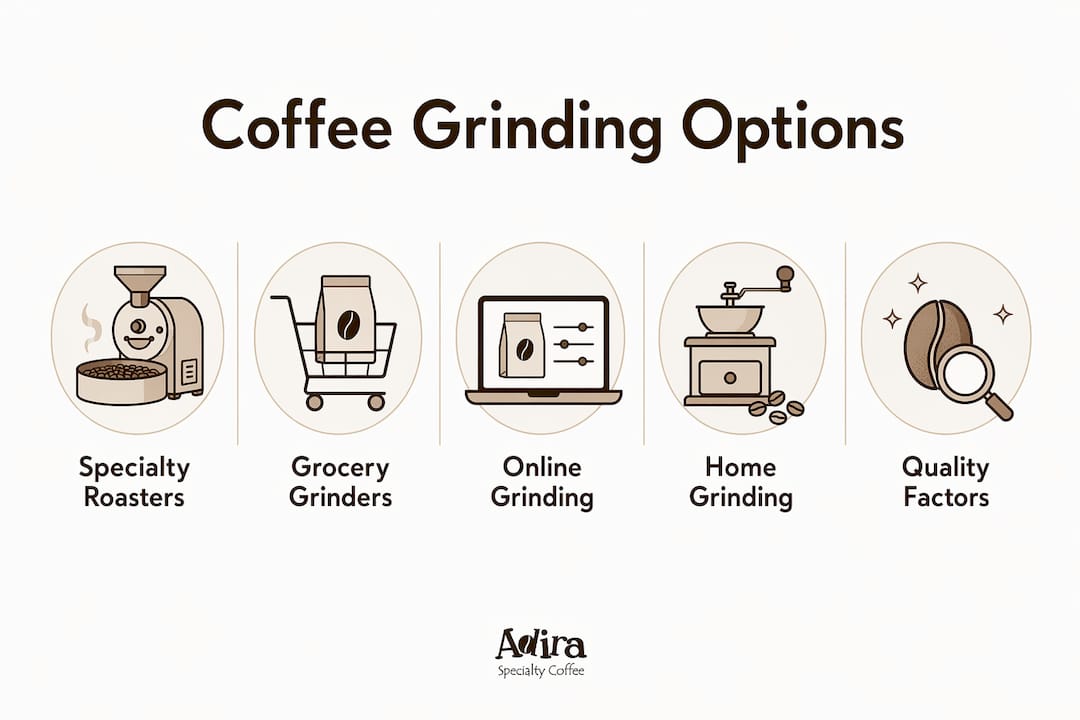
The best place to get coffee beans ground is a specialty roaster that grinds to order, calibrates the grind to your brewing method, and ships within days of roasting. That combination preserves far more of the bean’s character than any grocery-store grinder or pre-ground bag sitting on a shelf. If you need something local and fast, a specialty café or a store like Whole Foods or Trader Joe’s with an in-store grinder works as a quick fallback.
Your fastest options at a glance:
- Online specialty roaster (grind-to-order): Best for freshness and precision; request your brew method at checkout
- Local specialty café or roaster: High-quality burr grinders, staff who know grind settings; some won’t grind outside beans
- Grocery store in-store grinder: Convenient, often free with purchase; cleanliness and calibration vary widely
- Retail staff grinding (Kroger, Costco): Available at select locations; free with bean purchase, but grind options are basic
- Home burr grinder: Best long-term control; upfront cost pays off quickly if you brew daily
Pro Tip: When you arrive at a café or place an online order, state your brew method, not just “medium grind.” Say “pour-over” or “espresso” and let the grinder operator dial in the right setting.
Table of Contents
- Where can you get coffee beans ground near you?
- How to pick the right place to have your beans ground
- How to order ground beans online and what grind to request
- Why grinder cleanliness and roast-to-order grinding matter
- Key Takeaways
- Why roast-to-order grinding is the right call
- Freshly roasted, ground to your brewer, shipped to your door
- Useful sources and further reading
Where can you get coffee beans ground near you?
Local specialty roasters and cafés
A specialty roaster or café is the strongest local option. They run calibrated commercial burr grinders, and staff understand the difference between a 400-micron filter grind and a 200-micron espresso pull. The catch: many specialty shops refuse to grind beans you bought elsewhere. Their reasoning is straightforward — outside beans risk contaminating their grinders with old oils or foreign residues, which affects every customer after you. If you buy from them, grinding is usually free and done well.
Grocery store in-store grinders
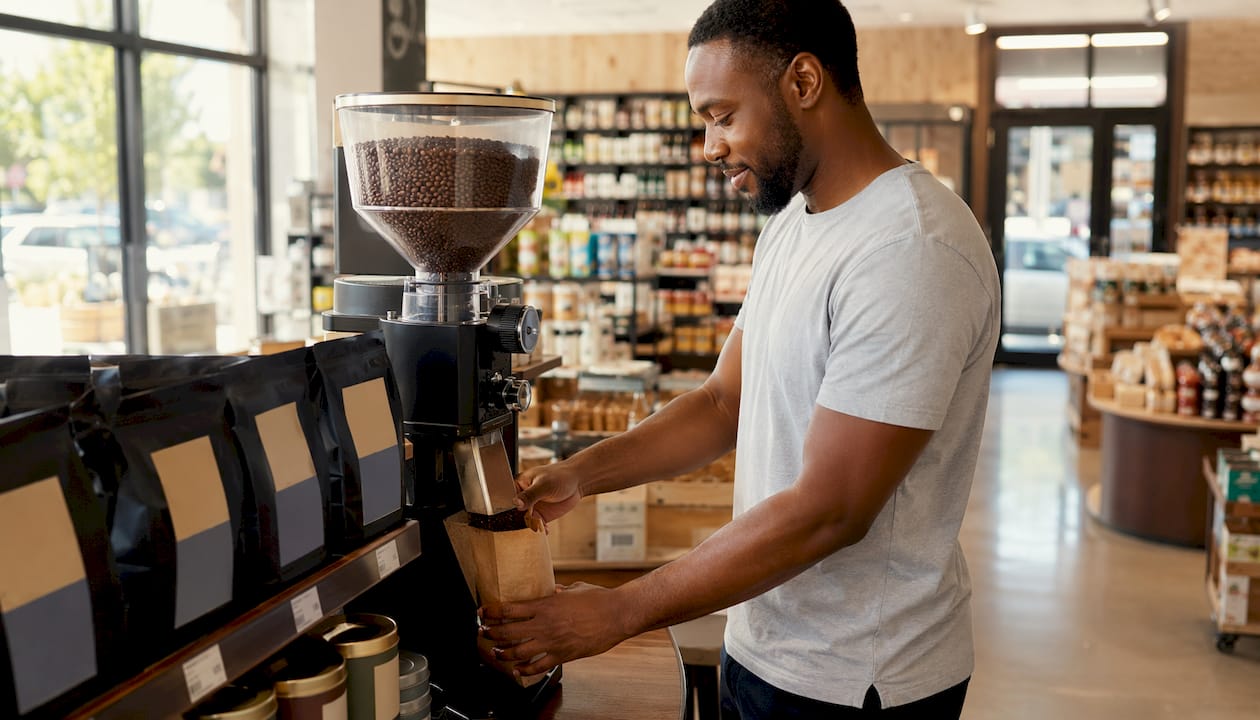
Chains like Whole Foods, Trader Joe’s, Costco, Walmart, and Kroger offer in-store grinders at many locations, though policies differ by store. Most require you to buy beans from that store before using the machine. The grinders are self-serve or staff-operated, and they cover basic settings: coarse, medium, fine. Convenient? Yes. Consistent? Not always. These machines are rarely cleaned after every use, so residue from the previous customer’s dark roast can end up in your light Ethiopian natural.
Online roasters that grind to order
This is the option most specialty-coffee buyers overlook. Some online roasters grind to your specified brew method, seal the bag with a one-way valve, and ship within days of roasting. You get a roaster’s calibrated burr grinder and their knowledge of the bean, without leaving your house. The tradeoff is lead time: you need to plan a few days ahead rather than grabbing beans on the way home.
Home grinding
A quality burr grinder at home gives you the most control over grind size and consistency. Entry-level burr grinders from brands like Baratza or Oxo are an investment that can last years. Blade grinders are cheaper but chop unevenly, producing a mix of fine powder and coarse chunks that throws off extraction. If you brew daily, a burr grinder pays for itself in the quality it adds to every cup.
Pro Tip: If you’re using a grocery-store grinder for a specialty bean, ask staff when it was last cleaned. If they can’t answer, that’s your answer.
How to pick the right place to have your beans ground
Not every grinding option suits every buyer. Run through these criteria before you commit:
- Grinder type: Burr grinders produce even particles; blade grinders don’t. Ask which type the location uses.
- Cleaning cadence: A grinder cleaned daily (or between customers) is far less likely to contaminate your beans with stale residue.
- Grind-size range: Espresso needs a fine, precise grind. French press needs coarse. Confirm the location can hit your target setting.
- Packaging: Grounds exposed to air go stale fast. Insist on a sealed bag or bring your own airtight container.
- Roast-to-order availability: The freshest option is a roaster who grinds the same day they roast and ships immediately.
Questions worth asking: “What grinder do you use?” “When was it last cleaned?” “Can you grind to a pour-over setting?” Red flags include staff who can’t name the grinder, no sealed packaging option, or a machine with visible old grounds caked in the chute.
Pro Tip: For espresso, skip grocery-store grinders entirely. Espresso demands a precise, consistent fine grind that most public machines can’t reliably deliver. Use a specialty roaster or a calibrated home burr grinder.
How to order ground beans online and what grind to request
Ordering ground coffee online is simple when you know what to ask for. The key is matching grind size to your brewing method. Here’s a quick reference:
| Brewing Method | Grind Size | Particle Feel |
|---|---|---|
| French press / cold brew | Coarse | Rough, like sea salt |
| Chemex / Clever Dripper | Medium-coarse | Slightly coarser than table salt |
| Pour-over | Medium | Like table salt |
| Auto-drip machine | Medium | Like table salt |
| Aeropress (filter) | Medium-fine | Finer than table salt |
| Espresso | Fine | Like powdered sugar |
| Turkish | Extra fine | Floury, almost dusty |
When placing an order, include your brew method in the notes field. Better yet, add a dose range: something like “drip, medium, ~18–20 g per 300 ml” helps a roaster calibrate precisely for your setup. Request valve-sealed bags and ask about the roast-to-ship window. Grounds lose aroma within hours to days of grinding, so a roaster who ships the same week they roast makes a real difference.
- Order small portions (8–12 oz) rather than bulk if you grind to order; freshness drops fast once the bag is open
- If you brew multiple methods, order separate grind sizes rather than splitting one bag
- Ask about packaging: one-way valve bags slow oxidation significantly compared to standard sealed bags
Pro Tip: If you’re ordering online and aren’t sure which grind to pick, check the roaster’s grind size guide — most specialty roasters publish one matched to their specific beans.
Why grinder cleanliness and roast-to-order grinding matter
Ground coffee starts losing its best aromatics within hours of grinding. Whole beans hold peak flavor for roughly 2–4 weeks after roasting; pre-ground coffee can lose a significant portion of its aroma in the first day or two. For a specialty bean with distinct fruit or floral notes, that window is everything.
Freshness matters most in the first 24–48 hours after grinding. Pre-ground coffee sealed in a valve bag right after grinding preserves more aroma than grounds left in an open container, but nothing matches grinding immediately before brewing.
Contamination is the other issue. Specialty-coffee experts point to the unknown maintenance history of public grinders as the main reason to avoid them for high-end beans. Even a small amount of rancid oil from a previous user’s dark roast can flatten the brightness of a delicate natural-process Ethiopian. That’s why many specialty shops won’t grind outside beans: it protects their equipment and their reputation.
Burr grinders matter here too. Burr grinders produce a more even grind than blade grinders, and even extraction depends on uniform particle size. A blade grinder’s uneven chop creates both over-extracted bitter fines and under-extracted coarse chunks in the same cup.
Pro Tip: If you must store pre-ground coffee, use a small airtight container, keep it away from light and heat, and consume within 1–2 weeks. Learn more about grinder cleanliness at home to protect your own equipment.
Key Takeaways
The single most effective way to get great ground coffee is to order from a roaster who grinds to your brew method and ships within days of roasting.
| Point | Details |
|---|---|
| Best grinding option | A specialty roaster that grinds to order and ships quickly beats every public grinder for freshness. |
| Grocery grinder risk | Public grinders are rarely cleaned between uses; always ask about cleaning cadence before using one. |
| Grind size by method | Match your request to your brewer: coarse for French press, medium for drip, fine for espresso. |
| Ground coffee shelf life | Pre-ground coffee loses aroma fast; consume within 1–2 weeks and store in a sealed, airtight container. |
| Adiracoffee option | Adiracoffee roasts to order in California, grinds to your brew method, and ships within days of roasting. |
Why roast-to-order grinding is the right call
Most coffee advice focuses on where to grind. The more useful question is when and how precisely the grinding happens relative to roasting and shipping.
Grocery-store grinders exist for convenience, not quality. They’re set to a handful of generic levels, cleaned on an irregular schedule, and used by dozens of customers with different beans. For a $6 bag of commodity coffee, that’s fine. For a single-origin natural-process bean you paid real money for, it’s a waste.
The roast-to-order model flips the whole equation. Instead of grinding a bean weeks before it reaches you, the roaster grinds it the same week it was roasted, seals it properly, and ships it directly. You get the roaster’s calibrated equipment and their knowledge of that specific bean’s ideal grind range. That’s a fundamentally different product than anything sitting on a grocery shelf.
Home grinding is worth the investment if you brew daily and want full control. But if you’re ordering specialty coffee online, having the roaster grind to your brew method is often the smarter move, especially if your home grinder is a blade model or an entry-level burr that struggles with espresso precision.
Freshly roasted, ground to your brewer, shipped to your door
If you’ve been searching for where to get coffee beans ground and want the freshest possible result, Adiracoffee does exactly what this article recommends: small-batch roasting in California, every bag ground to your specific brew method, and shipping within days of the roast date.
Stefan and Ekaterina built Adiracoffee after years of buying supermarket coffee that never delivered a second cup worth finishing. Every bean is sourced from cooperatives and small farms in Colombia, Ethiopia, Costa Rica, Mexico, and Sumatra, then roasted to order and matched to your grinder and brewing setup with a personalized digital recipe.
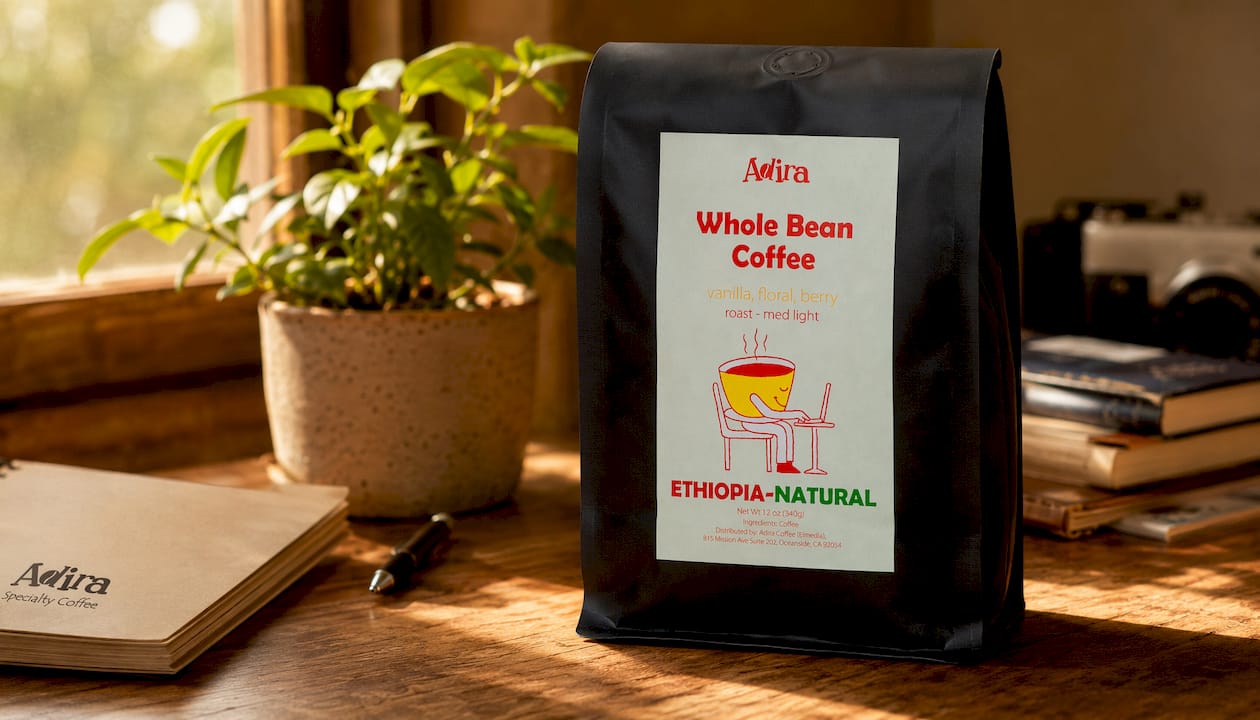
The Ethiopia - Natural is a strong starting point: a single-origin with bright fruit notes that shows exactly what roast-to-order grinding can do for a specialty cup. Order once, or subscribe for 10% off and free US shipping over $35. Tell us your brew method at checkout and we’ll handle the rest.
Useful sources and further reading
A few resources worth bookmarking if you want to go deeper on grinding options, freshness, and brew technique:
- Where to grind coffee beans (for free) — Barista HQ’s breakdown of local grinding options and grocery-store policies
- Whole bean vs. pre-ground coffee — Daily Home Coffee on freshness windows and aroma loss
- Burr vs. blade grinder quality — QZ on why grinder type affects extraction and flavor
- Grind size guide for home brewers — Adiracoffee’s guide to matching grind to brew method
- Why roast date matters — Adiracoffee on roast-to-ship timing and peak flavor windows
- Best brewing methods for home baristas — Adiracoffee’s method-by-method brewing guide