
TL;DR:
- Coffee terroir encompasses the environmental factors that influence a coffee plant’s development and flavor profile. It includes climate, altitude, soil, and ecosystem interactions that create unique, measurable chemical and sensory characteristics. Processing, roasting, and brewing further modify how terroir is expressed in the final cup.
Coffee terroir is defined as the complete set of environmental growing conditions that shape how a coffee plant develops and what flavors it ultimately produces. The term comes from French winemaking but applies directly to coffee, where climate, altitude, soil, and ecosystem all interact to determine the flavor potential locked inside every cherry. Understanding what is coffee terroir means recognizing that your cup of Ethiopian natural or Colombian single-origin does not taste the way it does by accident. The farm’s geography writes the first draft of that flavor. Processing, roasting, and brewing revise it.
What is coffee terroir and why does it matter?
Coffee terroir is best understood as a combined set of interacting environmental factors over time, not any single variable like altitude or rainfall alone. Green Coffee Collective defines it as the environmental conditions where coffee is cultivated that influence cherry maturation and flavor potential. That definition matters because it shifts how you think about origin. A bag labeled “Colombia” is not just a geography. It is a record of months of sunlight, soil chemistry, and temperature swings that no other place on earth can replicate exactly.
The role of terroir in coffee is foundational. Without understanding it, you cannot fully explain why two farms separated by ten miles in the same country produce cups that taste nothing alike. Terroir is the reason specialty coffee buyers pay premiums for microlots from specific farms. It is also why coffee origin explained goes far beyond a country name on a bag.

What environmental factors make up coffee terroir?
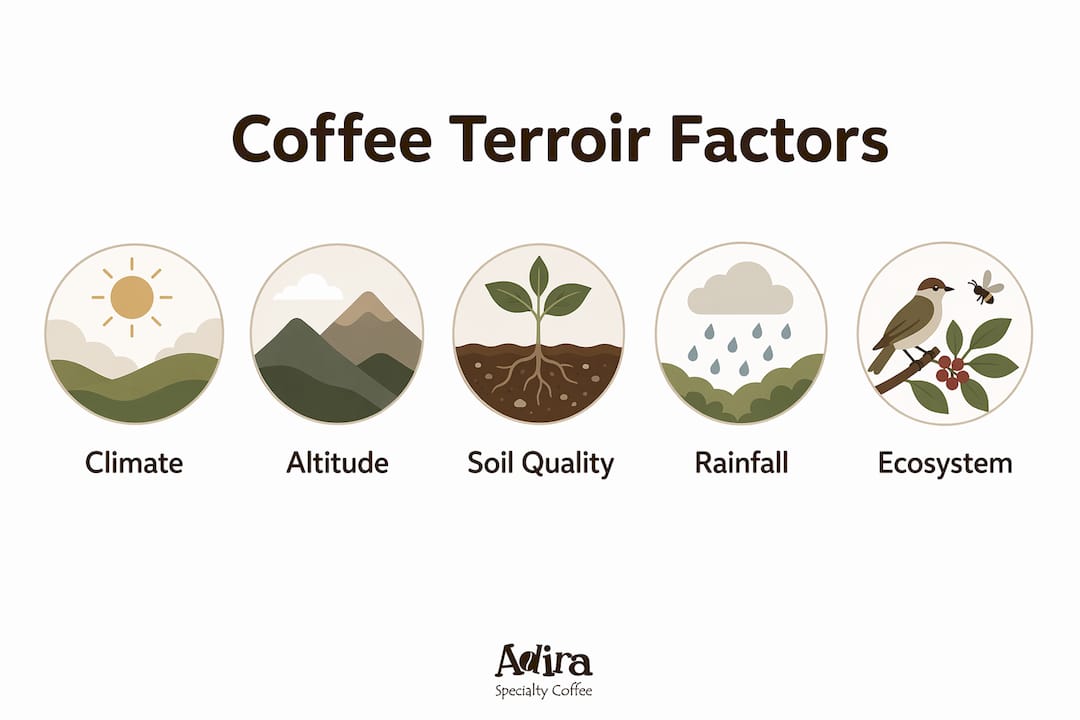
Every component of a coffee plant’s growing environment contributes to its flavor development. These factors do not work in isolation. They interact constantly throughout the growing season.
- Climate: Temperature and humidity control the pace of cherry development. Cooler temperatures slow ripening, which allows more sugars and organic acids to accumulate in the fruit. Regions with stable, mild climates like the highlands of Costa Rica or the Yirgacheffe zone in Ethiopia produce cherries with complex, layered sweetness.
- Altitude: Altitude affects ripening speed and bean density directly. At 800–1,200 meters, coffees tend toward chocolatey, full-bodied profiles. At 1,200–1,600 meters, expect more balanced sweetness and stone fruit. Above 1,600 meters, citrus and floral notes become dominant. Altitude does not create flavor directly. It alters the temperature and ripening time, which changes how sugars and organic acids develop inside the cherry.
- Soil composition: Volcanic soils in Sumatra and parts of Mexico deliver high mineral content that feeds the plant’s nutrient uptake. Well-drained, mineral-rich soils produce denser beans with more complex flavor precursors.
- Rainfall and water access: Consistent, well-distributed rainfall supports even cherry development. Irregular rainfall creates stress on the plant, which can concentrate sugars but also introduce defects.
- Surrounding ecosystem: Shade trees, biodiversity, and microbial life in the soil all influence how the plant grows. Farms within the Atlantic Forest biome in Brazil produce measurably different flavor profiles than farms in the Cerrado savanna, even when growing the same variety.
Pro Tip: When reading a coffee’s tasting notes, check the altitude listed on the bag first. It is the single fastest shortcut to predicting whether you are getting a bright, acidic cup or a heavier, chocolatey one.
Understanding how coffee farms define flavor through these environmental conditions is the first step toward tasting with real intention.
How does terroir shape coffee’s chemical and sensory profile?
Terroir does not just influence how coffee tastes in a vague, impressionistic way. It produces measurable changes in the chemistry of the bean itself. A 2026 Springer Nature study on Coffea arabica cultivated across different regions of Minas Gerais, Brazil confirmed that terroir modulates chlorogenic acids, lipids, trigonelline, and sugars in ways that directly correlate with sensory qualities. That means the brightness you taste in a high-altitude Ethiopian coffee is traceable to specific chemical compounds shaped by where and how that plant grew.
Chlorogenic acids are the primary source of perceived acidity and some bitterness in coffee. Higher concentrations, driven by cooler growing conditions, produce brighter, more acidic cups. Lipids affect mouthfeel and body. Sugars determine sweetness and caramelization potential during roasting. Terroir sets the starting ratios of all of these.
Microbial communities add another layer. A Springer Nature study found that distinct microbial signatures between Atlantic Forest and Cerrado biomes in Brazil correlate with different sensory scores and flavor notes. The microbes living in the soil and on the cherry skin during fermentation are shaped by the local ecosystem. They act as a biological extension of terroir, converting the plant’s chemistry into volatile flavor compounds.
| Terroir Factor | Chemical Effect | Sensory Result |
|---|---|---|
| High altitude, cool temps | Elevated chlorogenic acids | Bright acidity, citrus, floral |
| Volcanic soil | High mineral content | Complex body, earthy depth |
| Atlantic Forest biome | Distinct microbial profile | Fruity, wine-like fermentation notes |
| Cerrado biome | Different microbial signature | Nutty, chocolatey, lower acidity |
| Consistent rainfall | Even sugar development | Clean sweetness, balanced body |
How do processing and roasting interact with terroir?
Terroir builds the chemical foundation. Processing and roasting decide how much of that foundation reaches your cup. This distinction is critical for anyone serious about understanding coffee flavor.
- Washed processing strips the cherry fruit away before drying, which removes much of the fermentation influence and lets the bean’s terroir-driven chemistry speak clearly. Washed Ethiopian coffees from Yirgacheffe are a textbook example: the floral, tea-like clarity in the cup comes directly from the bean’s chemistry, not from fruit contact.
- Natural processing leaves the cherry intact during drying. The fruit ferments around the bean, and microbial activity adds fruity, wine-like notes that can amplify or mask terroir characteristics depending on execution. Processing acts as a translation layer between farm and cup, converting terroir potential into volatile flavor compounds.
- Anaerobic and experimental methods introduce controlled fermentation environments that can produce flavors far removed from the original terroir. These methods are exciting but can overshadow the farm’s natural expression.
- Roasting transforms the chemical balance set by terroir. Roasting modulates acidity, bitterness, body, and aromatics that originated from the farm’s chemistry. A light roast preserves more of the terroir-driven acids and aromatics. A dark roast converts those compounds into roast-forward flavors that can obscure origin character entirely.
- Brewing method determines extraction rate and which compounds reach your palate. A pour-over highlights clarity and acidity. A French press emphasizes body and oils. Neither is wrong, but they present terroir differently.
Pro Tip: To evaluate terroir expression specifically, brew the same coffee as a light-roast pour-over and compare it to a medium-roast French press. The differences you notice between the two brews reveal how much roasting and brewing are shaping what you taste versus the farm itself.
How does terroir vary across coffee regions and farms?
Regional terroir differences produce some of the most dramatic flavor contrasts in specialty coffee. The same species, Coffea arabica, grown in Ethiopia versus Sumatra versus Colombia produces cups so different that a trained taster can identify the origin blind.
The Minas Gerais state in Brazil illustrates this perfectly. The Atlantic Forest biome and the Cerrado biome sit within the same state but produce coffees with measurably different microbial communities and sensory profiles. Atlantic Forest farms trend toward fruity and wine-like notes. Cerrado farms produce nuttier, more chocolatey cups. The difference is not the variety or the farmer’s skill. It is the ecosystem.
Altitude ranges tell a similar story across top coffee growing regions worldwide:
- Colombia (1,500–2,000 meters): Bright acidity, red fruit, caramel sweetness
- Ethiopia Yirgacheffe (1,700–2,200 meters): Floral, bergamot, jasmine, tea-like clarity
- Sumatra (1,000–1,500 meters): Earthy, full body, cedar, dark chocolate
- Costa Rica (1,200–1,800 meters): Clean, balanced, honey sweetness, mild citrus
- Mexico (1,200–1,700 meters): Mild body, nutty, mild chocolate, low acidity
Microlots take this further. Within a single farm, microclimate differences cause unique flavor expressions from one hillside to the next. A plot facing east and receiving morning sun ripens differently than a shaded western slope. Appellation systems, borrowed from wine, are beginning to protect these distinctions in coffee-producing countries, giving buyers confidence that a labeled origin delivers consistent terroir characteristics.
Seasonality adds one more variable. The same farm harvested in different years produces different cups because rainfall patterns, temperature swings, and soil conditions shift year to year. Terroir is not static. It is a living record of a specific place at a specific time.
Key takeaways
Coffee terroir is the environmental foundation that determines a coffee’s flavor potential before processing or roasting ever begins.
| Point | Details |
|---|---|
| Terroir is multi-factor | Climate, altitude, soil, rainfall, and ecosystem all interact to shape flavor potential. |
| Chemistry is measurable | Terroir modulates chlorogenic acids, lipids, and sugars that directly produce sensory qualities. |
| Processing translates terroir | Washed methods reveal terroir clearly; natural and anaerobic methods can amplify or mask it. |
| Roasting sets the final balance | Light roasts preserve terroir character; dark roasts shift flavor toward roast-driven notes. |
| Region and microclimate matter | Even within one country, biome and altitude differences produce dramatically different cups. |
Tasting terroir: what most people get wrong
Most coffee drinkers credit the roaster when they taste something extraordinary. That instinct is understandable. The roaster is the last human hand before the bag reaches you. But the roaster is working with what the farm already built.
When I first started sourcing beans for Adiracoffee, I assumed roast profile was the dominant variable. I was wrong. I roasted the same profile on two Ethiopian lots from different farms, same altitude, same processing method. The cups were completely different. One was bright and floral. The other was dense and jammy. The farms were 15 miles apart. That experience made terroir real for me in a way no textbook could.
The common misconception is that terroir is just altitude. Altitude matters enormously, but it is a proxy for temperature and ripening time, not a flavor in itself. The actual flavor comes from the chemistry that altitude conditions create. Two farms at the same altitude in different soil types or biomes will still produce different cups.
What novice tasters often miss is the role of microbial fermentation as an extension of terroir. The microbes on a cherry’s skin are shaped by the local ecosystem. They are part of the terroir. When you taste a wine-like, funky note in a natural-processed Ethiopian, you are tasting the local microbial community as much as the soil or the altitude.
My practical advice: buy single-origin coffees from the same country but different regions and brew them side by side. Colombia versus Ethiopia is too obvious. Try two Colombian coffees from Huila and Nariño. That comparison teaches you more about terroir than any article can.
— Stefan
Taste terroir directly with Adiracoffee
Understanding coffee terroir is one thing. Tasting it is something else entirely.

Adiracoffee sources directly from cooperatives and small farms in Ethiopia, Sumatra, Colombia, Costa Rica, and Mexico, specifically to give you coffees where terroir expression is clear and intentional. The Ethiopia Natural is a textbook terroir showcase: natural processed, high altitude, with the floral and fruit-forward chemistry that Yirgacheffe’s ecosystem produces. The Adira Sumatra sits at the opposite end of the spectrum, earthy, full-bodied, and shaped by volcanic soil and lower-altitude growing conditions. Every bag is roasted to order in small batches in California and ships within days of roasting, so the terroir character you read about above is the terroir character in your cup.
FAQ
What is coffee terroir in simple terms?
Coffee terroir is the combination of environmental conditions, including climate, altitude, soil, and ecosystem, where a coffee plant grows that shapes its flavor potential. Think of it as the farm’s fingerprint on the bean.
Does altitude alone determine coffee flavor?
Altitude is a major factor but not the only one. It influences ripening speed and bean density, which affect sugar and acid development, but soil composition, rainfall, and microbial communities also shape the final flavor profile.
How is coffee terroir different from wine terroir?
Coffee undergoes significant post-harvest transformations through processing, roasting, and brewing that wine does not, making terroir expression more complex and dependent on downstream decisions. Terroir sets the foundation, but processing and roasting can amplify or mask it.
Can two farms in the same country taste completely different?
Yes. Research on Brazilian farms in the Atlantic Forest and Cerrado biomes shows measurably different microbial communities and sensory profiles even within the same state. Microclimate, soil type, and ecosystem all create distinct flavor expressions at the farm level.
What processing method best expresses coffee terroir?
Washed processing most clearly reveals terroir-driven flavor because it removes fruit contact and fermentation influence, letting the bean’s chemistry speak directly. Natural processing adds microbial and fruit-contact flavors that can enhance or obscure the farm’s natural character.
Recommended
- How Coffee Farms Define Flavor: Practices That Impact Quality – Adira Coffee US
- Explore the Best Coffee Flavor Profiles for Every Taste – Adira Coffee US
- The role of origin in coffee flavor: what every aficionado should know – Adira Coffee US
- What is coffee varietal? A guide for enthusiasts – Adira Coffee US