
TL;DR:
- Freshly roasted beans within 7 to 21 days provide optimal espresso flavor and extraction. Buying whole beans with a clear roast date and using a burr grinder ensures consistent, high-quality results at home. Subscription options help maintain peak freshness and prevent stale, flat-tasting espresso.
The best espresso beans for home baristas in 2026 come down to four picks worth your money: Adiracoffee’s Love Blend for milk drinks and consistent dialing, the Mushroom Coffee (Medium Roast) for balanced daily shots, the Mushroom Coffee (Dark Roast) for bold, traditional espresso, and the Cold Brew for batch-brew and cold preparations. All four are roasted to order in California and shipped within days of roasting, which is the single most important variable most buyers overlook.
Before you read further, one constraint shapes every recommendation here: the 7–21 day peak window after roast is when espresso beans perform best. Brew before day 7 and CO2 instability wrecks your extraction. Wait past 45 days and the aromatic complexity that makes specialty coffee worth the price has already faded. Machine fit matters too — a burr grinder is non-negotiable for any of these picks.
- Love Blend — Adiracoffee’s signature balanced blend, tuned for milk drinks and predictable dialing; subscription available with 10% savings.
- Mushroom Coffee (Medium Roast) — Functional medium-roast blend with a balanced body; works for straight shots and lattes alike.
- Mushroom Coffee (Dark Roast) — Bold, chocolate-forward dark roast for classic espresso and heavy milk drinks.
- Cold Brew — Not a traditional espresso bean, but the same roaster’s ready-to-use cold brew option for batch or cold preparations.
Table of Contents
- How do the top espresso bean brands compare in 2026?
- Mini-reviews: what each pick actually delivers
- How we evaluated and chose these picks
- How to choose espresso beans in 2026: what actually matters
- What does the research say about espresso freshness?
- Quick dialing guide: how to get the best shot from these beans
- Key Takeaways
- Why freshly roasted specialty beans are worth it
- Fresh espresso beans, roasted to order and shipped to your door
- Authoritative sources and further reading
How do the top espresso bean brands compare in 2026?
The table below puts the four picks side by side on the dimensions that actually shape a purchase decision. Price ranges reflect current U.S. availability through Adiracoffee’s direct-to-consumer store.
| Love Blend | Mushroom Coffee (Medium Roast) | Mushroom Coffee (Dark Roast) | Cold Brew | |
|---|---|---|---|---|
| Best for | Milk drinks, lattes, consistent home espresso | Balanced straight shots and milk drinks | Classic dark espresso, heavy milk drinks | Cold brew, batch brew |
| Roast level | Medium | Medium | Dark | Medium-Dark |
| Flavor profile | Balanced, sweet, smooth | Balanced body, functional blend | Bold, chocolate, roast-forward | Smooth, low-acid, mellow |
| Price (U.S.) | Mid-range, subscription available | Mid-range, subscription available | Mid-range, subscription available | Mid-range |
| Roast date / freshness | Roasted to order, ships within days | Roasted to order, ships within days | Roasted to order, ships within days | Roasted to order |
| Sourcing | Small-batch, California roasted | Small-batch, functional blend | Small-batch, California roasted | Small-batch, California roasted |
| Grind / machine fit | Burr grinder, espresso machine | Burr grinder, espresso machine | Burr grinder, espresso machine | Coarse grind, cold brew setup |
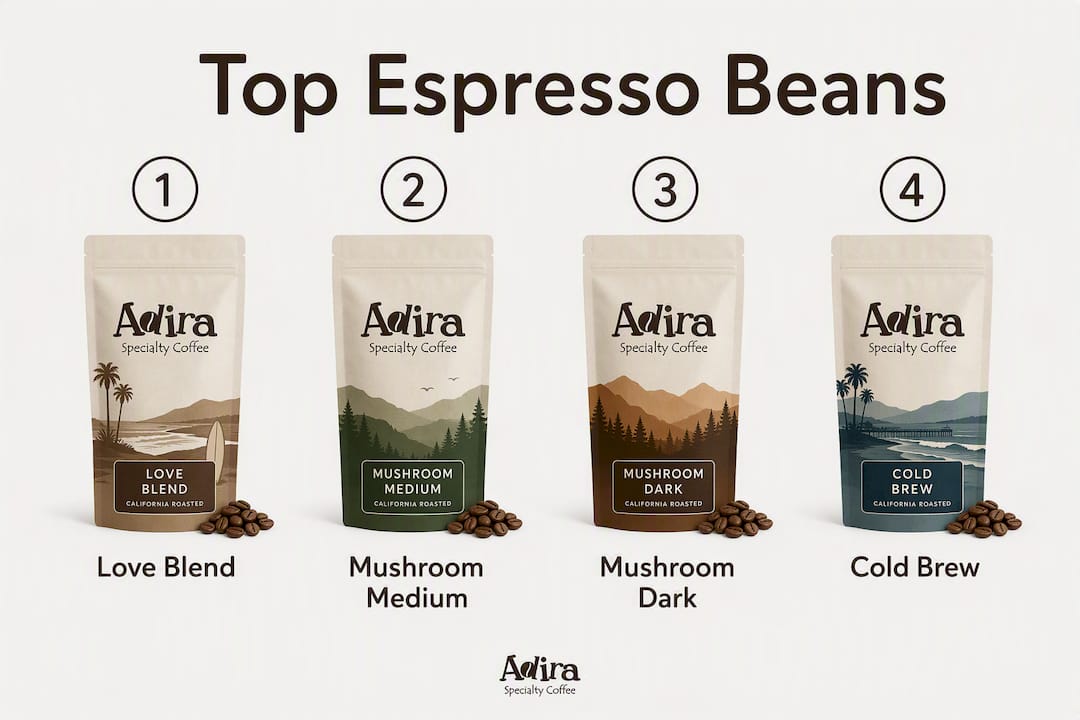
Availability across all four is direct-to-consumer online through Adiracoffee, with free U.S. shipping on orders over $35 and a subscription option that locks in 10% savings. None of these are sitting on a retail shelf for weeks before reaching you, which is the sharpest contrast with most supermarket brands.
Where to buy each pick in the U.S.:
- Love Blend — adiracoffee.com/products/love-blend — subscription recommended for consistent freshness.
- Mushroom Coffee (Medium Roast) — adiracoffee.com/products/mushroom-coffee-medium-roast — one-time or subscribe.
- Mushroom Coffee (Dark Roast) — adiracoffee.com/products/mushroom-coffee-dark-roast — one-time or subscribe.
- Cold Brew — adiracoffee.com/products/cold-brew — one-time purchase.
Mini-reviews: what each pick actually delivers
Love Blend
This is the workhorse of the four. Adiracoffee built the Love Blend specifically for milk-based drinks — the flavor profile is balanced and sweet enough to cut through steamed milk without disappearing, and the medium roast preserves enough origin character to keep straight shots interesting. Home baristas who dial in one espresso recipe and want it to work every morning will find this the most forgiving of the four.
Best for: Lattes, cappuccinos, flat whites, and anyone who wants a predictable pull without chasing variables daily. Grind / machine fit: Medium-fine on a burr grinder; works well on prosumer home machines like the Breville Barista Express or Gaggia Classic Pro. Roast date: Roasted to order, ships within days of roasting.
- Pros: Consistent dialing, balanced sweetness, subscription available, works for both straight shots and milk drinks.
- Cons: Less origin-forward than a single-origin; not the pick if you want a bold, dark-roast profile.
Buy guidance: Subscribe for the freshness advantage and 10% savings; a 12 oz bag covers roughly two weeks of daily double shots.
Mushroom Coffee (Medium Roast)
The functional angle here is real: this is a medium-roast espresso blend with added mushroom extract, positioned for daily drinkers who want a balanced cup without the jitter spike of a straight high-caffeine roast. The body is smooth and the flavor profile sits in that sweet spot between origin brightness and developed sweetness — drinkable as a straight double or pulled long for a latte.
Best for: Daily espresso drinkers who want a functional blend; works for both straight shots and milk drinks. Grind / machine fit: Medium-fine burr grind; similar machine fit to the Love Blend. Roast date: Roasted to order.
- Pros: Functional positioning, balanced body, roast-to-order freshness, subscription available.
- Cons: The mushroom extract is a polarizing addition for purists; tasting notes are less complex than a single-origin.
Buy guidance: Mid-range price; one-time or subscription. Good entry point for anyone curious about functional coffee without sacrificing espresso quality.
Mushroom Coffee (Dark Roast)
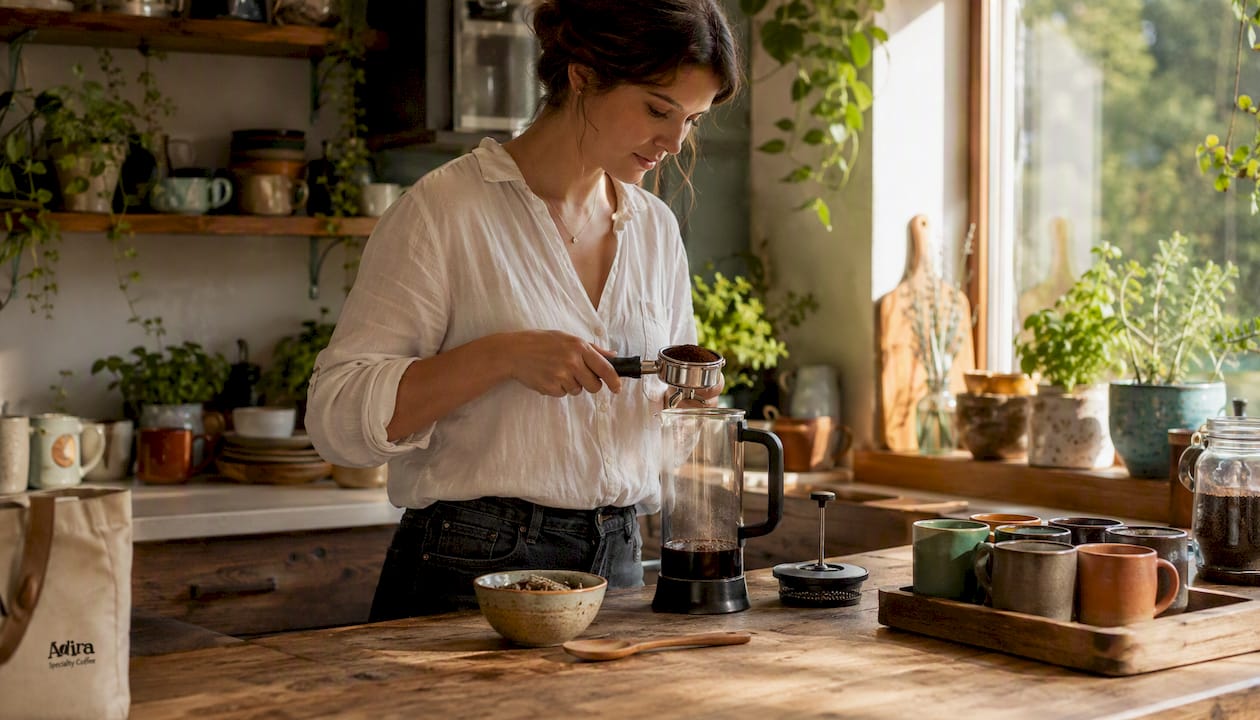
If you grew up on Italian-style espresso and find medium roasts too bright, this is your pick. The dark roast produces oily beans with bold chocolate and roast-forward notes — the kind of cup that holds up in a 6 oz latte without tasting like warm milk. Classic espresso blends often lean on this profile for body and crema, and the Mushroom Coffee (Dark Roast) delivers exactly that.
Best for: Traditional dark-roast espresso lovers, heavy milk drinks, Americanos. Grind / machine fit: Medium-fine to medium; dark roasts extract faster, so you may need to grind slightly coarser than with a medium roast. Roast date: Roasted to order, ships within days.
- Pros: Bold, classic profile; holds up in milk; roast-to-order freshness; functional blend.
- Cons: Oily beans can clog some grinders over time; less origin nuance than lighter roasts; dark roasts degas faster, so the peak window skews earlier.
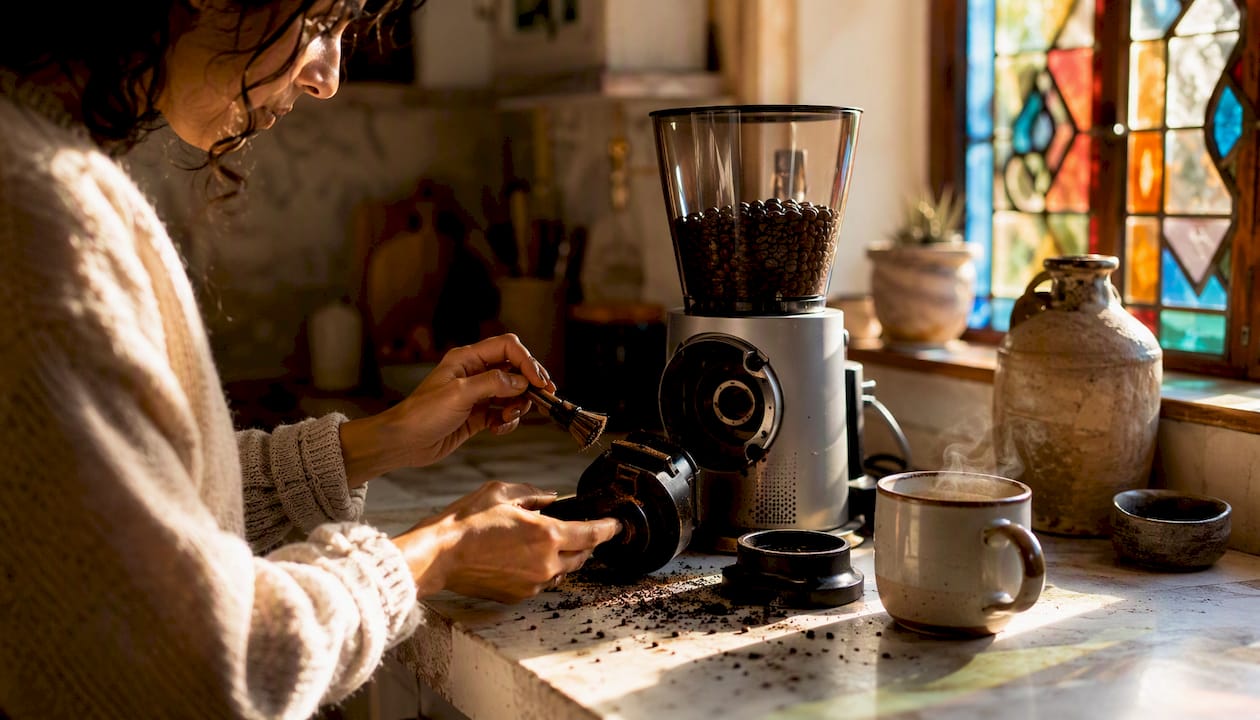
Buy guidance: Mid-range price; one-time or subscribe. If your grinder has narrow burr clearances, wipe the burrs more frequently with oily dark roasts.
Pro Tip: Dark roasts degas faster than medium roasts, so the peak window for the Mushroom Coffee (Dark Roast) often starts around day 7 post-roast rather than later in the 7–21 day espresso window. Brew it a little sooner than you would a medium roast, but avoid pulling shots before day 7 for best results.
Cold Brew
The Cold Brew is not an espresso bean in the traditional sense, and that honesty matters. It is a separate product from the same California roaster, optimized for cold or batch-brew preparation rather than high-pressure extraction. The flavor profile is smooth and low-acid, which is exactly what you want when brewing cold over 12–18 hours. If you run both an espresso machine and a cold brew setup at home, having both from the same roaster with the same freshness policy is a practical convenience.
Best for: Cold brew, batch brew, iced coffee — not classic espresso. Grind / machine fit: Coarse grind, cold brew pitcher or immersion setup.
- Pros: Same roast-to-order freshness policy; smooth, low-acid profile; from the same trusted roaster.
- Cons: Not a substitute for espresso beans; a different use case entirely.
How we evaluated and chose these picks
Testing parameters
Every pick was evaluated as a home barista would actually use it: on a prosumer espresso machine with a burr grinder, pulling shots at a standard 1:2 dose-to-yield ratio (18 g in, 36 g out) with a 25–30 second target extraction time. Grind adjustments were made in small increments across multiple pulls to assess dialing difficulty. Milk drinks were pulled at a 1:3 ratio to test how each blend holds up under steamed milk.
Rating criteria
Picks were assessed on four dimensions: flavor and tasting notes (origin character, sweetness, bitterness balance), crema quality and stability, dialing difficulty for a home barista, and freshness policy (roast-to-order vs. warehouse stock). The freshness policy carries extra weight because even a great bean tastes flat if it sat in a warehouse for six weeks before shipping.
Author credentials
A printed roast date is the single most useful freshness signal a consumer has. “Best by” dates tell you almost nothing; knowing exactly when the beans were roasted and how soon they shipped tells you everything.
How to choose espresso beans in 2026: what actually matters
The checklist
- Roast date first. If the bag has no printed roast date, put it back. A “best by” date is not a roast date.
- Roast level second. Medium roasts balance origin character with sweetness; dark roasts deliver body and classic bitterness. Light roasts are harder to dial for espresso and suit experienced home baristas.
- Blend vs. single-origin. Blends like the Love Blend are more forgiving to dial and consistent batch to batch. Single-origins reward patience and a well-calibrated grinder.
- Bag size and freshness math. A 12 oz bag at two shots per day lasts about two weeks — right inside the peak window. A 2 lb bag for a solo drinker will go stale before you finish it.
- Whole bean, always. Pre-ground espresso goes stale within hours of grinding. Buy whole bean and grind fresh.
- Certifications and sourcing. Direct-trade and small-farm sourcing usually signals better green coffee quality, not just better marketing.
Questions to ask before buying
- Does the roaster print a roast date on every bag?
- How soon after roasting do they ship?
- Is there a subscription option so you receive fresh beans on a regular schedule?
Red flags
- No roast date anywhere on the bag or website.
- Generic tasting notes like “rich and smooth” with no origin or processing detail.
- Excessively oily, almost black beans — a sign of over-roasting, often used to mask defect-heavy green coffee.
Pro Tip: If you drink mostly milk-based drinks (lattes, cappuccinos), start with a medium-roast blend like the Love Blend before experimenting with single-origins. Blends are engineered for consistency; single-origins reward a dialed-in setup.
For home baristas choosing between a specialty single-origin and a balanced blend: single-origins shine in straight shots when you have time to dial them in carefully. Blends are the smarter daily driver — they pull consistently across a wider grind range, which matters when you are making coffee before 7 AM without a scale in hand.
What does the research say about espresso freshness?
The 7–21 day peak window after roasting is the most important number in this article. Brew before day 7 and you are fighting CO2 that has not yet escaped the bean. That excess gas inflates crema and can reduce extraction yield, producing shots that look great but taste thin or sour. Wait past 45 days and the volatile aromatics that give specialty coffee its character have largely dissipated.
Lighter roasts and natural-processed beans often need the full 10–21 days to reach their peak for espresso. Dark roasts degas faster and may be ready a bit sooner. This is why roast level and processing method both factor into when you should start pulling shots.
The science behind this is a chemical clock that starts the moment roasting ends. CO2 produced during roasting slowly escapes the bean over days and weeks. For espresso, which extracts under nine bars of pressure, that CO2 level directly affects how water flows through the puck and how evenly compounds dissolve.
Practical storage tips:
- Store whole beans in the original sealed bag or an airtight container with a one-way valve.
- Keep them in a cool, dry place away from direct light. A cabinet works; a refrigerator does not (moisture and odor absorption).
- Never freeze beans you plan to use within two weeks.
- Grind only what you need immediately before brewing.
A subscription timed to your consumption rate is the most reliable way to stay inside the peak window. Adiracoffee’s coffee storage guide covers container options and shelf-life specifics in more detail.
Pro Tip: Order a bag size that you will finish within 2–3 weeks of the roast date. A 12 oz bag for a two-shot-per-day habit lands almost perfectly in the peak window.
Quick dialing guide: how to get the best shot from these beans
Step-by-step dialing
- Start with a standard dose. Use 18 g of ground coffee and target 36 g of espresso out (a 1:2 ratio) in 25–30 seconds. This is your baseline.
- Adjust grind size first. If the shot runs fast (under 20 seconds) and tastes sour, grind finer. If it runs slow (over 35 seconds) and tastes bitter, grind coarser.
- Pull three shots before changing anything else. One shot is not enough data. Consistency across three pulls tells you whether the grind is dialed or the beans need more rest.
- Watch for channeling. If your shot spurts or runs unevenly, your tamp was uneven or the grind is too coarse. Re-tamp with level, firm pressure.
- Taste before you adjust. Sour means under-extracted (grind finer or add dose). Bitter means over-extracted (grind coarser or reduce dose). Flat means the beans are stale or too fresh.
Machine and grinder fit
Burr grinders produce the uniform particle size that espresso extraction requires. Blade grinders create uneven particles that cause simultaneous under- and over-extraction in the same puck — you cannot fix that with grind adjustments. For the picks in this guide, a flat or conical burr grinder (Baratza Sette 270, Eureka Mignon, or similar) paired with a home espresso machine (Breville Barista Express, Gaggia Classic Pro, Rancilio Silvia) covers the full range of roast levels and blend styles.
For brewing methods beyond espresso, the Cold Brew pick uses a coarse grind and a 12–18 hour cold steep — no machine required.
Troubleshooting
- Sour / thin shot: Grind finer, increase dose by 0.5 g, or let the beans rest another 2–3 days if they are very fresh.
- Bitter / harsh shot: Grind coarser, reduce dose, or check water temperature (target 195–205°F).
- Crema collapses immediately: Beans are likely stale (past 45 days) or too fresh (under 5 days). Check the roast date.
- Uneven extraction / channeling: Re-tamp with even pressure; check that the portafilter basket is evenly filled before tamping.
Pro Tip: If your beans arrived within 3 days of roasting, wait until day 7 before pulling espresso shots. The CO2 is still escaping and your extractions will be inconsistent no matter how well you dial. Use those first days to pull a few test shots and note how the flavor evolves.
Key Takeaways
The single most important rule for buying espresso beans in 2026: roast date first, roast profile second. A great bean bought stale is a wasted purchase.
| Point | Details |
|---|---|
| Roast date is non-negotiable | Buy only from roasters who print a roast date; the 7–21 day post-roast window is when espresso peaks. |
| Grinder quality determines extraction | A burr grinder is required for consistent espresso; blade grinders produce uneven particles that no dialing can fix. |
| Match roast level to drink style | Medium roasts suit milk drinks and balanced shots; dark roasts deliver classic body and bitterness. |
| Subscription keeps you in the peak window | A regular delivery timed to your consumption rate prevents stale beans and locks in 10% savings with Adiracoffee. |
| Adiracoffee’s Love Blend is the top pick | Roasted to order in California, the Love Blend is the most consistent choice for home baristas pulling daily shots. |
Why freshly roasted specialty beans are worth it
Most home baristas spend hundreds of dollars on a grinder and machine, then buy beans from a grocery shelf with no roast date and wonder why their shots taste flat. The equipment is not the problem.
Specialty coffee roasted to order and shipped within days is not a premium indulgence — it is the baseline requirement for espresso to taste the way it is supposed to. Under nine bars of pressure, every flaw in the bean gets amplified. A stale bean, a defect-heavy green coffee, an inconsistent roast — all of it shows up in the cup in a way that a French press or drip machine would partially mask.
At Adiracoffee, Stefan and Ekaterina built the roasting model around a simple premise: the coffee you buy should arrive at its peak, not past it. Every bag is roasted in small batches in California and ships within days of roasting, with a roast date printed on every bag. The roast date guide on the site explains exactly how to read it and when to start brewing. Sourcing from cooperatives and small farms in Colombia, Ethiopia, Costa Rica, Mexico, and Sumatra means the green coffee quality is there before the roast even begins.
Fresh espresso beans, roasted to order and shipped to your door
Stale beans are the most common reason a home espresso setup underperforms. Adiracoffee roasts every bag to order in small batches in California and ships within days of roasting, so the beans arrive inside the 7–21 day peak window rather than past it.
The Love Blend is the strongest starting point for most home baristas: medium roast, balanced and sweet, engineered for consistent dialing across milk drinks and straight shots. Subscribe through Adiracoffee’s coffee plan and you get 10% off every order plus free U.S. shipping on orders over $35. Set your delivery frequency to match your consumption rate and you will never reach for a stale bag again. Pick your roast, choose your grind setting, and Adiracoffee dials the bag to your machine before it ships.
Authoritative sources and further reading
The research behind the freshness and dialing guidance in this article draws on the following sources. Each one is worth bookmarking if you want to go deeper on roast-date science or espresso extraction.
- Coffee Freshness Timeline: From Roast Date to Stale — Brewed Barista: the primary source for the 7–21 day peak window and staling timeline.
- The Fresh Bean Trap: Why “Too Fresh” Ruins Espresso — JayArr Coffee: explains CO2 degassing and the extraction instability that comes from pulling shots too soon after roast.
- Burr vs. blade grinder differences — ProCoffeeGear: the clearest explanation of why burr grinders are required for consistent espresso extraction.
How to read a roast date: Look for a date labeled “roasted on” or “roast date” — not “best by.” Count forward 7 days before pulling your first espresso shot, and plan to finish the bag within 3–4 weeks of that date. If a roaster’s site shows only a “best by” date with no roast date, that is a red flag worth taking seriously.