
Swiss Water decaf is a chemical-free, water-based process that strips out roughly 99.9% of a bean’s caffeine using only water, temperature, time, and carbon filtration. It generally holds onto a coffee’s origin character better than solvent-based decaf, and because no chemicals ever touch the beans, it keeps Organic certification intact. The one honest trade-off: the brightest, most delicate top notes can lose a little sparkle.
TL;DR:
- Swiss Water decaf removes approximately 99.9% of caffeine without using chemicals, but this process can slightly reduce the brightness of delicate top notes.
- The method preserves origin flavor better than solvent-based decafs and is favored by roasters targeting consumers who value high-quality, chemical-free processing.
- Swiss Water’s higher costs and limited processing capacity restrict its use to specialty coffee and premium pricing, making it less viable for low-cost mass-market decaf.
- Certification-wise, Swiss Water decaf reliably maintains Organic status and bears explicit “solvent-free” labels, unlike solvent-based decafs which may pose residue concerns despite regulatory limits.
- To ensure quality, buy decaf with a clear roast date, natural full-bodied origins, and favor small-batch roasters that ship fresh, as decaf beans are more sensitive to shelf time and handling.
Table of Contents
- How Swiss Water Decaf Works, Step by Step
- Swiss Water Decaf Process vs Other Decaf Methods
- What Chemical-Free Actually Means for Certifications
- How to Choose and Brew Swiss Water Decaf
- What Adira Coffee Looks for in Green Beans Bound for Decaf
- Which Roasters and Brands Use Swiss Water Process Decaf
- Where Swiss Water Struggles at Scale
- An Honest Take on the Swiss Water Hype
- Try Swiss Water Decaf From Adiracoffee
- Sources
How Swiss Water Decaf Works, Step by Step
The process starts with green, unroasted coffee beans that get cleaned and soaked in hot water to open their cell structure. That hydration step matters because caffeine, along with hundreds of other flavor compounds, only moves out of a bean when the bean is wet enough to let it go.
The clever part comes next. Rather than dumping fresh beans into plain water, where they’d bleed out both caffeine and flavor, Swiss Water uses something called Green Coffee Extract, or GCE. Workers create GCE by soaking an earlier batch of green beans until the water is saturated with everything that makes coffee taste like coffee, minus the caffeine, which gets filtered out separately through activated carbon. Since that water is already full of flavor compounds, new beans dropped into it have nowhere to lose their own flavor. Caffeine, though, still has room to move, so it diffuses out on its own. Think of it like a soup that’s already fully seasoned: adding a fresh vegetable to it won’t strip away flavor, because the broth has nothing left to absorb.
The extraction runs in cycles, a method called countercurrent extraction, where beans move through progressively fresher GCE while the used extract gets recirculated and its caffeine skimmed off by carbon filters again. A full run typically takes 8 to 10 hours, at carefully controlled temperatures that avoid cooking or damaging the green beans.
What comes out the other side:
- Caffeine removal around 99.9%, among the highest of any method
- Residual caffeine typically down in the low single-digit milligrams per cup
- No solvent contact at any point in the cycle
- A closed loop where the GCE gets reused and carbon gets thermally regenerated rather than discarded
That last point matters more than most explainers mention. The same extract batch runs through the system repeatedly, which is part of why the process can hold flavor steady across large volumes of beans.
Swiss Water Decaf Process vs Other Decaf Methods
Not all decaf is created equal, and the differences show up in the cup. The main split is between water-based extraction, CO2 processing, and traditional solvent methods that use methylene chloride or ethyl acetate.
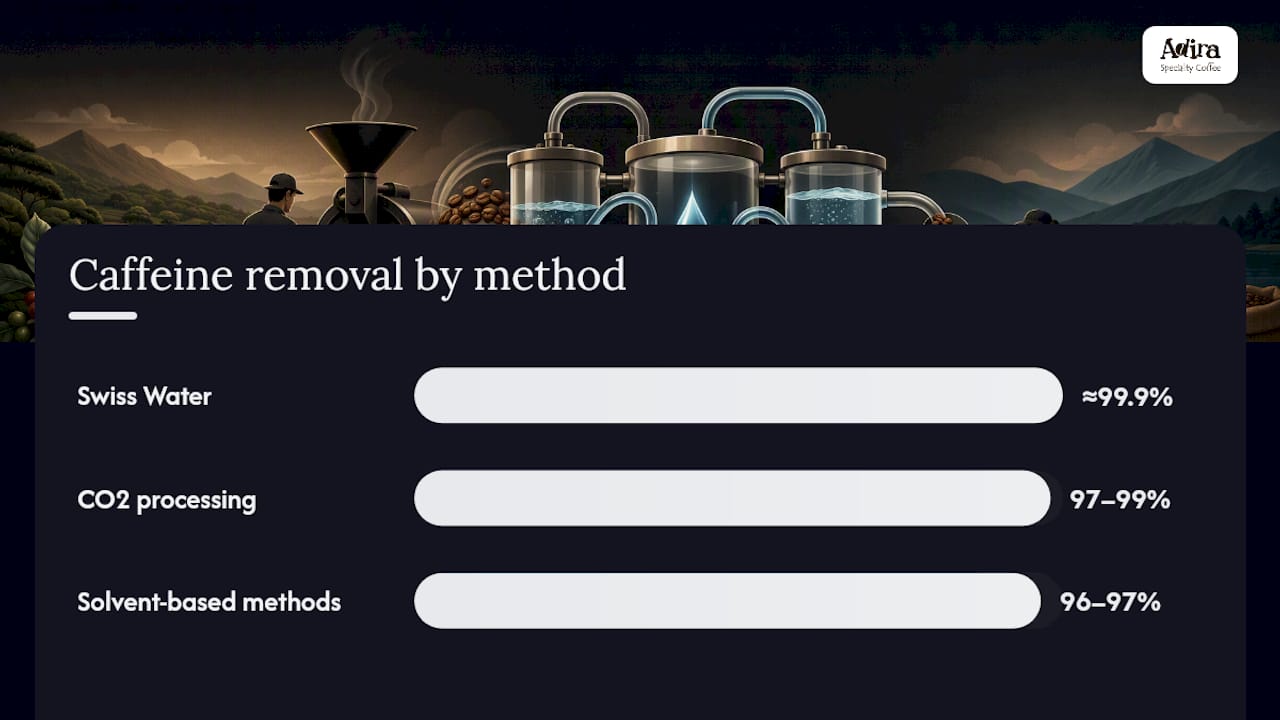
- Swiss Water: about 99.9% caffeine removal, no solvents, generally considered the strongest option for preserving origin flavor
- CO2 processing: roughly 97 to 99% removal, uses pressurized carbon dioxide rather than a liquid solvent, very good flavor retention but requires expensive equipment
- Solvent-based methods: around 96 to 97% removal, cheaper and faster, but carries a higher risk of flattening delicate flavor notes and leaves trace chemical residue that has to stay under regulatory limits
Solvent methods aren’t unsafe by any regulatory measure. Both the FDA and international standards cap residue levels well below any established risk threshold. But “meets the legal limit” and “chemical-free” are two different claims, and Swiss Water is the only major method in this list that can honestly make the second one.
Cost tends to track with complexity. Swiss Water and CO2 processing both require more time, equipment, and handling than solvent extraction, and that shows up in the shelf price of the finished bag. Roasters who choose Swiss Water are usually making a deliberate bet that flavor-focused drinkers will pay a premium for it, and that bet mostly pays off with people who already care about where their coffee comes from.
What Chemical-Free Actually Means for Certifications
A coffee’s Organic certification depends on more than how the beans were grown. Processing matters too, and any method that introduces synthetic solvents can jeopardize that status. Because Swiss Water never uses chemicals at any stage, it’s one of the few decaf methods that lets a bean keep its Organic certification straight through decaffeination without a regulatory asterisk.
Regulators don’t ban solvent-based decaf outright. Chemical residue limits exist and solvent processors generally stay within them. Still, consumer testing groups have flagged residue and labeling concerns as a reason more shoppers are checking labels before buying.
Look for a few specific cues on the bag:
- The Swiss Water® Process badge or explicit “Swiss Water” name, not just “naturally decaffeinated”
- The phrase “solvent-free,” which should mean exactly what it says
- An Organic seal, which confirms the certification survived processing intact
How to Choose and Brew Swiss Water Decaf
Getting a good cup starts before you ever brew it, at the point of purchase.
- Check the label for the Swiss Water badge, roast date, and origin. A vague “decaf blend” with no named origin tells you the roaster wasn’t picky about the green beans, which usually shows up in the cup.
- Favor single-origin decafs with naturally fuller bodies, like Sumatra or Colombia, since heavier-bodied origins tend to hide the slight softening that decaffeination can cause better than delicate, floral origins do.
- Adjust your grind slightly finer and your dose slightly higher than you would for the same bean in caffeinated form. Decaf beans lose a bit of density during processing, and a small bump in dose compensates for the muted solids.
- Keep water temperature in the standard 195 to 205 degree Fahrenheit range. Decaf doesn’t need hotter water to extract properly, despite a persistent myth that it does.
- Expect to pay more. Better green coffee costs more before it ever reaches a decaffeination facility, and the Swiss Water process itself costs more to run than solvent extraction. Both costs land on the retail price.
Pro Tip: If a decaf tastes flat, the problem is more often stale roasting than the decaffeination method itself. Buy from a roaster that ships within days of roasting, and check the roast date before you check anything else.
What Adira Coffee Looks for in Green Beans Bound for Decaf
Not every green coffee lot is a good candidate for decaffeination. Stefan looks for lots with strong inherent body and structure, since those hold up better through the hydration and extraction cycles than thin, delicate lots do. Cupping happens before and after processing whenever possible, comparing the same origin’s caffeinated and decaf versions side by side to catch any flavor drift early.
Small-batch roasting matters just as much as bean selection. Adiracoffee roasts to order and ships within days, which counts for more with decaf than with regular coffee. Decaf beans have already been through one intensive process before roasting even starts, so they’re more sensitive to sitting around on a shelf losing aromatics.
Decaf gets treated as an afterthought by a lot of roasters. We treat it as its own project, because the beans have already been through more than a caffeinated lot ever will, and that earns them more attention, not less.
Roasting profiles usually get pulled slightly shorter for decaf lots, since the beans are already more porous from the water processing and can scorch faster than expected.
Which Roasters and Brands Use Swiss Water Process Decaf
Swiss Water Process decaf shows up across a wide range of specialty coffee roasters, not just one or two boutique names. It’s become something close to an industry default for roasters who want to offer a decaf that doesn’t feel like an apology compared to their regular lineup.
You’ll find the Swiss Water badge on bags from small independent roasters as often as from larger specialty chains, because the licensing model lets any roaster send green beans to a Swiss Water facility for processing before roasting them under their own name. That’s different from, say, a proprietary in-house method, which only one company can use.
The common thread among roasters who choose it: they tend to be the ones already competing on origin transparency and freshness, since Swiss Water’s higher cost only makes sense if the rest of the coffee program backs it up with quality sourcing. A roaster charging premium prices for a muddy, stale decaf using an expensive process is wasting the investment. The roasters who get real value from Swiss Water are the ones treating decaf as a genuine specialty product rather than a compliance checkbox on the menu.
Where Swiss Water Struggles at Scale
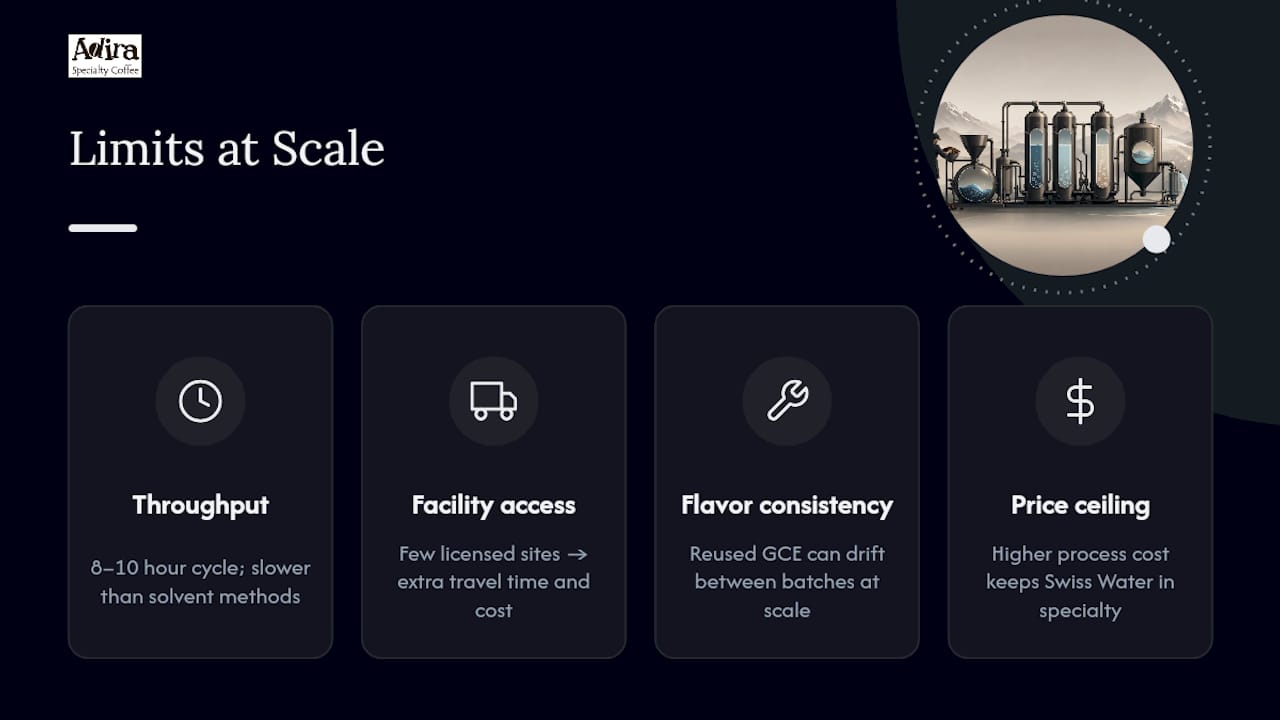
Throughput is the biggest constraint. An 8 to 10 hour processing cycle, run through dedicated facilities with limited GCE capacity, simply can’t match the speed of solvent extraction, which can process large volumes faster and with cheaper equipment. That bottleneck ripples through pricing and availability across the entire supply chain.
Facility access adds another layer. Swiss Water Process decaffeination happens at a small number of licensed facilities rather than at thousands of local processing plants, which means green coffee often has to travel to a specific location before it can even start the decaf cycle. That travel adds time and cost before roasting ever begins.
Flavor consistency is trickier at scale than the marketing suggests. Since GCE gets reused across cycles, facilities have to manage its composition carefully to avoid drift between batches. A roaster buying in small, curated lots can work closely with the facility on quality control. A massive commercial buyer sourcing decaf by the container load has less room to fine-tune that relationship, and quality can vary more as a result.
Finally, there’s the price ceiling it puts on decaf as a category. Because the process costs more than solvent methods, any coffee brand that leans heavily on rock-bottom pricing simply can’t use Swiss Water and stay competitive on shelf price. That keeps the process concentrated in the specialty tier rather than becoming universal across the entire decaf market.
An Honest Take on the Swiss Water Hype
The conventional wisdom treats “chemical-free” as the whole story, and that’s where most explainers stop short. The bigger variable is what happens after decaffeination, not during it. A perfectly processed Swiss Water bean that sits on a shelf for four months tastes worse than a solvent-processed bean roasted last week. Process gets all the attention because it’s the interesting science; freshness gets ignored because it’s boring, and boring things don’t make good headlines.
Where most buying guides fall short is treating Swiss Water decaf as one uniform product. It isn’t. A washed Colombian and a natural Ethiopian go into that GCE bath with very different starting flavor profiles, and they come out with different strengths and different vulnerabilities. Body-forward origins tend to survive the process better than delicate, floral ones.
If flavor is the priority, spend less energy hunting for the “best” Swiss Water bag and more energy checking the roast date and picking an origin with enough natural body to carry the cup. The process removes the caffeine. It doesn’t guarantee the coffee behind it was worth decaffeinating in the first place.
— Stefan
Try Swiss Water Decaf From Adiracoffee
Flavor-focused decaf only works when the roasting behind it is just as careful as the decaffeination process itself. This roaster offers single-origin and blended coffees roasted in small batches and aims to ship within days of roasting, helping preserve the character of decaf beans after processing.
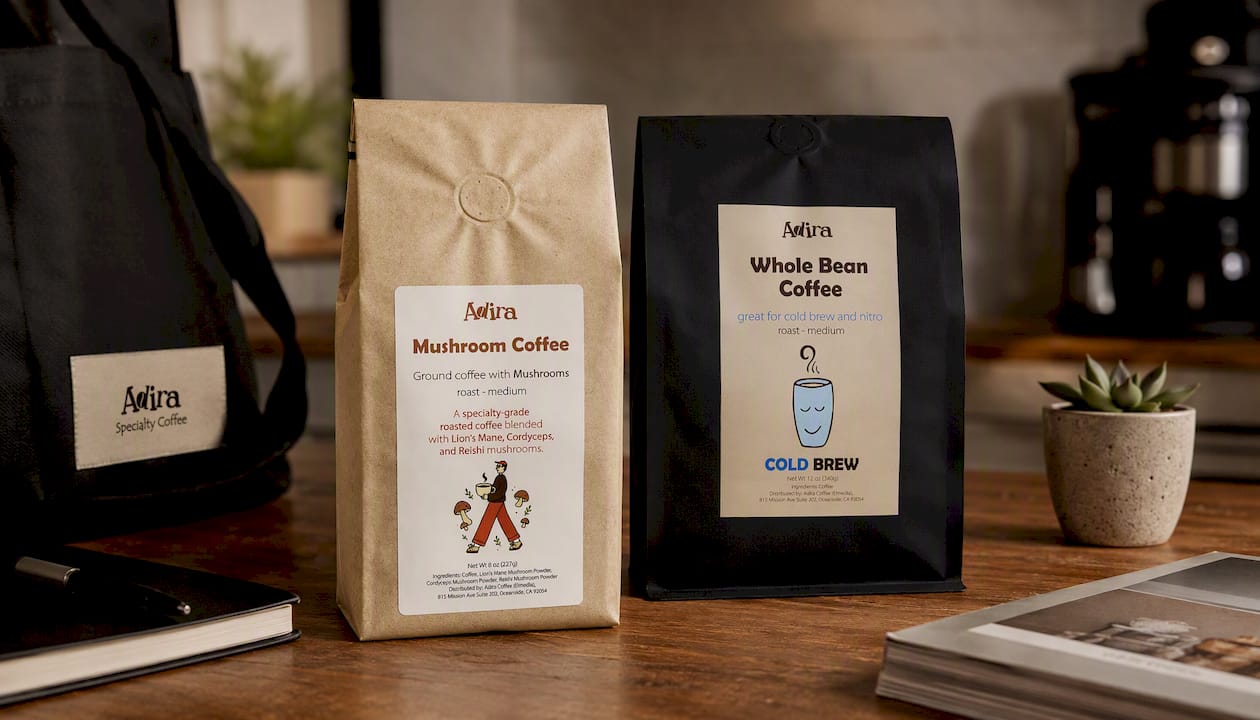
Origins like Sumatra and Colombia tend to carry enough natural body to hold up well through decaffeination, and both ship fresh rather than off a distributor’s shelf. If a full-bodied blend suits your brewer better, the African Blend is worth a look too. Pick an origin, check the roast date on arrival, and brew it while it’s still close to that date.
Sources
- Our Coffee Decaffeination Process | Swiss Water® Process
- A closer look at water-process vs chemical solvent method decaf coffee | Swiss Water® Process
- How Decaf Coffee Is Made: Science of Caffeine Removal | BrewedLate Coffee