
TL;DR:
- Organic coffee certification verifies that coffee is grown without synthetic pesticides, fertilizers, or GMOs, through third-party inspection. It requires a three-year land transition, 95% organic ingredients, annual audits, and full supply chain certification under the SOE rule since 2024. Certification guarantees standards but does not necessarily indicate better flavor or ethical practices, which require further transparency and traceability.
Organic coffee certification is the official confirmation that coffee is grown without synthetic pesticides, fertilizers, or genetically modified organisms, verified by an accredited third party. For anyone serious about understanding coffee certification, this label is more than a marketing badge. It represents a documented, inspected, and legally enforced farming standard that protects ecosystems, farm workers, and the integrity of what ends up in your cup. Certifying bodies like the USDA, along with accredited agencies such as CCOF and Oregon Tilth, issue these credentials after farms meet strict organic coffee standards and pass independent audits.
What are the standards required for organic coffee certification?
Organic coffee certification operates under a specific set of non-negotiable requirements. The most foundational rule is time: land must be managed without prohibited synthetic substances for at least 36 consecutive months before the first certified harvest. That three-year transition period exists because synthetic chemicals persist in soil, and certification agencies need proof the land has genuinely cleared. No shortcuts exist here.
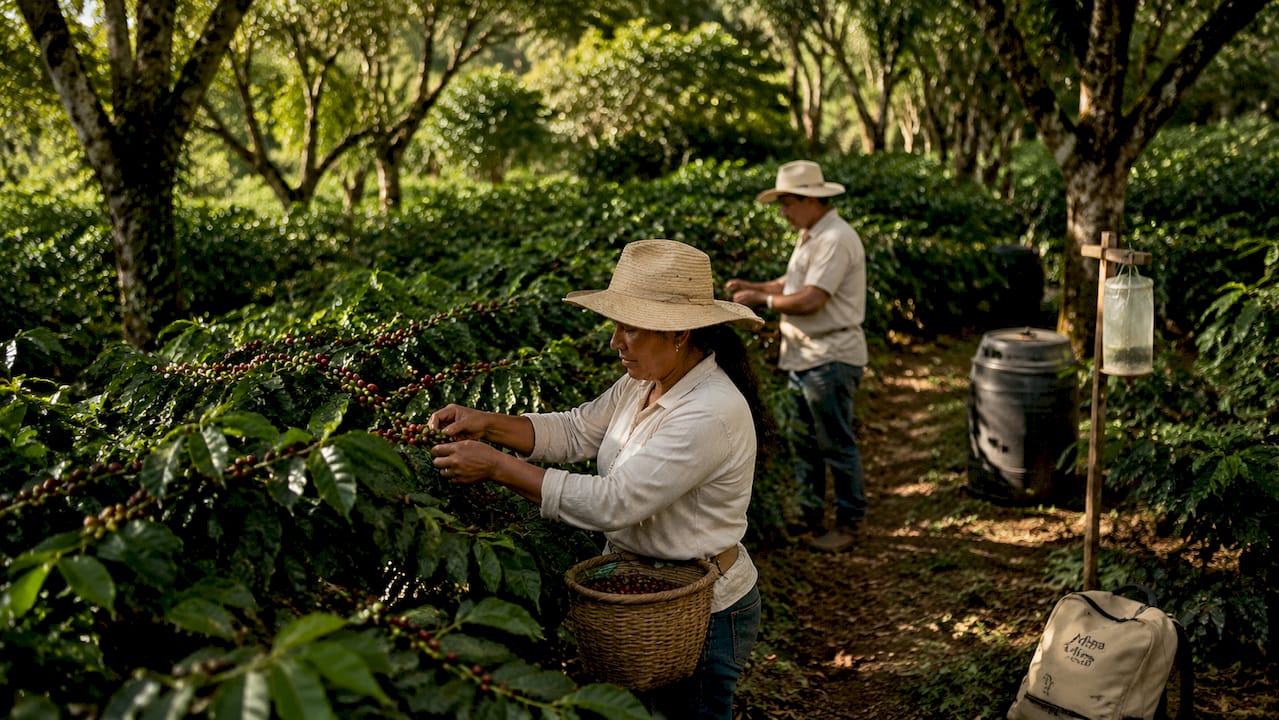
Once a farm clears the transition period, the standards do not stop. Products sold as certified organic must contain at least 95% organic ingredients by weight, excluding water and salt. Annual inspections are mandatory, and farms must maintain a living document called an Organic System Plan. This plan covers every input used on the farm, every practice applied to the soil, and every step taken to prevent contamination from neighboring non-organic land.
The supply chain requirements are equally strict. The Strengthening Organic Enforcement (SOE) rule, which took effect in March 2024, requires nearly all entities in the organic supply chain to be certified. That means roasters, importers, and handlers, not just farms, must now hold certification and appear in public listings. This change closed a significant loophole where uncertified middlemen could handle certified beans and still sell them under an organic label.
Pro Tip: When evaluating a certified organic coffee brand, ask whether their roaster holds SOE-compliant certification, not just whether the farm does. The weakest link in the supply chain is often where organic integrity breaks down.
Key requirements at a glance:
- Three-year chemical-free land transition before first certified crop
- Minimum 95% organic ingredients by weight in the final product
- Annual third-party inspections with no exceptions
- Organic System Plan documenting all inputs, practices, and traceability
- Full supply chain certification under the SOE rule, including roasters and importers
How does the certification process work, and what does it cost?
Getting certified organic is a structured process with real financial and administrative weight. Here is how it typically unfolds for a coffee farm or roaster:
- Application. The operation submits an application to an accredited certifying agent, such as CCOF, Oregon Tilth, or MOSA. The application includes a detailed Organic System Plan covering farming inputs, handling procedures, and contamination prevention measures.
- Document review. The certifying agent reviews the application and requests any missing records. This stage can take several weeks depending on the complexity of the operation.
- On-site inspection. An independent inspector visits the farm or facility to verify that practices match what is documented. Inspectors check soil records, input logs, storage areas, and equipment used for handling.
- Certification decision. The certifying agent reviews the inspection report and either grants certification, requests corrective actions, or denies the application.
- Annual renewal. Certification is not permanent. Operations must renew each year, submit updated Organic System Plans, and pass a new inspection cycle.
The financial reality is significant. Initial certification costs typically run between $700 and $1,500, with annual renewal fees ranging from $400 to $700. The upside is a price premium of 20 to 40% over conventional coffee, with most operations reaching break-even within 12 to 18 months. That math works well for mid-size and larger farms, but it creates a serious barrier for smallholders.
Pro Tip: USDA cost-share programs through the National Organic Program can reimburse up to 75% of certification costs for eligible small operations. If you are a small producer, check with your state department of agriculture before assuming certification is out of reach.
How does organic certification compare to Fair Trade and Rainforest Alliance?
Many consumers treat these three labels as interchangeable. They are not. Each certification addresses a different problem, and understanding the difference protects you from assuming one label covers everything.
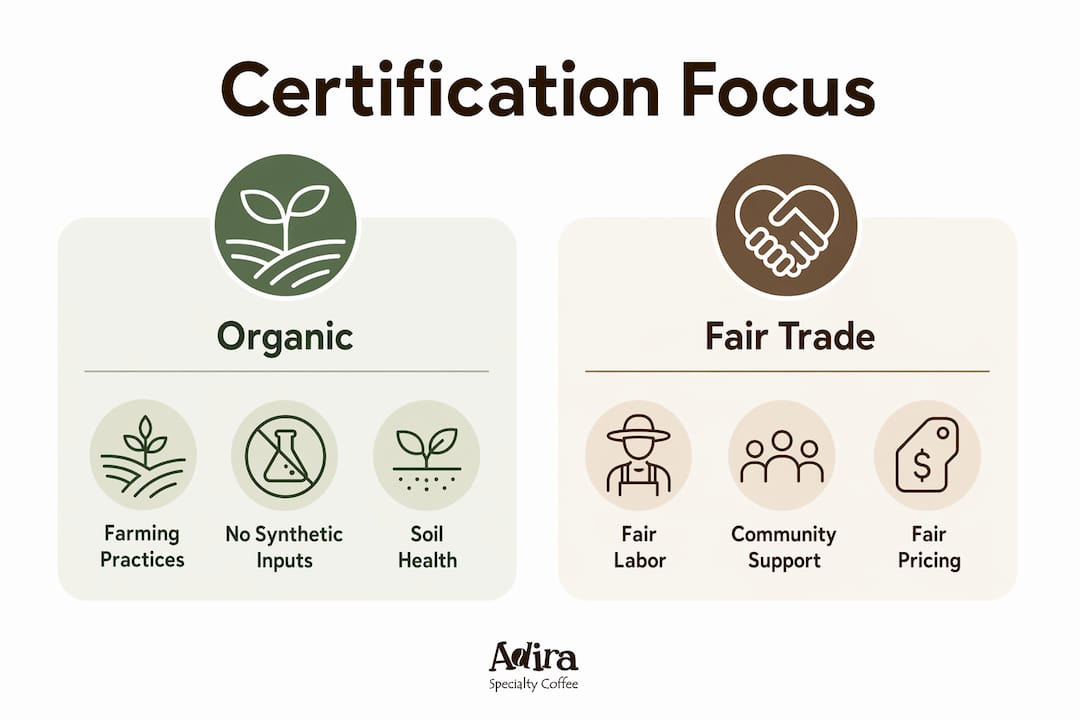
Organic focuses on growing practices and input restrictions. It says nothing about how workers are paid or whether the farm is socially responsible. Fair Trade centers on labor and economic fairness, guaranteeing minimum prices to farmers and requiring democratic cooperative structures. It does not require organic farming methods. Rainforest Alliance includes both environmental and social standards but is not a purely organic certification. A Rainforest Alliance farm may use some synthetic inputs as long as they meet the program’s integrated pest management criteria.
| Certification | Primary focus | Guarantees organic farming? | Guarantees fair labor? | Environmental standards? |
|---|---|---|---|---|
| USDA Organic | Growing inputs and practices | Yes | No | Partial |
| Fair Trade | Economic and labor fairness | No | Yes | Partial |
| Rainforest Alliance | Environmental and social | No | Partial | Yes |
| Dual certified (Organic + Fair Trade) | Inputs and labor | Yes | Yes | Partial |
Dual certifications are common among premium specialty coffee brands. A bag labeled both USDA Organic and Fair Trade Certified tells you the coffee was grown without synthetic chemicals and that the farmers received a fair minimum price. These dual-certified coffees tend to command the highest premiums in the specialty market.
The practical takeaway: organic certification is the right label to look for when your concern is what went into the soil and onto the plant. If you care equally about ethical sourcing practices, look for Fair Trade alongside it.
How can you verify if a coffee is genuinely certified organic?
The organic label on a bag is a legal claim, not just a marketing statement. That means it can be checked. The most reliable tool is the USDA Organic Integrity Database, a free public resource that lists every certified operation in the United States. You can search by farm name, certifying agent, or product type and confirm whether a certification is active or expired.
Understanding what the label actually says is equally important. The USDA distinguishes between several labeling tiers:
- “USDA Organic” means the product contains at least 95% certified organic ingredients and may display the USDA seal.
- “Made with Organic Ingredients” means 70 to 94% of ingredients are organic. The USDA seal cannot appear on this product.
- Uncertified organic claims on products below 70% organic content are permitted only in the ingredient list, not on the front of the package.
The SOE rule has made verification more reliable since 2024. Because supply chain entities must now be certified and publicly listed, you can trace a certified organic coffee from farm to roaster using the database. This is a meaningful improvement over the previous system, where only farms were required to hold certification.
Pro Tip: Search the USDA Organic Integrity Database using the roaster’s name, not just the farm’s. Under SOE rules, a legitimate certified organic coffee should have a traceable certified roaster on record.
For a deeper look at how to use traceability tools when buying coffee, Adiracoffee’s guide on traceable coffee sourcing walks through the verification process in practical terms.
Common misconceptions about organic coffee certification
The biggest misconception is that organic certification guarantees better-tasting coffee. It does not. Organic certification does not affect coffee flavor, which depends on processing method, bean variety, altitude, and roasting skill. A well-roasted conventional coffee from a skilled producer will outperform a poorly processed organic coffee in any blind cupping. The label tells you how the coffee was grown, not how good it tastes.
The second misconception is that organic means chemical-free. Certified organic farming permits certain approved natural inputs, including copper-based fungicides, sulfur compounds, and some botanical pesticides. The restriction is on synthetic chemicals, not all chemicals. This distinction matters when evaluating the actual health and environmental claims attached to the label.
“Organic certification is a trusted but complex guarantee. It confirms that a farm met a documented standard at the time of inspection. It does not mean the coffee is perfect, the farmer is wealthy, or the cup will be exceptional.”
The third and most overlooked issue involves small farms. Many smallholder farms grow coffee using entirely organic methods out of tradition or necessity, but cannot afford the $700 to $1,500 in certification fees. This creates a market paradox: some of the most genuinely natural coffee in the world carries no organic label, while larger certified operations may be farming organically primarily for the price premium.
Finally, certification failures rarely happen because a farm used a prohibited pesticide. They happen because of documentation lapses. Missing records in the Organic System Plan, incomplete mass balance audits, or traceability gaps during handling are the most common reasons operations lose certification. The paperwork burden is as demanding as the farming standard itself.
Key takeaways
Organic coffee certification is a legally enforced, third-party-verified standard requiring a three-year land transition, 95% organic ingredients, annual inspections, and full supply chain certification under the SOE rule.
| Point | Details |
|---|---|
| Three-year land transition | Farms must avoid all prohibited synthetic inputs for 36 months before the first certified harvest. |
| 95% organic ingredient threshold | Certified products must contain at least 95% organic ingredients to display the USDA Organic seal. |
| SOE supply chain rule | Since March 2024, roasters and importers must hold certification, not just farms. |
| Certification costs and ROI | Initial fees run $700 to $1,500, with a 20 to 40% price premium and 12 to 18 month break-even. |
| Organic does not equal better flavor | Coffee taste depends on processing, variety, and roasting. Certification addresses inputs, not cup quality. |
What I’ve learned from sourcing certified organic coffee
I have spent years working directly with farms in Colombia, Ethiopia, and Costa Rica, and the certification picture is more complicated than most consumers realize. The label is worth trusting when it comes from a supply chain you can actually trace. But the label alone is not the whole story.
The farms I respect most are not always the ones with the most certifications. Some of the most careful, chemical-free growers I have visited in Sumatra and Mexico operate without USDA Organic certification because the administrative cost is simply not viable for a 10-acre family farm. Their coffee is grown with more care than many certified operations I have seen. That reality does not make the certification meaningless. It makes it incomplete as a sole measure of quality or ethics.
What the SOE rule has changed, and I think for the better, is that it forces the entire chain to be accountable. When Adiracoffee sources certified organic beans, we now need our roasting operation to hold certification too. That is more work, but it is honest work. It means the label on our bag reflects a verified chain, not just a farm document from two years ago.
My honest advice: use certification as a floor, not a ceiling. It tells you the minimum standard was met. Then look at the roaster’s sourcing story, the farm’s practices, and whether the flavor reflects the origin. A certified organic label paired with genuine traceability and skilled roasting is where the real value lives.
— Stefan
Certified organic coffee, roasted to order at Adiracoffee
Adiracoffee sources beans from cooperatives and small farms in Colombia, Ethiopia, Costa Rica, Mexico, and Sumatra, with full traceability from farm to roast. Every bag is roasted in small batches in California and shipped within days of roasting, so you get certified organic coffee at peak freshness, not sitting on a warehouse shelf for months. The Adira Blend brings together certified organic beans in a signature espresso-forward profile, while the single-origin collection lets you explore traceable, certified sources one origin at a time. Subscriptions include 10% savings and free US shipping over $35.
FAQ
What is organic coffee certification?
Organic coffee certification is a third-party verified standard confirming that coffee was grown without synthetic pesticides, fertilizers, or GMOs. In the United States, the USDA National Organic Program governs these standards and accredits certifying agencies to conduct inspections.
How long does it take to get certified organic?
The process requires a minimum three-year transition period during which the land must be managed without prohibited synthetic substances. After that, the application, inspection, and certification decision typically add several additional months.
Does organic certification mean the coffee tastes better?
No. Organic certification addresses how coffee is grown, not how it tastes. Flavor is determined by bean variety, altitude, processing method, and roasting skill, none of which are covered by organic coffee standards.
How can I verify a coffee’s organic certification?
Use the USDA Organic Integrity Database, a free public tool that lists all certified operations by name and certifying agent. Under the SOE rule effective since 2024, you can verify both the farm and the roaster in the same search.
Why do some organic farms not have certification?
Many smallholder farms grow coffee using entirely organic methods but cannot afford the $700 to $1,500 in initial certification fees. Cost barriers, not farming practices, keep genuinely organic small producers off the certified list.
Recommended
- How Coffee Farms Define Flavor: Practices That Impact Quality – Adira Coffee US
- Identifying quality coffee beans: a connoisseur’s guide – Adira Coffee US
- The role of origin in coffee flavor: what every aficionado should know – Adira Coffee US
- How to source ethical coffee: a step-by-step guide – Adira Coffee US