
To steep coffee means to fully submerge grounds in water for a controlled time, then separate them. That’s the whole mechanism. Here are the practical defaults you need before anything else:
- French press: 1:15 ratio (coffee to water), medium-coarse grind, 200°F, ~4 minutes
- Hot cupping: 1:18 ratio, medium grind, 200°F, typical steep time
- AeroPress short immersion: 1:12 ratio, medium-fine grind, 185–200°F, typical steep time
- Cold brew (fridge): 1:8 ratio (concentrate) or 1:15 (ready-to-drink), coarse grind, 38–40°F, 12–24 hours
- Toddy-style cold brew: 1:8 ratio, coarse grind, room temp, 12–18 hours, then refrigerate
Steep time is one lever among several. Grind size, brew ratio, water temperature, and agitation all interact with it. Change one, and the others shift. The sections below explain why, and how to use that to your advantage.
Key Takeaways
| Point | Details |
|---|---|
| Default steep times | French press ~4 min; hot cupping 3–5 min; AeroPress 1–2 min; cold brew 12–24 hr minimum. |
| Ratio controls strength | TDS scales inversely with brew ratio; adjust coffee dose before extending steep time. |
| Decant immediately | Leaving grounds in contact after steeping continues extraction and increases bitterness. |
| Cold brew needs 12+ hours | Research confirms minimum 12 hours; ratio and grind size affect flavor as much as time does. |
| Adiracoffee | Freshly roasted single-origin beans and blends, dialed in for your method, with pre-tested steep recipes. |
Table of Contents
- What does “steep” actually mean in coffee brewing?
- Recipes and steep times for every major immersion method
- How grind, ratio, temperature, and agitation change your steep time
- Troubleshooting common steeping problems
- What the science says about immersion extraction
- Tools and workflow for consistent steeping results
- The part most guides skip
- Fresh beans make every steep recipe work better
- Sources
What does “steep” actually mean in coffee brewing?
Steeping is full immersion: a fixed volume of water surrounds the grounds completely, and extraction happens by diffusion as soluble compounds move from the grounds into the water. The water gradually approaches equilibrium with the grounds, and extraction slows as the concentration difference narrows.
Percolation works differently. Pour-over, drip, and espresso continuously push fresh water through the grounds, maintaining a steep concentration gradient the whole time. Fresh solvent keeps pulling more from the grounds.
The practical consequences of that difference are significant:
- Immersion (steeping): fuller body, more oils and suspended solids, heavier mouthfeel, self-limiting extraction
- Percolation: cleaner cup, brighter acidity, higher sensitivity to grind and flow rate, more extraction-efficient
Immersion brews approach an equilibrium that limits further extraction; percolation maintains a concentration gradient and is therefore more extraction-efficient and more sensitive to grind and flow. The liquid trapped inside the grounds (interstitial liquid) can be as concentrated as the cup itself, which is why immersion brews retain more body and why standard extraction calculations sometimes underestimate yield.
The Coffee ad Astra analysis puts it plainly: immersion and percolation taste different because the physics are different, not because one method is better. Scott Rao’s immersion vs. percolation breakdown explains how the interstitial liquid complicates extraction math and why immersion cups feel heavier in the mouth.
For home brewers, the takeaway is this: steeping rules apply to French press, cold brew, cupping, AeroPress short-immersion, and any method where water and grounds sit together without continuous flow. Pour-over rules are a different game.
Recipes and steep times for every major immersion method
The table below covers the main immersion methods with the parameters that matter most. Use it as a starting point, then adjust according to your beans and taste.
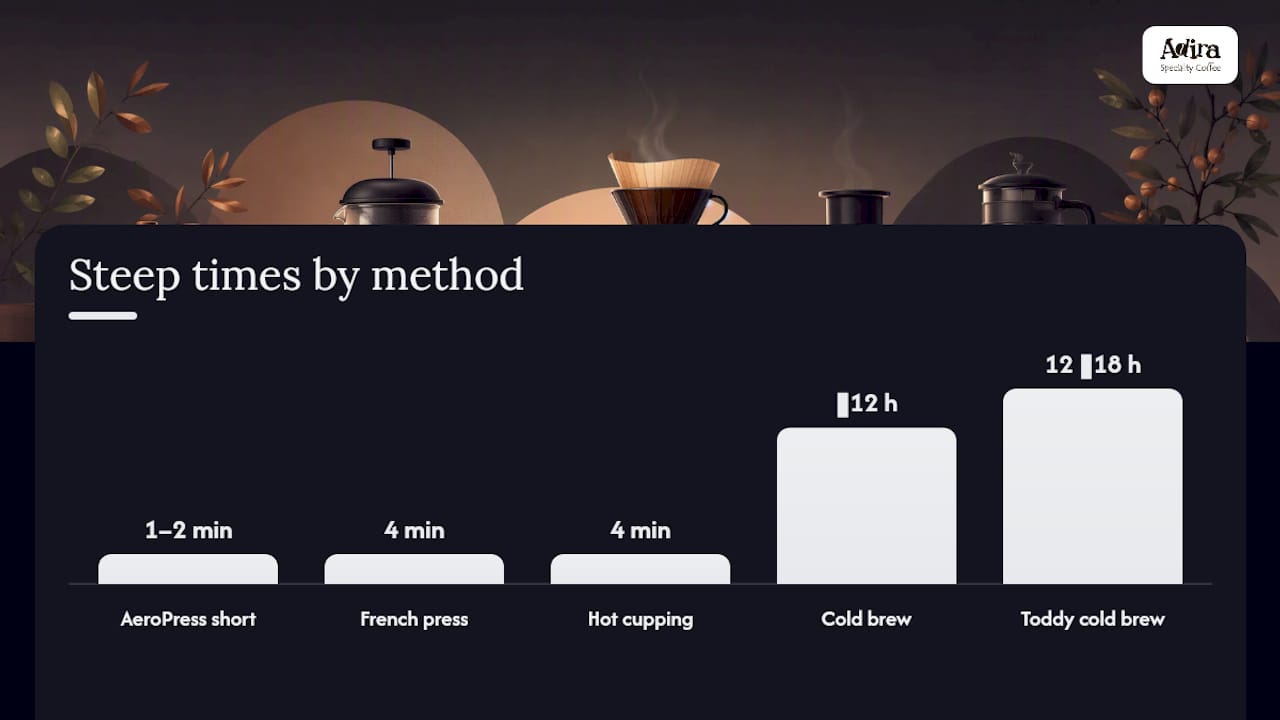
French press is the most forgiving immersion method. Add your grounds, pour water just off the boil (200°F), give it one gentle stir to wet all the grounds, then leave it alone. At 4 minutes, press slowly and pour immediately. Don’t let it sit after pressing — the grounds keep extracting through the mesh.
Pro Tip: Decant French press coffee into a separate carafe right after pressing. Leaving it on the grounds for even 2 extra minutes noticeably increases bitterness.
Hot cupping is what roasters use to evaluate beans. Grind medium, pour 200°F water directly over the grounds, and let it sit for 4 minutes. Break the crust (the floating grounds layer) with a spoon, skim the foam, and slurp from a spoon. It’s a tasting protocol, not a daily brew method, but it’s the most direct way to understand what a bean actually tastes like.
AeroPress short immersion is the fastest path to a clean, concentrated cup. The shorter steep time and finer grind mean extraction happens quickly. Invert the AeroPress, add grounds and water, stir once, steep 1–2 minutes, then press. The paper filter removes most oils, giving you clarity that French press can’t match.
Cold brew is where steep time becomes the headline number, but controlled cold-brew research recommends a minimum of 12 hours and shows that brew ratio, grind size, and temperature affect extraction yield and sensory properties like acidity and color just as much as time does. A coarser grind at 1:8 ratio gives you a concentrate you dilute 1:1 before drinking. A 1:15 ratio at the same steep time gives you ready-to-drink strength.
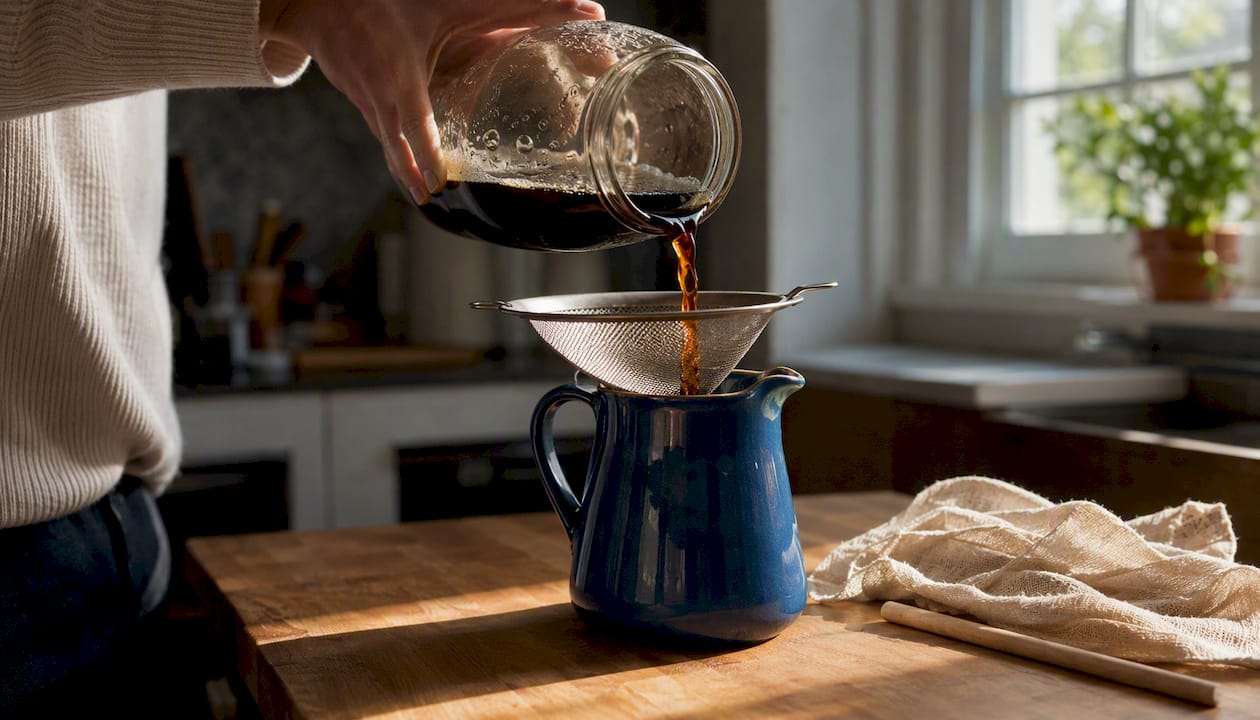
Pro Tip: For cold brew, filter twice: once through a mesh strainer, then through a paper filter or cloth. The second pass removes fine particles that make the concentrate cloudy and slightly bitter after a few days in the fridge.
Toddy-style cold brew uses room-temperature water instead of refrigerator-cold water, which speeds extraction slightly. The Toddy system uses a cloth filter at the bottom of the vessel, which produces a cleaner cup than most mesh-only setups. Steep 12–18 hours at room temperature, then drain and refrigerate.
Expected sensory outcomes by method:
- French press: rich, oily, full mouthfeel; low acidity; some sediment at the bottom of the cup
- Cold brew: smooth, low acidity, naturally sweet; concentrate can taste flat if under-extracted
- AeroPress: clean, bright, concentrated; adjustable body depending on filter type (paper vs. metal)
- Cupping: unfiltered, direct; shows the bean’s true character without equipment influence
How grind, ratio, temperature, and agitation change your steep time
No single variable controls flavor on its own. A systematic review of extraction parameters confirms that extraction time, water temperature, grind size, and brew ratio are interdependent — change one, and the others shift in response. That’s not a reason to feel paralyzed. It’s a reason to change only one thing per brew session.
Here’s how each variable moves the needle:
- Grind finer: more surface area, faster extraction, shorter effective steep time needed
- Grind coarser: slower extraction, longer steep time required to reach the same strength
- Higher water temperature: faster extraction rate (strongly so, per the UC Davis extraction research); equilibrium yield is largely unaffected by temperature, but you get there faster
- Higher brew ratio (more water per gram of coffee): lower TDS at equilibrium; the Scientific Reports predictive model shows TDS scales approximately inversely with brew ratio
- Agitation: speeds extraction modestly; occasional slow stirring is often as effective as continuous agitation for immersion brews
- Roast level: lighter roasts are denser and extract more slowly; they often benefit from slightly finer grind or slightly longer steep time
The MDPI espresso kinetics study shows that grind and flow dynamics are high-impact levers across brewing methods. The same principle applies to immersion: adjusting grind size moves flavor faster and more predictably than adjusting steep time.
Decision flow for common flavor problems:
- Cup tastes weak or thin → increase brew ratio (use more coffee) or grind slightly finer
- Cup tastes bitter or harsh → grind coarser, lower water temperature, or shorten steep time
- Cup tastes sour or sharp → grind finer, increase water temperature, or extend steep time slightly
- Cup is muddy or gritty → grind coarser, improve filtration, decant sooner
- Cold brew tastes flat → check ratio first (likely too dilute), then grind size
Micro-experiments to dial in your brew:
- Keep everything constant. Change only the grind size by one setting. Brew and taste.
- Keep grind and temp constant. Change the ratio by 10% (add or remove 2g of coffee per 200ml water). Taste.
- Keep grind and ratio constant. Change steep time by 30 seconds for hot methods, or 2 hours for cold brew. Taste.
- Record results in a simple notebook or phone note: date, method, ratio, grind setting, time, and one-sentence tasting note.
For grind-size control, a burr grinder is non-negotiable. Blade grinders produce uneven particle sizes that make extraction unpredictable — you get both over- and under-extracted particles in the same cup.
Troubleshooting common steeping problems
Most steeping problems have one of three root causes: wrong grind size, wrong ratio, or wrong time. Here’s how to read the symptoms:
- Bitter, harsh, dry finish: over-extraction. Grind coarser, shorten steep time, or lower water temperature. For French press, decant immediately after pressing.
- Sour, thin, sharp: under-extraction. Grind finer, extend steep time slightly, or raise water temperature.
- Muddy, gritty texture: grind too fine for the filter, or grounds disturbed during pressing. Grind coarser, press more slowly, and use secondary filtration (paper filter over your cup).
- Cold brew tastes flat or watery: brew ratio is too dilute, or steep time was too short. Start with a 1:8 concentrate ratio and dilute to taste. Minimum 12 hours, per cold-brew immersion research.
- Cold brew turns bitter after a few days: fine particles continuing to extract in the fridge. Filter more thoroughly before storing.
Cold brew storage: properly filtered cold brew concentrate keeps refrigerated for up to 2 weeks. Ready-to-drink strength (1:15 ratio) is best consumed within 7–10 days. Always store in a sealed glass container.
Pro Tip: For any immersion brew that tastes slightly off, run it through a paper filter before drinking. It removes suspended solids and oils that carry bitterness and muddiness, and it takes 30 seconds.
Water quality matters more than most home brewers realize. Distilled water extracts poorly because it lacks the minerals that help carry flavor compounds. Very hard water (high calcium/magnesium) can suppress acidity and produce flat-tasting cups. The SCA recommends water in the 50–150 ppm total dissolved solids range for brewing. If your tap water tastes good, it probably brews well. If it tastes flat or heavily chlorinated, filtered water makes a real difference.
Light roasts extract more slowly than dark roasts because the beans are denser. If you’re steeping a light roast Ethiopian or Colombian and the cup tastes sour and thin, grind finer before you add steep time. Dark roasts extract faster and can turn bitter quickly in a French press — keep the grind coarse and the time at 4 minutes or under.
What the science says about immersion extraction
The chemistry of steeping breaks into two stages. First, a rapid surface wash dissolves the most soluble compounds from the outside of each particle. Then, a slower diffusion phase pulls compounds from inside the particle through the porous structure to the water. Research on aqueous extraction modeling identified this two-stage mechanism decades ago, and it explains something counterintuitive: most of the flavor you want extracts in the first few minutes. What comes out later is slower, often more bitter, and sometimes astringent.
Brew ratio is the most reliable single knob to change final TDS in full-immersion methods. Grind and temperature change the dynamics but often do not change equilibrium extraction yield substantially. The Scientific Reports predictive model shows equilibrium extraction yield converges to roughly 21% across typical brew ratios — meaning the grounds give up about the same fraction of their solubles regardless of how much water you use. What changes is the concentration of the resulting cup.
The UC Davis dissertation on full-immersion extraction measured that increasing brew temperature strongly increases extraction rate, while agitation speeds it modestly. Grind size primarily affects kinetics (how fast you get there) rather than the equilibrium extraction yield over typical home ranges. That’s why experienced baristas treat steep time as a consistency control rather than a strength dial.
The interstitial liquid point is worth understanding. The liquid trapped inside the grounds after pressing or filtering is as concentrated as the cup itself. This is why immersion brews feel heavier and why Scott Rao’s extraction analysis notes that standard extraction calculators can mis-estimate immersion yields. For home brewers, the practical implication is simple: the grounds absorb roughly 2g of water per gram of coffee, so a 30g dose absorbs about 60ml of your brew water. Factor that into your yield expectations.
For cold extraction specifically, the 2023 cold-brew kinetics study tested steep times from 5 minutes to 18 hours across temperatures from 38°F to 99°F. Cold extraction is genuinely slow, and brew ratio and grind size affect sensory outcomes even when time is long. Time is necessary but not sufficient.
Tools and workflow for consistent steeping results
Consistency comes from measuring the same things the same way every time. You don’t need expensive equipment. You need a few reliable tools and a repeatable process.
Tool checklist:
- Burr grinder (hand or electric) with repeatable grind settings
- Kitchen scale accurate to 0.1g
- Thermometer or kettle with temperature control
- Timer (phone works fine)
- Appropriate filter: metal mesh for French press, paper or cloth for cold brew and AeroPress
- Decanter or second vessel for immediate separation after steeping
Step-by-step workflow for any hot immersion brew:
- Weigh your coffee dose on the scale (e.g., 30g for a 450ml French press at 1:15).
- Grind to the appropriate setting for your method.
- Heat water to target temperature (200°F for French press and cupping; 185–195°F for AeroPress).
- Rinse your filter or vessel with hot water to preheat it.
- Add grounds, start your timer, and pour water evenly over the grounds.
- Stir once gently to wet all grounds. For specialty coffee recipes, a brief bloom (30 seconds with a small pour) before the full pour can improve evenness.
- Steep without disturbing. One additional gentle stir at the halfway point is optional and speeds extraction slightly.
- At the target time, separate grounds from liquid immediately. Press, pour through a filter, or decant.
- Serve or store right away.
For cold brew, the workflow is the same except you skip heating, use cold or room-temperature water, and move the vessel to the fridge (or leave at room temperature for Toddy-style). Filter before refrigerating.
Recording results: note your grind setting, ratio, time, and a one-sentence tasting note after each brew. After three or four sessions, patterns emerge. Without a meter, use your palate: strength (how much coffee flavor), balance (sweet vs. bitter vs. sour), and body (how heavy it feels).
Pro Tip: Change only one variable per brew session. If you adjust grind and ratio at the same time, you won’t know which change fixed the problem.
The manual brewing guide from Adiracoffee covers step-by-step workflows for multiple methods if you want a deeper reference alongside this one.
The part most guides skip
Most steep guides hand you a time and move on. Four minutes for French press, 12 hours for cold brew, done. What they don’t say is that those times assume a specific grind, a specific ratio, and a specific water temperature — and that if any of those are off, the time is wrong too.
The research is pretty clear on this: once an immersion brew reaches equilibrium, more time doesn’t make it stronger. It makes it more bitter. The compounds that extract slowly are often the ones you don’t want. That’s why experienced baristas dial in grind and ratio first, then use time as a consistency anchor, not a flavor dial.
There’s also a practical point about freshness that most steep guides ignore entirely. A freshly roasted bean extracts differently than one that’s been sitting in a bag for three months. Fresh coffee releases CO2 during brewing (that’s the bloom), which affects how evenly water contacts the grounds. Stale coffee extracts unevenly and often tastes flat regardless of how precise your steep time is. The steep workflow only works as well as the beans you start with.
Fresh beans make every steep recipe work better
Adiracoffee roasts single-origin beans and signature blends to order in small batches in California, then ships directly to you within days of roasting. Every bag is matched to your grinder and brewing method, and the cold brew blend comes with a pre-tested steep recipe built around the 12–24 hour parameters covered here.
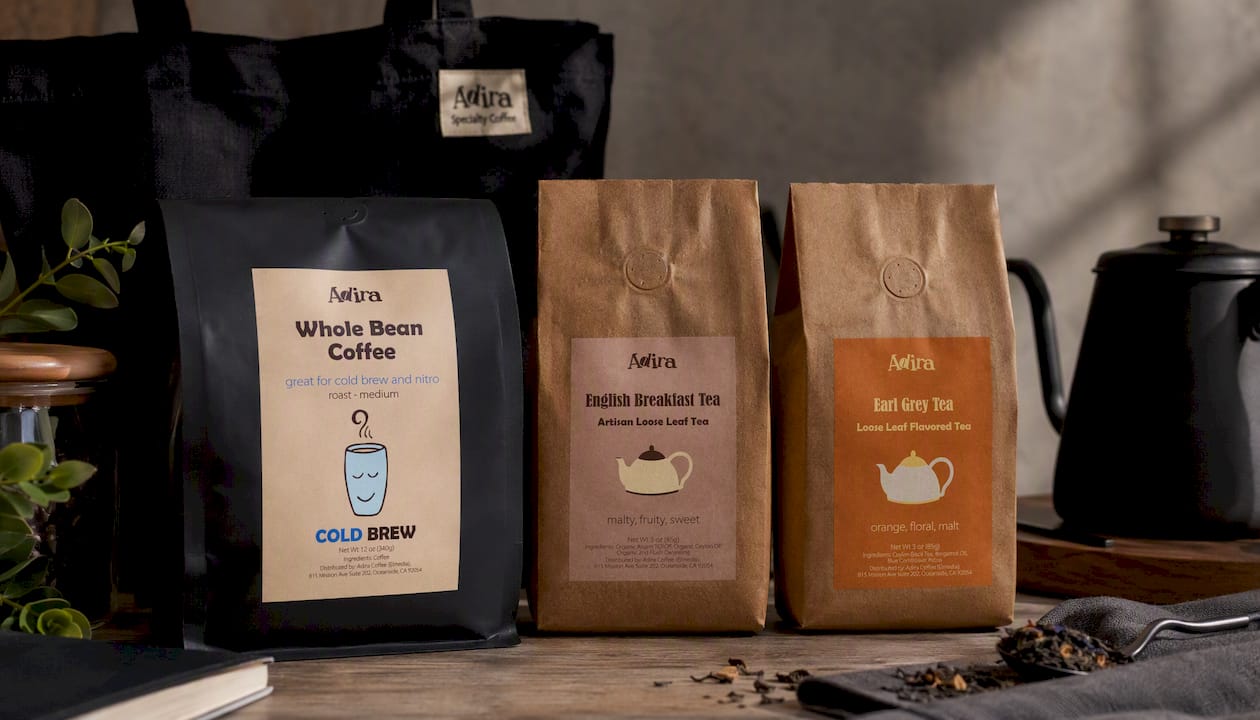
For immersion brewing specifically, the English Breakfast blend is roasted for full-body extraction and holds up well in a French press at 4 minutes without turning bitter. The Earl Gray works as a lighter steep option for cupping or AeroPress short-immersion. If you want guidance on bean selection for your equipment, Adiracoffee also provides personalized digital brewing recipes at checkout. Browse the full lineup at Adiracoffee and pick the beans that match your method.
Sources
These are the primary references behind the recipes and science in this article:
- Scientific Reports: Predictive model for full immersion brewed coffee (2021)
- Effects of grind size, temperature, brew ratio and steeping time on immersion cold-brew properties (2023)
- Effects of grinding, flow rate and temperature on espresso extraction kinetics — MDPI (2023)