
If your V60 finishes in under two minutes and tastes thin or sour, your grind is too coarse for the bed to slow the water down. The single best first move: grind finer by one to three clicks on your grinder’s scale, keep everything else the same, and brew it again. Taste before you touch anything else.
TL;DR:
- Coarser grind size and inconsistent grinders often cause fast V60 drawdown times, leading to under-extracted, sour, or thin-tasting brews.
- Pour technique, including pouring speed and height, significantly influences channeling and water flow, affecting the brew’s resistance.
- Adjusting grind finer by one to three clicks and controlling pour rate can typically fix fast drawdowns within a few brews.
- Inconsistent results across identical brews usually point to grinder inconsistency rather than technique, emphasizing the importance of grinder quality.
- Using fresh, single-origin beans with a stable roast profile simplifies testing and reduces variables causing rapid water runoff.
Table of Contents
- Why does my V60 have a fast drawdown?
- What should I fix first for a v60 fast drawdown?
- How do you test and measure V60 drawdown time?
- What grind size and ratio actually work for V60?
- How does Adira Coffee troubleshoot a fast V60 drawdown?
- Why the standard V60 advice misses the point
- How can fresh, single-origin beans simplify your V60 testing?
- Sources
Why does my V60 have a fast drawdown?
Fast drawdown almost always means the coffee bed isn’t offering enough resistance, so water races through before it can pull out the sugars and acids that balance a cup. The result tastes thin, sharp, or sour, because you extracted mostly the fast-dissolving compounds and left the rest behind. A few things create that low-resistance situation, and they rarely act alone.
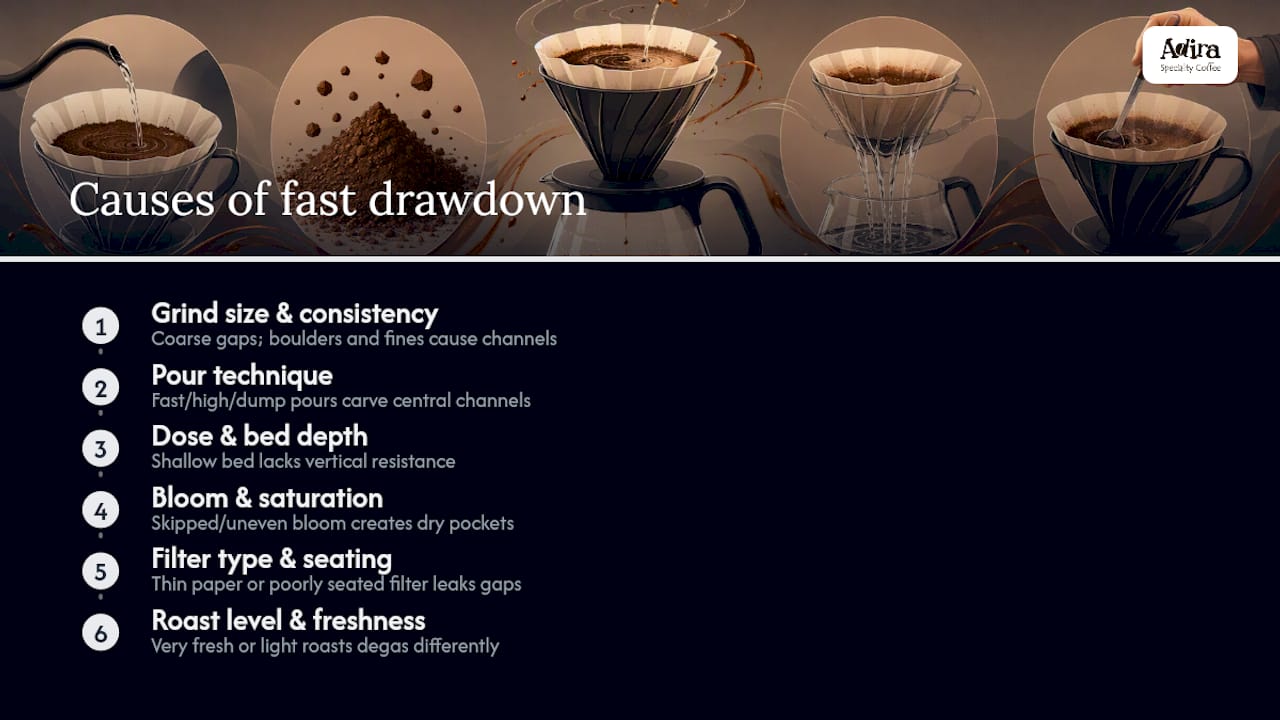
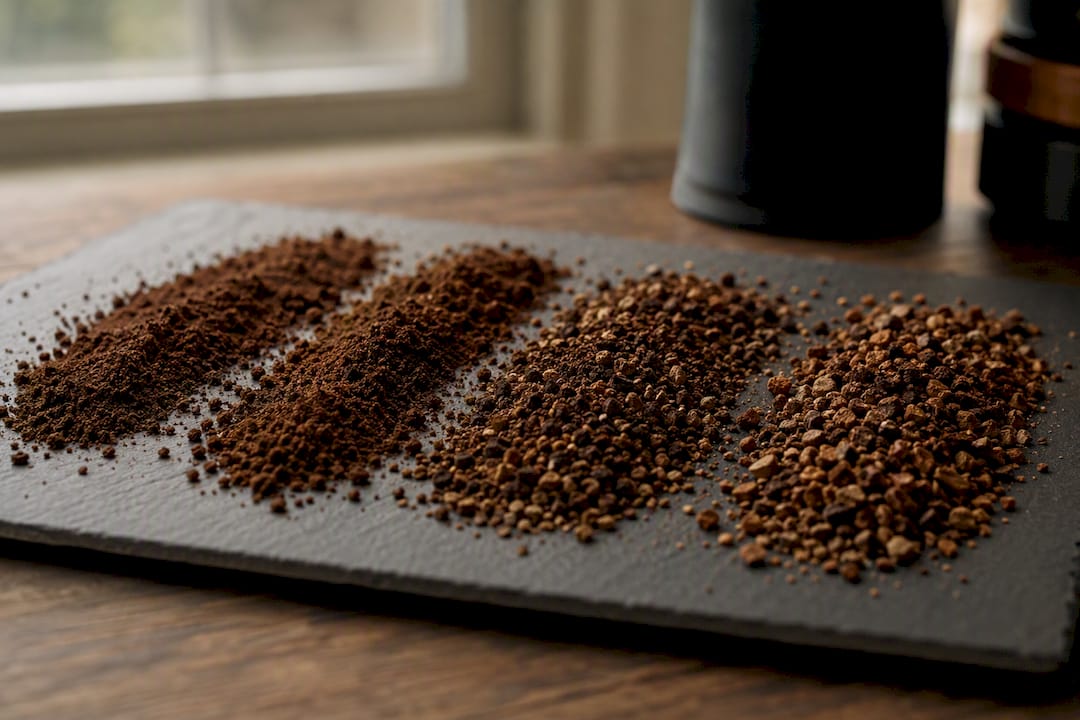
Grind size and grinder consistency top the list. Coarser particles leave bigger gaps in the bed, so water finds the path of least resistance and shoots through. But grind size isn’t just about the average setting. A cheap or dull grinder can produce a wide mix of boulders and fines at the same setting, and that inconsistency causes the drawdown time to wander from brew to brew even when you think you’re doing everything identically.
Pour technique matters just as much as grind. Pouring too fast, from too high, or dumping water straight into the center creates channeling, where water carves a fast tunnel through the bed instead of soaking evenly through it. You can have the correct grind and still finish in ninety seconds if your pour blasts a hole down the middle of the slurry.
Dose and bed depth play a quieter role. A shallow bed, from too little coffee, simply doesn’t have the vertical distance to slow water down, no matter how fine you grind.
Bloom and saturation set up everything that follows. Skip the bloom or pour it unevenly, and dry pockets form. Water reaching the brew later finds an already-open channel through wetted grounds and drains fast, so uneven saturation early on can cause a fast finish even in a well-dosed brew.
Filter type and how well the dripper seats matter too. Some paper is thinner and drains faster, and a filter that doesn’t collapse evenly against the plastic ridges leaves gaps water slips through.
Statistically speaking, most V60 recommendations target a ratio between 1:15 and 1:17, and a brew that finishes well outside the expected drawdown window at that ratio is telling you something upstream is off, not just that the clock ran fast.
Roast level and freshness round out the list. Very fresh, light roasts degas differently than dark roasts, which changes how water moves through the bed in ways we’ll cover below.
What should I fix first for a v60 fast drawdown?
Change one thing, re-brew, and taste before you touch a second variable. Here’s the order that fixes the most brews the fastest:
- Grind finer by one to three clicks. Keep your dose, water amount, and pour pattern identical to your last brew so you know the grind change is what moved the needle.
- Slow down and lower your pour. Pour in gentle, controlled spirals instead of a hard stream aimed at the center, and keep the kettle spout close to the bed rather than pouring from height.
- Add a gram or two of coffee if your dose feels light for your brewer size. A deeper bed adds resistance on its own, separate from grind.
- Rinse your filter and reseat it firmly against the dripper ribs, or swap back to your previous filter brand if you recently changed.
If you run the same grind setting three times back to back and get three different drawdown times, stop blaming your technique. Inconsistent results across identical runs point to the grinder itself, usually excess fines clogging parts of the bed while coarser chunks elsewhere let water rush past.
Pro Tip: Do a “two-dose test”: grind two identical doses, pour one into a white bowl, and eyeball the particle spread. If you see a dusty layer mixed with visibly larger chunks, that inconsistency, not your pouring, is probably your real problem.
How do you test and measure V60 drawdown time?
You need a scale, a timer, and ideally a gooseneck kettle for pour control. A thermometer helps, though a kettle with a temperature setting works fine.
Run this recipe: 15 grams coffee to 225 grams water (a 1:15 ratio), or scale up to 16 grams to 256 grams for 1:16. Bloom with about 40 grams of water for 30 to 45 seconds, then pour the rest in two or three controlled additions. Start your timer at first contact with water and stop it the moment the last drip falls.
Change only the grind setting between tests. Keep ratio, water temperature, and pour pattern locked so any timing shift is attributable to one cause.
| Total drawdown time | What it usually means |
|---|---|
| Under 2:00 | Grind too coarse, or channeling from a fast pour |
| 2:30 to 3:30 | Target zone for most V60 recipes |
| 3:30 to 4:00 | Slightly slow, often fine if the cup tastes balanced |
| Over 4:00 | Grind too fine, or too much fines clogging the bed |
That 2:30 to 3:00 window lines up with what most V60 recipes are built around, and it’s a far more useful benchmark than staring at the dripper wondering if it “looks right.”
What grind size and ratio actually work for V60?
Stick to a 1:15 to 1:17 ratio, with 1:16 as a solid default for most beans and roast levels. Weigh both coffee and water rather than eyeballing scoops; a kitchen scale removes more guesswork than any grind adjustment will.
Aim for a grind texture close to granulated sugar, medium-fine rather than fine. If your drawdown consistently lands under 2:00, go finer in small steps. If it creeps past 4:00 and tastes bitter or muddy, back off coarser.
- Light roasts are denser and often need a slightly finer grind than dark roasts to hit the same drawdown window.
- Very fresh coffee, especially within a few days of roasting, releases more gas during blooming, which can push water around unevenly if the bloom is too short.
- A modest one to two click grind adjustment paired with a slightly longer bloom usually fixes a roast-level mismatch faster than changing your ratio.
How does Adira Coffee troubleshoot a fast V60 drawdown?
Stefan’s checklist, refined through years of dialing in beans for customers on wildly different grinders: run a grind test, check your bloom, verify your dose, swap the filter, then tighten pour control. In that order, because grind and bloom cause the most fast-drawdown complaints by far.
One case that comes up often: a customer switches from a dark roast to a light roast and suddenly their V60 races through in under two minutes. The fix isn’t a new dripper. It’s moving the grind two clicks finer, stretching the bloom to 40 seconds, and slowing the pour rate to match the denser bean structure.
- Follow the Hario V60 starting recipe for a locked baseline before you experiment.
- Use the V60 one cup recipe if you’re brewing single servings and want a smaller, still reliable test batch.
Every bag Adiracoffee roasts ships within days, in small batches, which matters here because degassing behavior is one less variable to fight when you’re isolating what’s actually causing your fast drawdown.
Why the standard V60 advice misses the point
Most troubleshooting guides hand you a grind chart and call it done. That’s backwards. Grind matters, but it’s the variable people jump to first precisely because it’s the easiest one to blame, not because it’s always the culprit.
In practice, pour technique and bloom saturation cause as many fast drawdowns as grind size does, and they get far less attention. A perfectly ground bed still drains fast if you blast water into the center and carve a channel straight through it. I’d argue the real skill gap in home brewing isn’t grind selection at all. It’s pour control, something almost nobody practices deliberately.
Here’s what I’d prioritize if I could only fix one habit: change one variable per brew and actually taste the result before touching anything else. Most people adjust grind, pour speed, and dose all in the same session, then have no idea which change fixed (or broke) the cup. Slow down the testing, not just the pour.
— Stefan
How can fresh, single-origin beans simplify your V60 testing?
Fresh, small-batch beans take degassing off your list of suspects, which matters more than most guides admit. When a bag was roasted weeks ago and sat on a supermarket shelf, you’re never sure if a fast drawdown came from your grind or from stale, over-degassed coffee behaving unpredictably in the bed. Adiracoffee roasts to order and ships within days, so that variable is already controlled before you pull out your scale.

For controlled testing, reach for a single-origin like Colombia or Sumatra, since both hold a predictable roast profile brew after brew. If you’d rather standardize around a blend, the Ocean Blend or Cold Brew works as a steady baseline while you isolate grind and pour variables. Grab a bag, pair it with the starting recipe, and run your one-change-at-a-time tests. A subscription keeps fresh beans arriving on schedule, with free US shipping over $35, so freshness never becomes the unknown in your next test batch.
Sources
For deeper technique background, see BrewMark’s V60 guide, TheCoffeeCalculator’s ratio guidance, and ProjectBarista’s brewing recommendations. For how the V60’s single drain hole compares to drip machines, Wine Drop Cookery breaks down the mechanics.
- Hario V60 Brewing Guide: Complete Recipe and Step-by-Step Technique | BrewMark
- Brewing with pour-over (V60) | TheCoffeeCalculator
- Coffee ratios and V60 recommendations | ProjectBarista