
TL;DR:
- French press coffee is an immersion brewing method where coarsely ground coffee steeps in hot water before a mesh plunger separates the grounds from the liquid. Getting the correct grind size, ratio, temperature, and steep time ensures a consistent, full-bodied cup every time. Using a burr grinder, a digital scale, and proper preheating helps achieve repeatable and optimal results.
French press coffee is defined as an immersion brewing method where coarsely ground coffee steeps directly in hot water before a mesh plunger separates the grounds from the liquid. The result is a full-bodied, rich cup that no paper filter can replicate. Mastering the step by step French press process comes down to four variables: grind size, coffee-to-water ratio, water temperature, and steep time. Get all four right, and every cup is repeatable. This guide gives you the exact numbers and sequence to brew confidently at home, whether you’re working with a French press 2 cups or a French press 8 cup carafe.
What equipment do you need for a perfect French press brew?
The right tools make the difference between a guessed result and a repeatable one. You need six items before you start: a French press, a burr grinder, a digital scale, a gooseneck or standard kettle, a timer, and a long spoon for stirring.
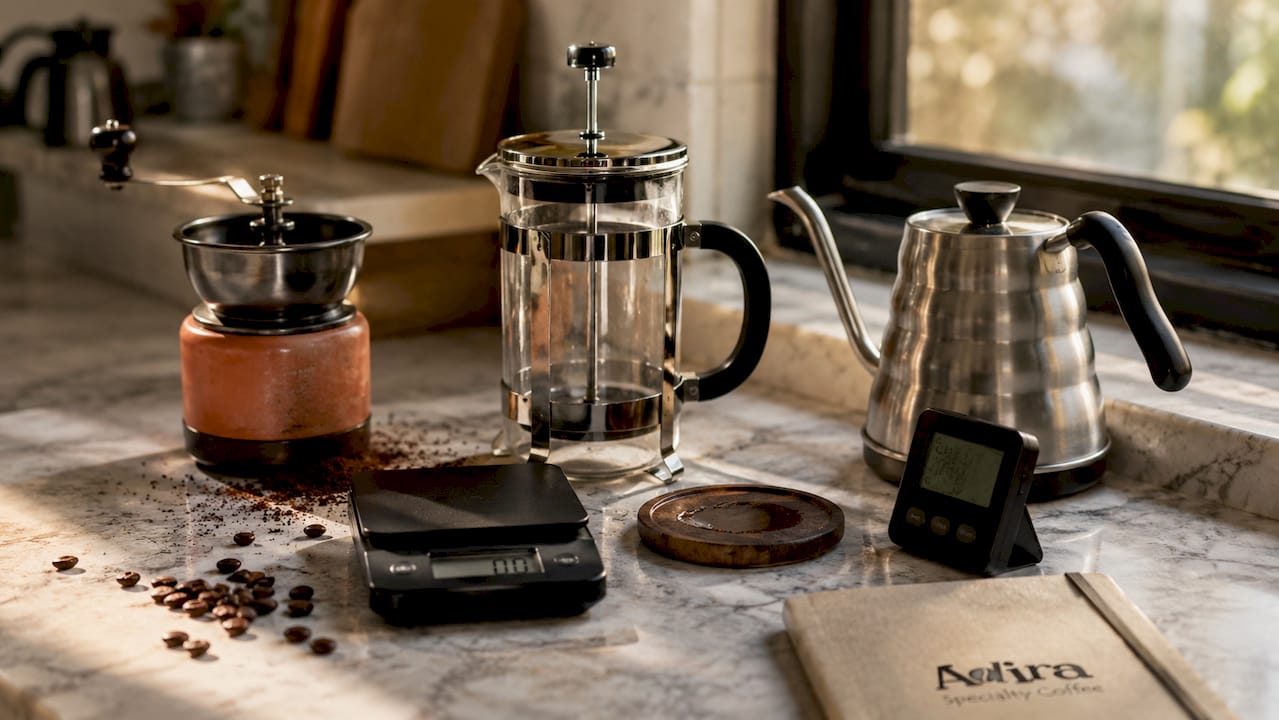
The burr grinder is non-negotiable. Grind size is the most impactful variable on cup quality, and a burr grinder produces consistent particle sizes that a blade grinder cannot match. Inconsistent grind means some particles over-extract while others under-extract, producing a bitter and sour cup at the same time.
A digital scale matters just as much as the grinder. Weighing coffee and water by grams yields more reliable results than measuring by volume. Volume measures shift depending on grind density and how tightly grounds pack into a scoop.
| Method | Consistency | Accuracy |
|---|---|---|
| Digital scale (grams) | High | Repeatable every brew |
| Volume scoop | Low | Varies with grind and packing |
Pro Tip: Preheat your French press by filling it with hot water, swirling, and discarding before adding grounds. Preheating stabilizes brew temperature and keeps your finished coffee warmer longer.
How do you grind and measure coffee for French press?
Grind size is the single variable that shapes your cup more than anything else. The correct French press grind resembles coarse sea salt. Technically, that means a coarse grind of 690–1,500 microns in particle size. Grind finer than that and grounds slip through the mesh filter, creating sludge and over-extraction.
The standard coffee-to-water ratio for French press is 1:15 by weight. That means 1 gram of coffee for every 15 grams of water. The 1:15 ratio produces a balanced cup; 1:14 brews stronger; 1:16 brews lighter. Here are practical gram amounts by press size:
- French press 2 cups (350 ml): 23g coffee, 350g water
- French press 4 cups (600 ml): 40g coffee, 600g water
- French press 8 cup (1 liter): 67g coffee, 1,000g water
Start with 1:15 and adjust from there once you taste the result. Changing ratio is the fastest way to fix a cup that tastes too weak or too strong without touching any other variable.
Pro Tip: Weigh your water directly into the French press on the scale instead of measuring in a separate vessel. You save a step and measuring by weight removes one more source of error.
For a detailed starting point, Adiracoffee publishes a French press starting recipe that walks through ratios and grind settings for different roast levels.
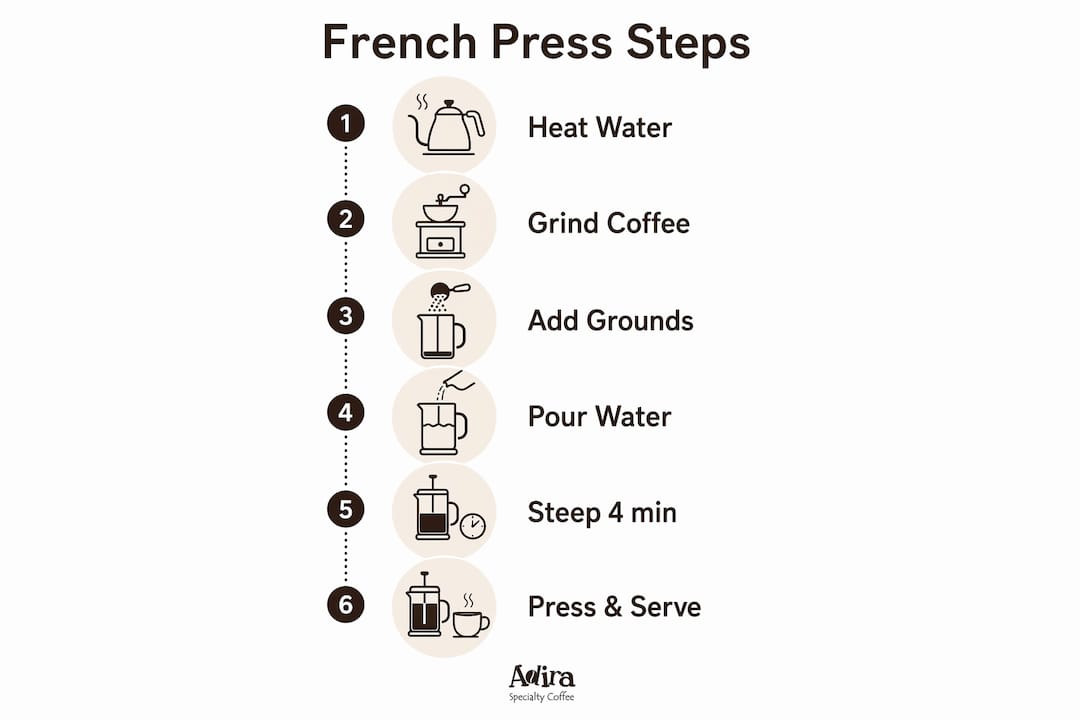
What are the exact brewing steps from heating water to pressing?
This is the core of the French press brewing guide. Follow these steps in order and you will produce a clean, full-bodied cup every time.
-
Heat your water. Bring water to a boil, then wait 30–45 seconds. The target is 195°F–205°F. Water cools roughly 2°C every 15 seconds after boiling, so a 30-second rest lands you near 200°F, which is ideal for medium roasts.
-
Preheat the French press. Pour a small amount of hot water into the empty press, swirl it around, and discard. This step keeps the brewing temperature stable from the first second of contact with the grounds.
-
Add your grounds. Place the French press on your scale, tare it to zero, and add your pre-weighed coarse grounds. For a standard 8-cup press, that is 67g.
-
Start your timer and pour. Pour your measured hot water over the grounds in a slow, circular motion to saturate them evenly. Fill to your target weight (for example, 1,000g for a full 8-cup press). Start the timer the moment you begin pouring.
-
Stir and bloom. After 30 seconds, use your long spoon to gently stir the crust of grounds that forms on top. This breaks the bloom and ensures all grounds contact the water evenly.
-
Place the lid and steep. Set the lid on top with the plunger pulled all the way up. Do not press yet. Steep for 4 minutes as the standard. Adjust slightly by roast: 3.5 minutes for dark roasts, up to 5 minutes for dense light roasts.
-
Press slowly. When the timer hits your target steep time, press the plunger down steadily. Pressing over 15–20 seconds prevents disturbing the grounds and reduces sediment in the cup. If the plunger resists hard, your grind is too fine. If it drops with no resistance, your grind is too coarse.
-
Pour immediately. Do not let the brewed coffee sit on the grounds. Coffee continues extracting after pressing and turns bitter quickly. Decant the full batch into a serving carafe or cups right away.
Pro Tip: If you are brewing for one, pour the entire press into a thermal mug immediately after pressing. Leaving coffee in the press, even after plunging, extracts bitterness within minutes.
How do grind, temperature, steep time, and ratio affect taste?
Each brewing variable pulls the flavor in a specific direction. Understanding the direction helps you fix a bad cup without starting from scratch.
Grind size controls how fast water extracts flavor from the grounds. A grind that is too fine extracts too fast, producing bitterness. A grind that is too coarse extracts too slowly, producing sourness and a thin body. The coarse sea salt texture sits in the middle of that range on purpose.
Water temperature should be customized by roast level to avoid bitterness or sourness. Light roasts are denser and need hotter water and a longer steep to fully extract their complex flavors. Dark roasts are more soluble and extract faster, so slightly cooler water and a shorter steep prevent over-extraction.
| Variable | Too high / too long | Too low / too short |
|---|---|---|
| Grind size | Sludgy, bitter | Sour, thin |
| Water temperature | Bitter, harsh | Flat, sour |
| Steep time | Bitter, astringent | Weak, sour |
| Coffee ratio | Overpowering | Watery |
Pro Tip: Change one variable per brew session. Adjusting one factor at a time and tasting the result is the only reliable way to learn what each change does to your cup.
For a broader look at how grind affects every brewing method, Adiracoffee’s guide on coffee grind size explains the science without the jargon.
What are the most common French press mistakes and how do you fix them?
Most bad French press cups trace back to one of five mistakes. Knowing the cause makes the fix obvious.
-
Using boiling water straight from the kettle. Water at a full boil (212°F) scorches the grounds and pulls harsh, bitter compounds. Rest the kettle for 30–45 seconds before pouring.
-
Grinding too fine. Fine grounds clog the mesh filter and over-extract. The plunger becomes hard to press and the cup tastes muddy. Reset your grinder two or three clicks coarser.
-
Oversteeping. Leaving the coffee to steep beyond 5 minutes extracts tannins and bitter acids. Set a timer every time, without exception.
-
Pressing too hard or too fast. Forcing the plunger disturbs the grounds and pushes sediment into the cup. It can also crack the glass carafe. Press slowly and steadily over 15–20 seconds.
-
Leaving coffee in the press after plunging. The grounds keep extracting even after the plunger is down. Pour the entire batch out immediately.
Adiracoffee’s expert brewing tips cover these fixes in more detail, including how bean freshness affects each variable.
Key Takeaways
Consistent French press coffee requires a coarse grind, a 1:15 coffee-to-water ratio, water at 195°F–205°F, a 4-minute steep, and immediate decanting after pressing.
| Point | Details |
|---|---|
| Grind size first | Use a coarse, sea-salt texture grind (690–1,500 microns) to avoid sludge and bitterness. |
| Weigh everything | Measure coffee and water by grams, not scoops, for repeatable results every brew. |
| Temperature by roast | Use hotter water for light roasts, slightly cooler for dark roasts to balance extraction. |
| Press slowly | Take 15–20 seconds to press the plunger and decant immediately to stop extraction. |
| One change at a time | Adjust a single variable per session to understand its effect on flavor. |
Stefan’s take on getting French press right at home
The first time I brewed French press with a scale and a timer instead of eyeballing everything, the difference was immediate. Not subtle. The cup tasted like the coffee was supposed to taste, not like a rough approximation of it.
What I have found over years of brewing is that most home brewers underestimate how much grind size matters and overestimate how complicated the process is. People spend money on expensive beans and then grind them on a blade grinder set to medium. The result is a muddy, uneven extraction that makes the beans look bad. A decent burr grinder fixes that problem faster than any other upgrade.
The other thing I keep coming back to is the decanting step. I used to leave the press on the counter and pour cup by cup as I drank. By the second cup, the coffee was noticeably more bitter. Pouring everything out immediately after pressing is the simplest habit that produces the biggest improvement in the second and third cup.
My honest advice: brew the same recipe three times in a row before changing anything. Consistency teaches you more than experimentation does. Once the process is automatic, small adjustments become meaningful because you have a reliable baseline to compare against.
— Stefan
Adiracoffee blends worth brewing in your French press
French press rewards coffees with body and complexity. The immersion method pulls out oils and depth that lighter brewing methods leave behind.

Adiracoffee’s Mushroom Coffee Medium Roast is roasted specifically for full-immersion methods. It brews clean at a 1:15 ratio with a 4-minute steep and produces a smooth, earthy cup with functional mushroom benefits built in. For brewers who prefer a bolder result, the Mushroom Coffee Dark Roast responds well to a 3.5-minute steep at 195°F. Every bag ships within days of roasting from California, so the beans arrive at peak freshness. Subscriptions include 10% savings and free US shipping over $35.
FAQ
What is the best coffee-to-water ratio for French press?
The standard ratio is 1:15 by weight, meaning 1 gram of coffee per 15 grams of water. A 1-liter press needs approximately 67g of coffee and 1,000g of water.
How long should French press coffee steep?
Steep for 4 minutes as a baseline. Reduce to 3.5 minutes for dark roasts and extend to up to 5 minutes for dense light roasts to optimize extraction.
What grind size is correct for French press?
Use a coarse grind that resembles coarse sea salt, roughly 690–1,500 microns. Finer grounds clog the filter and cause over-extraction and sludge.
Why does my French press coffee taste bitter?
Bitterness usually comes from water that is too hot, a grind that is too fine, oversteeping, or leaving the coffee sitting on the grounds after pressing. Fix one variable at a time and taste after each change.
Can I use a French press for 2 cups instead of a full pot?
Yes. Scale the recipe down proportionally. For a 350 ml press, use 23g of coffee and 350g of water, keeping the same 1:15 ratio and 4-minute steep time.