
Half caff is a 50/50 blend of regular and decaffeinated coffee that delivers roughly half the caffeine of a standard cup. If you want the ritual and flavor of coffee without the full stimulant load, this is the most practical middle ground available. You can get there three ways: buy a pre-blended bag, ask your barista for a split shot, or mix brewed regular and decaf yourself at home.
Key Takeaways
Half caff delivers roughly half the caffeine of a standard cup — typically 40–60 mg per 8 oz — while preserving most of the flavor, making it the most practical option for afternoon drinking or gradual caffeine reduction.
| Point | Details |
|---|---|
| Caffeine per 8 oz | Half caff typically yields 40–60 mg, versus 85–100 mg for regular and 2–7 mg for decaf. |
| Best home method | Blend regular and decaf beans before grinding for the most consistent extraction and flavor. |
| Cafe ordering tip | Ask for a “split shot” for espresso drinks; say “50/50 blend” for drip to avoid ambiguity. |
| Decaf quality matters | Choose Swiss Water or CO2 decaf; the decaf component makes up half the cup and its quality shows. |
| Adiracoffee option | The Love Blend paired with a fresh Swiss Water decaf, roasted to order and shipped within days. |
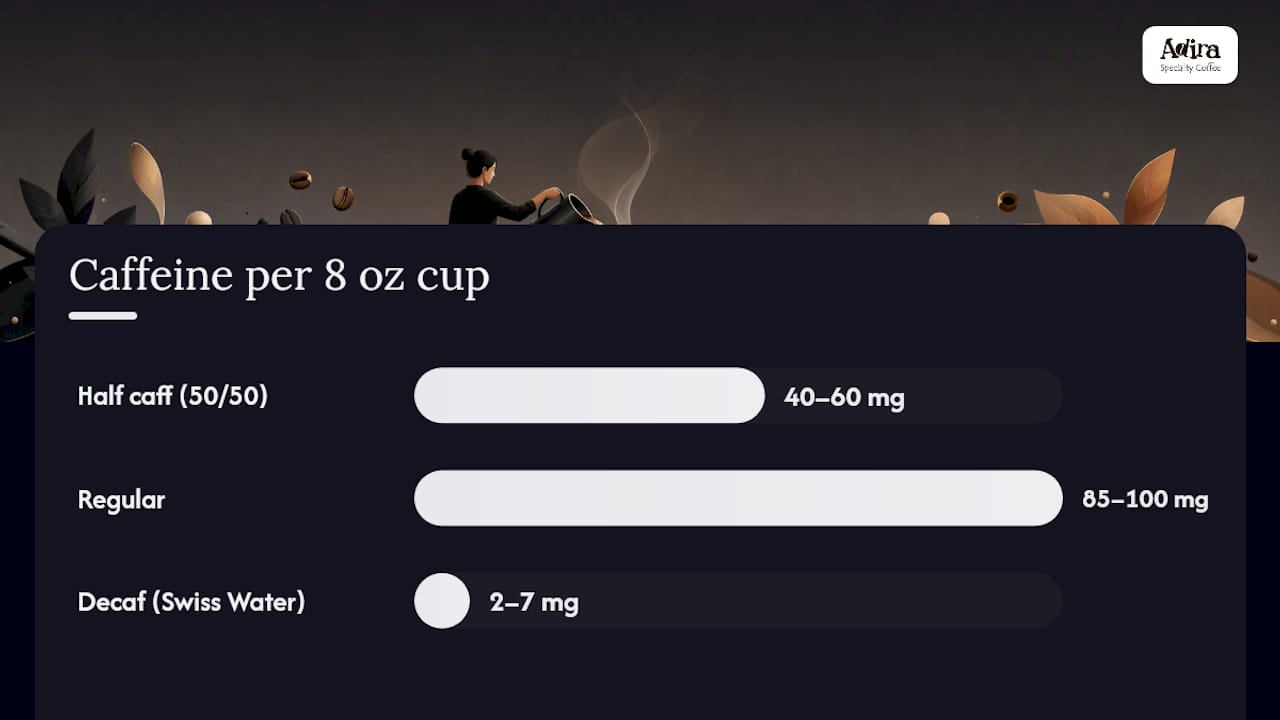
Table of Contents
- What does “half caff” actually mean?
- How much caffeine is in a half-caff cup?
- How to make half caff at home
- How to order half caff at a cafe
- Pros and cons of choosing half caff
- Half caff, decaf, or regular: how to choose
- What specialty roasters know about half caff quality
- Fresh-roasted half caff from Adiracoffee
- Sources
What does “half caff” actually mean?
Half caff coffee is most commonly a 50/50 mix of regular and decaffeinated beans, either blended before roasting, combined after roasting, or split at the espresso machine. The name describes the outcome, not a single fixed method, which is why you’ll encounter it in several forms.
The three most common implementations:
- Pre-blended bag: A roaster combines regular and decaf beans before or after roasting and sells them as a single product. This is the most consistent approach because the ratio is fixed.
- Mixed brewed coffee: You brew a pot of regular and a pot of decaf separately, then combine them in the cup. Simple, but flavor matching is harder to control.
- Split espresso shot: One regular shot and one decaf shot pulled into the same drink. Common in cafes and easy to replicate at home if you have two portafilters or a single-boiler machine.
Beyond the classic 50/50, some roasters offer 60/40 blends (more regular than decaf) for drinkers who want a lighter reduction. The result still carries the “half caff” label informally, though the caffeine reduction is less dramatic.
What makes the numbers genuinely variable: decaf is never fully caffeine-free. Decaffeination methods differ significantly in how much caffeine they remove. The decaf component in your blend contributes a small but real amount of caffeine, and that residual varies by process, origin, and roast.
How much caffeine is in a half-caff cup?
For an 8-oz brewed cup, expect roughly 40–60 mg of caffeine from a well-made half caff. That compares to about 85–100 mg in a standard brewed cup and just 2–7 mg in a typical decaf.
| Coffee type | Caffeine per 8 oz (approx.) |
|---|---|
| Regular brewed | 85–100 mg |
| Half caff (50/50 blend) | 40–60 mg |
| Decaf | 2–7 mg |
Those ranges are estimates. Cappuccino Oracle’s practical testing puts many 8-oz half-caff brews closer to 40–50 mg, depending on brew strength and grind. The variables that push the number up or down:
- Extraction method: Espresso extracts more caffeine per gram of coffee than drip. Cold brew concentrate can extract even more, so a half-caff cold brew concentrate diluted 1:1 may still land higher than a drip half caff.
- Brew strength: A longer steep or finer grind pulls more caffeine regardless of blend ratio.
- Residual decaf caffeine: The decaf component is not zero. A Swiss Water decaf contributes less residual caffeine than a solvent-processed one.
- Cup size: An 8-oz estimate does not scale linearly to a 16-oz travel mug. Double the volume, and you’re roughly doubling the caffeine.
For espresso-based drinks, the math is more direct. A regular single shot carries roughly 60–65 mg; a decaf shot adds a few milligrams. A split double (one regular, one decaf) lands somewhere around 65–70 mg total, which is meaningfully less than a full double espresso.
How to make half caff at home
The cleanest results come from blending beans before brewing, not mixing finished cups. Here’s how to do it across the most common methods.
Pour-over (Hario V60 or similar)
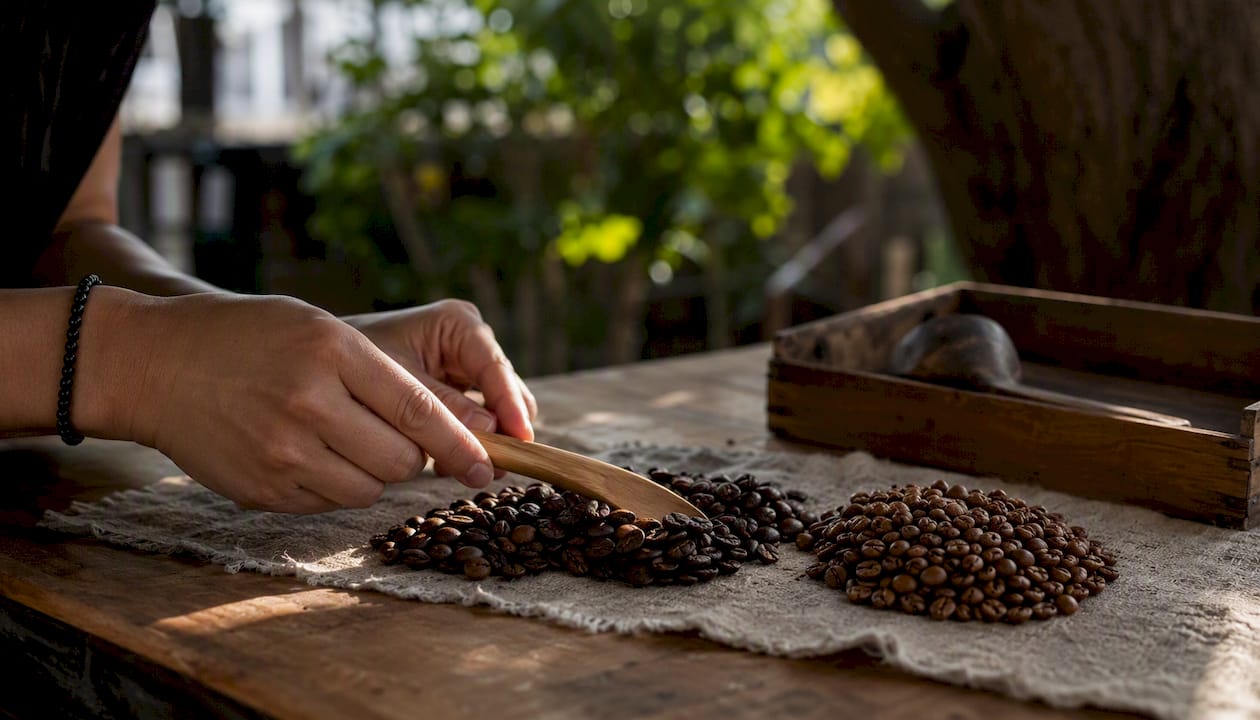
- Weigh out 16 g of regular beans and 16 g of decaf beans (32 g total for a standard 8–10 oz brew).
- Grind together on your usual pour-over setting. Decaf beans are often slightly more porous after processing, so you may need to go one notch coarser than you would with all-regular beans to avoid over-extraction.
- Use water at 200°F (93°C). Bloom with 60 g of water for 30 seconds, then pour in stages to your target of 480–520 g total.
- Target a total brew time of 3:00–3:30. If it’s running long, coarsen the grind slightly.
For a tested starting point, Adiracoffee’s Hario V60 starting recipe gives you a solid baseline to adapt.
Pro Tip: Match roast levels between your regular and decaf beans. A light-roast Ethiopian regular paired with a dark-roast decaf will produce a muddled, uneven cup. Aim for the same roast level and a similar origin profile — both washed Central Americans, for example — and the blend will taste intentional rather than accidental.
Drip / batch brewing
Two approaches here, and they’re not equal.
- Blend beans before brewing: Measure equal parts regular and decaf into your grinder. This gives you even extraction and a consistent cup every time. Preferred method.
- Mix brewed coffee: Brew a full pot of regular and a full pot of decaf, then combine 50/50 in the cup. Faster if you already have both brewed, but flavor matching is harder and you’re working with two separate extractions that may not complement each other.
The bean-blend approach wins on consistency. The brewed-mix approach works in a pinch.
Espresso split shot
Pull one regular shot and one decaf shot into the same cup. At home, this means:
- Dose your portafilter with 9–10 g of regular beans, pull a single shot (25–30 seconds target).
- Without rinsing the cup, pull a second shot with 9–10 g of decaf, same parameters.
- Combine and use as the espresso base for your latte, cappuccino, or Americano.
Timing may differ slightly between your regular and decaf because of the porosity difference. Pull them separately and adjust grind for each if needed.
Cold brew
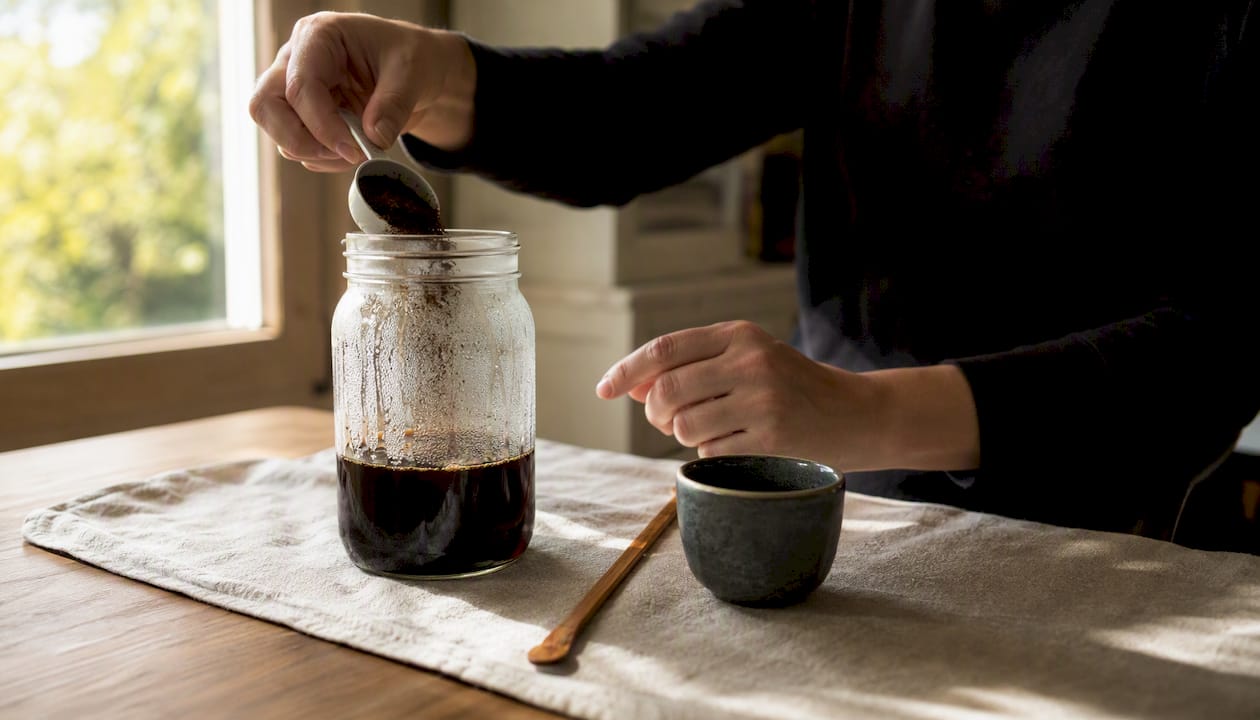
Cold brew is one method where “half caff” math gets complicated. Cold brew concentrate typically uses a 1:4 to 1:5 coffee-to-water ratio and steeps for 12–18 hours, which can extract more caffeine per gram than hot brewing. A 50/50 blend in cold brew concentrate will still yield more caffeine per ounce than a drip half caff. Dilute your concentrate at least 1:1 before drinking, and consider a 40/60 regular-to-decaf ratio if you’re sensitive to caffeine. Adiracoffee’s Cold Brew is a good starting point for experimenting with concentrate ratios.
Pro Tip: Buy smaller bags of decaf. Decaf beans go stale faster than regular because the processing removes some of the oils that slow oxidation. A 250 g bag consumed within 2–4 weeks of the roast date will taste dramatically better than a half-used 1 kg bag sitting in a cabinet.
How to order half caff at a cafe
The phrase “half caff” is understood at most specialty cafes, but what happens behind the bar varies. Knowing what to ask for gets you a more consistent result.
Common ways to phrase the request and what each typically triggers:
- “Half caff, please” — The barista will usually pull a split shot (one regular, one decaf) for espresso drinks. For drip, they may mix brewed coffee or tell you they don’t carry decaf brewed separately.
- “Split shot” — The clearest request for espresso. Most trained baristas know exactly what this means and will pull one regular and one decaf shot.
- “50/50 blend” — More useful when ordering drip or asking about a pre-blended bag. Signals you know what you’re talking about and reduces ambiguity.
- “Can you do half decaf?” — Works fine, but slightly more ambiguous. Some baristas interpret this as a split shot; others may offer a different ratio.
What baristas actually do depends on the shop. Specialty cafes with espresso programs almost always have decaf on hand and can pull a split shot without hesitation. Drip-focused shops may not have decaf brewed, so your options narrow to espresso or a pre-blended bag if they carry one. Some high-volume shops will decline the request during a rush simply because pulling two separate shots takes longer.
Pro Tip: Ask what decaf they’re using before you order. A shop running a solvent-processed decaf will produce a noticeably different cup than one using Swiss Water or CO2 decaf. If the barista doesn’t know, that’s useful information too.
Pros and cons of choosing half caff
Half caff is not the right choice for everyone. Here’s the honest breakdown.
Pros:
- Reduces jitters and anxiety for caffeine-sensitive drinkers without eliminating the coffee ritual
- Allows an extra cup or two per day while staying within moderate caffeine limits
- Preserves most of the flavor experience, especially when the decaf component is high quality
- Useful for tapering caffeine gradually rather than cutting cold turkey
Cons:
- Typically costs 15–25% more than regular coffee because decaffeination adds processing cost
- Flavor quality depends heavily on the decaf component; a poor decaf drags the whole cup down
- Still contains meaningful caffeine, so it’s not appropriate for people who need to eliminate caffeine entirely (pregnancy, certain medications, severe sensitivity)
- Pre-blended bags are less common than regular or single-origin offerings, limiting your options at smaller roasters
Who benefits most: afternoon drinkers who want a second cup without disrupting sleep, people reducing caffeine gradually, parents who want a late-day cup without the full stimulant effect, and anyone who gets jitters from a full-strength brew but finds decaf unsatisfying.
For readers exploring other ways to reduce caffeine crashes without giving up their routine, there are complementary strategies worth knowing.
Half caff, decaf, or regular: how to choose
The decision usually comes down to time of day, sensitivity, and what you actually want from the cup.
- Morning, no sensitivity concerns: Regular coffee. No reason to reduce caffeine if you tolerate it well and you’re drinking it before noon.
- Afternoon cup (after 2 PM): Half caff is the practical choice. You get the ritual and most of the flavor; the reduced caffeine is less likely to push your sleep window later.
- Evening or close to bedtime: Decaf. The 2–7 mg residual in a good decaf is unlikely to affect sleep for most people.
- Caffeine sensitivity, anxiety, or heart conditions: Start with half caff and move toward decaf if needed. The reduction is real and meaningful.
- Pregnancy or medical restrictions: Decaf, and confirm with your healthcare provider. Consumer Reports’ coverage of decaf safety is a useful starting point for understanding residual caffeine in decaf.
What specialty roasters know about half caff quality
From a roaster’s perspective, the single biggest quality variable in a half-caff blend is the decaf component. Because decaf makes up half the cup’s mass, a mediocre decaf doesn’t hide behind the regular — it shows up clearly in the finish, often as a flat or papery aftertaste.
The decaffeination method matters more for half-caff buyers than for anyone else. Swiss Water and CO2 processes remove caffeine without chemical solvents and tend to preserve more of the bean’s original character. Solvent-based methods are effective at caffeine removal but can strip some of the flavor compounds that make a good origin interesting. For a half-caff blend, that difference is amplified.
Practical buying checklist:
- Ask for Swiss Water or CO2 decaf. If the roaster can’t tell you which process they used, that’s a gap worth noting.
- Check the roast date. Decaf beans oxidize faster than regular. A roast date older than 4–6 weeks is a red flag for a decaf component.
- Match roast levels. A roaster who lists both components and their roast levels is doing the work properly.
- Prefer small-batch roasters who roast to order. The decaf in a large commercial blend may have been sitting in a warehouse for months before it reached the bag.
Pro Tip: When buying a pre-blended half-caff bag, look for roasters who disclose the decaf process on the bag or their website. Transparency there is a reliable signal of overall quality — roasters who care enough to list the decaf method usually care about the rest of the process too.
For a deeper look at how roast-matching and blending technique affect the final cup, Adiracoffee’s blending guide covers the principles in detail.
A note on making half caff a daily habit
Half caff works best as a deliberate habit, not a compromise. My afternoon cup is almost always a split shot pulled from a matched pair of beans — same origin profile, same roast level, one regular and one Swiss Water decaf. The difference in flavor compared to a full double is minimal. The difference in how I feel at 10 PM is not.
One practical habit worth adopting: buy your decaf component in smaller quantities than your regular. A 250 g bag of decaf, consumed within three weeks of the roast date, will outperform a 1 kg bag of the same decaf that’s been open for two months. Freshness matters more for decaf than most people realize.
Fresh-roasted half caff from Adiracoffee
Adiracoffee roasts every bag to order in small batches in California, which means the decaf component in any blend you build arrives fresh, not sitting on a shelf. The Love Blend is a natural starting point for half-caff experiments: a balanced, medium-roast signature blend that pairs well with a matched Swiss Water decaf at a 50/50 ratio.
For ongoing half-caff brewing, the Coffee Plan subscription ships fresh-roasted beans on your schedule with a 10% discount and free US shipping over $35. You choose the beans, the grind, and the frequency. Roast date is always on the bag.
Sources
- What is half caff coffee? - The Manual
- Half Caff Coffee Guide: Enjoy Flavor Without Jitters | Coffee Maker Buyer Guides
- What Is Half Caff Coffee? A Specialty Coffee Guide to Getting Your Caffeine Right
- Is decaffeinated coffee bad for you? - Consumer Reports
- What Is Half Caff Coffee and How Much Caffeine Is in It - Cappuccino Oracle