
Anaerobic coffee is coffee fermented with little or no oxygen, usually sealed in tanks or bags before drying, and that oxygen-starved environment pushes flavor toward fruit-forward, wine-like, or downright boozy territory. Results vary widely by protocol. Done well, it produces some of the most striking cups in specialty coffee; done poorly, it tastes like nail polish remover. The Specialty Coffee Association and certified Q-Graders have spent the last decade sorting out which is which, and roasters like Adiracoffee track that research closely when deciding which lots are worth roasting.
Key Takeaways
Anaerobic fermentation reshapes coffee’s chemistry, boosting flavor-precursor metabolites, and the resulting cup quality depends entirely on process control, not the label alone.
| Point | Details |
|---|---|
| Oxygen level defines the method | Sealed, low-oxygen fermentation separates anaerobic from aerobic and semi-anaerobic processing. |
| Fermentation time shapes complexity | Extending fermentation from 24 to 48–72 hours tends to increase volatile compounds and sensory complexity. |
| Flavor range runs wide | Expect anything from jammy, floral, wine-like cups to boozy or vinegar-sharp defects. |
| Transparency signals quality | Look for stated fermentation time, tank type, and cupping scores before paying a premium. |
| Adiracoffee applies the same standard | Adiracoffee roasts to order in small batches and prioritizes sourcing transparency across its single-origin and blend offerings. |
Table of Contents
- What Anaerobic Processing Actually Is
- Anaerobic Variants You’ll See on a Bag
- What the Research Says About Fermentation Chemistry
- Reading the Flavor Profile of Anaerobic Coffee
- Why Anaerobic Lots Cost More and What Can Go Wrong
- How to Choose an Anaerobic Coffee Worth Buying
- Brewing and Tasting an Anaerobic Coffee
- Why Transparency Matters More Than the Label
- Try a Process-Forward Cup From Adiracoffee
- Frequently Asked Questions
- Sources
What Anaerobic Processing Actually Is
Coffee cherries are always full of microbes and sugar, and fermentation happens whether a producer wants it to or not. The question is what kind. Aerobic (open-air) fermentation exposes cherries or parchment to ambient oxygen, favoring yeasts and acetic bacteria that work fast and produce a fairly predictable, cleaner cup. Anaerobic fermentation seals the coffee away from oxygen, in a bag, sealed tank, or barrel, which shifts the microbial population toward anaerobic bacteria and slows the whole process down. Semi-anaerobic sits in between: partial oxygen exposure, often through looser sealing or shorter sealed windows before drying.
- Aerobic: open exposure, yeast and acetic bacteria dominate, faster fermentation, cleaner and more predictable flavor
- Semi-anaerobic: partial sealing, mixed microbial activity, moderate flavor intensity
- Anaerobic: fully sealed, anaerobic bacteria and lactic acid bacteria take over, slower fermentation, higher flavor variability
There’s no single industry standard for “anaerobic.” One producer’s 24-hour sealed bag and another’s 96-hour temperature-controlled tank both get the same label on the bag, even though the resulting coffee can taste nothing alike.
Anaerobic Variants You’ll See on a Bag
Once you start reading labels, you’ll run into a handful of recurring terms, and each describes a different technical choice that changes the cup.
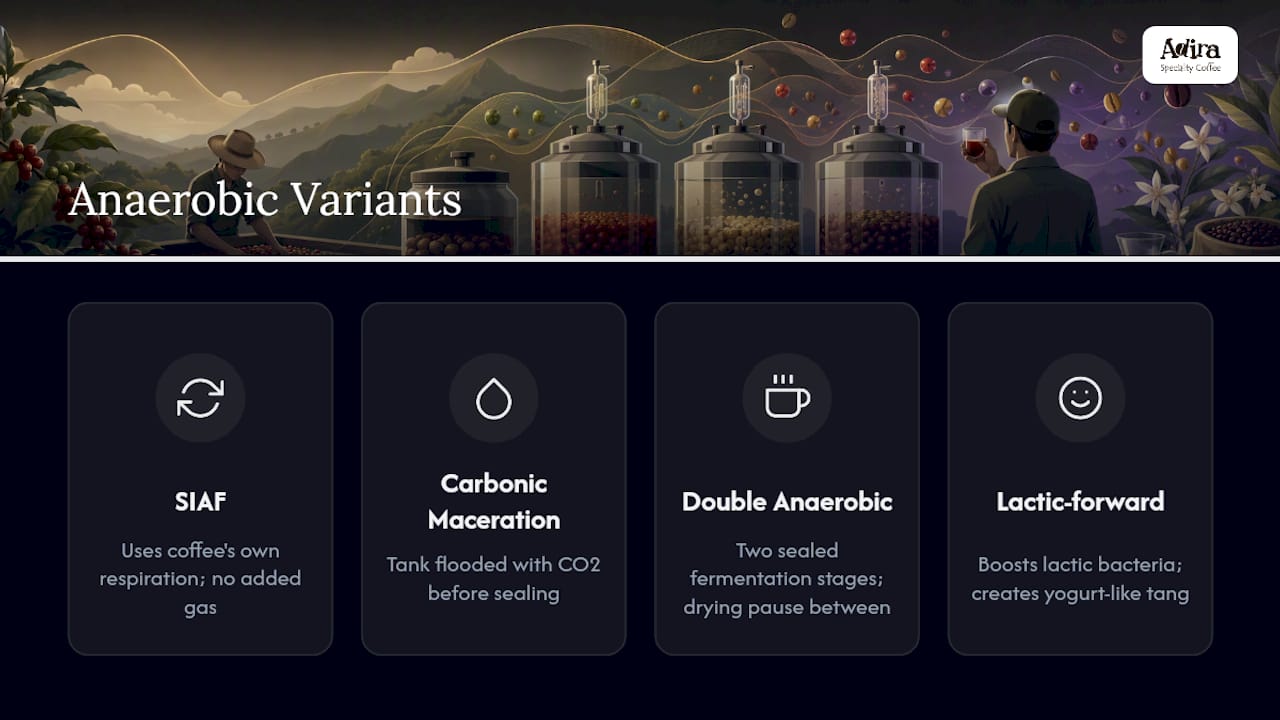
Self-induced anaerobic fermentation (SIAF) relies on the coffee’s own respiration to consume available oxygen inside a sealed vessel, no added gas or starter culture required. Carbonic maceration, borrowed directly from winemaking, floods the tank with CO2 before sealing it, accelerating the shift to anaerobic metabolism. Double anaerobic fermentation runs the cherries through two separate sealed fermentation stages, often with a drying pause between, to layer complexity. Lactic-forward processes lean on inoculation or extended fermentation to boost lactic acid bacteria, chasing a yogurt-like tang some cuppers love and others find overwhelming.
Cherry (natural) fermentation ferments the whole fruit and tends to produce heavier, jammier sweetness. Depulped fermentation strips the skin first and usually yields a cleaner, brighter result. Producers control outcomes with equipment choices: sealed GrainPro-style bags for low-cost experimentation, stainless steel tanks with one-way valves for pressure release, and CO2 purging for consistency. Static tanks aren’t uniform inside, either. Fermentation can progress unevenly between the bottom, middle, and top layers of a single batch, which is one reason some producers now agitate or rotate tanks mid-ferment.
What the Research Says About Fermentation Chemistry
Peer-reviewed work on self-induced anaerobic fermentation found that sealed environments favor Enterobacteriaceae and filamentous fungi over the lactic acid bacteria and yeast that dominate open fermentation, and that extending fermentation from 24 to 48–72 hours measurably increases production of esters, alcohols, and acids, the volatile compounds most responsible for fruity, complex aromas. The same study identified roughly 70 distinct volatile compounds in the roasted beans, with furfural, ethanol, and 2,3-pentanedione rising significantly at the longer fermentation windows.
Metabolomics research goes further on the non-volatile side. One analysis found 843 differential metabolites among 1,682 compounds tested between anaerobic and conventionally processed beans, with 125 characteristic metabolites and 75 that correlated directly with sensory scores. Anaerobically fermented samples outscored conventional coffee on aroma, flavor, aftertaste, acidity, body, and balance in the same panel.
- Longer fermentation (48 to 72 hours) generally builds more volatile complexity than 24 hours
- Amino acid derivatives and organic acids accumulate as flavor precursors under anaerobic conditions
- Microbial activity differs by tank layer, not just by fermentation time
Fermentation time is a lever, not a guarantee. Push it too far without temperature control and you get instability instead of complexity.
Reading the Flavor Profile of Anaerobic Coffee
Well-executed anaerobic lots tend to cluster around a recognizable set of descriptors: jammy fruit, floral high notes, lactic sweetness, bright acidity, and a dense, syrupy body. A Gayo Arabica study using 24 to 48 hour pulped natural fermentation linked much of that fruit and honey character to β-damascenone, a volatile compound with an outsized effect on perceived aroma even in tiny concentrations.
- Positive outcomes: jammy fruit, floral aromatics, lactic sweetness, syrupy body, bright wine-like acidity
- Negative outcomes: boozy or solvent-like notes, sharp vinegar acidity, excessive funk, vegetal or rotten undertones
Roast level and origin both interact with the fermentation. A dark roast can mute delicate ester notes that a light roast would showcase, while a naturally fruity origin like an Ethiopian heirloom variety can amplify anaerobic character to the point of overwhelming the cup. Origin and terroir still set the baseline; anaerobic processing is the amplifier layered on top.
Why Anaerobic Lots Cost More and What Can Go Wrong
Small-batch experimentation is expensive. Producers need dedicated tanks, temperature monitoring, and staff time to babysit fermentation that can run three or four days instead of a few hours, and they risk losing an entire lot if the batch goes acetic or moldy from oxygen ingress or a temperature spike. Sorting is also more labor-intensive since anaerobic lots need closer cupping before export to catch defects early.
- Uncontrolled temperature swings can push fermentation toward vinegar-sharp acetic acid instead of clean fruit acidity
- Oxygen leaks into a “sealed” tank invite the same acetic bacteria anaerobic processing is meant to avoid
- Overgrown mold or rot risk rises the longer a batch sits without monitoring
Industry reporting is consistent on one point: anaerobic isn’t a synonym for higher quality, it’s a tool that rewards process control and punishes sloppiness equally.
Pro Tip: Look for a roaster or producer willing to state fermentation time, tank type, and whether the lot was cupped or scored by a Q-Grader. Vague language like “specially fermented” with no specifics is a red flag, not a selling point.
How to Choose an Anaerobic Coffee Worth Buying
Before you buy, scan the bag or product page for the details that actually predict cup quality:
- Named process variant (SIAF, carbonic maceration, double anaerobic)
- Fermentation duration in hours
- Cherry versus depulped fermentation
- Tank type or evidence of gas purge and temperature control
- Cupping score or Q-Grader notes
- Roast date and lot or batch size
Roast date matters more with anaerobic lots than with conventionally processed coffee, since the volatile compounds driving that fruity complexity fade fastest. A bag roasted three weeks ago has already lost some of what made it worth the premium. When judging price, compare price-per-pound against a comparable single-origin lot from the same region and harvest year. A premium of a few dollars a pound is reasonable given the labor and risk involved; a premium with zero process detail to back it up is not.
Brewing and Tasting an Anaerobic Coffee
- Filter brewing: Start with a slightly coarser grind than usual and water around 200°F to avoid over-extracting bitterness that can mask fruit notes.
- Espresso: Pull a shorter, higher-ratio shot to keep boozy or funky notes in check; anaerobic lots can turn muddy at long, slow extractions.
- Cupping: Break the crust and note aroma first, then sip for acidity, body, and how the finish lingers or fades.
Pro Tip: If a shot tastes overripe or fermented rather than fruity, pull it shorter and grind slightly coarser before writing off the lot.
Pro Tip: A cup that reads too extreme on its own can work beautifully blended fifty-fifty with a cleaner washed origin to round out the edges.
Why Transparency Matters More Than the Label
At Adiracoffee, we treat “anaerobic” as a starting point for questions, not a finish line. Before we roast an experimental lot, we want fermentation time, tank type, and cupping notes from the producer, the same details we tell readers to look for. We roast to order and dial roast profiles specifically to preserve the fruit and floral notes that process-driven lots are built around.
Try a Process-Forward Cup From Adiracoffee
If anaerobic fermentation has you curious about what oxygen-starved processing can do to a cup, Adiracoffee’s small-batch, roast-to-order model means you’re never drinking coffee that’s been sitting on a shelf for months. Every bag ships within days of roasting, so the volatile compounds that make process-driven coffee interesting are still intact when it hits your cup.

While we don’t currently carry a straight anaerobic single-origin, our Mushroom Coffee (Medium Roast) and Mushroom Coffee (Dark Roast) show the same philosophy at work: careful sourcing, small-batch roasting, and full transparency about what’s in the bag. If you want to explore our single-origin lineup sourced from Colombia, Ethiopia, Costa Rica, Mexico, and Sumatra, or lock in fresh roasts on a schedule, check out the Coffee Plan subscription for 10% savings and free US shipping over $35.
Frequently Asked Questions
Is anaerobic coffee always better than washed or natural coffee? No. Anaerobic processing changes flavor direction, not inherent quality. Poorly controlled anaerobic fermentation can produce worse defects than a well-executed washed or natural lot.
How long does anaerobic fermentation typically take? It ranges widely, commonly 24 to 96 hours, depending on the variant and the producer’s target flavor profile. Longer fermentation generally increases volatile compound production but raises the risk of spoilage.
Why does anaerobic coffee cost more? Small-batch experimentation, dedicated tanks, closer monitoring, and higher risk of losing a batch to spoilage all add cost that gets passed on in the price per pound.
Can I brew anaerobic coffee like any other specialty coffee? Mostly yes, with small adjustments. A slightly coarser grind for filter brewing and a shorter espresso extraction help keep intense fermentation notes from turning muddy or overly boozy.
Sources
- Understanding the Effects of Self-Induced Anaerobic Fermentation on Coffee Beans Quality: Microbiological, Metabolic, and Sensory Studies
- Metabolome analysis of processing methods regulating flavor precursors in Arabica coffee beans and correlation with sensory attributes
- A Quick Guide to Anaerobic Coffee
- Sensory Properties and Volatile Compound Profile of Anaerobic Fermented Gayo Arabica Coffee In Non-Washed Processing