
TL;DR:
- A coffee flavor wheel provides a structured vocabulary to better identify and describe coffee’s complex aromas and tastes, moving from broad categories to specific attributes. It is rooted in scientific calibration through the World Coffee Research Sensory Lexicon, ensuring consistency across tasters worldwide. The wheel enhances sensory analysis for both casual drinkers and professionals, making tasting more mindful, precise, and communicative.
Aroma and taste account for up to 80% of sensory perception in every cup of coffee, yet most people struggle to describe what they’re actually tasting beyond “strong” or “smooth.” That’s exactly the problem the coffee flavor wheel was designed to solve. It gives you a shared vocabulary, a structured framework for translating vague impressions into precise, recognizable descriptors. Whether you’re tasting your morning cup with more curiosity or preparing for a serious cupping session, understanding this tool changes how you experience coffee entirely.
Table of Contents
- Key takeaways
- What is a coffee flavor wheel
- The science behind the flavor wheel
- How to use a coffee flavor wheel effectively
- Common flavor categories and what they actually taste like
- From casual drinker to professional: who uses the wheel
- My honest take after years of tasting with the wheel
- Taste more with Adiracoffee
- FAQ
Key takeaways
| Point | Details |
|---|---|
| Wheel structure matters | The flavor wheel moves from 9 broad categories in the center to 86 specific attributes at the outer edge. |
| Science backs every term | All descriptors are calibrated against physical reference products through the World Coffee Research Sensory Lexicon. |
| Use it in three tasting stages | Smell dry grounds, wet grounds, then sip to capture the full coffee flavor profile. |
| Start broad, go specific | Begin at the center with general categories and work outward to narrow down precise flavor notes. |
| It works for everyone | Casual drinkers and professionals alike use the flavor wheel to sharpen sensory skills and communicate taste accurately. |
What is a coffee flavor wheel
The coffee flavor wheel is a concentric circular diagram that maps out every major flavor and aroma attribute found in coffee, organizing them from the most general in the center to the most specific at the outer edge. Think of it as a visual language for your palate. Instead of saying a coffee tastes “kind of fruity and a little tangy,” you can land on “citrus, lemon” with confidence.
The wheel’s structure follows three concentric layers. The innermost ring holds 9 core categories. The middle ring breaks those into more focused subgroups. The outer edge contains 86 specific flavor attributes where you’ll find terms like “jasmine,” “dark chocolate,” “dried mango,” and “cedar.” The first version of this tool appeared in 1995, then updated in 2016 after the most extensive collaborative coffee taste research ever conducted, expanding from 52 to 110 attributes.
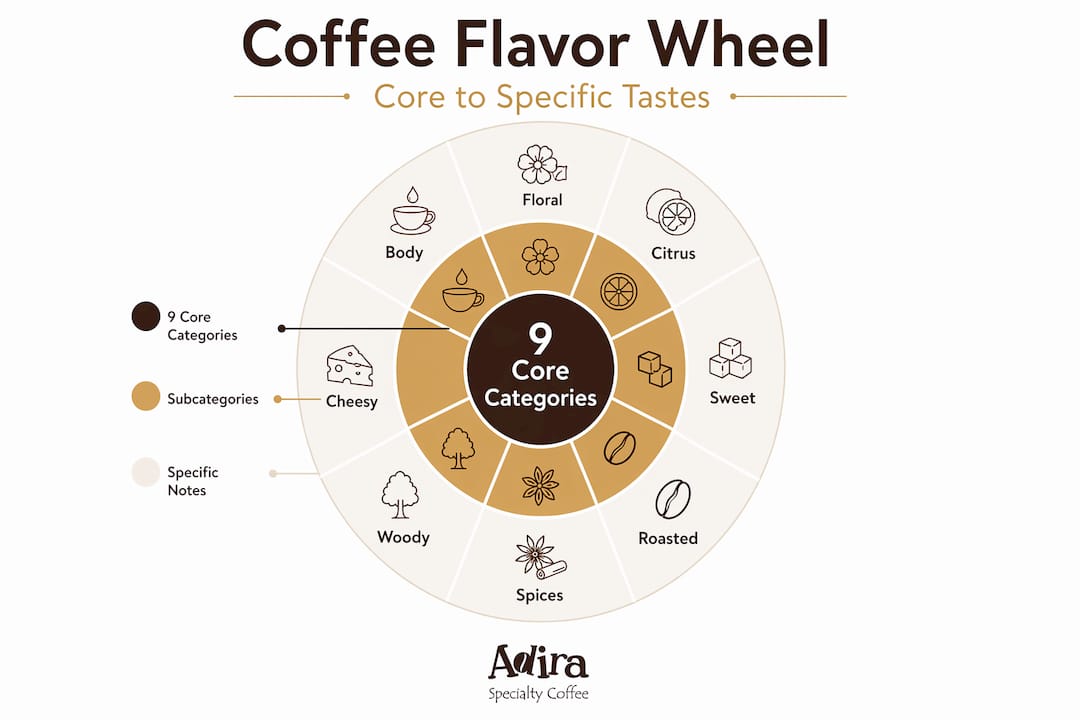
Color coding makes the wheel far more practical than a plain text chart. Each flavor group carries a distinct color family, so color-coded categories help tasters navigate between related descriptors without losing their place. Green shades, for example, cluster around vegetal and herbal notes, while warm oranges and reds signal fruity territory.
Here’s a quick reference to the nine core categories and what each covers:
| Core category | Examples of notes |
|---|---|
| Fruity | Citrus, berry, dried fruit |
| Floral | Jasmine, rose, chamomile |
| Sweet | Honey, vanilla, maple syrup |
| Nutty / Cocoa | Almond, dark chocolate, hazelnut |
| Spices | Cinnamon, clove, nutmeg |
| Roasted | Tobacco, cedar, pipe tobacco |
| Green / Vegetative | Olive, raw, straw |
| Fermented | Wine, beer, whiskey |
| Other | Chemical, papery, rubber |
The last two categories (fermented and other) often signal processing methods or defects, which makes them just as useful for quality evaluation as the more appealing flavor groups.
The science behind the flavor wheel
The coffee flavor wheel is not a marketing graphic or a decorative coffee shop poster. It is grounded in the World Coffee Research Sensory Lexicon, a rigorously developed standard vocabulary built specifically for sensory analysis. Every descriptor in that lexicon was tested, defined, and assigned a physical reference product so tasters anywhere in the world can calibrate their perception to the same standard.
That calibration detail matters more than most people realize. When you see the term “blackberry” on the wheel, it doesn’t just mean “something berry-like.” Professionals calibrate using Smucker’s Blackberry Jam as the defined physical reference for that specific attribute. This turns a subjective impression into an objective, repeatable data point. Two tasters in different countries can now confirm they’re experiencing the same note.
“The flavor wheel is more than a decorative infographic; it is a scientifically rigorous instrument designed for mindful tasting and sensory training.”
The wheel also reflects how flavor is a combination of taste sensations on the tongue and aromatics perceived through your nose simultaneously. This is why coffee tasted while pinching your nose loses most of its complexity. The wheel accounts for both channels by covering everything from roasted bitterness (taste) to floral perfume notes (olfactory), giving you a complete sensory map rather than a partial one.
Pro Tip: Before your first serious tasting session with the wheel, spend five minutes smelling reference ingredients from your kitchen, whole spices, fresh citrus zest, a piece of dark chocolate. Grounding your nose in real-world references before tasting coffee makes the wheel’s outer attributes click much faster.

How to use a coffee flavor wheel effectively
Using the flavor wheel actively is what separates a memorable tasting from just drinking a cup. Here is a practical process you can apply immediately, whether you’re at home with a coffee cupping setup or simply tasting a fresh pour-over at your kitchen table.
-
Smell the dry grounds. Before adding water, inhale deeply over the dry, freshly ground coffee. This is the fragrance stage. Notice the first impressions: Is it chocolatey? Fruity? Earthy? Match those first impressions to the core categories at the center of the wheel.
-
Smell the wet grounds. After adding hot water or blooming the grounds, lean in and inhale again. Moisture releases volatile aromatics that weren’t detectable in dry form. This aroma stage often reveals floral or fruit notes that were hidden.
-
Sip and hold. Take a sip and let the coffee coat your entire palate before swallowing. Notice the first sensation on your tongue (bitterness, sweetness, acidity), then pay attention to what develops 5 to 10 seconds later. That evolution is where the most interesting notes live.
-
Start at the center, work outward. Once you have a general impression, find it on the wheel’s inner ring. From “fruity,” move to the middle ring to narrow it down (citrus? berry? dried fruit?). Then scan the outer edge for the most precise match (lemon? strawberry? raisin?). The wheel is designed to refine identification step by step, not deliver an instant answer.
-
Note multiple attributes. Most specialty coffees carry more than one discernible note. A well-roasted Ethiopian might show jasmine, blueberry, and a honey-like sweetness in the same cup. Track them separately and note whether they appear in the fragrance, aroma, or flavor stage.
-
Revisit as the coffee cools. Temperature dramatically affects flavor perception. Notes that were buried under bitterness when the coffee was scalding often emerge clearly once it drops to around 130°F.
Pro Tip: Keep a small tasting notebook. After a few sessions, you’ll notice patterns: coffees from certain origins consistently land in specific wheel zones. That pattern recognition is how your coffee flavor profile literacy grows fastest.
Common flavor categories and what they actually taste like
Understanding the flavor categories as abstract terms is one thing. Knowing what they actually taste like in your cup makes the wheel truly useful. Here’s how the major categories show up in real coffee experiences.
The sweet category is one of the most accessible. Notes like honey, brown sugar, vanilla, and maple syrup appear most prominently in light to medium roasts, especially from Colombian or Brazilian origins. These aren’t artificial sweetness sensations. They’re natural compounds in the bean that survive the roast process. Sweet, fruity, and floral notes like honey, lemon, jasmine, cinnamon, and tobacco represent the main categories encountered in specialty coffee.
The fruity category splits into three distinct directions on the wheel:
- Red fruits: Strawberry, raspberry, cherry. These tend to appear in washed Ethiopian or Kenyan coffees with bright acidity.
- Citrus: Lemon, orange, grapefruit. Common in coffees with high acidity and light roast profiles from Central American origins.
- Dried fruits: Raisin, prune, fig. These appear more often in natural-process coffees or darker roasts where the original fruitiness has concentrated.
The floral category is where many tasters get excited and confused at the same time. Jasmine and rose are the benchmark references here. If you’ve never encountered a floral coffee, a lightly roasted Ethiopian natural process is your best starting point. The aroma stage is where floral notes are most detectable.
Roasted notes occupy their own world at the other end of the spectrum. Tobacco, woody undertones, dark chocolate, and smoky notes characterize darker roasts. These aren’t flavor defects. They’re intentional, valued attributes in espresso blends and dark roast traditions. Understanding how roasting profiles transform these attributes is key to appreciating why the same bean from the same farm tastes so different at different roast levels.
Spice notes like cinnamon, clove, and nutmeg often appear in coffees from Sumatra or Guatemala and show up most clearly in the finish, the lingering aftertaste after swallowing.
From casual drinker to professional: who uses the wheel
The coffee flavor wheel is genuinely useful across the full spectrum of coffee experience, from someone who just upgraded from instant coffee to Q-graders with formal sensory training. The barrier to entry is lower than most people assume.
For casual drinkers, the wheel reframes tasting as an active skill rather than a passive habit. Instead of deciding whether you like or dislike a cup, you start asking what you’re tasting and why. That shift alone deepens enjoyment significantly. It also makes it much easier to find your best coffee match when you can articulate what you’re looking for beyond “something bold.”
For professionals, the wheel serves several specific functions:
- Sensory analysis during cupping: Q-graders use the wheel to score and document coffee attributes against a standard scale, which is how specialty coffee gets graded and priced.
- Quality control: Roasters reference wheel descriptors to confirm a roast profile is hitting its intended flavor targets and not introducing off-notes.
- Communication between partners: A farmer in Colombia and a roaster in California can describe the same lot’s flavor profile using wheel terms with confidence that both are referencing the same sensory experience. Understanding how coffee origin shapes flavor is the first layer of that conversation.
- Consumer education: Baristas use wheel terminology to help customers identify what they enjoy and guide them toward coffees they’ll love.
Even science is catching up. Electrochemistry measurements now add numeric precision to flavor profiling, but these techniques quantify what the flavor wheel already maps conceptually. The wheel remains the gold standard for human sensory understanding because no instrument can replicate the nuance of a trained palate working through a structured tasting.
My honest take after years of tasting with the wheel
I’ll be direct: before I started using the flavor wheel regularly, I thought I understood coffee. I’d been sourcing and roasting for years, working with farms across Colombia, Ethiopia, and Costa Rica. But my tasting vocabulary was lazy. I’d describe a lot as “clean and bright” and call it done.
What I’ve learned through repeated structured tasting is that the wheel doesn’t just give you words. It trains your attention. When you know you’re looking for something specific, like whether that citrus impression is closer to lemon or orange peel, you engage your palate in a completely different way. The flavor is the same. Your ability to perceive it changes.
The misconception I hear most often is that the wheel is intimidating or only for professionals. That’s backwards. Professionals have access to formal sensory training that gives them an advantage. But the wheel itself is a democratic tool. Anyone willing to slow down and taste mindfully can use it. The only thing it requires is patience with yourself during the first few sessions.
What I tell people who are starting out: don’t try to identify everything at once. Pick one category per session and focus there. After four or five sessions, you’ll be surprised how much your tasting vocabulary has expanded without it feeling like studying.
— Stefan
Taste more with Adiracoffee
At Adiracoffee, every coffee we roast is selected because it has something interesting to say on the flavor wheel. Our small-batch, freshly roasted beans from farms in Colombia, Ethiopia, Costa Rica, Guatemala, Brazil, and Sumatra each carry distinct, traceable flavor profiles, the kind that reward the attentive tasting approach you’ve just learned. If you’re not sure where to start, our coffee preference quiz helps you identify your sensory profile and match it to the right origin and roast. Ready to explore by roast level and flavor character? Browse our coffees by roast level and pick a starting point that fits exactly where your palate is right now.
FAQ
What is a coffee flavor wheel exactly?
The coffee flavor wheel is a concentric diagram with 9 core flavor categories at the center and 86 specific attributes at the outer edge, developed by the Specialty Coffee Association using the World Coffee Research Sensory Lexicon to standardize tasting vocabulary.
How do I start using a coffee flavor wheel?
Start at the center of the wheel during tasting. Identify a broad category first (fruity, sweet, roasted), then move outward ring by ring to narrow your impression down to a specific descriptor like “lemon” or “dark chocolate.”
Is the coffee flavor wheel only for professionals?
No. While Q-graders and sensory scientists rely on it for formal analysis, any coffee enthusiast can use the wheel to sharpen their palate, describe what they’re tasting, and discover new flavors with more precision.
What are the main categories on the coffee flavor wheel?
The nine core categories are fruity, floral, sweet, nutty and cocoa, spices, roasted, green and vegetative, fermented, and other. Each category branches into more specific subcategories at the outer edge.
Why does the coffee flavor wheel use color coding?
Color coding groups related flavors visually so tasters can navigate the wheel faster. Each color family clusters related descriptors together, making it easier to spot connections between similar notes without reading every term on the outer edge.