
Your moka pot needs a medium-fine grind, finer than drip coffee but noticeably coarser than espresso powder. Picture table salt or fine sand — that’s the texture you’re after. A practical particle-size reference puts the sweet spot at roughly 360–660 microns, which lands between the two extremes most home grinders can hit. And whatever you do, don’t tamp the basket.
Three quick checks before you brew:
- Texture check: Pinch a small amount between your fingers. It should feel gritty and granular.
- Brew time check: Total brew should take 4–5 minutes. Faster than 2 minutes means grind too coarse; only sputtering with no steady stream means too fine.
- Taste check: Balanced, slightly sweet, and full-bodied is the goal. Bitter points to over-extraction; sour or thin points to under-extraction.
Key Takeaways
The ideal moka pot grind size is medium-fine with a table salt texture, brewed on medium heat for a suitable duration, with small adjustments and stopping before the sputter phase.
| Point | Details |
|---|---|
| Target grind texture | Medium-fine, like table salt — roughly 360–660 microns, finer than drip but coarser than espresso. |
| Brew time target | Aim for a 4–5 minute total brew with a steady stream; under 2 minutes means grind too coarse. |
| Bitter fix | Go one click coarser and remove from heat before the gurgling sputter phase begins. |
| Sour or weak fix | Go one click finer and confirm the basket is filled level with the correct dose. |
| Adiracoffee recommendation | Fresh-roasted beans from Adiracoffee, dialed in for your specific grinder and pot size, reduce the trial-and-error significantly. |
Table of Contents
- Why medium-fine grind works for your moka pot
- How to dial in your moka pot grind step by step
- How pot size, roast, and heat change your ideal grind
- Diagnosing and fixing common moka pot problems
- Quick-reference cheat sheet for moka pot brewing
- Barista-tested tips from Adiracoffee’s Stefan
- What I’ve learned from dialing in moka pots
- Fresh beans make every grind setting work harder
- Sources
Why medium-fine grind works for your moka pot
A moka pot generates roughly 1–2 bars of steam-driven pressure. An espresso machine runs at 9 bars. That gap matters enormously for grind choice. Research confirms that moka extraction depends on pressure buildup, bed permeability, and heat loss — water only flows once pressure exceeds the resistance of the coffee bed. Pack the bed too tight with espresso-fine grounds and the pressure can’t push through, causing clogging, stuttering flow, and bitter over-extraction. Go too coarse and water races through without extracting enough, leaving a thin, sour cup.
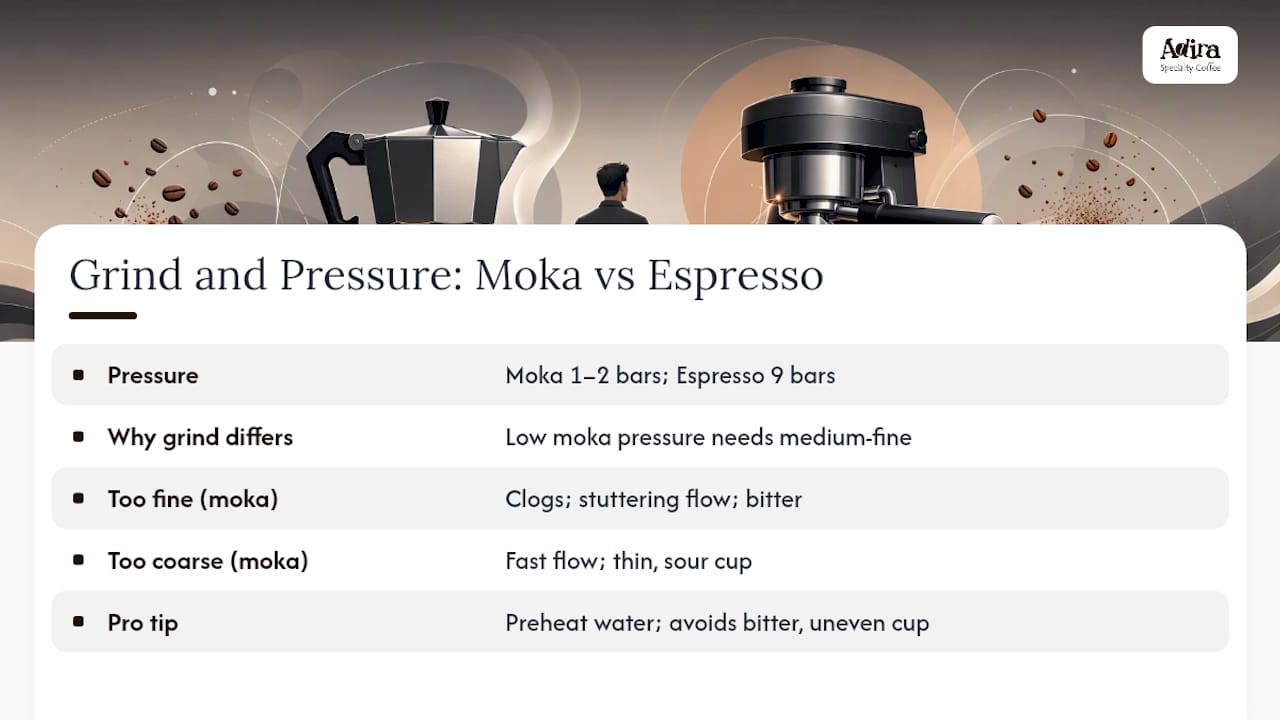
Medium-fine grounds create enough resistance for full extraction while allowing steady flow at the low pressure a moka pot generates. Bialetti, the original moka pot manufacturer, explicitly recommends medium-grained coffee and warns that overly fine powder prevents water from passing through and that it produces burnt flavors.
Pro Tip: Start with preheated water in the bottom chamber. Cold water sitting on the stove takes longer to reach pressure, which means the coffee bed sits in contact with warming water before extraction even begins — that’s a recipe for uneven, slightly bitter results. Preheating shortens the ramp time and keeps the extraction window clean.
How to dial in your moka pot grind step by step
Follow this sequence once, adjust, and you’ll land on your setting within two or three brews.
- Set your starting grind. On a Baratza Encore, begin around setting 10–12. On a Comandante C40, try 18–20 clicks. On a blade grinder, aim for a medium-fine pulse (about 10–12 seconds). These are starting points, not final answers.
- Dose by pot size. Fill the basket level and loose — no mounding, no pressing. Use the doses in the table below.
- Use preheated water. Fill the bottom chamber to just below the safety valve with hot water from a kettle.
- Assemble and heat on medium. Medium heat keeps pressure buildup steady. High heat spikes pressure and scorches the end phase.
- Time the brew. Start your timer when you put the pot on the stove. The main flow should begin around the 2–3 minute mark and run as a steady, honey-colored stream.
- Taste and observe. After the first brew, taste critically. Bitter? Go one click coarser. Sour or weak? Go one click finer. Change only one variable per trial.
- Stop before the sputter. Remove the pot from heat the moment the stream starts to sputter and gurgle. That end-phase pulls harsh, scorched compounds into the cup.
Dosing guidance sourced from The Coffee Locator’s moka pot guide.
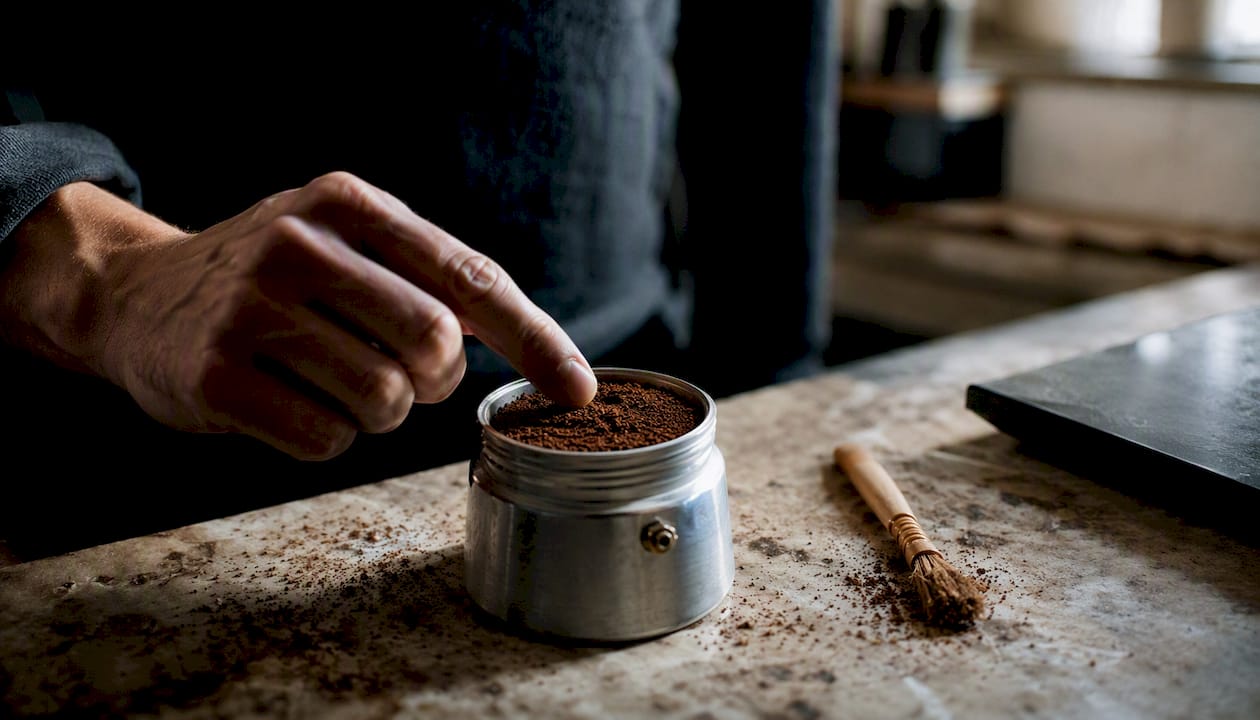
Pro Tip: Level the grounds in the basket with your finger or a small brush — never press them down. Distribution matters; tamping does not. A flat, even bed extracts far more consistently than a packed one.
How pot size, roast, and heat change your ideal grind
The medium-fine target is a starting point, not a fixed rule. Real-world variables push it in either direction.
- Smaller pots (1–3 cup) have a shallower coffee bed, so water passes through faster. Dialing slightly finer compensates for the shorter contact time.
- Larger pots (6–9 cup) have more coffee mass and a deeper bed. A touch coarser prevents over-restriction and keeps flow steady.
- Light roasts are denser and harder to extract. They often benefit from grinding a hair finer and using slightly lower heat to extend contact time.
- Dark roasts are more porous and extract faster. Go slightly coarser and pull the pot off heat a few seconds earlier than you would with a medium roast.
- Heat control is underrated. Medium heat is the consistent choice. High heat rushes the end phase and introduces the scorched, ashy notes that most people blame on their grind when the stove is actually the culprit.
Diagnosing and fixing common moka pot problems
Most moka pot problems trace back to grind, dose, or heat — and usually one of them.
- Bitter, harsh cup. Likely cause: grind too fine, or you brewed into the sputter phase. Fix: go one click coarser and remove from heat the moment the stream starts to gurgle.
- Sour, thin, or weak cup. Likely cause: grind too coarse, or dose too low. Fix: go one click finer, confirm you’re filling the basket level, and check your brew time — under 2 minutes usually signals too coarse a grind.
- Sputtering with no steady stream. Likely cause: grind too fine, heat too high, or gasket worn. Fix: coarsen the grind first, then lower the heat. If the problem persists, inspect the rubber gasket and filter plate for buildup.
- Slow or no flow. Likely cause: grind too fine or basket overfilled. Fix: coarsen the grind and level the dose without mounding.
- Inconsistent results brew to brew. Likely cause: blade grinder producing uneven particles, or stale coffee. Fix: switch to a burr grinder and grind fresh for each brew. Stale coffee loses CO2 and behaves unpredictably in the basket.
Always change one variable per trial. Changing grind and dose simultaneously makes it impossible to know which fix worked.
Quick-reference cheat sheet for moka pot brewing
Three rules that apply to every row: use a burr grinder when possible, never tamp the basket, and stop the brew before aggressive sputtering.
Barista-tested tips from Adiracoffee’s Stefan
Stefan Nedelchev co-founded Adiracoffee with his wife Ekaterina after years of frustration with supermarket coffee that couldn’t survive a second cup. At Adiracoffee, every bag is roasted to order in small batches in California and ships within days of roasting — which means the coffee you’re dialing in is actually fresh, not sitting in a warehouse for months.
A few tips that don’t show up in most guides:
- Grind fresh, every time. Pre-ground coffee loses its CO2 rapidly, which changes how the bed compresses and flows. A grind that worked perfectly on Monday may run differently by Thursday with the same bag pre-ground.
- Stop before the sputter, every time. The strombolian end-phase is predictable. You’ll hear the pitch of the flow change from a steady hiss to a gurgling sputter. That’s your cue. Remove the pot immediately.
- Try Adiracoffee’s Love Blend for moka. It’s a signature blend dialed for balance across roast levels — forgiving enough for beginners and interesting enough for experienced home baristas.
Pro Tip: Clean your burr grinder every two weeks with a dry brush or grinder cleaning tablets. Old coffee oils coat the burrs and shift your effective grind size without you touching the setting. If your brew suddenly tastes off and you haven’t changed anything, the grinder is often the culprit.
What I’ve learned from dialing in moka pots
The most common mistake I see home brewers make is treating the moka pot like a set-and-forget appliance. They buy pre-ground coffee labeled “espresso,” pack it into the basket, crank the stove to high, and then wonder why the cup tastes burnt. The fix is almost always the same: coarser grind, lower heat, stop earlier.
Small adjustments produce surprisingly large flavor changes in a moka pot. One click on a burr grinder can shift the cup from harsh to balanced. Keep a simple log: write down your grinder setting, the roast, and a one-word taste note after each brew. After three or four sessions, you’ll see a pattern and stop second-guessing yourself.
Fresh beans make every grind setting work harder
Dialing in grind size is only half the equation. Stale coffee undermines every adjustment you make — the bed behaves differently, the flavors are flat, and no setting feels quite right. Adiracoffee roasts every bag to order in small batches in California and ships directly to you within days of roasting, so the coffee arriving at your door is genuinely fresh.

For moka pot brewing, the Mushroom Coffee Medium Roast and the Mushroom Coffee Dark Roast are both dialed for the medium-fine range — approachable for beginners and rewarding for experienced home baristas. Prefer a signature blend? The Love Blend is a consistent performer across moka pot sizes. Subscribers save 10% and get free US shipping over $35. Start your coffee plan and get freshly roasted beans matched to your grinder and brew method.
Sources
- Ground coffee for Moka should never be pressed! — Bialetti
- Minimal thermo-fluid model of moka pot extraction — arXiv
- How to Use a Moka Pot (Step-by-Step) | The Coffee Locator
- Moka Pot Grind Size | Honest Coffee Guide
- Moka Pot Grind Size: The Complete Extraction Science Guide — CoffeeGearHub
- Best Grind Size for Moka Pot (Fine, Not Espresso Fine) - Home Coffee Beginner
- Moka pot end-phase dynamics and sputtering — DOI article