
TL;DR:
- Natural process coffee involves drying whole cherries with their fruit intact, leading to rich, fruity flavors.
- However, its production is weather-dependent and challenging, demanding careful monitoring to prevent spoilage.
If you’ve ever picked up a bag of coffee and wondered what “natural process” actually means, you’re not alone. What is natural process coffee? It’s one of the most flavor-forward methods in the specialty coffee world, yet it’s also one of the least understood. The way coffee is processed after harvest shapes everything in your cup, from sweetness and acidity to aroma and body. This guide breaks down how the natural process works, why it produces such distinctive flavors, what makes it challenging to do well, and how you can use that knowledge to find coffees you’ll genuinely love.
Table of Contents
- Key takeaways
- What is natural process coffee?
- How natural processing shapes flavor
- Challenges of natural coffee processing
- Practical tips for coffee drinkers
- My perspective on natural process coffee
- Taste natural process coffee with Adiracoffee
- FAQ
Key takeaways
| Point | Details |
|---|---|
| Whole cherry drying | Natural process coffee dries with the entire fruit intact, transferring deep sweetness and fruit flavors to the bean. |
| Fermentation drives flavor | Microbial activity inside the cherry during drying creates fruity, wine-like, and complex flavor notes. |
| Weather is the main risk | Rain, humidity, or temperature swings during drying can spoil an entire batch, making quality control demanding. |
| Distinct from washed coffee | Washed coffees taste cleaner and brighter; natural process coffees taste fuller, sweeter, and more fruit-forward. |
| Regional strongholds | Ethiopia, Brazil, and Yemen are the most celebrated origins for naturally processed coffee. |
What is natural process coffee?
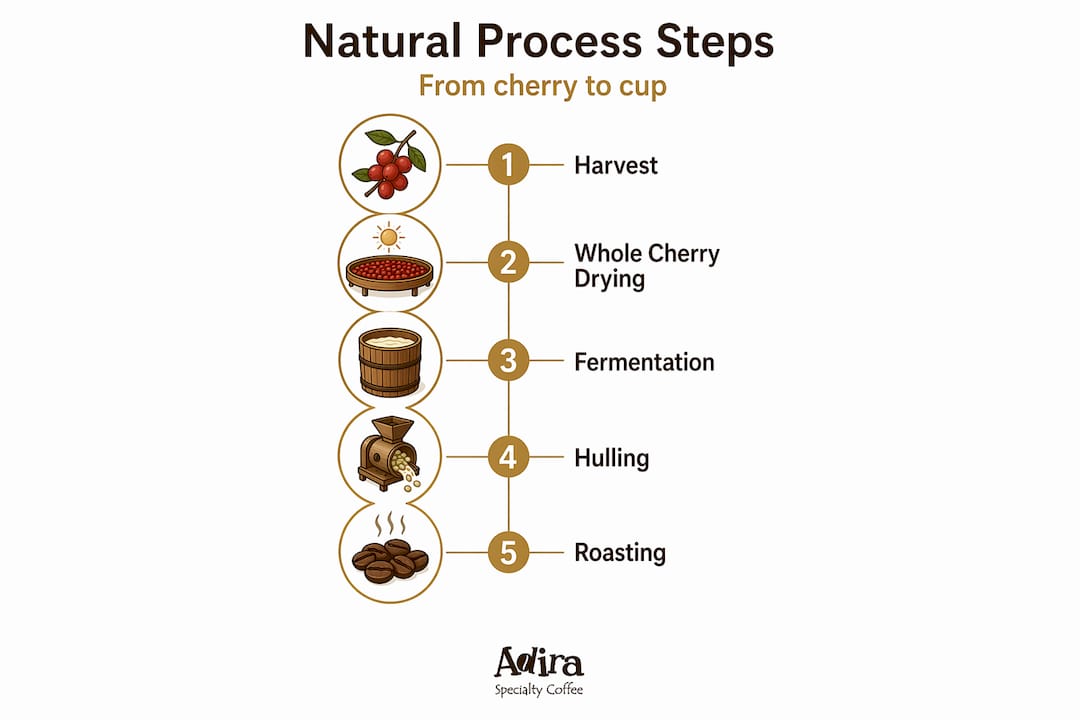
Natural process coffee, also called dry process coffee, is one of the oldest and most straightforward coffee processing methods on the planet. The concept is simple: after harvest, whole coffee cherries are spread out to dry in the sun with the skin and fruit still fully intact. Nothing is removed, nothing is pulped. The bean sits inside the cherry for the entire drying period, absorbing sugars and compounds from the fruit as it slowly loses moisture.
The step-by-step process looks like this:
- Harvest: Coffee cherries are picked, ideally at peak ripeness.
- Sorting: Floaters and defective cherries are removed, often in water.
- Spreading: Sorted cherries are laid on raised drying beds or cement patios in a single layer.
- Drying: Cherries dry over 2 to 4 weeks until moisture content drops to roughly 10 to 12 percent.
- Raking: Workers turn the cherries multiple times a day to encourage even drying.
- Hulling: Once the fruit is dried and leathery, hulling removes all dried layers including skin, pulp, and parchment in a single mechanical step.
- Milling and grading: The raw green beans are sorted, graded, and prepared for export.
During that extended drying window, microbial fermentation happens naturally inside the sealed cherry. Bacteria and yeasts break down the fruit’s sugars, producing flavor compounds that eventually transfer to the bean. This is where the magic, and the complexity, comes from.
Pro Tip: When comparing processing methods, the honey process sits between natural and washed. Honey process coffees remove the skin but leave varying amounts of fruit mucilage on the bean during drying, producing a sweetness level somewhere between the two.
How natural processing shapes flavor
This is where natural process coffee earns its devoted following. The microbial fermentation inside the cherry produces ethanol, acetaldehyde, lactic acid, and a rich array of esters over the course of several weeks. These compounds become embedded in the bean’s structure long before roasting ever takes place.
The specific flavor precursors matter here. Ethyl acetate and isoamyl acetate from fermentation contribute the characteristic fruity and banana-like notes that make natural process coffees so recognizable. These aren’t added flavors. They develop entirely from the extended contact between bean and fruit.
What that means for your cup is a flavor profile unlike anything a washed coffee can produce:
- Intense fruit aroma: Blueberry, strawberry, mango, and dried cherry are common descriptors.
- Layered sweetness: The natural sugars from the fruit give a rich, almost candy-like background sweetness.
- Fuller mouthfeel: Natural process coffees tend toward fuller body and more pronounced acidity compared to washed coffees of the same origin.
- Wine-like complexity: Prolonged fermentation often creates flavors reminiscent of red wine, port, or dark fruit compote.
- Occasional funk: Done well, this is a positive fermentation complexity. Done poorly, it turns sour or musty.
Compared to washed (wet process) coffees, which taste cleaner, brighter, and more terroir-focused, natural process coffees lean into richness and intensity. Neither is better. They are fundamentally different sensory experiences. Understanding the difference is what coffee flavor profiles are really about: finding what resonates with you personally.
The science behind this is genuinely fascinating. Microbial succession during drying follows a predictable pattern: acetic acid bacteria dominate early, followed by Candida yeasts in the mid-fermentation stage, with Klebsiella and Lachancea yeasts shaping the final flavor precursor profiles in the later drying phase. Each stage hands off to the next, building layers of complexity that no controlled fermentation tank can fully replicate.
Challenges of natural coffee processing
Natural processing is often described as a collaboration with the weather, and that captures both its appeal and its difficulty precisely. Unlike washed processing, which moves beans indoors into controlled fermentation tanks, natural processing is entirely at the mercy of the environment. That is both the source of its complexity and its biggest operational risk.
Here is what producers contend with throughout the drying period:
- Weather instability: Natural processing requires 15 to 20 days minimum of stable sun and dry air. A single unexpected rainstorm mid-cycle can soak the cherries and trigger mold growth or unwanted fermentation.
- Humidity risks: High ambient humidity slows surface drying while fermentation continues inside, often leading to over-fermented, sour batches.
- Rewet and redry cycles: Rewet-redry cycles are especially dangerous. When cherries absorb moisture and dry again repeatedly, mold risks multiply significantly, and protective drying infrastructure becomes necessary.
- Mold and toxins: If contamination occurs during drying, mold toxins may persist after roasting. Unlike water-soluble contaminants, certain mycotoxins are heat-stable.
- Labor demands: Workers must rake and turn cherries multiple times daily. Frequent monitoring is non-negotiable to prevent hot spots where uneven fermentation can concentrate.
Temperature swings during drying add another layer of complexity. Cooler nights slow fermentation; hot afternoons accelerate it. The result is a dynamic fermentation environment that increases both risk and flavor complexity simultaneously. A producer who manages it skillfully ends up with something extraordinary. One who doesn’t can lose an entire harvest.
This is why exceptional natural process coffees command premium prices. The risk is real, the labor is intensive, and the margin for error is narrow.
Pro Tip: When buying natural process coffee, look for producers who use raised African drying beds rather than flat cement patios. Raised beds allow airflow under the cherries, dramatically reducing mold risk and improving even drying.
Practical tips for coffee drinkers
Understanding what natural process coffee means is one thing. Knowing how to find it, brew it, and store it is where that knowledge becomes useful. Here is what to look for in practice.
Identifying natural process coffees:
- Look for the words “natural,” “dry process,” or “sun-dried” on the bag or product listing.
- Ethiopian natural coffees from the Yirgacheffe or Sidama regions are a classic starting point for first-time natural coffee drinkers.
- Brazilian naturals are a different expression, often more chocolatey and nutty than the intensely fruity Ethiopian style.
Brewing for natural process flavor:
Natural process coffees reward brewing methods that highlight body and sweetness. A French press or Aeropress brings out the full mouthfeel and fruit complexity. Pour-over methods like the V60 or Chemex let you explore the more subtle fruit aromas and layered acidity. You can read more about brewing specialty coffee at home to fine-tune your approach for each cup.
Natural processing dominates in Ethiopia, Brazil, Yemen, and parts of Southeast Asia, partly because the method requires very little water. That’s worth knowing when choosing origins to explore.
Storage and freshness:
Natural process coffees are not fundamentally different from washed coffees in terms of storage. Keep them in an airtight container away from heat, light, and moisture. What changes is how you taste the coffee as it ages: fruit-forward notes from natural processing can shift and mellow noticeably within a few weeks of the roast date. Freshness matters more with natural coffees than with most other styles.
My perspective on natural process coffee
I’ve cupped hundreds of natural process coffees over the years, and they still surprise me. When they’re done right, they are unlike anything else in coffee. There’s a depth to a well-made Ethiopian natural that you simply cannot engineer with washed processing. The fruit isn’t a note. It’s structural.
What most people don’t realize is how much the producer’s experience shapes that result. I’ve tasted naturals from the same farm, same harvest, that ranged from magnificent to barely drinkable, simply because conditions changed during one batch’s drying window. That variability is part of what makes natural processing so compelling to work with, and so humbling for everyone involved.
I think consumer appreciation for natural coffees is genuinely growing. More specialty coffee drinkers are seeking out processing information, reading bag notes, and connecting flavor to origin decisions. That’s an exciting shift. But I’d encourage you to stay curious beyond the label. Understanding how farm practices shape flavor gives you the full picture of why one natural coffee tastes transcendent and another falls flat.
The best natural coffees are a balance between tradition and risk management. They represent producers who understand their climate, trust the process, and know when to intervene. That’s not luck. It’s craft.
— Stefan
Taste natural process coffee with Adiracoffee
At Adiracoffee, we work directly with around 50 farms across Ethiopia, Brazil, Costa Rica, and other celebrated origins, specifically to source coffees that showcase what each processing method can do at its best. Our small-batch roasting approach means every natural process coffee we offer reaches you at peak freshness, when those fruit-forward flavors are most vivid and alive.

If you’re ready to taste the difference for yourself, explore our coffee beans collection to find natural process options from Ethiopia, Brazil, and more. Not sure where to start? Our coffee psych test matches your taste preferences to the right origin and process. Natural process coffee is best experienced, not just read about.
FAQ
What does natural process mean on a coffee bag?
“Natural process” or “dry process” means the coffee cherries were dried whole, with fruit intact, before the bean was extracted. This method imparts intense fruit flavors and fuller sweetness to the final cup.
How is natural process coffee different from washed coffee?
Washed coffee removes the fruit before drying, producing a cleaner and brighter flavor. Natural process coffee dries with the full cherry intact, creating a richer, more fruit-forward and wine-like flavor profile.
Is natural process coffee higher quality?
Not inherently. Quality depends on the producer’s skill and consistency. Natural processing introduces more variables and risk, which means a well-executed natural can be extraordinary, while a poorly managed one can taste over-fermented or flat.
Which origins are best known for natural process coffee?
Ethiopia and Brazil are the most celebrated origins for natural process coffee. Ethiopian naturals are often intensely fruity; Brazilian naturals tend toward chocolate and nuts. Yemen and parts of Southeast Asia also have strong natural processing traditions.
Does natural process coffee have more caffeine?
No. The processing method does not meaningfully affect caffeine content. Caffeine levels are primarily determined by the coffee species (Arabica vs. Robusta) and the specific variety, not the drying method.