
TL;DR:
- Direct trade coffee involves roasters negotiating directly with farmers or cooperatives, emphasizing quality and ongoing relationships. Unlike Fair Trade, it lacks standardized certification, making transparency and named farm sourcing essential for credibility. The model benefits farmers and consumers through better prices and traceability, but verification relies on the roaster’s integrity and shared documentation.
Direct trade coffee is a sourcing model where roasters negotiate prices and build ongoing relationships directly with coffee farmers or cooperatives, bypassing third-party certification systems entirely. Unlike Fair Trade or Rainforest Alliance labels, direct trade has no legal standard as of 2026, meaning any roaster can use the term without verification. Specialty coffee pioneers like Intelligentsia, Stumptown, and Counter Culture helped establish this model in the early 2000s, and it has since become the defining philosophy behind the best single-origin coffees on the market. Understanding what direct trade coffee actually means helps you spend your money on beans that are genuinely better for farmers, the environment, and your cup.
What is direct trade coffee and how does it work?
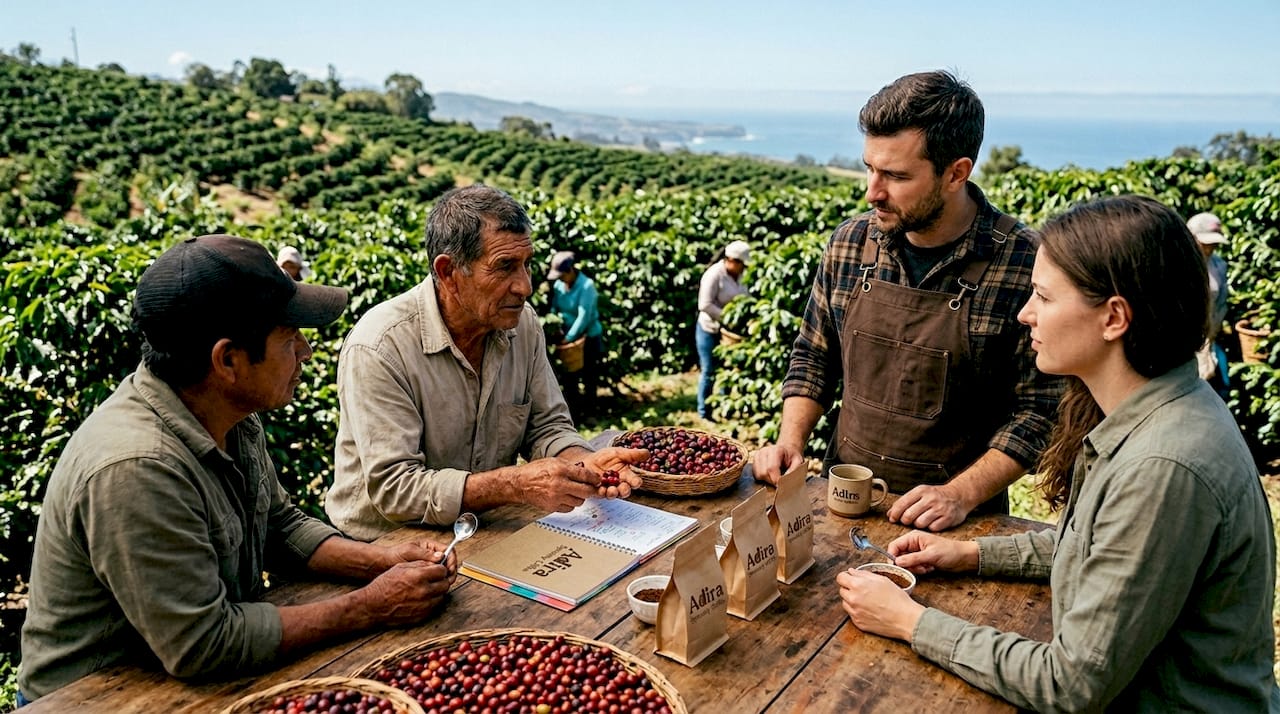
Direct trade coffee sourcing starts with a roaster traveling to origin, meeting producers face to face, and tasting coffee at the farm level. Buyers negotiate prices and quality based on cupping scores and relationship history, not a certification body’s minimum floor price. This is the core distinction: quality drives the conversation, not compliance paperwork.
The process typically involves several recurring steps:
- Farm visits at origin: Roasters travel to Colombia, Ethiopia, Costa Rica, or other producing countries to cup samples and assess harvest conditions firsthand.
- Sample tastings and quality negotiation: Green coffee samples are shipped to the roaster’s facility for blind cupping before any purchase agreement is finalized.
- Price negotiation tied to quality: Higher cup scores translate directly into higher prices paid to the farmer, creating a real financial incentive for quality improvement.
- Repeat purchasing across harvests: Sustained purchasing relationships across multiple seasons are the clearest marker of genuine direct trade, not a one-time buy.
One common misconception is that direct trade eliminates all middlemen. It does not. Licensed exporters and importers are still required for export compliance and international logistics. “Direct” refers to the negotiation and relationship, not a bypass of the entire supply chain. The relational layer replaces the certification layer, which is a meaningful shift but not a logistical miracle.
Pro Tip: When evaluating a roaster’s direct trade claims, look for named farms or cooperatives on the bag, not just country of origin. A bag that says “Ethiopia Yirgacheffe, sourced from Dumerso Cooperative, 2025 harvest” signals a real relationship. A bag that just says “Ethiopia” does not.
Direct trade vs Fair Trade: what’s the real difference?
Fair Trade and direct trade share a goal: getting more money to coffee farmers. Their methods are fundamentally different, and the gap matters more than most consumers realize.
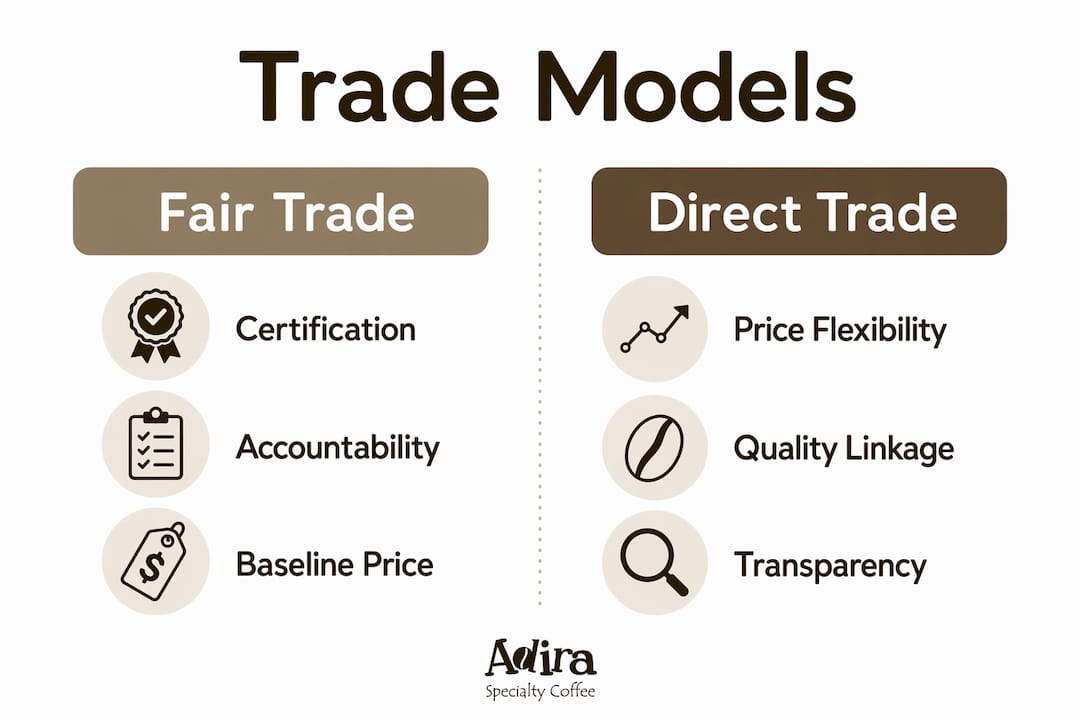
| Factor | Fair Trade | Direct Trade |
|---|---|---|
| Certification | Third-party certified (Fair Trade USA, Fairtrade International) | No certification, self-defined by roaster |
| Minimum price | Set floor price per pound regardless of quality | Negotiated price, often quality-linked |
| Auditing | Regular third-party audits of farms and cooperatives | No external audit; roaster sets own standards |
| Price premium | Fixed premium above commodity price | Often 25% or more above Fair Trade prices when standards are published |
| Transparency | Standardized label with traceable certification | Varies widely by roaster; best cases publish full pricing |
| Relationship depth | Transactional compliance model | Ongoing, visit-based relationship with producers |
Fair Trade’s strength is its accountability structure. Third-party audits confirm that farms meet labor and environmental standards, and the certification fee funds cooperative development. The weakness is that the floor price is tied to commodity markets, not cup quality, so exceptional farmers receive the same price as average ones.
Direct trade’s strength is price flexibility and quality linkage. When a roaster like Intelligentsia publishes standards that include paying above Fair Trade minimums and conducting annual farm visits, the farmer has a genuine incentive to improve. The weakness is that quality expectations rely entirely on the buyer’s internal standards, with no external body confirming the claims. You are trusting the roaster’s word.
For consumers, the practical takeaway is this: a Fair Trade label guarantees a baseline. A direct trade claim from a transparent roaster who names farms, publishes pricing, and shows multi-year sourcing history often means more. A direct trade claim from a roaster who offers no details means nothing at all. You can explore how these models compare in depth through Adiracoffee’s guide on Fair Trade vs direct trade to sharpen your evaluation skills.
What are the real benefits and challenges of direct trade?
The benefits of direct trade coffee are real, but they are not automatic. They depend entirely on the integrity of the roaster executing the model.
For farmers, the most significant benefit is price. Direct trade relationships frequently result in payments well above commodity market rates, and because pricing is tied to quality, farmers who invest in better processing or harvesting techniques see direct financial returns. Direct trade also helps manage price volatility through repeat buying agreements that provide income predictability across harvests. For small farms in countries like Mexico or Sumatra, that stability is transformative.
For roasters, direct trade functions as both an ethical sourcing model and a strategic business tool. Locking in supply relationships with trusted farms reduces exposure to commodity market swings. Relational governance through trust and repeated interaction also transfers quality information downstream more effectively than any contract alone. A roaster who visits the same farm every year knows exactly what the harvest will taste like before the green coffee ships.
For consumers, direct trade coffee explained honestly means better traceability, more interesting flavor profiles, and confidence that your purchase supports a real person at origin.
The challenges are equally real:
- No formal standards: The term is unregulated, so “direct trade” on a bag can mean anything from a decade-long farm partnership to a single purchase from a broker who visited once.
- Verification is nearly impossible: Without third-party audits, consumers cannot independently confirm the claims a roaster makes about its sourcing.
- Logistical complexity: Building and maintaining farm relationships requires travel budgets, language skills, and time that smaller roasters may not have.
- Risk of misleading marketing: Direct trade serves as a trust signal but without audits, the extent of farmer relationships cannot be confirmed by the consumer.
Pro Tip: Ask your roaster three questions: Do you publish your pricing above Fair Trade minimums? Can you name the specific farm or cooperative? Have you purchased from them across more than one harvest? A roaster with genuine direct trade relationships will answer all three without hesitation.
How direct trade shapes coffee taste and sustainability
The connection between direct trade sourcing and what ends up in your cup is direct and measurable. Here is how the relationship model improves both quality and long-term sustainability:
-
Quality feedback loops at origin. When a roaster visits a farm annually and cups the harvest together with the producer, specific flavor notes become a shared language. A farmer learns that their natural-process lots score higher than their washed lots, and they invest accordingly. This feedback loop does not exist in commodity trading.
-
Investment in better farming inputs. Direct trade encourages investment in sustainable farming by guaranteeing better compensation linked to quality. A farmer who knows a premium buyer is returning next year will spend money on shade trees, better fermentation tanks, or raised drying beds. A farmer selling to an anonymous broker has no such incentive.
-
Consistency across harvests. Quality linkage improves through repeat visits and cupping sessions at origin, with negotiated contracts tied directly to producer payments. Consumers who buy the same single-origin coffee year after year from a direct trade roaster notice that the flavor profile evolves but stays recognizable. That is not an accident.
-
Community and environmental sustainability. Fair pricing funds school fees, healthcare, and farm infrastructure in producing communities. When a cooperative in Colombia receives above-market prices for three consecutive years, the reinvestment into the community is visible. Environmental practices improve because farmers can afford to maintain shade cover and reduce chemical inputs when their income is stable.
The consumer’s role in this system is straightforward. Buying from roasters who source with transparency and publish their relationships creates the demand signal that makes direct trade economically viable for more farms. Your purchase is a vote for the model.
Key takeaways
Direct trade coffee delivers its full promise only when roasters publish pricing, name specific farms, and maintain multi-year sourcing relationships rather than using the term as a marketing label.
| Point | Details |
|---|---|
| No certification standard | Any roaster can use “direct trade” without verification, so buyer research is required. |
| Quality drives pricing | Direct trade prices are negotiated based on cup scores, often exceeding Fair Trade minimums. |
| Intermediaries still exist | Licensed exporters handle logistics; “direct” means the relationship, not a supply chain bypass. |
| Repeat purchasing matters | Sustained multi-harvest relationships are the clearest sign of genuine direct trade sourcing. |
| Transparency is the test | Roasters who name farms, publish pricing, and document farm visits are the ones worth trusting. |
Why I think “direct trade” deserves more scrutiny, not less enthusiasm
Stefan here. I have spent years sourcing beans for Adiracoffee from cooperatives and small farms in Colombia, Ethiopia, Costa Rica, Mexico, and Sumatra. And I will tell you something that most roasters will not: the term “direct trade” made me uncomfortable before it made me proud to use it.
When Ekaterina and I started Adiracoffee, we saw how easily the phrase could be applied to anything. A roaster buys once from a farm they found through an importer’s catalog, slaps “direct trade” on the bag, and charges a premium. The farmer sees none of that premium. The consumer has no way to know the difference.
What changed my thinking was not the label but the practice. The first time I sat across from a farmer in Colombia, cupped his harvest, and told him exactly what I would pay and why, something shifted. He asked me to come back. That request, more than any certification, told me the relationship was real.
My honest advice: treat “direct trade” the way you treat any unverified claim. Ask for specifics. A roaster who cannot name the farm, explain the pricing, or describe what they saw on their last visit is not doing direct trade. They are doing direct trade marketing. The difference is worth knowing, and you can dig deeper into ethical sourcing practices to build your own framework for evaluating claims.
The model works. But it only works when the roaster is willing to be held accountable to it.
— Stefan
Taste the difference with Adiracoffee’s single-origin selections
Adiracoffee sources single-origin beans from cooperatives and small farms in Colombia, Ethiopia, Costa Rica, Mexico, and Sumatra, with every relationship built on the transparency and repeat purchasing that genuine direct trade requires. Each bag is roasted to order in small batches in California and ships within days of roasting, so the quality you read about in the sourcing notes is the quality in your cup. Explore the single-origin collection to find beans with full farm and cooperative details listed. Not sure where to start? Take the coffee quiz to match your taste preferences to the right origin. Free US shipping on orders over $35, with a 10% subscription discount available.
FAQ
What is direct trade coffee in simple terms?
Direct trade coffee is a sourcing model where roasters buy directly from farmers or cooperatives through negotiated relationships rather than through certification systems. The price is tied to quality, and the relationship is ongoing across multiple harvests.
Is direct trade coffee better than Fair Trade?
Neither model is universally better. Fair Trade provides verified accountability through third-party audits. Direct trade from a transparent roaster often pays farmers more and produces higher-quality coffee, but without audits, the claims are harder to verify.
Does direct trade coffee have any certification?
No. Direct trade has no legal or certification standard as of 2026. Any roaster can use the term without meeting defined criteria, which makes transparency from the roaster the only reliable indicator of quality sourcing.
Where can I buy direct trade coffee?
Specialty coffee roasters who publish farm names, pricing details, and sourcing relationships are the most reliable source. Adiracoffee’s single-origin collection lists specific origins with cooperative and farm details for each selection.
How do I know if a direct trade claim is genuine?
Look for roasters who name specific farms or cooperatives, disclose pricing above Fair Trade minimums, and document multi-year purchasing relationships. One-time purchases or vague origin descriptions are signs the claim may not reflect a real direct trade relationship.