

TL;DR:
- Ethiopia is the birthplace of Coffea arabica and provides unmatched genetic diversity that shapes global coffee flavor profiles. Its wild forests, cultivated farms, and cultural traditions have profoundly influenced coffee development and social rituals worldwide. Preserving Ethiopia’s wild coffee forests supports genetic resilience and ensures the preservation of unique flavors for future generations.
Ethiopia is the birthplace of Coffea arabica, the species that accounts for the majority of coffee consumed worldwide. The role of Ethiopian origins in coffee extends far beyond geography. Ethiopia contributes unmatched genetic diversity, centuries of cultural ritual, and a living wild forest ecosystem that shapes every cup of specialty coffee you drink today. Ethiopia accounts for approximately 17% of the global coffee market and supports the livelihoods of about 15 million people. That number tells you this is not a footnote in coffee history. It is the opening chapter.
What is the role of Ethiopian origins in coffee?
Ethiopia’s role in coffee is genetic, historical, and cultural all at once. No other country on earth holds the same depth of wild coffee diversity, and that diversity is the direct source of the flavor complexity that specialty roasters and connoisseurs prize today.
Genetic research confirms that Ethiopian coffee varieties exhibit the highest range of genetic markers globally. This means the flavor potential locked inside Ethiopian beans is broader than anywhere else on the planet. When a roaster in California or Tokyo talks about a coffee with jasmine florals, blueberry sweetness, or dark forest earthiness, those flavors trace back to Ethiopian genetics.
Coffee’s evolution is also multi-regional within Ethiopia and surrounding areas, making the “mother tree” narrative a simplification. The Specialty Coffee Association describes Ethiopia’s genetic diversity as a “cornucopia of flavor profiles.” That phrase is not marketing language. It reflects a scientific reality that directly shapes what lands in your cup.
How does Ethiopia’s genetic diversity shape flavor profiles?
Ethiopia produces a wider range of flavor experiences than any other single origin. The reason is the depth of its wild coffee gene pool, which has never been narrowed by centuries of monoculture farming the way coffee genetics in Central America or Southeast Asia have been.
Ethiopian coffees broadly split into two growing categories that produce very different results:
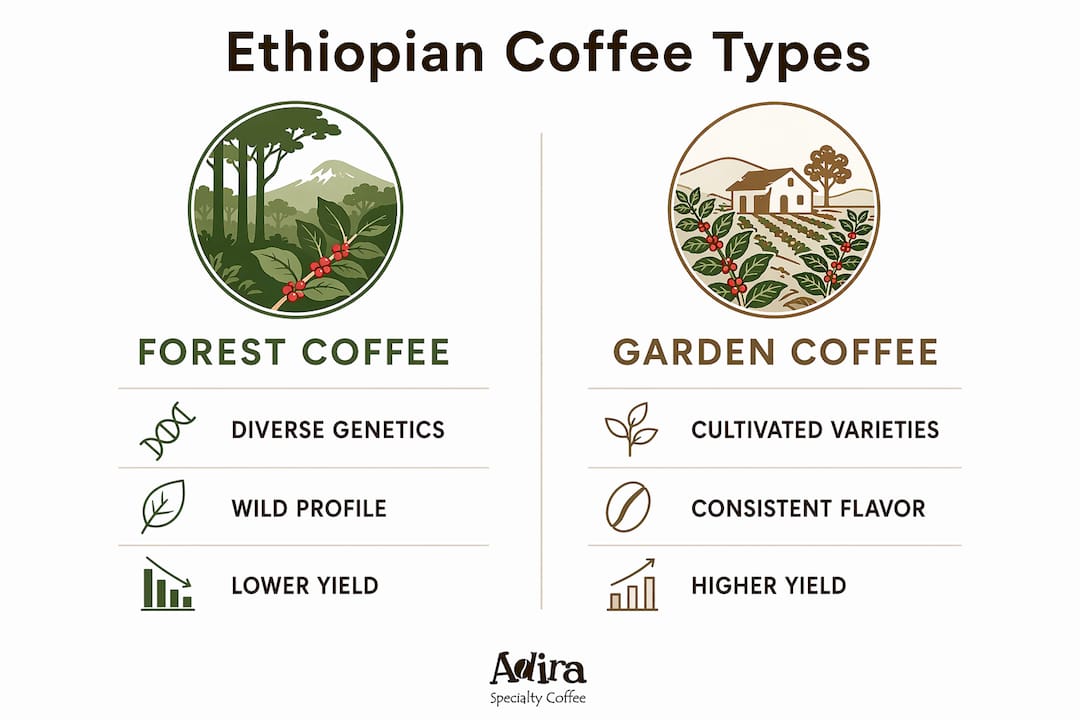
- Forest coffee grows wild under a natural canopy with no human cultivation. Yields are lower, but flavor complexity is higher. Wild forest beans often carry earthy, wine-like, and intensely fruity notes that are nearly impossible to replicate in a managed farm setting.
- Garden coffee is cultivated on small farms alongside food crops. This semi-wild approach produces more consistent yields while still preserving significant flavor variation compared to fully commercial growing methods.
- Plantation coffee is grown on larger estates with more controlled conditions, producing cleaner and more uniform cup profiles.
- Shade-grown semi-forest coffee sits between wild and garden, where farmers manage the canopy but allow natural undergrowth.
Forest and garden coffees differ significantly in yield and flavor complexity. That distinction matters when you are buying a bag labeled “Ethiopian natural” because the growing method is as important as the region name on the label.
Pro Tip: When buying Ethiopian coffee, look for producers or roasters who specify whether the beans are forest-grown or garden-grown. Forest-grown coffees from regions like Kaffa or Bench Maji carry flavor notes you will not find in any other origin.
Regional names like Yirgacheffe, Sidamo, and Harrar each carry distinct flavor signatures. Yirgacheffe is famous for its bright citrus and floral notes. Harrar produces dry-processed beans with a wild, wine-like intensity. Sidamo sits in the middle, offering balanced fruit and chocolate tones. Understanding these distinctions helps you match flavor profiles to your personal preferences with real precision.
How did coffee travel from Ethiopia to the rest of the world?
Coffee’s global spread followed a clear path, and it started in Ethiopian forests long before any trade route existed. Here is how that journey unfolded:
- Wild discovery in Ethiopia. Coffee grew wild in the highland forests of southwestern Ethiopia, particularly in the Kaffa region. Local communities chewed the berries and brewed leaf teas long before roasting became standard practice.
- Introduction to Yemen in the 15th century. Coffee moved from Ethiopia to Yemen in the 15th century, where Sufi Muslim communities began cultivating and consuming it as a drink to sustain nighttime prayer sessions.
- The rise of Arab coffeehouses. Early coffeehouses appeared in Mecca in the 1510s. These spaces became centers of intellectual exchange, debate, and social connection. The coffeehouse model we recognize today was born here.
- Ottoman adoption and expansion. The Ottoman Empire embraced coffee culture and spread it across its vast territory, from Istanbul to Cairo to the Balkans. By the 17th century, coffeehouses had reached Europe.
- Colonial-era global spread. European colonial powers transplanted coffee cultivation to the Americas, Indonesia, and beyond. Every plant in those new regions descended from the genetic stock that originated in Ethiopia.
Each step in that chain depended on the genetic raw material Ethiopia provided. Without the wild diversity of Ethiopian forests, the global coffee trade would have had a far narrower foundation to build on.
What makes Ethiopian coffee culture unique and globally influential?
Ethiopia did not just give the world a plant. It gave the world a way of relating to coffee as a social experience. The Ethiopian coffee ceremony is a ritual that reflects hospitality and community values, and it directly influenced the social traditions of early Arab and Ottoman coffeehouses.
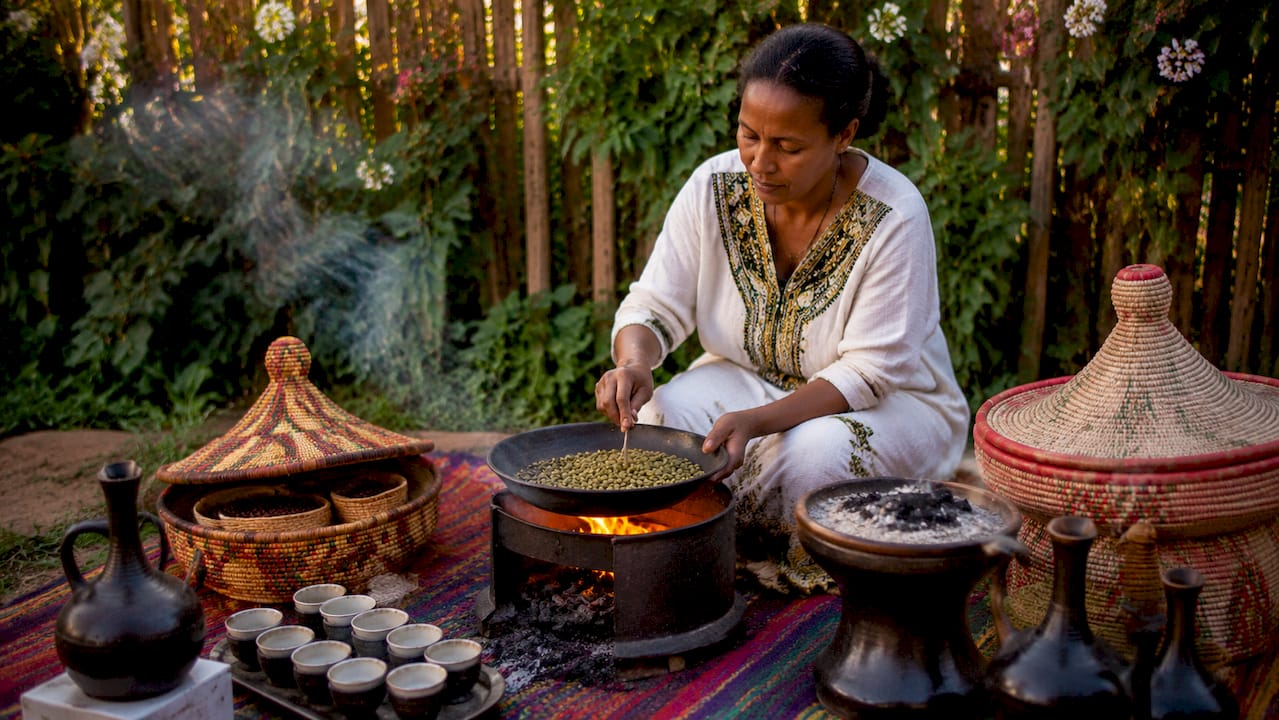
The ceremony itself takes up to an hour. Green beans are roasted over charcoal, ground by hand, and brewed in a clay pot called a jebena. Guests receive three rounds of coffee, each with a distinct name and meaning. Refusing the invitation is considered impolite. The ceremony is not about caffeine. It is about connection.
- The first round, abol, is the strongest and most aromatic.
- The second round, tona, is slightly weaker and marks the deepening of conversation.
- The third round, baraka, translates roughly to “blessing” and signals the close of the gathering.
Pro Tip: If you want to understand why Ethiopian coffee tastes the way it does, brew it slowly and drink it without milk. The ceremony tradition was built around appreciating the bean’s natural character, not masking it.
The legend of Kaldi, the goat herder who noticed his animals dancing after eating coffee berries, is the most famous origin story in coffee culture. Coffee historian James Harper notes that origin myths like Kaldi’s are cultural stories honoring Ethiopia’s ancient relationship with coffee rather than verified history. The myth matters not because it is factual, but because it captures something true about how deeply coffee is woven into Ethiopian identity.
Researchers identify Ethiopia’s coffee ceremony as a foundational social institution that shaped coffeehouse culture across the Arab and Ottoman worlds. That influence is still visible today in the way a good café functions as a gathering place rather than just a transaction point.
How do Ethiopian origins affect today’s coffee market and connoisseurship?
Ethiopian coffee’s impact on the modern specialty market is direct and measurable. Specialty Coffee Association experts continue to map Ethiopia’s lesser-known origins, finding unique flavor profiles that have barely been explored outside the country. That means the full range of what Ethiopia offers is still being discovered.
One critical nuance for serious coffee lovers: regional labels like Sidamo or Yirgacheffe often represent broad commercial categories rather than precise, genetically distinct types. A bag labeled “Yirgacheffe” can contain beans from dozens of different micro-lots with meaningfully different flavor profiles. Understanding how origin shapes flavor means looking past the regional name to the farm, the processing method, and the growing environment.
| Factor | What it tells you |
|---|---|
| Growing method (forest vs. garden) | Predicts flavor complexity and wildness |
| Processing method (natural vs. washed) | Natural processing adds fruit intensity; washed adds clarity |
| Regional label (Yirgacheffe, Harrar, Sidamo) | Broad flavor category, not a precise genetic type |
| Altitude | Higher altitude generally means slower cherry development and more complex sugars |
| Farm or cooperative name | The most reliable indicator of consistent quality and traceability |
Preserving wild coffee forest genetics is critical for future climate resilience and the continued diversity of coffee species globally. Wild Ethiopian forests are a genetic library. Losing them to deforestation means losing flavor possibilities and climate-adaptive traits that no lab can recreate. When you choose a traceable Ethiopian single-origin coffee, you are supporting the economic case for keeping those forests intact.
Key Takeaways
Ethiopia’s role in coffee is irreplaceable: it is the source of Coffea arabica’s genetic diversity, the origin of coffee culture’s social rituals, and the foundation of the modern specialty coffee market.
| Point | Details |
|---|---|
| Genetic diversity is unmatched | Ethiopian coffees carry the widest range of genetic markers of any origin globally. |
| Forest vs. garden matters | Growing method determines flavor complexity; forest-grown beans carry the most distinct profiles. |
| Regional labels are broad | Names like Yirgacheffe or Sidamo are commercial categories, not precise genetic designations. |
| Culture shaped the coffeehouse | Ethiopia’s coffee ceremony directly influenced Arab and Ottoman social coffee traditions. |
| Wild forests need protection | Preserving Ethiopian wild coffee forests safeguards genetic resilience for the entire species. |
Why the myths are the least interesting part of Ethiopian coffee
I have tasted a lot of Ethiopian coffees over the years, and the Kaldi legend comes up in almost every conversation about this origin. I understand why. It is a good story. But the myth is actually the least interesting thing about Ethiopian coffee, and I think leaning on it does the origin a disservice.
What genuinely moves me is the genetic reality. The fact that a single country holds this much evolutionary variation in one species is extraordinary. When I cup a natural-processed coffee from Bench Maji against a washed Yirgacheffe, I am not tasting two versions of the same thing. I am tasting two entirely different expressions of what coffee can be, and both of them come from the same country.
The ceremony piece also hits differently once you have experienced it. Slowing down, roasting fresh, drinking three rounds with people you care about. That is not a ritual for ritual’s sake. It is a technology for connection that predates every café concept we think of as modern.
My honest advice: stop reading about Ethiopian coffee and start tasting it with intention. Buy a forest-grown natural and a washed garden coffee from the same season. Brew them the same way. The difference will teach you more about origin than any article can. Supporting traceable Ethiopian coffees also puts money into the hands of farmers and cooperatives who have an economic reason to protect those wild forests. That is the most practical thing a coffee lover can do.
— Stefan
Ethiopian single-origin coffee at Adiracoffee
Adiracoffee sources directly from cooperatives and small farms in Ethiopia, roasting every bag in small batches in California and shipping within days of roasting. The Ethiopia Natural is a direct expression of what makes this origin extraordinary: wild fruit intensity, floral complexity, and a finish that lingers.

If you want to taste the genetic and cultural heritage described in this article, the Ethiopia Natural is the place to start. Adiracoffee also offers a single-origin collection that lets you compare Ethiopian coffees against other origins and build a real sense of how terroir shapes flavor. Subscriptions include 10% savings and free US shipping over $35.
FAQ
Where did coffee originally come from?
Coffee originated in the highland forests of Ethiopia, where Coffea arabica grew wild before being introduced to Yemen in the 15th century for cultivation and trade.
Why is Ethiopian coffee considered the best for flavor diversity?
Ethiopian coffee varieties carry the highest range of genetic markers globally, producing flavor profiles that range from bright citrus and jasmine to dark berry and earthy forest notes.
What is the Ethiopian coffee ceremony?
The Ethiopian coffee ceremony is a social ritual involving freshly roasted and brewed coffee served in three rounds, each with a distinct name and cultural meaning, reflecting hospitality and community values.
Is Yirgacheffe a specific type of coffee bean?
Yirgacheffe is a regional label representing a broad commercial category of washed Ethiopian coffees, not a single genetically distinct variety. Flavor can vary significantly between farms within the region.
Why does it matter to preserve Ethiopian wild coffee forests?
Wild Ethiopian coffee forests hold genetic traits critical for climate resilience and species diversity. Losing them to deforestation removes flavor and adaptive potential that cannot be recovered through cultivation alone.